The Woman in 4C

No one remembered exactly when Yasmin appeared in the building, which should have been the first warning.

It was a faded, four story complex tucked into a side street of Los Angeles, where ceiling fans clicked through the heat and distant traffic hummed at all hours. Each apartment had a small balcony overlooking the courtyard with its dry grass and rusty park benches. Most of the tenants had been there for years, and certain patterns were like clockwork. Maria in 3B watered her plants at seven each morning. Darla in 1C played the same Coltrane record every evening after dinner. Daniel returned from his nightshift, slamming his door too early in the wee hours. The landlord, Mr. Alvarez, collected rent on the first Monday of the month, never making direct eye contact.

Then one day, without ceremony, apartment 4C was no longer empty. There had been no moving truck and no hauling of furniture up the exterior stairwell. Just a name penciled onto the row of mailboxes.

Yasmin.

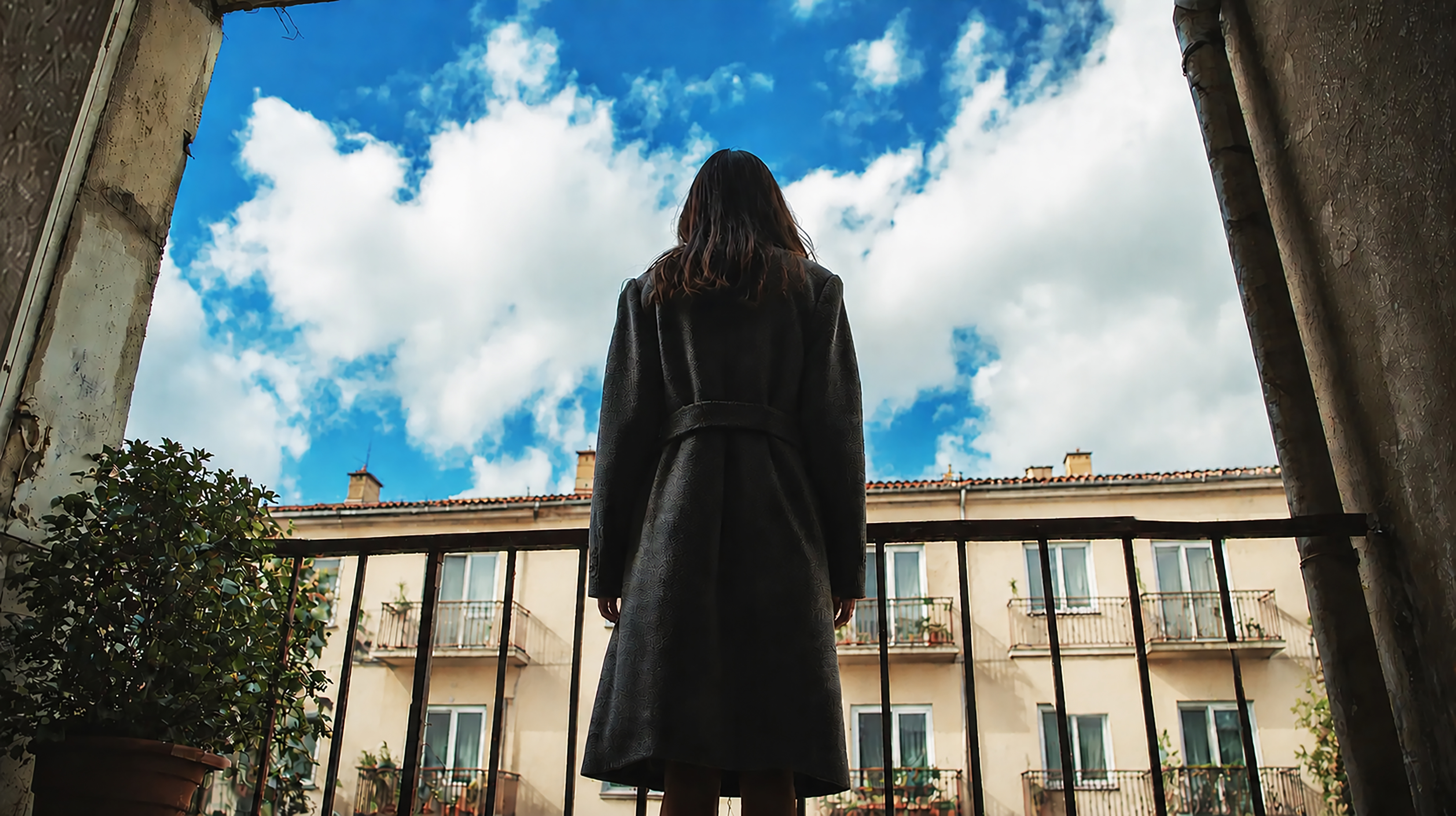
The first person to notice her was Maria. Yasmin was standing very still on the exterior staircase, late afternoon sun highlighting her long dark hair. She wore a knee-length charcoal coat despite the heat, and her pale eyes shifted over the courtyard, then the hazy L.A. sky, never settling on one thing for too long.

“Oh,” Maria said, startled into politeness. “You must be new. Did you move in recently?”

When Yasmin turned, she seemed to look through Maria, not just at her.

“I suppose I’m new,” she said, “but I’ve been here long enough.”

Her voice was neither warm nor cold, a bit unnerving.

“Well, let me welcome you,” Maria said. “We’re a close knit group of neighbors.”

“Yes, I know,” said Yasmin.

That answer stayed with Maria long after they parted.

The second person to notice her was Daniel in 3B, though he didn’t realize it until later. A struggling screenwriter by day, he worked swing shifts for UPS, sleeping late and awakening around noon to confront his persistent writer’s block. One day, after a cup of strong coffee, he noticed minute details out of place in his apartment: a book shifted slightly on a shelf, a chair angled a few degrees differently, his notebook open to a page he didn’t recall writing. It wasn’t enough to report a break in; the police would think he was batty.

He told himself he was only tired, but then he read the line in the notebook. It was undeniably his handwriting.

“You keep treating the future like a possibility instead of a memory.”

Daniel stared at the sentence for a long time. Not only was he sure he hadn’t written it; he couldn’t even remember thinking it. And its meaning was so cryptic that he couldn’t wrap his mind around it.

That same evening, he came upon Yasmin for the first time. They were in the courtyard near the mailboxes, where Yasmin flipped slowly through a stack of letters. She was still wearing her charcoal coat, and Daniel wondered how someone who had recently arrived could receive so much mail.

“You’re new here?” Daniel asked, trying to sound casual.

Yasmin swung her gaze to him.

“By some definitions of new,” she said.

Daniel frowned a bit. “Right.”

They stood there a beat too long, staring at each other. Daniel was intrigued by Yasmin’s pale eyes.

“You write,” Yasmin said, breaking the silence.

It wasn’t a question.

Daniel blinked as a slight chill ran up his spine. “I try.”

“You doubt yourself,” she said. “That’s the part that always slows you down.”

Daniel felt a flicker of irritation. “Do I know you?”

Yasmin considered that, as if weighing her answer.

“Not yet,” she said.

Then she slipped past him and ascended the exterior stairs, leaving him with a feeling he could only describe as queasy

By the end of the week, everyone in the building had a story. The college student in 4D swore that Yasmin quoted a line from her private journal. A struggling actor on the second floor insisted that Yasmin quietly muttered lines from an audition scene he had only practiced alone. An older woman near the back stairwell said Yasmin asked her whether she planned to visit her son in Sacramento again, even though she’d told no one of their estrangement. Mr. Alvarez insisted he had no record of a lease for 4C, though he remembered collecting rent from someone. One tenant claimed that Yasmin congratulated him on a promotion before he even applied for the position. Another said she passed Yasmin in the hallway and heard her softly humming a song played at her husband’s funeral twenty years earlier. The young couple in 1A had been arguing in the hallway when Yasmin passed them and casually remarked, “You already know which one of you leaves first.”

The stories overlapped in an unsettling way that was clear to all of them. Yasmin seemed to know things she shouldn’t, and she never seemed surprised.

Maria tried to ignore it. She had lived in the building long enough to understand that people were strange in their own ways. But one morning, as she watered her plants, she noticed something that made her pause. Across the courtyard, through the window of 4C, she saw Yasmin sitting at a desk. A pen rested in her hand, and she was working on something. That wasn’t strange by itself. What was unusual was Yasmin’s rhythm. She would jot down a few lines, pause, then look up as if listening to some source Maria couldn’t see. Then she would nod, put down a few more words, and repeat the pattern.

Maria had always been bold to the point of meddling, a trait that had gotten her into trouble over the years. The next morning, she decided to visit Yasmin and get to the bottom of things.

She knocked on the door of 4C and it opened immediately. “Yes?” Yasmin said.

Maria hesitated. “I hope I’m not bothering you. I just wanted to ask you something.”

“Of course,” Yasmin said.

Maria glanced past her with no attempt to hide her nosiness. The studio apartment was sparsely furnished with a desk, a chair, and a bed. No unpacked boxes or signs of settling in.

“What do you do?”

Yasmin tilted her head slightly, her lips curling as if she was slightly amused.

“I pay attention,” she said.

“That’s not really an answer.”

“It is the only one that matters.”

Maria crossed her arms. “People are saying things about you.”

“I’m not surprised. They usually do.”

“That you know things,” Maria pressed on. “Private things you shouldn’t. Things you would have no way of knowing.”

Yasmin studied her for a few seconds, then stepped aside.

“Would you like to come in?” she asked.

Maria should have said no. Instead, she crossed the threshold. The air in the apartment was still, and on the desk was the open notebook she had seen through the window. Maria’s eyes fixed on it longer than she intended.

“Go ahead and read it,” said Yasmin with her cool, neutral tone.

Maria hesitated. “That feels invasive.”

“It’s only invasive if it’s not already yours,” Yasmin said.

Something about that answer unsettled Maria more than if Yasmin had simply refused. Slowly, she approached the desk. The open page was filled with neat, deliberate handwriting, and as she started to read, her breath caught. The words were about her. Not just vague or general observations, but specific details. The way she counted steps without realizing it. The way she avoided calling her sister because she didn’t want to admit how distant they had become. The way she watered her plants at seven each morning because it gave her a small sense of control. The way she sometimes replayed old conversations in the shower, changing what she should have said years earlier.

Maria stepped back, feeling a mix of curiosity and anger.

“How do you know this?” she demanded.

Yasmin didn’t move.

“You told me,” she said.

“No, I didn’t.”

“Not in words.”

“That doesn’t make sense.”

“It does,” Yasmin said gently, “if you have the right way of observing.”

Maria shook her head. “This isn’t normal.”

“No,” Yasmin agreed. “Unfortunately, it isn’t.”

Maria shook her head, growing angrier by the second. “But why are you writing about us?”

Yasmin looked at the notebook for a long moment before answering.

“Because people reveal themselves long before they understand what they’re doing,” she said quietly. “Because they rarely notice the full spectrum, just like they can’t see the full spectrum of light.”

Maria frowned with anger “What the hell does that mean?”

Yasmin’s eyes bore into hers.

“It means most people only register one surface of things.”

“And you’re somehow able to recognize all this?”

Yasmin sighed as if she was burdened.

“I’m just catching up,” she said.

___

Maria was the primary gossip in the building, so she quickly told the other residents what had happened in Yasmin’s apartment. That was the exact moment that fear began to take root. It spread quietly at first. A shared glance in the hallway, a conversation cut short when Yasmin came near, and doors that closed more quickly.

Other things happened as well.

Daniel started writing again, feeling a compulsion he hadn’t known for years. The sentences came faster, sharper, and more precise, flowing as if an internal dam had busted. One night, he wrote a line that made his hands go still on his keyboard.

“She sees people the way we usually see memories and unfinished thoughts.”

Daniel stared at the words.

Then he heard slow and measured footsteps outside his door. He got up and cautiously opened it to find Yasmin standing there. He wasn’t surprised.

“You’re getting closer,” she said.

“To what?”

Her expression was almost sympathetic. “To the part where your plot lines stop feeling like coincidence.”

Daniel swallowed. “Who are you, really? Or should I ask, what are you?”

Yasmin considered the question. “Someone who stopped pretending moments arrive one at a time.”

“That’s not an answer.”

“It is the only one that will make sense later.”

Like Maria, Daniel felt a surge of frustration and anger. “Later when?”

Yasmin met his eyes.

“Soon,” she said, then walked away.

___

People had trouble sleeping. The building seemed claustrophobic, as if the walls had shifted slightly inward. Maria lay awake, staring at the ceiling, replaying the words she had read in Yasmin’s notebook. She couldn’t shake the feeling that something had already been decided and that she was moving through moments that had been written long before she ever reached them.

In his apartment, Daniel sat at his desk, staring at a blank screen. He knew what he was supposed to write. He didn’t want to, but his hands moved across the keyboard anyway to form a short sentence.

“She never seemed surprised.”

At that instant, sounds erupted through the building: doors, footsteps, and echoing voices. One by one, all the tenants felt the need to exit their apartments and gather in the courtyard, compelled by a something they couldn’t name. Daniel got up for the same reason and joined them.

They looked at each other in the wan light, uncertain what was happening. Then they looked up. The sliding glass door to the balcony of 4C was open, its drapes blowing even though there was no wind.

 Daniel glanced around the circle of onlookers. “What the fuck? Maria and I will go up and check to see if Yasmin’s okay. We’ll be right back.”

Maria needed no further prodding. She and Daniel quickly ascended the exterior stairwell, entered the hallway on the fourth floor, and proceed to 4C. The door was open so they stepped inside.

“Yasmin!” called Daniel. No answer. The apartment was empty, but the desk was still there with Yasmin’s open notebook on top.

Daniel approached it hesitantly, then he looked down and read the words aloud.

“The moment you realize you were never standing outside it is the moment you begin writing the story that matters most.”

Maria stepped closer. “What the hell does that mean?”

Daniel turned the page as his face went pale.

“What?” Maria asked. “Tell me.”

He swallowed. “There’s no more. Just blank pages.”

A faint breeze moved through the room through the open sliding glass door.

___

The next day, apartment 4C was empty again. No name on the mailbox. No record with Mr. Alvarez. Not a trace.

The tenants tried to move on, acting as if the whole interlude with Yasmin had been some kind of collective hallucination. The routines of the building resumed. Maria watered her plants at seven. Darla bopped to Coltrane after dinner. The actor rehearsed in front of his mirror. Mr. Alvarez collected rent with his usual stiff silence.

But the familiar patterns no longer felt unconscious.

People hesitated before speaking, as if listening for words before choosing them. Several tenants began anticipating knocks on their doors before they occurred. Others found themselves thinking of people they hadn’t spoken to in years, only for the phone to ring hours later. A woman on the third floor burst into tears; she had smelled her late mother’s perfume in the laundry room just moments before she learned that her childhood home had been sold. The actor began having strange intuitions during conversations where he already knew the next sentence the other person was about to say, along with the exact expression that would cross their face. A young mother on the first floor began setting an extra plate at dinner without understanding why, only to receive unexpected visits from relatives later that evening.

Daniel kept writing, a story about an apartment building filled with a diverse cast of characters and a stranger that came into their midst. He changed the names and altered circumstances, but it was all there. His writing continued to flow freely, unnervingly precise, and he told himself that Yasmin had merely shaken something loose creatively.

One evening he froze after typing a particular sentence that seemed to come from nowhere. “Maria stood at her kitchen sink for almost ten minutes, rehearsing her first sentence before she finally called her sister at 9:14 p.m.”

Daniel stared at the screen.

That night, shortly after 9:00 p.m., he quietly watched Maria’s apartment through a gap in his curtains. Her shades were open, so he could see her clearly. At 9:04 p.m., she stood at her kitchen counter, and ten minutes later she slowly lifted her phone.

Daniel backed away from the window as though burned.

___

No one spoke openly about Yasmin anymore. That was the strangest part. It was as though they had a silent pact to never name what had happened.

Weeks later, Daniel felt the urge to return to 4C. It was still vacant, so he asked Mr. Alvarez for permission, using the subterfuge that he wanted to take pictures for a friend who needed new lodging. Mr. Alvarez shrugged and gave him the key.

Inside, dust had coated the bare floor and the air smelled musty. The room was silent except for that distant traffic hum that seemed to penetrate the entire building. He stood there for a long time before noticing something propped against the sliding glass door on the balcony outside.

A notebook. His stomach tightened because it wasn’t Yasmin’s, it was his.

He opened the door and picked it up. Inside, once again, was a sentence in his handwriting that he had never seen before.

“She was never staying here. She was just teaching you how to see.”

He flipped through the rest of the notebook. It was blank except for a final line waiting on the very last page. It read: “You were noticing long before you understood what you were seeing.”

Daniel slowly lowered the notebook. Across the courtyard, lights glowed behind apartment windows, and for one strange instant the entire building felt conscious of itself.

Then, somewhere in the courtyard four floors beneath him, he heard a woman’s voice drift upwards.

“You must be new here.”

Ramón’s Decision

Delano, California

It’s just before dawn, and even though it’s early spring, the mornings are still cold, seeping through the boards of the shack that Ramón Salazar shares with his family. He awakens to the sound of his father’s stubborn coughing, like an engine that won’t start.

The date is March 17, 1966. Ramón doesn’t know this because it’s written anywhere. He knows it because he’s been counting down to it, each day like a bead on a rosary that he fingers in the dark.

The farmworker’s camp squats at the edge of Delano like something the town spat out. Rows of wooden shacks lean into one another, patched with tar paper and tin. Between them, tents sag with dew, their ropes creaking softly. The ground is a churned-up paste of dust and old mud, smelling faintly of human waste. A single spigot stands at the far end of camp, issuing water that is rusty brown. Still, every morning, a line of women arrives before dawn with dented pots to fill, their shawls pulled tight around their shoulders.

Ramón sits up on his cot, a slender young man of 17 with dark, sullen eyes. His sister, Ari, is still asleep on the cot next to him, her hair fanned across her pillow. She dreams with her mouth open, one hand clutching the edge of a blanket that smells of sweat. Their mother lies on the other cot next to their father. She is also awake, staring at the ceiling, and when she hears Ramon move, she turns her head.

“Hoy te levantas temprano,” she says softly.

Ramón nods. His chest feels tight from the excitement of the coming day, as if a rope has been pulled a notch tighter every day for months. He puts on his threadbare jacket and steps outside.

In the predawn light, he can see grapevines stretching out in neat lines into the distance. Most of the workers have been striking for months, leaving clusters of fruit unpicked. At first, Ramón felt the protest would be futile, but now a faint hope has been flickering among both the Filipino and Mexican workers. They are daring to believe they might finally secure a union contract with the growers. That hope has grown stronger because Dolores Huerta and the union organizers will arrive this morning to help launch the historic march to Sacramento.

As Ramón’s gaze sweeps across the vineyard, his hope mingles with an old, acidic anger. It has burned inside him longer than he can remember. He imagines the juice that has stained his hands since he was a young boy, joining his family on their annual migration through the vineyards and fields of California. He sees the looks on his parents’ faces as they wince from the pain in their backs. He visualizes the growers’ foremen squinting at their tally sheets, finding reasons to dock their pay. Gloves. Water. A broken ladder that “must have been your fault.” It was always something, and as if that humiliation wasn’t enough, there were the low flying planes that sprayed pesticides on both workers and crops alike.

He swallows the anger like bile and decides to focus on what this day promises. He hears the laughter of Filipino men nearby. He has learned some of their words by spending time among them. They’ve taught him card games and shared meals of pancit and pinakbet. They’ve been on strike longer than the Mexicans, longer than anyone, and their patience has worn thin. Everyone’s has.

He walks toward a large flatbed truck parked near the edge of camp, a makeshift stage for the day’s event. People are already gathering. He can hear murmurs: Huerta viene. Hoy es el día. Someone starts a chant, testing it like a drumbeat: “¡Viva la Causa!” It falters, then catches, echoing through the camp.

His father comes up beside him, hands shoved deep into his pockets. José Salazar’s face is lined from sun and constant worry. His eyes seem permanently narrowed against glare and disappointment. He smells of sweat, tobacco, and the faint metallic tang of blood from a cut on his arm that never quite heals.

Escucha,” his father says, nodding toward the stage. “Pero no te hagas ilusiones

Ramón swallows. No illusions? Too late! He has allowed them to enter his mind as this day approached. They have crowded his skull, buzzing like bees. He has listened to the union organizers in the evenings. Having taught himself to read with the help of a woman in the encampment, he has understood the pamphlets they distribute. He reads them by lantern light, tracing the letters with his finger, learning new words: dignidad, justicia, sacrificio. Words that feel like something you can build your life upon.

The crowd continues to swell until, right on time, Dolores Huerta arrives with fellow organizers from the National Farm Workers Association. The gathering grows quiet. Huerta carries herself with calm certainty. The throng presses close. Ramon can smell sweat and damp clothing. A baby fusses until its mother presses it against her breast.

“Estamos aquí porque hemos decidido caminar,” Huerta says. “Caminar juntos. De Delano a Sacramento. Para demostrarle a este país que los trabajadores del campo merecen dignidad, justicia, y respeto.”

A murmur runs through the crowd. Ramón’s heart thuds so hard he’s sure the people next to him can hear it. Standing near him is an Anglo student organizer, one of many who have joined the cause. Ramón can hear his Mexican friend translating for him. We are here because we have decided to walk, To walk together. From Delano to Sacramento. To show this country that the hands that feed it are tired of being invisible.

Nuestra peregrinación mostrará nuestra fuerza,” Huerta continues. “Pero recuerden esto: caminamos en paz. Caminamos unidos. Y caminamos porque nuestros hijos merecen algo mejor.”

Again, the whispered translation. Our pilgrimage will be the match to light our cause. But remember this: we walk in peace. True courage is not in raising a fist, but in offering your own body, your own suffering, for the good of others.

Ramón thinks of his mother’s cracked hands,, of his father’s cough, of Ari’s bare feet in winter. He thinks of the growers’ houses he’s glimpsed from the road with their wide lawns, white fences, and sprinklers ticking like clocks that always tell the right time.

Sacrificio,” says Huerta. “Unidad. Estas son nuestras armas. ¡Viva la Causa!

The shout erupts, loud and fierce. “¡Viva la Causa!”

“¡Viva la huelga!” someone yells.

“¡Viva la huelga!” The chant rolls and lifts, like a huge kite whose tail you could grab and ride into the sky.

Ramón feels something click inside him, like a door finally opening. He is seventeen years old and tired of bending. Tired of watching his parents swallow their anger like bitter medicine. Tired of being told to wait, to endure, to be grateful for scraps.

He looks at his father. José’s face is unreadable, as if carved from stone. His mother stands a few rows back, Ari beside her with eyes wide.

When the speech ends and people begin to talk in excited knots, Ramón knows what he must do. He will join the march. He will do more than move from one field to another, picking crops with nothing to show for it. He will make his life count for something larger than mere survival.

His mother, who seems to know him better than he knows himself, comes to stand near him and his father.

¿Qué te pasa? she asks her son, the trepidation in her voice showing that she already suspects the answer.

He takes a breath. The words feel too big for his mouth. “Voy a unirme a la marcha,” he says finally. “Voy a ayudar al sindicato.”

His father’s jaw tightens and his mother’s face goes slack. Ramón braces himself, anticipating their objections, ready to respond with the speech he has rehearsed a million times in his head. I’m not a child. This matters. I can help.

He expects anger and fear. Instead, his father exhales, long and slow, as if he’s been holding his breath for years.

Sabía que esto venía,” José says.

His mother reaches for Ramón’s hand. Her fingers are rough and warm. “Tienes miedo?” she asks.

Si,” Ramón says, surprised by his own honesty. “Pero más miedo tengo de quedarme igual.”

Ari looks between them, confused. “¿Te vas?” she asks, as if she can’t quite believe it.

Por un tiempo,” Ramón says. He smiles at her, trying to ease her anxiety. “Voy a caminar mucho.”

His father nods once. “No te vamos a detener,” he says. “Pero prométenos algo.”

Que?”

Que no olvides quién eres,” José says. “Y que regreses.”

Ramón’s throat tightens. No matter how much he has been frustrated by his parents’ submission to the injustice of their plight, he could never forget them and their loving dedication to their family. He will never forget his roots. And returning? Always, no matter how far the time or distance. These are easy promises to make.

He nods. “Claro. Lo prometo.”

___

The march begins just as the sun clears the horizon. Feet hit the dirt road that leads out of the camp to the highway, a mixed crowd of Filipino workers, Mexican workers, clergy, students, and Anglo sympathizers. Union organizers help lead the way, alongside banners emblazoned with the image of the Virgen de Guadalupe. Always at the head of the march is the legendary Cesar Chavez.

            Days turn into weeks as Ramón walks with strangers that quickly feel like family. They pass through farmworker camps and small towns across California’s Central Valley. They sleep in churches, on floors, and in fields beneath the stars. Ramón watches organizers labor tirelessly—planning meetings, encouraging workers, and reminding everyone to remain disciplined and nonviolent. Ramón carries signs, hands out flyers, and listens to nightly talks. His conviction grows stronger as he learns to speak to people who are angry, afraid, and skeptical.

Often, they pass police lines and jeering crowds, opposition the organizers have warned them to ignore. Ramón keeps his fists unclenched even when insults fly, strengthened by the movement’s commitment to nonviolence. He learns that suffering shared becomes lighter, and he feels something knitting together inside him.

When the march ends in Sacramento, they are greeted by thousands of supporters. During the rally, organizers ask the originales to come forward, the small group of marchers who completed the entire 300-mile journey. Ramon stands among them with tears in his eyes, both proud and humbled.

But Ramón doesn’t stop. He stays. He becomes an organizer, moving up and down the state, from fields to towns, learning to weave Spanish, English, and Tagalog as he shares words of hope and struggle. He is arrested twice but quickly released. He writes letters home when he can.

And not once does he regret the decision he has made

___

Nearly a year later, Ramón crosses back into Tijuana where his family lives during the months they aren’t picking crops in the US. He walks along familiar streets, some paved, some dirt. The air is warmer, carrying the smell of fried meat and diesel.  A stray dog eyes him warily as he turns and walks down the alleyway that was the backdrop to his earliest memories.

            His parents’ house is small, but it is home. Ramón and his father, with the help of neighbors, built it piece by piece from cement block. Rebar sticks out from the roof, where the Salazars dream of one day adding a second floor, a dream that has been deferred for a decade.

            When Ramón knocks, the door flies open.

His mother pulls him into her, laughing and crying. “Mijo!”

Ari seems so much taller as she also joins the hug. His father stands back for a moment, looking him over, as if to be sure he’s real. Then José grins, wide and proud.

They feast that night. There is carne asada, beans in a thick broth, and rice flecked with cilantro. A crowd of neighbors join them, packing the house with a sense of community. Ramon tells stories of the march and his organizing in the days since it ended. Remembering what the movement taught him, he is careful not to make himself too important. It is la gente, the people, who are the real strength in la lucha.

He watches his parents listen and sees the way their shoulders straighten.

When they eat, his father lifts a bottle of beer. The room quiets.

A mi hijo,” José says. “Que caminó por todos nosotros.”

Ramon’s eyes burn. His father raises the bottle even higher. “¡Viva la Causa!”

They echo the cry, their voices filling the room and spilling out into the night.

Julia’s Thin Place

To observe without evaluating is the highest form of intelligence. – Jiddu Krishnamurti

The restaurant smells like toasted sourdough, garlic oil, and espresso. Outside the windows, San Francisco bustles with activity while inside, forks click against plates, chairs scrape, and a server calls out an order for the lunch rush.

Julia Ravenwood sits with her back to the wall, lost in thought, watching reflections slide across the window glass. She’s a tall woman with cropped black hair and muscles toned from time in the gym. Her face has a strong jawline and cheekbones, but her eyes are soft and lustrous, giving her an androgynous look. Across the table sits her wife, Emily, a blonde whose lithe figure speaks of her devotion to yoga. Emily’s soft features are highlighted by tasteful makeup.

This restaurant is their favorite hole-in-the-wall eatery, conveniently close to the IT firm where they both work.

Emily leans forward. “So,” she says with a smile, circling back to the previous night’s discussion, a theme they’ve rehashed for years, “what did you think of the reading this week?”

Julia sips her coffee. “It was good. Pema Chödrön is a mental warrior, and like I’ve said, on one level I do get it. Mindfulness is attention training, a sort of cognitive hygiene. But the way our culture and your classmates talk about it, like it’s some gateway drug to enlightenment, drives me nuts.”

Emily chuckles. “You’ve always been allergic to overclaim.”

“I’m allergic to claims that can’t survive daylight,” Julia says. “Buddhism talks about impermanence, which I respect. Christianity talks about love, which I respect. Hinduism talks about the divine in everything, which I respect. Then each of them turns around and insists that their map gives the best directions for how to live our lives.”

Emily tilts her head. “Maps can still be useful.”

“Until people start idolizing the map,” Julia says. “Most world religions solve a problem they defined to begin with. The problem of sin, the problem of ignorance, the problem of suffering. But for me, the solutions don’t generalize to the billions of people on our planet. They don’t account for the diversity of human experience. They don’t account for me.”

Emily sips her water as the ice clinks. She has learned to slow play their discussions, never rushing to debate. “What about secular philosophies? We haven’t talked about that for a while. Do any of them still hold your attention?”

Julia smiles despite herself. She loves the repartee. She loves having a partner that will deep dive beyond chitchat. “Stoicism is good for getting through the day but not for explaining why the day matters. Existentialism is honest about the void, which I appreciate, but it treats meaning like a do-it-yourself kit with missing parts. Humanism is lovely, but it assumes our species will be more noble given enough time and good intentions. Really? Just read any fucking news stream and you can see that isn’t true.”

The server drops off their sandwiches. The smell of melted cheese and tomato arises, laced with oregano. Emily waits, letting them both begin eating before responding. That’s one of the things Julia loves most about her. The space she creates, the way she doesn’t try to win conversations.

“I know I’ve invited you to my classes too many times,” Emily finally says. “I get so much from them, and I think you could also. I just want to share the experience with you.”

“I hear you,” Julia says quickly with a hint of exasperation. “But I’d appreciate it if you’d stop asking. I don’t think you’re wrong. That’s your path. I just refuse to perform openness. I don’t want to fake wonder that I’m not feeling.”

Emily nods. “Fair enough. This will be the last time.” She says it in a neutral tone, devoid of disappointment. She’s never been one to gaslight her wife.

They continue eating while the restaurant’s piped-in music features a saxophone bending notes like light through water. Emily watches a couple at the next table lean toward each other, their heads almost touching, and she feels a familiar ache, her mind roaming over the travels she and Julia have shared. Many of those trips were an intentional survey of what others call “thin places.” Julia was searching, as always, and Emily was glad to accompany her.

“I was thinking about Iona yesterday,” Emily says.

Julia’s mouth tightens, then softens. “I remember the wind. The way it smelled of salt and wet stone. And the abbey ruins were beautiful, like the bones of belief. Someone else’s belief.”

Emily nods.

“And nothing happened,” Julia adds, playing her part in the script. “No voice. No burning bush. No sense of being seen by something other than ourselves.”

Emily continues the litany. “Machu Picchu?”

“Stunning,” Julia says. “Green like it had been invented that morning. Llamas chewing like mute philosophers. And those sacred mountains rising against that blue sky! Maravillosa! I kept waiting for my awe to turn into revelation.”

“Ghost Ranch?”

Julia laughs, syncing with the rhythm of their game. “Red earth and wide sky. Georgia O’Keeffe certainly knew how to capture and frame that landscape. I wanted…” She stops, surprised by the sudden nakedness of her emotion. “I hoped something would break through. That I’d feel… addressed.”

Emily reaches across the table and squeezes Julia’s hand. Her palm is warm, familiar, and grounding. “I’ve loved every mile of our travels. Even if they speak to us in different ways.”

Julia looks away. “I can’t help it if I want something more tangible, some kind of contact. Would you want me to change to meet your expectations? I guess I could join your classes if it really means that much to you.”

Emily’s smile is gentle and teasing. “Nope. I love you just as you are, my Iconoclast. And you keep me on my toes. That’s for sure.”

Julia snorts. The Iconoclast nickname has stuck. Even some of their coworkers have begun to use it to address Julia. “I don’t smash icons for fun,” she says. “I just don’t bow to them.”

Emily’s eyes are soft. “I know. It’s just that I see how you get a bit melancholy about all of it. The empath in me can’t help it, especially with those I love.”

Julia looks down at their joined hands. “I really don’t want to be closed. I just don’t want to lie to myself or anyone else.”

Emily squeezes once more, abruptly changing the subject. “We can be open tonight.”

“With a head count?”

“Bearing witness,” Emily says. “Point-in-time counts of those experiencing homelessness really does matter. It can turn their invisibility into the funding that St. Vincent de Paul needs to continue their work.”

Julia nods and shakes off her cynicism. She also believes this, deeply, and has enjoyed volunteering with Emily at the shelter. Outside, a siren rises and falls. “So, the Tenderloin?”

Emily’s mouth curves into a determined line. “The Tenderloin.”

They pay their bill and step back into the city, where the afternoon light of a summer day seems brittle. A bus passes in a whoosh of turbulent air as they begin their two-block return to work. Striding next to Emily, Julia feels a familiar mix of affection and ache for her partner, the longing that comes from loving someone who has a quality you desire for yourself. Her mind roams over the supposed thin places they discussed at lunch. As often happens, she feels a quiet, stubborn hope that she pretends not to have.

___

The sun sets behind the buildings like a coin slipping into a pocket. The Tenderloin smells of asphalt and old beer, of urine and frying onions from a corner food cart, of damp cardboard and sweat. Julia walks with Emily and a small group of volunteers. They are holding clipboards and wearing reflective vests that catch the day’s last light.

The streets are busy, voices drifting from doors and alleys. Julia hears laughter, sudden and bright, then an argument that burns out in mid-sentence. Another person’s cough goes on for too long. From the open window of a building, the thumping bass of a rap song echoes over the street.

The group turns into an alley. It’s narrower than Julia expects, the walls close enough to touch with one’s hands and feet if you were to stretch out on the pavement. There’s cardboard flattened in various places along with dirty blankets. A shopping cart stands sentinel, filled with plastic bags that rustle in the breeze, as if they’re whispering to themselves. About a dozen people are there, some loitering, some already bedding down.

A young Black woman sits on a tarp, her back against the building. She wears a knit cap pulled low, her jacket too thin for a San Francisco summer night, when the legendary fog will likely creep into the city. Her eyes are bright and alert, not guarded like many of the others the volunteers have encountered. She looks at Julia as if she’s been waiting.

“Join me, sister,” she says, patting the tarp beside her.

Emily’s hand tightens on Julia’s arm. “We shouldn’t—”

“It’s okay,” Julia says, surprised by her certainty. She hands her clipboard to Emily, then settles next to the woman. She can feel the cold pavement seeping through the tarp into her pants. The woman smiles at her, and up close, Julia can see the fine lines at the corners of her eyes. Her gaze is steady, one of those people who seems to occupy her body fully.

“My name’s Mariah,” she says.

“Good to meet you. I’m Julia.”

“Look up,” Mariah says, nodding toward the slice of sky above them.

Julia turns her gaze skyward. Stars have begun to prick through the twilight, resisting the city’s glare. A plane passes, its lights blinking, a mechanical constellation cutting across the dark.

“Do you see it?” Mariah asks softly.

Julia’s chest suddenly tightens. Something speaks to her. It’s not a voice, nor a vision, nor an answer to a question, but a simple and powerful widening. The sounds of the city fall back, as do the smells of the alleyway. Time seems to loosen its grip as the present thickens into a presence both luminous and intimate.

Julia feels it like a warmth spreading through her ribs, like a recognition without an object. She knows intuitively that this is not about proof, but simply the fact of being here, with this woman, under these stars, in this narrow place that opens unexpectedly into a depth she has always longed for.

Tears come, uninvited. Then Julia laughs, breathless, the sound startling in the quiet.

“Yes,” says Mariah. “I see it also.”

Emily crouches nearby, her worry easing into wonder. The other volunteers instinctively give them space. Mariah begins to hum a low tune without words.

They sit for moments that Julia can’t measure because time has lost its edges. Then she becomes aware again, gradually, of smaller things: the chill creeping up from the concrete, the faint ache in her knees, the smell of old rain trapped in the brick behind her. A breeze moves through the alley, lifting a scrap of paper that skitters and settles. None of it breaks the spell. It just folds into it.

She thinks, fleetingly, of all the arguments she has honed over the years. How she has dismantled certainties piece by piece, proud of the clarity she felt she possessed. But in this instant, she realizes that her clarity was never the same as fullness.

Later, Emily will say nothing profound about Julia’s experience. She will not try to name it or wrap it in language that shrinks it. Instead, she will say, “I could see it on your face,” and that will be enough. For now, she waits, honoring the stillness the way she has learned to do, by not interrupting.

Mariah stops humming. The silence that follows isn’t empty. It hums of its own, a low resonance that seems to come from the walls, the sky, even Julia’s own chest. Julia thinks of the word communion and, for once, she doesn’t feel the need to bracket it with disclaimers.

“You never know when it will happen,” Mariah whispers, as if she’s talking about the weather.

Julia nods, unable to speak. When she finally stands, it’s as if her axis has shifted. The grimy, cramped alleyway looks the same, but it no longer feels accidental. It feels chosen, as if this place, of all places, has been quietly waiting to be seen without judgment.

“Thank you, Mariah,” she says.

Mariah smiles. “Come sit with me again, sister.”

Julia and Emily join the other volunteers and they walk on. The count continues with quiet questions and small kindnesses. The city exhales into night, its neon and shadow interweaving. Julia listens to footsteps, to distant traffic, to her own breath, and realizes her search has shifted. The thin place was never somewhere she needed to arrive. It was something that happened when she stopped standing apart.

And now she carries that alleyway with her, as well as the soulful eyes of Mariah. Not as some kind of proof, but as an ongoing invitation.

The Only Law West of the Pecos

On February 21st, 1896, Judge Roy Bean made national headlines by promoting a unique boxing match. Robert James Fitzsimmons was to fight James J. Corbett, the heavyweight champion, but the Texas Legislature had outlawed boxing. While promoters sought a new location for the match, Corbett retired, handing the title to Irishman Peter Maher, who soon agreed to fight Fitzsimmons. Bean arranged for spectators and the press to travel by train from El Paso to Langtry, where he held the fight on a sandbar on Mexico’s side of the Rio Grande. Texas lawmen had no authority there and Mexico had no law enforcement on hand. 

The desert along the Rio Grande looked especially ancient that morning. Canyon walls towered above the sparkling coil of the river. A cool winter breeze blew across the sandbar, carrying the smell of mud and horse sweat. The sun climbed quickly, illuminating a throng of spectators gathered around a makeshift boxing ring. They had travelled by train from El Paso to Langtry, and they were eagerly awaiting the contest.

John Walsh worked the crowd.

He moved easily among them, a lean man of twenty-five with dirty blonde hair, dust on his boots, and a practiced smile. He had learned at a young age that confidence was mostly a matter of posture and timing. Just short of a swagger, he told himself, because no likes a poser. A wide-brimmed hat shaded his face, and beneath his coat, pressing against his ribs, hung the leather satchel that held coins, bills, promissory slips, and the occasional gold watch. Anything that could be wagered. John’s hands were quick, his voice calm, and his gaze scanned for new prospects.

“Maher pays as long as a dry summer,” he told potential bettors. “Fitz is the favorite for sure, but Maher could surprise the world.”

He said it casually, like something he might not believe. That was the trick. Men trusted doubt more than certainty. Some of them laughed, shaking their heads. Others leaned in closer, smelling opportunity the way vultures smell death. Walsh gave Maher odds so generous that they bordered on insult, and the crowd responded exactly as he knew they would. Money flowed toward the underdog like water downhill, pooling fast and deep.

That was the plan, and Judge Roy Bean had calculated it perfectly.

Walsh had quickly learned about the judge’s shrewdness when he had drifted into Langtry at age nineteen, half-starved, riding a stolen mule whose ribs showed through its hide. Abandoned in Detroit at 12 years old, he had lived by his wits in the poor Irish neighborhood of Corktown. He sold matches and newspapers to survive, sleeping in whatever empty building or alcove he could find. Finally, with no prospects, he jumped a freight train heading west. He drifted between towns and jobs, often getting into trouble for theft. When he reached Langtry, he was at his lowest point, desperate for a new beginning.

He remembered the way the town first appeared to him, a cluster of buildings crouched in the desert along the Southern Pacific tracks, miles away from any other settlement. The Jersey Lilly Saloon stood at its center, leaning slightly. It was there that the legendary Roy Bean held court with his reputation as a “hanging judge.” He had famously called himself “the Only Law West of the Pecos,” a phrase the newspapers picked up and spread.

Bean had been sitting on the porch of the saloon that afternoon. He had a grizzled gray beard and a worn black Stetson perched on his head. There was a law book open on his lap, but even then, Walsh suspected it was more for show than reference. The judge watched the boy approach with the lazy interest of a man who had seen everything twice.

“You hungry, boy?” the judge had asked.

Walsh had nodded, too tired to lie, too proud to beg.

Bean fed him, then put him to work with the horses. He made it clear from the start: steal from me and I’ll hang you, steal for me and I’ll protect you. It wasn’t said cruelly or kindly. It was simply the truth, a verdict already reached.

Walsh mucked stalls until his arms ached and his back screamed. He hauled water under a Texas sun that seemed to burn him to the bone. He learned the smells of the stable and the moods of the horses. He also learned the rhythm of Langtry’s rough justice, listening from the doorway as Bean held court, watching men argue for their lives or their money under a mounted bear skin and a framed photograph of the famous English actress, Lillie Langtry.

Walsh never understood the judge’s infatuation with the British woman. He’d probably never meet her, and she certainly didn’t care about him. He claimed he had seen a photo of her in a magazine, and she embodied all his ideals of femininity and culture. Then again, since the town was named after George Langtry, an engineer who supervised Chinese labor for the railroad, maybe the judge just linked the last names in his mind. Either way, Walsh figured it was part of Bean’s calculated mystique, along with the “hanging judge” label even though he’d never executed a man.

Over time, Bean sent him on small errands, then longer ones with packages carried by horse to Del Rio, Uvalde, even San Antonio 200 miles away. Walsh knew that the bags could be sent by rail, and that Bean was simply testing him. A courier had to be trusted. He had to do what he was told and keep his mouth shut. Walsh learned which roads to avoid, which men to ride past without slowing, which questions not to ask.

He learned that reputation traveled faster than a horse, and that his was tied forever to Bean’s. People knew not to trouble John Walsh. If they did, they would answer to the Only Law West of the Pecos.

Now, standing amidst the spectators at the prizefight, the weight of the money satchel pulled at his shoulder, a physical reminder of how much trust rested on him, and how easily it could tip one way or another.

The crowd thickened as the hour approached. Sportswriters in stiff collars jotted notes, already shaping tomorrow’s headlines. Gamblers argued odds until their voices grew raw. Somewhere upriver, Texas Rangers fumed, unable to touch what happened on Mexican sand. Bean had chosen the place perfectly. It was just across the border and out of reach. He knew that Mexican authorities, if they even cared to come, would be delayed by distance in this remote stretch of the desert.

Walsh finished a final transaction with a cattleman from El Paso, then stepped aside to count. The sum dwarfed anything he’d ever carried. Enough to disappear, to buy land and anonymity.

That very thought had been creeping into his mind for weeks. Roy Bean treated him well, but Walsh knew the truth. He was a useful thing. Trusted, yes. Protected, yes. But loved? Maybe, in Bean’s rough way, but Walsh knew he would always be subservient, an extension of another man’s will. It had been grating on him.

Suddenly, the fighters entered the ring to a roar that echoed off the canyon walls. Fitzsimmons looked calm, coiled like wire, his eyes steady. Maher, broader and heavier, was already soaked in sweat, perhaps aware that he carried the hopes of every longshot gambler in the crowd. Walsh felt a flicker of sympathy for the fellow Irishman.

The bell rang and people began shouting encouragement to their favored fighters.

95 seconds later it was over.

Fitzsimmons’ rock-hard punch landed clean under Maher’s jaw, collapsing him like a toppled statue, his head hitting the packed sand with a finality that quieted the crowd for an instant. Fitzsimmons stepped back, his arms raised in triumph, while Maher remained motionless on the ground.

Then chaos erupted. “This fight was rigged!” yelled the gamblers who’d believed in miracles. Others jeered, some cursed, and some stared as if they’d just awoken from a dream.

Walsh stood still, watching a medic kneel beside Maher. Even though Bean had just hit the jackpot, disappointment washed through him. After all the maneuvering, bribing, and scheming to organize the fight, it had ended as suddenly as a candle snuffed out by a gust of wind. That was the world in a nutshell, Walsh thought.

By late afternoon, he’d finished collecting all the wagers, invoking Bean’s name to men who were reluctant to pay. The satchel was almost obscene with its weight. Bean would be richer than ever. Langtry would buzz for years on this event alone. The judge’s legend would grow, fed by exaggeration and envy, while Walsh would remain a footnote.

He mounted his horse as the sun dipped west. But instead of riding north towards Langtry, he headed south. No one stopped him. Why would they? He was Judge Bean’s man.

He rode along the river, keeping to the low ground where tracks were more concealed. The farther he went, the more the satchel spoke to him. Not with words but with possibility. Each mile put distance between the life he’d been given and the one he had decided to claim for himself.

By nightfall he reached Boquillas del Carmen, a small village clinging to the banks on the Mexican side. He paid cash for a room without giving his name. Its walls were bare, its bed narrow, and it smelled heavily of dust. Walsh barred the door with his saddle, then sat on the mattress and untied the satchel, spreading out its contents. It was more money than he’d expected. With this, he could vanish into Mexico and be nobody’s man but his own.

He lay down with the bag under his head, one arm looped through the strap, telling himself he would sleep lightly and awaken at the slightest sound. But he was restless, surprised at how much his conscience bothered him. He told himself that what he’d done was no different than what Bean had done all his life. He was just seizing his chance when it came. Then he recalled a quote from Mark Twain he’d heard a man once tell him: “A clear conscience is the sure sign of a bad memory.”

He tossed and turned until sleep descended harder than he expected.

He dreamed of the Rio Grande rising without warning and washing everything away. All the money and players, the boxing ring, even the border itself. Then he dreamed of Judge Bean sitting in his chair without a face, the law book open to blank pages.

He was torn from sleep as the door to his room burst inward. Rough hands seized him. He reached for the satchel by instinct, even as someone twisted his arm behind him.

“Don’t,” one of them said quietly. “Ain’t no call for that.”

Walsh recognized all three men as Bean’s employees. He had worked alongside them and ridden with them. They didn’t strike him or curse at him. They simply moved with the quiet efficiency of men following orders.

They rode north under a full moon. Walsh watched the silvery river slide past and thought about how close he’d come. Another hour, another day, another hundred miles south, and he might have outrun his old life. The men didn’t speak to him, giving no explanations. They didn’t have to. Langtry pulled at them like gravity. Judge Bean always knew where his people were. That was the real law, a presence that followed you even when you tried to cross a border.

Langtry seemed smaller in the early light of dawn. The Jersey Lilly leaned the same way it always had, like it might collapse any minute. Bean sat inside at his massive mahogany desk, his law book closed, his reading glasses low on his nose. The men brought Walsh to stand before him, then laid the satchel open on the desk, its riches spilling out as if it were a cornucopia.

For a moment, Walsh considered speaking up for himself. He would lay out the justification he’d rehearsed on the ride back. A man only gets so many chances; he must seize them when he can. Surely the wily old man would understand that brand of conniving. But as he looked at the judge, it all drained away. This was the man who’d fed him, trusted him, and pulled him up from rock bottom.

“I’m sorry,” Walsh said quietly. “I have no real excuse. I just fell prey to some grand dreams I’ve never had before. I’ll take whatever punishment you see fit. Even hanging. I deserve it.”

He waited for the sentence. He waited for the rope.

Bean studied him for a long time. The room was silent except for the distant nickering of horses.

Finally, the judge spoke.

“Go muck the stalls.”

Walsh blinked.

“You heard me,” Bean said. “You’re starting over. And I don’t know if I’ll ever be able to trust you again. Just get your ass back to work.”

That was it. No lecture. No sentence. No gallows.

Walsh felt weak with relief. Shame burned hot in his chest, but beneath it ran something else. A gratitude that was both fierce and painful. He turned and walked out toward the stables, the sun rising behind him, the desert still ancient and indifferent.

The stable door creaked as he pushed it open. The familiar smell embraced him, a mixture of manure, hay, and warm animal breath. Horses shifted in their stalls, their ears flicking, their eyes rolling toward him with the dim patience of creatures who understood work and routine but not ambition.

He took up a shovel and began his toil, sweat gathering quickly. As he worked, he felt something settle inside him, a kind of grounding. This was how he had begun, by doing what was set before him and doing it well. No matter how long it took, he vowed to return to a place of respect, if not in Bean’s eyes, at least in his own.

Outside, Langtry continued to awaken. A door opened. A voice called out. Somewhere up the hill, Judge Roy Bean took his morning coffee and sat on the porch of his saloon, the world lining up before him as it always did.

Walsh kept shoveling until any thoughts of what lay ahead disappeared. The future could wait. Right now, there was only the task before him. Right now, there was still breath in his lungs.

Simply being here and working was a grace he hadn’t earned.

Victor Benavides and the Power of Words

Welcome back to our series of interviews with authors in the Story Sanctum family. As I said in the first installment—a conversation with Soter Lucio—it’s a privilege to connect with these writers and learn the backstories to their artistry. This is especially true since they come from vastly different countries and experiences.

This time, meet Victor Benavides, a Texas-based author whose debut short story Carrier the Fisherman appeared on our site on July 1, 2025. It’s a piece dedicated to his grandfather that evokes vivid scenes of war, a brawl in New Orleans, and life along the southern coast of Texas. At the center of it all is Carrier, a larger-than-life presence with an unexpected fate. Take a few moments to read it!

KVT: First, Victor, thank you for taking the time to share with us. I see that you grew up in the Lower Rio Grande Valley (RGV). As a fellow Texan, I’ve spent a lot of time on both sides of the American/Mexican border. Does your family have historic roots in that area?

VB: My father moved here in 1943 when he was fourteen years old. I remember him sharing a story about his first day here—how his brother gave him a pair of canvas shoes that he cherished. He began his career as a radio personality and DJ in the Valley, and later became a writer, producer, director, and actor in several hit films shot locally, such as Treinta Segundos Para Morir and La Banda del Carro Rojo. My mother was born at Mercy Hospital in Brownsville, Texas, and grew up in Port Isabel. She met my father in 1979.

KVT: Your father sounds like a creative character. Do you remember any specific advice he gave you?

VB (chuckling): My dad gave me advice about everything and anything. When it came to writing, he said to write about something that I find truly inspiring. If I get excited with my own words and feel a sense of wonderment and connection, then I have something worthwhile to share with the world. He also told me that whenever I write fiction, add a bit of truth because it will then become greater. Lastly, he told me to write while in the moment. If I feel inspired in the moment and write something down, even if it’s incomplete, I know that one day I will revisit that piece of writing and finish it when inspiration strikes again. 

KVT: Your bio also says that after earning a master’s degree in business administration from the University of Texas Rio Grande Valley, you are now working on a master’s in English. What prompted this shift?

VB: I’m an English teacher here in the RGV, and I decided to pursue a master’s in English Studies to strengthen my skills and broaden my knowledge of the field. I felt that deepening my understanding of rhetoric, literacy, and composition would make me a more effective and impactful teacher for my students.

KVT: I love this quote from you: “I have always been fascinated with the power of words and how they can stir emotions and help a reader transcend into different literary worlds.” Do you have some favorite authors who influenced you?

VB: Authors who have influenced me deeply include Américo Paredes, María Amparo Ruiz de Burton, John Berger, Rudolfo Anaya, Margarita Longoria, Sandra Cisneros, and many others. I’m also drawn to science fiction and admire writers like George Orwell, Ray Bradbury, and others for their ability to expand the imagination and reflect on society.

KVT: Can you share any anecdotes from your teaching when you saw students whose emotions were stirred by the power of words?

VB: There’s a famous story I read to my students called The Appointment in Samarra. It’s about a wealthy merchant who sends his servant to get provisions in the bustling marketplace of Baghdad. The servant returns full of fear. When the merchant asks him why, he says that he saw Death in the image of a cloaked woman and she seemed to make a threatening gesture. The servant asks to borrow the merchant’s horse, then gallops to the faraway city of Samarra to hide and escape from her. Later, the merchant goes down to the marketplace and sees the same cloaked figure “Why did you make a threatening gesture towards my servant?” he asks her. “That was not a threatening gesture,” she says. “I was simply startled to see him in Baghdad, because I have an appointment with him tonight in Samarra.” After reading this, I get a lot of wide-eyed epiphany-induced looks from my students. They realize that the story elicits an emotional response from them because they can identify with the servant’s feelings. No young student really takes into account their own mortality. At that age, they feel invincible. However, the story helps them realize that death is inevitable and that time is a precious resource. Although it’s a bleak story, it helps students appreciate the power of words.

KVT: What are some of your plans for using your writing and your new degree?

VB: I’ve always seen education as a lifelong journey; we’re constantly learning and growing. With my writing, I hope to create literary works that forge emotional connections with readers. I also want to offer more diverse “mirrors” in my work—stories and characters that allow readers from all backgrounds to see themselves reflected and to connect personally with what they read.

KVT: Well, I look forward to reading your work in the future, and I thank you for taking the time to speak with us.

VB: You’re very welcome!

You can find Victor Benavides on Facebook here.

Under the Bell Jar with Sylvia

But I wasn’t sure. I wasn’t sure at all. How did I know that someday—at college, in Europe, somewhere, anywhere—the bell jar, with its stifling distortions, wouldn’t descend again? – from “The Bell Jar” by Sylvia Plath

Throughout my career, I walked with the wounded. I communed with those suffering grief, addiction, disease, and mental illness. I’m certain that my personal struggles, so close to the surface, helped me become what Henri Nouwen called a “wounded healer.” It was a privilege to share sacramental moments with fellow human beings.

There’s an incident seared in my memory. Bob, a member of a church I served, had reached the end of what he could tolerate. He took a pistol, walked out to his driveway around midnight, and shot himself. I lived two blocks away, where I was awoken by my phone jangling. It was a police officer. An ambulance was on its way, he said, but Bob, somehow still conscious, was asking for Pastor Krin to come to his side. I got there quickly, where I kneeled next to him, his head haloed by blood. Under the bell jar, our eyes met. I assured him that both his Creator and I loved him, and that nothing could separate him from that reality. I believed it then; I still do.

Miraculously, he survived without brain damage and went on to heal the underlying depression that drew him into the abyss.

My empathy for those who suffer has never subsided. Recently it extended to Esther Greenwood, the main character of Sylvia Plath’s only novel, The Bell Jar, published just before she committed suicide. Set during a single summer, it’s the story of a young woman’s descent into depression. Beginning with a writer’s internship in New York, she plummets through a series of mental asylums, enduring primitive shock treatments along the way.

The novel had been on my radar for years, one of those “must reads” for students of serious literature. I knew about Sylvia’s tumultuous relationship with poet Ted Hughes. I had read some of her poems which really didn’t speak to me, but this novel was both lyrical and terrifying. I will never forget it.

The bell jar becomes a metaphor, a symbol of the pressures Esther faces to conform to societal norms. The conventional paths of marriage and motherhood, held up as ultimate goals for women, feel like chains to her, stifling her ambitions and suffocating her spirit. She yearns for freedom, for the ability to define her own life, yet every attempt to assert control pushes her further into despair.

Esther speaks of this inner turmoil. “I was supposed to be the author of my own life.” “I wanted to be intelligent and popular.” “I wanted to be a perfect person.” “I always believed that if I did or said the right thing, then everything would turn out all right.” “What is the point of this life if we are not living it to the fullest?”

Increasingly, depression dictates her thoughts. “It was as if I were always wearing a mask.” “I felt like I was drowning.” “The world was a big, dark ball, and I was all alone.” “The only thing I could do was stay quiet and let the shadows take me.” “I wanted to disappear.”

Seen through the bell jar’s distortion, Esther’s urge to vanish means ending her life. She contemplates multiple methods. Jumping off a roof. Drowning in the ocean. Then, in her most dedicated effort, taking an overdose of pills.

That final attempt still chills me. Esther makes her way to the family cellar, then to a dugout tucked in its furthest recess. She crawls inside, pulls some firewood against the entrance, and takes every pill in her bottle.

It’s hard to describe how that affected me. I was right there, sitting next to her in the damp darkness, powerless to banish her despair, bearing witness to a life that mattered as preciously as any of ours.

My colleagues and I call it the “ministry of presence.” Simply being with another person during their trials. Refraining from trite platitudes. Offering only love and grace. Over the years, it led me to sit beneath the bell jar with so many people, enduring their pressures with them, believing that the necessary remedies would emerge but that love and empathy come first.

Admittedly, I took this further than many. I remember being at the bedside of an elderly woman in her final days. She had no family left, and her failing heart would soon stop beating. I had been walking with her through all of this like a surrogate son.

She looked up at me, and in a weak voice said, “Pastor Krin, will you lie down next to me?”

Frankly, I didn’t care what the hospital staff felt. There was enough space next to her frail body, so I stretched out alongside her. She turned, laid her head against my shoulder, and softly fell asleep.

As I looked up at the ceiling of the hospital room, listening to her shallow breathing and the echo of voices in the hallway, something transcendent happened. The distortions of the bell jar completely cleared. There was only the present, the connection of two lives, and the omnipresent love that embraces all of us if we let it.