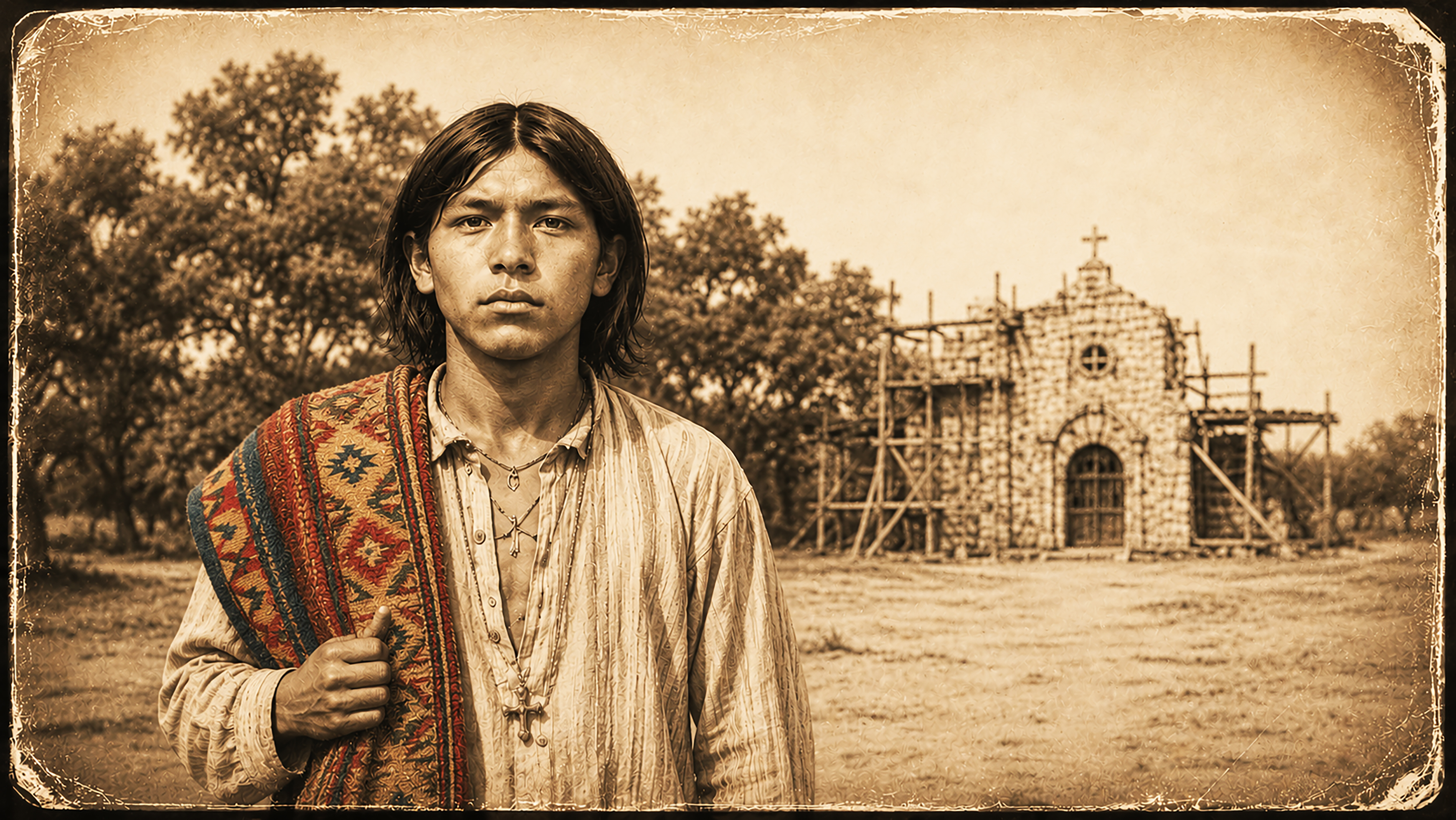
1759, Mission San Antonio de Valero, Province of Tejas, Viceroyalty of New Spain
Near dawn, Tupam was already carrying heavy limestone blocks. They pressed into his forearms, scraping skin hardened by months of labor. Chilly air drifted over the river his people called Yanaguana, settling over the mission compound where shadows clung to unfinished walls and wooden scaffolds. The Franciscan priests called this God’s work, but Tupam wondered why their god sought beauty in buildings instead of the sacred earth surrounding them.
He was seventeen years old, lean and sun-browned from a life spent outdoors. A year earlier he had walked the open land beside his father, Keta, following traditional deer trails. He had learned where fish gathered beneath river bends. He had slept beneath stars instead of roofs. Now bells ruled his days. Bells for prayer, for labor, for meals, and for sleep. And as the mission walls climbed higher, he felt his people’s world growing smaller.
The promise of food and security within the compound had seemed beneficial at first, even to Tupam’s family. Like many of his band, the Payaya, they had accepted the terms because of their fear of raiding Apaches from the north. But then came the coercive pressure to be baptized, coupled with increasing restrictions. Some realized their mistake and attempted to flee, but were tracked down and punished by soldiers from the presidio.
“Tupam,” came a voice from behind him. He turned to find Father Ignacio approaching through the early morning light. The priest was young, but age lines already framed his eyes. He moved quietly, his sandals brushing dust from the packed dirt.
“You should be wearing gloves,” Ignacio said in Tupam’s dialect, his Spanish accent thick.
“I have none,” Tupam replied.
The priest hesitated. “I will see what I can do.”
Tupam nodded and turned back to his task. Father Ignacio treated him kindlier than most, teaching him from translated catechisms, first in his own language, then in Spanish. Tupam learned quickly, and before long the priest was bringing him lessons that few others received. Ignacio often returned to the same passages spoken by his god named Jesus. Love your enemies. Do good to those who hate you. Blessed are the peacemakers. The words sounded noble enough, but Tupam couldn’t understand why men who employed soldiers seemed so intent on teaching them.
Near midday, Tupam found his father, Keta, carrying timber, his shoulders straining from the weight.
“You lift too much,” Tupam said. “We all lift too much.”
His father glanced toward the unfinished church. “They build walls around our bodies first,” he said quietly. “Then around our minds.”
Tupam lowered his gaze. His father spoke like this more often now, especially at night when the bells stopped ringing and shadows hid dangerous thoughts.
___
The diseases carried by the Spaniards came first. Tupam’s younger sister, Sani, survived the fever, but others didn’t. Ten children died within a single moon. An elder who had once remembered every hunting trail was gone, as was a woman who carried the old songs in her memory. Death moved quietly through the mission, taking without warning or mercy. The priests prayed over the sick as though grief could simply be folded into their daily routine.
While he worked under the sun, Tupam often thought of fishing beside his grandfather beneath the open sky. He recalled listening to stories rise with the firelight at night, the smell of mesquite smoke drifting through their camp. Their life had not been easy, but they had enjoyed a freedom so ordinary that no one had given it a name. Now Spanish cattle trampled the old gathering grounds. Children answered to Christian names, and their traditional language was more fragmented with each passing day. Tupam even heard himself thinking in Spanish sometimes, which frightened him more than anything else.
One evening, Father Ignacio paused while teaching Tupam in an unfinished wing of the mission.
“You are reading better every day. You learn so quickly.”
Tupam looked up from the rag paper page in his hands. “I still wonder why you teach us all this.”
“Because knowledge brings power, and it should belong to everyone.”
A humorless smile touched Tupam’s face.
“My people had power before the soldiers came.”
Ignacio hesitated.
Tupam met his eyes. “Now we need permission to leave. Permission to hunt. Permission to live as we always have.” He held up the catechism. “Will these words give that back to us?”
The priest’s gaze drifted toward the unfinished walls beyond the doorway. “Knowledge is still a kind of power,” he said at last, but the words sounded rehearsed.
Tupam studied him. “Even for us?”
Something flickered across Ignacio’s face.
“Especially for you.”
Did Ignacio believe his own words? wondered Tupam. He felt conflicting emotions about the priest. Cruel men were easy to understand. They could be hated openly and resisted clearly. But men who saw the suffering around them and still convinced themselves it served a greater good were harder to fathom. Tupam sensed a genuine struggle within Ignacio, but it changed nothing.
___
Weeks passed and summer settled over the mission, pressing heat into limestone and bare skin. One afternoon, an older worker named Tecan refused to continue laboring. His hands bled openly, and exhaustion bent his body so badly he could barely remain standing. A soldier crossed the distance without hesitation and struck him hard enough to send him collapsing into the dust.
No one moved—not the workers, not Tupam, not even Father Ignacio. The priest simply turned back to his work, and as he did, something inside Tupam snapped. He clearly remembered another lesson from the catechism. If someone strikes you on one cheek, turn to him the other also. Did the command only apply to people like Tecan? he wondered. No one asked the priests or the soldiers to obey it. Tupam also recalled the Romans mocking Jesus before his death. Father Ignacio had spoken of their cruelty with obvious sorrow, yet he showed no remorse today as the soldier struck Tecan.
Anger stirred inside him and for a moment he imagined what it would feel like if fear changed sides.
That night he lay awake listening to the wind pass through unfinished beams overhead. Beside him, Sani coughed softly in her sleep while his father stared upward into the sky with its billions of stars.
“You cannot sleep?” Tupam whispered.
“No.”
“Because of Tecan?”
“No.”
Silence stretched between them.
Then his father spoke quietly. “I dreamed of your grandfather.”
Tupam waited.
“He asked me why I stay.”
The darkness seemed to grow heavier around them.
“Why do we stay?” Tupam whispered.
His father didn’t answer.
___
Two days later, Keta disappeared. There had been no farewell, only an absence his family felt immediately.
“His spirit was already gone,” his mother said with sad resignation. “Now the rest of him has followed. Let us hope they never find his tracks.”
A group of soldiers rode out before dawn the next morning. One day passed, then another, and Tupam’s family dared to believe that Keta had truly escaped. Perhaps freedom still existed somewhere beyond the stone walls.
Then, on the third day, the soldiers returned, Keta walking beside them with his hands bound and a bruise darkening one side of his face. He had not been beaten badly, which almost made it worse. What they brought back to the mission was something quieter and far more devastating than violence. It was humiliation, a lesson meant for everyone who was watching.
Workers gathered silently as a soldier cut the bindings from Keta’s wrists.
“Try again,” said the soldier in Spanish, “and we will bring you back. We will always bring you back.” Though many of the workers didn’t understand the Spaniard’s words, his meaning was unmistakable.
That night, Tupam sat beside his father in the darkness of their sleeping quarters. For a long time neither of them spoke.
Finally Tupam asked, “How far did you go?”
Keta was silent before replying. “Far enough that I could no longer hear the bells. Far enough to sleep beneath the stars and wake to the sound of nothing but the wind.” His gaze drifted toward the darkness outside the door. “I wanted to remember who I was before these walls. Before their prayers. Before they made us seek permission to walk the land that has always been ours.”
The words settled heavily between them.
Keta turned toward his son, and Tupam saw the hopelessness in his father’s eyes.
“And I thought about you,” Keta said quietly, “I began to think that you belong more to this place than to our people.”
The words struck Tupam harder than the butt of a soldier’s rifle.
___
As autumn settled over the land, sections of the mission neared completion. Tupam spent his days laboring and his evenings bent over the lessons that Father Ignacio placed before him. Reading was no longer a struggle. The words now flowed with a familiarity that would have astonished him only months earlier.
He became more familiar with each episode in Jesus’s life—his arrest, his humiliation, and his execution. In the contempt of the soldiers, the silence of those who stood by, and the punishment of an innocent man, he recognized the world he had come to know within the mission compound.
One afternoon, Father Ignacio found him sitting alone on a stone wall, taking a break from the work.
“You missed your lesson last night.”
Tupam shrugged. “I was tired from all this work.”
“We all work.”
A bitter laugh nearly escaped Tupam. “But we don’t all work the same.”
Father Ignacio sat beside him as the afternoon wind stirred grass in the courtyard. “It seems you’ve been hearing something in the lessons that I never intended to teach.”
Tupam nearly laughed in the priest’s face, choking back his anger. “No, I’ve been hearing exactly what the lessons teach. And I see how those who run this place fail to live by them.”
Ignacio’s expression hardened. “You see walls. I see children who survived the winter. I see protection from your enemies.”
Tupam watched a line of laborers carrying stone across the yard. “You speak of salvation. What if we do not wish to be saved?”
The priest was silent for a beat. “Your people came here because they were hungry and afraid. Do not pretend there was no suffering before we arrived.”
Stunned by Ignacio’s arrogance, Tupam nodded toward the workers. “My uncle died carrying those stones.”
Ignacio’s expression hardened even further. “I know.”
“And our children speak your language now.” Tupam looked down at his hands. “Some can’t even remember the old stories.”
“I know what has been lost,” said Ignacio, “but I also know what has been gained.”
Tupam could barely control his anger. He knew that if he unleashed it, the soldiers would quickly be upon him. Through clenched lips, he said, “You taught me that blessed are the peacemakers. Then why do soldiers guard your peace with rifles?”
The priest’s shoulders sagged a bit and he looked away. For a while, neither of them spoke as dust drifted through shafts of sunlight between the unfinished walls.
Finally Ignacio said, “I have seen faith transform lives.”
Tupam thought of his father, of the desperation that had driven him to flee.
“Has it transformed this place?”
Ignacio didn’t answer.
Tupam thought of the stories he had been reading. “Those men who condemned Jesus, did they believe they were doing wrong?”
The priest looked at him sharply.
“No.”
“Then they were certain, too.”
Ignacio looked away.
“I am trying not to hate you, Father.”
The priest turned back to meet Tupam’s eyes. “I know.”
“But I believe your Jesus would hate this place.”
The sudden sadness in Ignacio’s eyes was something Tupam would never forget.
___
Winter crept in by degrees. Mist rose from the river each morning, lingering a bit longer as the days grew colder.
One evening, Tupam wandered beyond the mission’s boundaries—not so far to cause an alarm, but enough to breathe freely. His mother found him there, and together they watched the sun settle beyond the trees, painting the sky orange as darkness slowly crept along the river’s edge.
“Some of the children asked me about life before the mission today,” she said softly.
“What did you tell them?”
She was quiet for a bit. “Very little.”
He frowned. “Why?”
“Because they listened as if they might someday enjoy that life for themselves.”
The words hung between them.
“And they won’t?” Tupam said, but it was more a statement of fact than a question.
Sadness touched her face. “I cannot predict the future. But I am tired of filling children’s minds with hopes that this place has taken away.”
He thought of his mother’s words as he tried to sleep that night. This loss they all felt was wearing them away. The smoldering anger that had been building inside him was now a bed of coals that refused to cool.
___
One night he found an old bundle hidden beneath blankets near his family’s sleeping mats. Inside was his grandfather’s stone knife, its surface worn smooth by years of use. The moment his hand closed around it, something hardened inside him. It wasn’t hatred toward the soldiers. Soldiers were simply obeying orders. But Father Ignacio was different. The priest had taught him to recognize injustice when he saw it. He had placed the story of an innocent man condemned by powerful authorities into Tupam’s hands and asked him to revere it. Then he walked each day through a mission built upon the suffering of people who were no longer free to leave. The contradiction had become unbearable for Tupam.
Long after the mission had gone quiet, he took the knife and walked alone beneath the cold moonlight toward Father Ignacio’s quarters. He passed sleeping families and unfinished scaffolding where labor would begin at dawn. Above him rose the mission, not a sanctuary but a fortress.
By the time he reached Father Ignacio’s door, he carried the weight of everything that was slipping away: hunting trails swallowed by mission fields, children speaking Spanish more easily than their own language, ceremonies no longer practiced, and elders who died before passing on what they knew.
As he stood there galvanizing his anger into action, he suddenly remembered another lesson from the catechism. Those who live by the sword will die by the sword. He had hated the words when he first heard them, wishing that the soldiers who bore arms around him would die violent deaths.
But now, he hated that the words rang true, and he imagined Jesus speaking to him personally.
Wind moved softly through the compound. Tupam looked down at the knife in his hand and thought of Jesus standing quietly before his tormentors—a man beaten, mocked, and killed by people convinced they were serving a righteous purpose.
For a long time, Tupam had wondered how such a thing could happen. Standing outside Father Ignacio’s door, he finally saw that the men who condemned Jesus had never imagined that his story was about them.
Slowly, Tupam lowered the knife.
The Yanaguana flowed through the darkness beyond the walls, and above him the stars burned cold and distant.
Perhaps, he thought, Jesus did not belong to empires or missions. Perhaps he stood instead with those forced to bear the weight of both.
The thought settled uneasily within him.