July 1863, Mount Locust, Mississippi
Based on a true story
Paris Martin paused to straighten his broad shoulders made strong by years of fieldwork. He wiped his brow and swept his eyes over the plantation.
On the surface, everything seemed the same. The Chamberlain’s house, an inn for travelers on the Natchez Trace, stood on its knoll. Cotton fields stretched across the landscape, shimmering with heat. Cicadas droned from the woods, and a red-tailed hawk circled lazily overhead. Paris breathed in the familiar smells of damp earth and mule sweat from the nearby wagon yard.
Yet beneath it all, something had shifted. Travelers staying at the inn had relayed some startling news. Vicksburg had fallen and Yankee troops had occupied Natchez. Enslaved people were escaping across the region and finding refuge behind Union lines. Most astonishing of all, Black men could enlist in units of the United States Colored Troops, putting on uniforms and carrying rifles.
At twenty-two, Paris had spent his entire life at Mount Locust. Every mound, stream, and stand of trees was familiar to him. Yet now his thoughts drifted toward Natchez beyond the southwestern hills, where an unfamiliar life seemed suddenly possible.
“If you stare hard enough, maybe it’ll come walking over here.”
Paris turned and found his brother Anthony grinning at him from the next row in the cotton patch. Lean and quick on his feet, Anthony carried an irrepressible smile that hardship never managed to erase.
“What will?”
“Natchez.”
“That’s foolish.”
“So is standing in the sun daydreaming.”
Paris chuckled. Anthony always found humor, even on the hardest days. Their mother used to say that if the world ended, Anthony would ask whether there might still be supper afterward. She had needed that kind of laughter since their father died.
“I’m not daydreaming.”
“Then you’re thinking about something solid.”
“Maybe.”
Anthony lowered his voice and glanced toward the far end of the field.
“About the Yankees occupying Natchez?”
Paris hesitated. The enslaved at Mount Locust had more privileges than others in Mississippi. Their owner, Paulina Chamberlain, sometimes allowed them to visit a nearby plantation to socialize, a freedom unheard of elsewhere. But to think about escaping for good? That was a different prospect.
“Maybe.”
Anthony nodded. “Me too. Imagine being able to join up and fight against the Confederacy. To bear arms…”
For a while they worked in silence beneath the scorching midday sun. Sweat trickled down Paris’s neck until his homespun shirt clung to his back. Despite himself, hope began to stir inside him, a dangerous thing that tempted a man to imagine a life beyond the one laid before him.
___
Later that afternoon, the brothers went to repair a fence damaged by a recent storm. The work took them beyond the edge of the main field where they could talk more freely.
Anthony drove a post into the ground and stepped back to examine it. Sweat darkened the backs of their shirts, and every hammer blow sent grasshoppers scattering through the weeds.
“You ever think about what you’d do?”
Paris adjusted another rail.
“If what happened?”
“If you woke up truly free tomorrow.”
Paris considered the question. “Sleep late.”
Anthony laughed. “That’s your dream?”
“For the first day.”
“And the second?”
Paris smiled. “Maybe spend the whole day deciding what to do.”
“You dream too small.”
“What about you?” Paris asked.
Anthony rested both arms on the fence. “I’d walk.”
“Walk where?”
“Everywhere.”
Paris shook his head. “You’d get awful tired.”
“Maybe. But it’d be my choice, and I see parts of this country I’ve never seen.” He studied the distant woods to the southwest. “You think we’d make it?”
Paris drove another nail into the rail before answering. “I don’t know. There’s still a lot of danger out there, especially along the Trace. The Union may control Natchez, but it doesn’t control the minds of those who hate colored people.”
Anthony nodded. “Fair enough, but we’d have each other for protection.” He fell silent for a moment, then said quietly, “I keep wondering if this is what it feels like before your whole life changes.”
Paris stood straight, mopped his brow, and let his eyes drift over the fields. “I know what you mean. Everything looks the same. The fence. The cotton. The trees. But somehow the whole world feels totally different.”
Movement along the distant Trace caught his attention. A group of horsemen emerged from the trees, riding slowly beneath the afternoon sun. Both brothers froze.
“Who are they?” Paris asked.
“Most likely a slave patrol,” said Anthony.
The horsemen continued without stopping, but neither brother spoke until they disappeared. The weight of what they were considering settled heavily between them.
___
The brothers sat outside their cabin as the last traces of sunlight slipped beyond the western hills. Smoke from cook fires carried the aromas of cornbread, greens, and salt pork.
An elder named Isaiah approached them. He lowered himself onto a sitting stump with a weary sigh, rubbing one knee before settling into place. Age had bent his shoulders and silvered his hair, but his eyes remained sharp.
“You two look like men carrying secrets.”
Anthony grinned.
“Maybe we’re just thinking.”
“Thinking too much can be dangerous.”
“Then we’re definitely thinking,” said Paris with his own grin.
Isaiah chuckled. “I’ve watched both of you grow up. Neither one of you ever learned to hide your thoughts.” His gaze shifted toward the Trace. “Generations have walked that road searching for something better. Sometimes I think the land remembers them all.” He paused. “Most folks see dirt and wagon ruts. I see hope.”
“You ever think about taking it?” asked Anthony.
Isaiah smiled sadly. “Every day when I was your age.”
The answer surprised them.
“You never tried?” Paris asked.
“Once.” The old man folded his hands in his lap. “I got about three miles from here.”
Anthony leaned forward. “What happened?”
Isaiah laughed softly. “Fear happened.”
The honesty of the answer surprised them.
“I was younger than you boys are now when I left,” Isaiah continued. “I thought I had everything figured out. Then the woods got dark. Every sound became a posse in my mind. Every shadow became somebody looking for me.” He shrugged. “So I turned around.”
One of the Chamberlain’s dogs barked in the distance.
“Do you regret it?” Paris asked.
Isaiah stared toward the fading light at the edge of the southern woods. “Sometimes. Other times I tell myself I made the right choice. Truth is, neither matters now. The chance came but I let it pass.”
His gaze moved back to Paris to Anthony, studying their faces.
“If you boys are waiting for your fear or uncertainty to leave, it won’t. If you mean to go, you’ll have to carry those feelings with you.”
In the distance a whip-poor-will called from the woods, and the night’s first stars began to brighten overhead.
___
The following evening, Elijah returned from Natchez with a small wagonload of supplies. He was a short, compact man with a full beard whom the Chamberlains trusted him enough to send on multi-day trips. After unloading, he walked towards his quarters, dust coating his boots and the cuffs of his trousers. He passed Paris and Anthony sitting outside their cabin.
“I hear you’ve been to Natchez,” Anthony called out to him.
Elijah stopped in mid track and nodded. “I have.”
For a moment he simply looked at them with a weary face, as though deciding how much to say.
“They’re there,” he said at last. “Union soldiers. Colored soldiers too.”
Neither brother spoke.
“I watched them marching through town wearing blue uniforms with rifles on their shoulders.” Elijah smiled faintly. “You should’ve seen the way they carried themselves. Like men who’d finally remembered who they were.”
Paris felt that stirring of hope again. “They’re taking in folks from plantations all over the county?”
“They are.”
Elijah lowered his voice. “If you’re thinking about going, don’t wait too long. Every day more people are slipping away.” He paused. “And the patrols have noticed.”
He rose, lifted a small sack onto his shoulder, and started toward his quarters. After a few steps he looked back. “Hope has a way of not waiting forever.”
Then he disappeared into the gathering dusk.
___
The next morning, Paris woke before sunrise and stepped outside the cabin while the rest of the plantation slept. A pale gray light lingered along the eastern horizon. For a few precious moments, the world seemed suspended between night and day. The air smelled of pine and dew as a faint mist drifted across the low ground beyond the fields.
He stood quietly, listening. Somewhere in the distance a rooster crowed, and a mockingbird called from a nearby tree. Ordinarily, even a beautiful morning like this would have seemed unremarkable, but now it felt unlike any morning before it.
By nightfall, there would be no turning back.
Anthony stepped outside a few moments later, following Paris’ gaze toward the southern woods.
“You nervous?”
“Yes.”
“Good.”
Paris smiled. “You too?”
Anthony laughed softly. “I feel like my stomach’s trying to climb out of my body.”
The honesty of the answer eased something inside Paris. He had assumed that he alone carried the burden of fear.
“What if we get caught?” Anthony asked quietly.
Paris looked across the fields.
“I don’t know.”
“Well, that’s comforting.”
Paris laughed despite himself. It felt good to not know, perhaps because the alternative, as Isaiah had warned, was thinking too much.
___
That evening, after the plantation had grown quiet, Paris and Anthony crossed the yard to their mother’s quarters. She had moved temporarily from their family cabin to care for two elderly women.
She looked up as they entered. Deep lines framed her gentle face, but her steady eyes held the strength of a woman who had endured much and complained little. She knew why they were there.
“So,” she said softly, “it’s tonight.”
Both nodded solemnly.
“Mama…” Anthony began.
She raised a hand to stop him.
“I’ve known this day was coming since the first time I heard you two whispering about Natchez.”
Silence settled over the little cabin. The only sound was the soft crackle of the cooking fire.
Finally Paris said, “We hate leaving you.”
“I know.”
Anthony stared at the floor. “Come with us.”
She stood and stepped towards them, smiling sadly as she shook her head.
“The Lord has a different road for me.”
She reached out and smoothed the front of Paris’ shirt as she had done ever since he was a little boy. Then she took each of their hands.
“Your father used to tell me a man doesn’t get many chances to change the course of his life. If the Lord puts one in front of you, you take it.”
Tears welled in Anthony’s eyes.
“We’ll come back.”
“I’ll pray you do.” She squeezed their hands. “But don’t you look back because of me. You just keep walking.”
She embraced them both, holding them a long while before stepping away.
“Take care of each other.”
“We will,” Paris said.
She smiled through her tears.
___
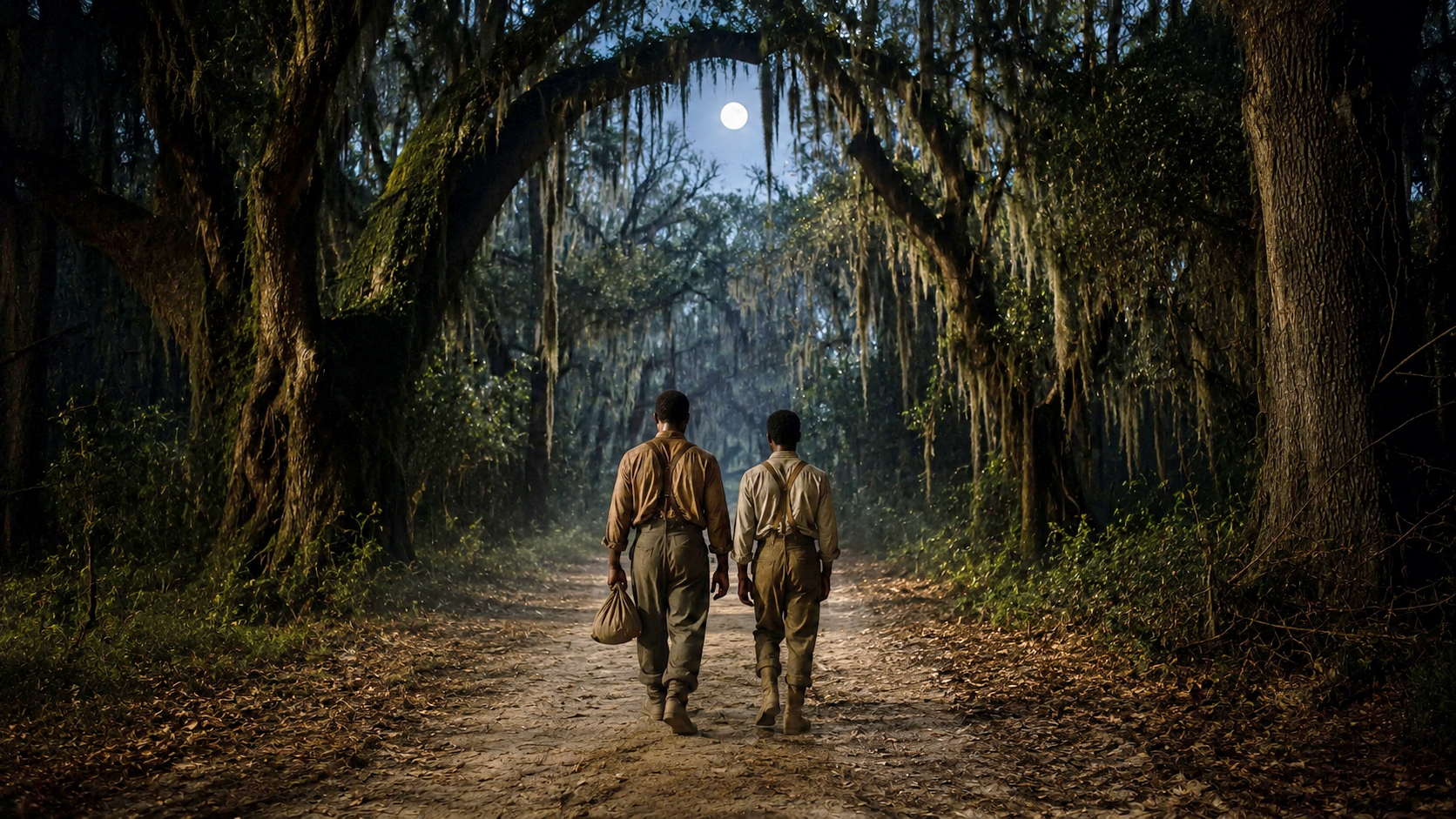
The plantation slept beneath a full moon as Paris and Anthony slipped between the cabins and crossed the open ground. They each carried a small burlap sack containing personal belongings. Silver light washed across the fields while a breeze stirred the cotton. Anthony’s foot struck an old pail, sending it clattering across the yard. Both brothers froze, scarcely daring to breathe as they waited for a lantern to flare or a dog to bark. None did, and the night settled around them once more.
At the edge of the plantation, they stopped at the tree line and turned for one last look. Mount Locust lay beneath the moonlight, the old house watching over the cabins and fields that had shaped every memory they possessed. Paris was surprised by the sadness that rose in him.
“Feels strange,” said Anthony.
Paris nodded.
“You ready?”
Paris turned his eyes south toward Natchez and the uncertain future waiting beyond the darkness. Fear remained, but hope walked beside it now.
“Yes.”
They entered the woods, where the air cooled around them. It didn’t take long to reach the Trace. Both had walked it before, but never like this. It stretched before them into the darkness. Wagon ruts caught the moonlight, and generations of footsteps had worn the earth smooth. Pale sycamores arched overhead, their white trunks glowing in the darkness.
Paris knelt and ran his fingers across the cool, packed earth. He imagined all the feet that had traveled this road before his own: Choctaw hunters, traders, soldiers, settlers, runaway slaves, families seeking new homes. He stood without saying a word.
“When I was a boy,” he said. “I used to imagine owning a horse. Now I’m imagining a whole different life.”
“Come on,” said Anthony. “Let’s find that new life.”
Somewhere ahead a whip-poor-will called. Anthony answered by softly but badly imitating its song. Paris laughed under his breath.
Then, side by side, they followed the Trace into the Mississippi night.
Epilogue, Jefferson County, Mississippi, 2018
The cemetery was quiet except for the rustling of leaves overhead. Time had softened the edges of a weathered government headstone, but the name inscribed on was still readable.
PARIS MARTIN
For years, the fate of the Martin brothers had been unknown. Patient research through church records, military files, and family histories eventually led to the discovery of the enlistment card for Anthony, dated July 20, 1863. Then they uncovered Paris’ grave at Jefferson Chapel African Methodist Episcopal Church. After the war, he had returned to Jefferson County to build a new life.
Freedom hadn’t spared him hardship. He came home to a Mississippi where prejudice endured. But no hatred could erase what he and Anthony had claimed for themselves when they walked away from bondage and stood beneath the United States flag as soldiers.
A breeze stirred the trees overhead. Sunlight touched the worn headstone before drifting away. And somewhere beyond memory, beneath an eternal Mississippi moon, Paris and Anthony Martin were still walking south along the Trace, carrying hope into the darkness with every step.
About the author: Krin Van Tatenhove is an author, visual artist, and spiritual adventurer. He has worked as a cleric, community organizer, and director of a nonprofit. His 40 years of professional writing experience have led to countless articles and 19 books. You can freely download most of his words and images by visiting krinvan.com, or purchase books on his Amazon Author’s Page. In addition to his creative pursuits, Krin suffers from chronic wanderlust, always seeking new travel experiences to satisfy his gypsy soul. He is married, has four children, and lives with his wife and disabled adult son in San Antonio, Texas.