Where is the Habitat of Your Heart?

Studies show that our favorite music—the tunes that stir us the most—come from the soundtracks of our younger years. Musicologist Nolan Gasser, architect of The Music Genome Project, says that even though our tastes evolve, “The music people listened to at an early age becomes their native home comfort music. It will always be a part of who they are, tied in with deeper memories. It becomes a stake in the ground that says ‘this is who I am.’”

This rings true for me. My playlists are eclectic—new age, ambient, 70s/80/90s, jazz, metal, reggae, flamenco, bluegrass, folk—but there are certain classic rock tunes that transport me to another time and place. As Boston said, “It’s more than feeling.” I see this in my parents. On a recent visit, they asked me to sit with them and watch a rerun of an old Lawrence Welk episode. I squirmed in my chair, but they were enraptured.

This kind of organic resonance also applies to our favorite places. In a book I recently co-authored, one of the chapters begins like this:

“Think of a place that has a powerful hold on you. It may be a family homestead, a setting in nature, or a venue in your city where you spend quality time. These locations evoke more than memories; they stir our spirits and connect us with memories of times past.”

Where is this habitat of your heart, past or present? Specifically, where is that place in the woods, the fields, the mountains, or along the seashore that stakes your heart powerfully in time? Tell me its sights, smells, sounds and textures.

For me, the chaparral hills of Southern California, mingled with orange and avocado orchards, will always lay claim to my spirit. This was the playground of my childhood. It’s Mediterranean climate, Santa Ana winds, sage, manzanita, scrub oak, and “warm smell of colitas rising up through air.” Its kingsnakes, alligator lizards, roadrunners. The intoxicating aroma of orange blossoms on a summer evening.

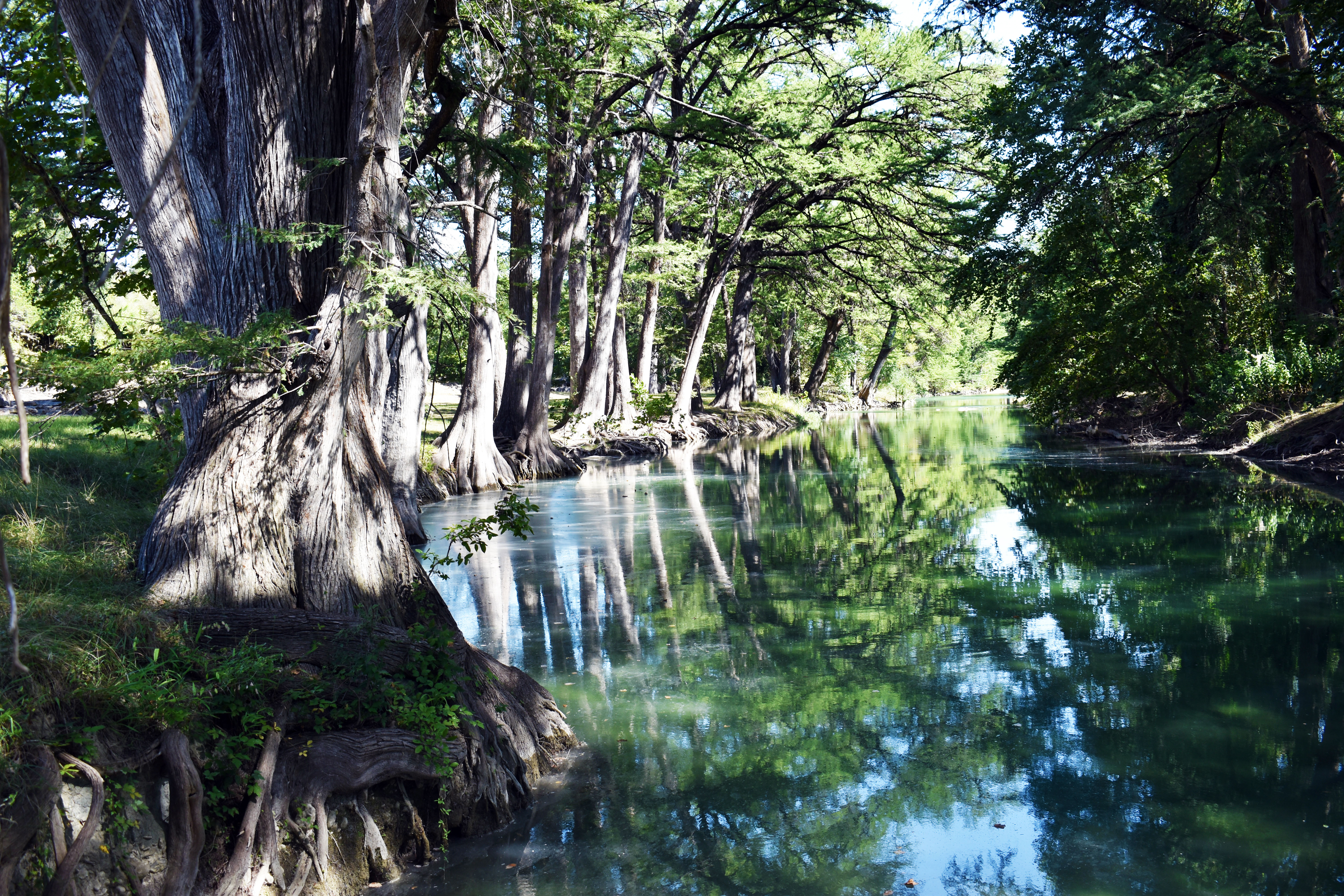
As a geographical transplant, I now have a new heart habitat. 15 years in Texas has led me to a lasting kinship with its Hill Country, especially its cypress-lined rivers. When I feel restless, experiencing what Richard Louv calls “nature deficit,” I drive a half hour north to Bandera. I park at a secluded place on the northern edge of town, then walk to the banks of the Medina River and wander slowly along its course. I am learning the names of trees, shrubs, flowers and grasses in this biome. Its birds, butterflies, reptiles and mammals are becoming family members.

I have taken this walk countless times, savoring every season, but it is always fresh. Here is an image from a recent trips.

Medina River banksI ask again: where is the habitat of your heart? If it’s a childhood place and you still live there, immerse yourself! If you live in a new locale but have not discovered a habitat to cherish, get out there!

As Stephen Stills sang, “If you can’t be with the one you love, love the one you’re with.”


In Defense of Perla

Early morning, a colonia on the outskirts of Reynosa, Mexico. Chilly winter air tinged with smoke from trash fires. The neighborhood is mostly shacks cobbled from old wood, tin, and cardboard. There is no running water; the city has promised electricity, but so far those pledges are hollow.

Most of the residents are migrants from Chiapas, lured to jobs in maquiladoras along la frontera. These are not squatters. They have purchased their tiny lots with a mortgage through Habitat para la Humanidad, and now they hope to build their dream homes: 500 square foot, cement block structures with 2 bedrooms, a living space, a kitchen, often housing large families. Latrines remain outside.

884274_avs-front-pic

Our crew of volunteers is inspecting construction sites. We will work alongside members of the community, a day of labor and fellowship, but first I have other tasks. Word has rippled through the dirt streets that a pastor is present, and I have received invitations to bless homes recently completed. One family asks me to pray for their newborn child.

I am glad to oblige, even though my bendiciones are clumsy mixtures of English and broken Spanish. It doesn’t matter. I have friends who translate, and my smile and eyes communicate more love than my words could ever convey.

One house after another, joining hands, lifting our hearts to God with petitions for abundance and safety. I receive many more blessings than I give, especially when I arrive to pray for the infant. Her home is a one-room shack where she lives with her parents and two siblings, walls of scrap plywood, a roof of rusted tin. Outside is a cooking fire, and they share a pit latrine with an adjacent family.

An old bench seat from a bus is near the front door, listing slightly, its surface torn to reveal the springs beneath. The parents ask me to sit as they bring their tiny daughter to me, only two weeks old.

Que preciosa,” I say. “Come se llama ella?”

Perla,” is the answer.

I cradle the girl in my arms, bundled in blankets. She is quiet, her dark eyes staring up at me, and though she will never remember this moment, it is sacramental for me.

I make the sign of the cross on her forehead. I pray for God’s guiding hand to be upon her and her family all their days, giving them strength, safety, and abundance for this new life they seek to establish.

Then I hold her against my chest for a moment, encircled by her family and smiling neighbors.

Our work that week was a triumph for all of us. Yes, we helped two structures rise from that neighborhood, but more importantly we joined our hearts across cultures, time, and space.

Months later, through my Habitat connections, I received a photograph and a brief note. Perla’s family was standing proudly in front of their new home, and the words said: “To Perla’s padrino. Muchas bendiciones.” To Perla’s godfather. Many blessings!

In over three decades of ministry, I have occasionally been asked what drives my passionate efforts for justice and peace. I could give answers complicated by theological jargon, socio-economic statistics, or political convictions, but my reasons are far simpler.

I act in defense of Perla and countless others I have met. I stand in unity with those struggling on the edge, joining hands in our one human family.

You see, Perla is also my daughter. She is your daughter as well.

 Selah!

Born Again?

There are people with stellar IQs who are short on common sense. People who exhibit genius within the narrow bandwidth of their expertise but lack any breadth of cultural literacy.

Conversely, there are human beings who will never be labeled brilliant by societal standards but who startle us with insights about life. I know this firsthand as father to a special-needs son. Kristoffer often voices simple nuggets of wisdom that awaken me to what is truly important.

I believe there is one definition of intelligence that is sorely needed in all of us. It is the ability to get outside ourselves and our given culture. The ability to see our reality in time and place, then respond (not react) to it with a fresh, objective perspective.

Sociologists say that when it comes to our cultures, we are like fish in water. We swim in the conditioning of our upbringing, our genetic makeup, our juncture in history. Often, we never rise above these determining factors. We never decide what to claim and what to reject, what to shed and what to make part of our flesh. Examples are rife in our world.

  • People who adopt the spoon-fed religion of their tribe or nation, then wield it as an exclusive truth that trumps the faith and beliefs of others. James Fowler, in his Stages of Faith, called this Stage Three—Synthetic-Conventional Faith—a closed mindset that prevents us from celebrating the mystery of spirituality in all its diversity.
  • People reared with a righteous sense of patriotism, an idolatry of their country’s identity and flag. American Exceptionalism is a tragic example, but history is replete with similar examples of dangerous nationalism.
  • People indoctrinated with racism, sexism, or homophobia who never rise about the fear that promotes their exclusion and hatred.
  • People whose skin color or class has afforded them a privilege that traffics, consciously or not, in systemic injustice.
  • People raised to put their trust and security in material things.
  • People trained to gauge their worth by the hollow standards of power and prestige.

In the Christian Gospel of John, Jesus has a clandestine meeting with the Jewish leader Nicodemus. He says to him, “Very truly, I tell you, no one can see the kingdom of God without being born from above.” (John 3:7) It’s a pity that these words have been coopted by Christian fundamentalists as being “born again,” a pat phrase that means conversion to their brand of Stage Three Christianity.

I see them as a deeper call to wake up, to be born outside the determinates of our lives, to recognize the timeless existence of Source’s liberating presence that permeates everything around us.

When this happens, the scales fall off our eyes in a kind of conversion experience. I believe we ALL need this transformation. It helps us evolve into citizens of the world, not just the territories of our genetic and cultural conditioning.

This is hard work. It begins with a sobering analysis of our own habitual thinking, our prejudices and privilege. It often requires repentance, amends, even restitution. But the resulting freedom is well worth the effort!

How did Jesus describe this freedom in that conversation with Nicodemus? “The wind blows where it chooses, and you hear the sound of it, but you do not know where it comes from or where it goes. So it is with everyone who is born of the Spirit.” In a mysterious and beautiful way, this is a powerful image of liberation.

Kristoffer recently said, “Dad, there will never be peace unless people change.”

Amen! I could phrase it another way. There will never be peace until more people are born again into the ENTIRE human family, not just their tribe or nation.

Are you next?

Box of Darkness

From the introduction to Box of Darkness. Here is a link to the entire book.

The title of this book comes from The Uses of Sorrow by Mary Oliver, beloved American poet who died on January 17, 2019. She wrote it following the death of Molly Malone Cook, her partner for 40 years. With her usual straightforward imagery, Oliver reminds us that the darker aspects of life can offer surprising inspiration.

We invited the following artists to share some of their work, prompted by simple questions: ‘How do you receive inspiration from the darker fringes? How are you drawn artistically to the shadows?’

The result? A box of darkness, presented through paintings. photographs, collages, and poems. Our images and words are eclectic—a multiplicity of perspectives—but together we invite you to become more familiar with your shadow side, finetuning your eyes to its presence.

Krin Van Tatenhove and Angelica Gudino, Editors/Curators

Photo for Crowdfunding campaign

In Search of Higher Power

The longer I live, the more I believe that faith is a miracle. Faith that unflinchingly views our world in all its warring madness, yet still trusts in love. Faith that weathers those nights of existential angst, the abyss yawning, and somehow reorients to hope.

I also believe that each person’s faith journey is unique. Religions proselytize, sharing their versions of absolute truth, but every signpost pointing to Mystery should include a disclaimer: “This is the best approximation we are living with now. We invite you to join the dialogue!”

As a recovering alcoholic, I treasure a cornerstone of Twelve Step fellowships. We share the wisdom that a “power greater than ourselves can restore us,” but we never proselytize. One’s higher power must arise from personal understanding. Otherwise, the relationship lacks authenticity and strength. Spirituality, not religion, is the wellspring of recovery.

Over the years, I have heard some stirring accounts of people’s searches for truth. Here is one of many from my book, The Pattern (freely downloadable here). I hope it increases our sensitivity to the sacred journeys of those around us.

One woman, raised in oppressive church environments, rejected all notions of God or religion. She believed that ever since we crawled out of caves, we have grappled with the question of being born to die, the issues of ultimate meaning, the enormity of mystery surrounding us. She saw the beauty in certain faith systems and philosophies, but if those who practiced them became even slightly insistent that their truth trumped others, she quickly exited the scene. She had forever had her fill of judgment, misguided zeal, and the pressure to conform.

In early recovery, she was forced to confront the truth that her life had led her to anger, cynicism, isolation from others—a state of mind she medicated with prescription drugs.

One morning she was seated on her porch, meditating on a passage of daily reading. The air was cool, the early light soft upon her face, a chorus of birds lilting from the trees. A sense of peace settled over her. It was deeper and more profound than anything she had ever experienced, calming her body, mind, and soul. Though she had always balked at prayer, familiar words echoed in her mind: “Grant me the serenity…”

She says she will never personify this experience, attributing it to a deity, but its power is undeniable, and she believes it is not an outcome of her own thinking. It is something greater than herself. Her Higher Power is this peace, this serenity, and learning to live in the middle of it one day at a time is her program.  

I am eternally grateful to my faith community known as the Presbyterian Church (USA). Raised in a Christian household, I became a wandering soul, searching through many philosophies and faith systems until my friend, Rev. Rex Stewart, invited me to visit his home church, St. Andrew Presbyterian, Albuquerque. I describe what followed in my book Invitation to the Overview (freely downloadable here).

From the moment I entered that church, I experienced a homecoming. This was a community of faith that embraced searchers and encouraged free thinking. They respected the sanctity of individual conscience. My personal beliefs were my territory, not theirs; they simply celebrated the chance to commune with me. Giving people the space to connect to Spirit without the pressure of conformity is a priceless gift. This is one of the meanings of sanctuary.

I feel privileged to be on this journey with all of you!

Colorful hot-air balloons flying over the mountain with with sta

Confession-less or Confession-free?

I chuckled at the media furor over Donald Trump’s choice not to recite the Apostle’s Creed during the funeral of George H. W. Bush in 2018. I laughed for two reasons. First, Americans politicize every action; it’s the bait and fodder of the endless news barrages that polarize us. Second, I laughed because I, too, might have remained silent beside the Donald.

The difference is that unlike Trump, I know every syllable of this ancient Christian creed. It was branded – even seared! – into my memory during two years of Lutheran confirmation classes. In retrospect, that process maddens me. Take a young mind just beginning to think for itself, then tell it to confirm a list of absolute truths passed on from institutional powers. No encouragement to explore other faiths or philosophies. No freedom to broaden one’s search. Just force feed and regurgitate the age-old tropes.

Yes, I know the Apostle’s Creed as readily as I know the American pledge of allegiance. It’s just that I (like many I know and love) no longer resonate with its doctrines: a patriarchal blueprint for god (almighty father, only son), a virgin birth, the descent into hell, a literal resurrection.

I simply don’t believe these things. What I do believe is that we should carefully scrutinize any formulas presented to us. We should ask ourselves if these truths make sense in the laboratories of our own daily lives.

In the introduction to my 2019 book, Neighborhood Church: Transforming Your Congregation into a Powerhouse for Mission (co-authored with Rob Mueller), I quoted my oldest son, Pieter. He speaks here of the spiritual values he shares with his circle of millennial friends.

“We are seekers first, Christians second (if at all). We are reluctant to make statements of faith because they calcify that part of our brain that seeks new understanding.”

For 32 years, I was affiliated with the Presbyterian Church (USA), a branch of Christianity that claims a “confessional heritage.” It’s Book of Confessions – faith pronouncements from key, often turbulent eras of history – provide clinical insights into Western colonial thinking. However, on the level of doctrine, I cannot accept or affirm any of them in totality.

It’s not that I don’t have faith. You could even say I have my own creed, but it’s always evolving. Further, I don’t expect others to describe their journeys in any way that doesn’t make sense to them. Here’s a taste of where I’m at. I would love to hear your own thoughts in response to this post.

I believe in a Presence that humans have variously called God, Spirit, Tao, Higher Self – a mystery at the heart of all spiritual awareness, yet personal in a way that guides my life. I believe in the power of love and how it spurs me to work for justice in nonviolent ways. I believe that the teachings of many spiritual leaders – among them Jesus and the Buddha – call us to counter the cold love, materialism and self-centeredness that plague us as a species. I believe that forgiveness, even of enemies, is a triumph of human evolution. I recorded something similar in my book, Invitation to The Overview.

In my final years as an ordained worship leader, I struggled mightily with that part of the liturgy traditionally called the Affirmation of Faith. How can we affirm the miracle of belief without anthropomorphic boundaries? How can we seek Truth without stumbling over truths as articles of faith?

There is one creed that I do like, almost in its entirety. It hails from the Iona community of Scotland.

“We believe that God is present in the darkness before dawn; in the waiting and uncertainty where fear and courage join hands, conflict and caring link arms, and the sun rises over barbed wire. We believe in a with-us God who sits down in our midst to share our humanity. We affirm a faith that takes us beyond a safe place: into action, into vulnerability and onto the streets. We commit ourselves to work for change and put ourselves on the line; to bear responsibility, take risks, live powerfully and face humiliation; to stand with those on the edge; to choose life and be used by the Spirit for God’s new community of hope. Amen.”

Words like these allow me, in good conscience, to raise my voice with others in corporate worship. They don’t calcify the search but spur me onwards.

Many may call me confession-less; I believe I am confession-free. And for all those classic-rock buffs reading this: freedom tastes of reality.

Foxcatcher and the Power to Bless

I recently watched Foxcatcher, the award-winning film based on true events. It tells the story of eccentric multimillionaire, John du Pont, and his recruitment of two Olympic gold medalists, Mark and David Schultz, to help coach U.S. wrestlers. It’s a painful tale, especially the tragic ending.

foxcatcher-uk-quad
One of its poignant themes is what I call “a lack of blessing.” Though they come from starkly different classes, both du Pont and Mark Schultz share the same malady. Each of them is searching for an affirmation they never found in their family of origin. Each of them is trying to fill a hole that drives their personalities in unconscious ways.

No family is perfect. Most of us suffer a bit from what R.D. Laing called the “post hypnotic trance induced in childhood.” One sign of maturity is to not only grow beyond the limitations of our upbringing, but to embrace the lessons we learned in that struggle. I deeply admire women and men who overcome troubled beginnings and go on to live productive lives.

However, as a pastor I have also seen the addiction, depression, and grief that stem from early psychic damage. This is why I call all of us to exercise our POWER TO BLESS. Through our words and actions, we can help others slowly heal the scars they carry beneath the surface.

Years ago, Gary Smalley and John Trent wrote The Blessing: Giving the Gift of Unconditional Love and Acceptance. Using Isaac’s Old Testament blessing of Jacob as a model, the book suggests five elements of this treasure that we can shower on others:

  • meaningful touch,
  • words of love and acceptance,
  • attaching high value to them,
  • picturing a special future for them,
  • committing to our part in helping them fulfill that future.

Here is a blessing I recently gave my wife, Donna. Yes, I thought of it ahead of time. Yes, she knew it followed a model. She also knew every word is heartfelt.

After hugging her, I said: “Donna, I love you unconditionally. You have amazing qualities of mercy, patience, perseverance, and an ability to meet people on their terms. I believe that your work to obtain a college degree will not only come to fruition, but give you deep satisfaction. As your partner, I will do everything I can to support you.”

So simple, a mere moment, yet these blessings can make a miraculous difference, especially when others are facing circumstances that erode their trust in themselves, in others, and in God.

Friends, we have the power to bless others! We can wield it in our families, neighborhoods, workplaces, and churches. In this world that continually grades (and degrades) people according to societal standards, we can help them remember that they are created in God’s image, unique children of our Maker.

Early in Moby Dick, Ishmael is dealing with the harsh realities of life on a whaling ship. He says, “…however the old sea-captains may order me about—however they may thump and punch me about, I have the satisfaction of knowing that it is all right; that everybody else is one way or other served in much the same way— either in a physical or metaphysical point of view, that is; and so the universal thump is passed round, and all hands should rub each other’s shoulder-blades….”

So true! Let’s rub each other’s shoulder blades through our power to bless.

Unmoored: A Life Untethered to Places and Things, by Emily Rohrer

“We don’t need more closet space. We need fewer things.” “Don’t get me a gift. Let’s go somewhere.”

IMG_6900

I’ve repeated these statements dozens, if not hundreds of times. And for more than three years now, I’ve been lucky enough to share with my husband a lifestyle that combines both tenets.

In 2015, we downsized out of our 2900-sf house in the suburbs, and into a 355-sf RV.

So now we have way fewer things, and they’re inside a mobile living space that allows us to go.

It is a lifestyle that offers both the joy of simplicity, and the excitement of complications.

Our life is simple in that there is a place for every thing, and every thing has its place. If even a few things are left out of place, our home looks messy in a hurry. Plus, we can’t exactly leave dirty dishes on the countertop when we’re about to tow our kitchen around the corner and down the highway, because that is not where they’ll be when we stop!

Our life is complicated in that there are regular challenges like figuring out where we’re going to stay (RV park, campground, friend’s driveway?), what our water and electrical situation will be (both, one, none?), where to have an online shopping order sent, and our proximity to necessities like a grocery store and a laundromat. There are also unexpected and often expensive challenges like a flat tire (we’ve got ten; odds are high), a mechanical failure, lack of cellular service, weather hazards, poor road conditions, and more.

It’s not for everyone.

And yet, in a consumer culture that screams MORE, we have chosen LESS.

In a society that seems designed for STAY PUT, we have chosen DON’T STOP MOVING.

With a home on wheels, wherever we park — for a night, week, or month — is where we live, and that suits both of us just fine.

For more than two decades, we were a military family, the arc of our lives subdivided by regular changes of duty station. You’d think that after my husband’s retirement, we’d have chosen to settle in one place, and never. move. again.

But we’re not ready yet. And we don’t even know where our place is. We do have favorite towns and favorite people in them. We’re just not ready to trade the freedom and mobility to visit all of them, at the time of year and for the duration we choose, for the commitment of maintaining a permanent residence in one of them.

Sure, we’ll tie ourselves to property again someday, but even that will involve travel — specifically, a strange and curious journey through the items in our storage unit, which, best I can recall, is located at the corner of Why Did I Save This Street and I Forgot We Even Had That Avenue. Now that will be trip!

Emily Rohrer and her husband, Tim, a retired Navy officer, have been living and traveling full time in an RV since 2015. They miss having a bath tub. Find them online at www.ownlessdomore.us, and on Instagram, Twitter, and Facebook.

Even Jesus had to Unlearn Racism and Privilege

Our images of the mystery we call “God” do matter. The ultimate reality that we worship shapes our lives until our final breath. It is important to continually expand our concepts of the Creator, the One in whom we live and breathe and have our being.

No wonder God gave that powerful name to Moses at the burning bush: “I am being what I am being.” Fluid, evolving, free from anthropomorphic boxes of human imagination. Paul tells us in I Corinthians 1:25, “God’s foolishness is wiser than human wisdom.” Even Einstein at the height of his brilliance only touched the floorboards of God’s estate.

I have issues with a certain type of theological box–those who constantly emphasize the divinity of Jesus. You know what I mean: the Cosmic Christ, the Resurrected One, the sinless Son of God, the Ascendant Deity sitting in power on high.

That Jesus holds no appeal for me, and this brings me to a story that I hold dear in my quest to follow the Nazarene’s footsteps. No matter how many times you’ve heard it, the message of this brief incident is prophetic in our fractured world.

canaanite-woman

Jesus is travelling in the region of Tyre and Sidon in what is now Lebanon (Matthew 15:21-28). At that time, it was part of the Roman Empire, but had previously been home to the Phoenicians, those legendary seafarers who traded a rare purple cloth dyed from the extracts of a sea-snail.

Jesus encounters a Canaanite woman agonizing over the condition of her daughter, described as “having a demon.” Obviously, Jesus’s reputation as a healer has preceded him because the woman goes to him pleading for help.  But Jesus ignores her, and his disciples mutter, “Send her away; she’s annoying.” Jesus basically agrees, saying, “That’s right; I came only to minster to Israelites, my own people.” Then, in order to brush the woman off, he turns to her and says, “It’s not fair to take the children’s food and throw it to the dogs.”

Ouch! Wait a minute! Jesus just called this suffering woman a dog! Fill in the blank with your most hated racial slur and dog ranks up at the top.

But, what a woman! Driven by loyalty to her child, she perseveres. She throws this incredible line back at him: ““Yes, Lord, yet even the dogs eat the crumbs that fall from their master’s table.”

At that very instant, a miracle happens. I’m not just talking about the healing of the woman’s daughter. I include the conversion of Jesus’s narrow-mindedness. He sees this woman, really sees her, recognizing the imago dei within her. The boundaries of his love stretch to include someone other than the privileged children, the chosen ones of Israel. This Canaanite woman becomes just as worthy of God’s love as any Israelite.

In the end, we must come to this story as the Spirit leads us. Those who insist on the “sinless Jesus” will claim he was only testing the woman’s faith. For me, it is Jesus’s very humanness that endears me to him more. This is a savior who struggled like me, like all of us.

And if a man who called a woman a dog could go all the way to the cross, saying in his final moments, “Father forgive them, for they know not what they do,” then there is hope for humanity.

Selah.