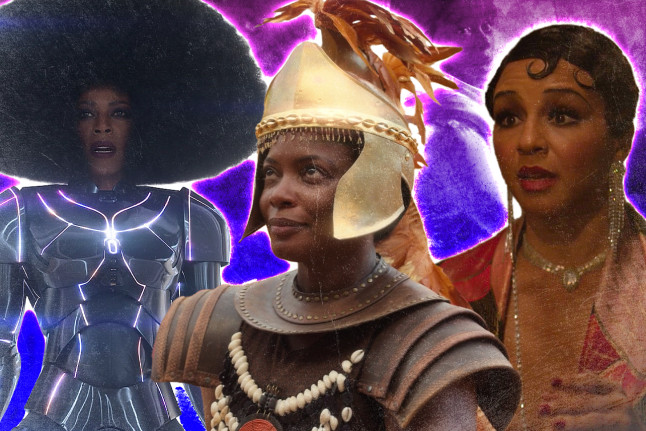
Lovecraft Country and the Great “I Am”

HBO’s Lovecraft Country, based on Matt Ruff’s provocative novel, is not for the faint-hearted. Part sci-fi, part horror, it features savage monsters and a copious spilling of blood. But its plot, its cast, and its exposé of America’s horrific racism are gripping!

One of the characters is Hippolyta Freeman, a brilliant woman adept in mathematics and astronomy. She is also a devoted mother and wife to her late husband George, having worked with him to produce The Safe Negro Travel Guide, a fictional counterpart to The Negro Motorist Green Book.

After George’s death, Hippolyta embarks on a multidimensional voyage of self-discovery. She unlocks the secrets of an orrery, takes the key it offers, then travels to Mayfield, Kansas, the place where George died. There, within an observatory, she finds a machine right of out of H.G. Wells that fits her key. It launches her to what seems like a space ship, where a towering black woman looms above her.

“Who are you?” asks Hippolyta. The woman answers, “I Am.” “Am I in prison?” asks Hippolyta.  “No, you are not in a prison,” responds the woman. “Name yourself! Where do you want to be?”

What follows is a beautiful journey of a soul becoming unbound. Hippolyta first goes to Paris to dance alongside Josephine Baker, letting the sisterhood and bohemian nightlife unwind her. She tastes new freedom, and at first it angers her. She describes it this way to Baker:

“All those years I thought I had everything I ever wanted, only to come here and discover that all I ever was was the exact kind of Negro woman white folks wanted me to be. I feel like they just found a smart way to lynch me without me noticing a noose … Sometimes I just, I wanna kill white folks. And it’s not just them … I hate me, for letting them make me feel small.”

Hippolyta then zooms to a dimension where she learns swordplay, preparing her to command a band of Amazons (fitting given her name). She leads her sister warriors into a savage victory against Confederate soldiers. Finally, she revisits George in a touching bedroom scene, this time confronting him with an awareness that she diminished herself by always putting him and his activities first.

In each of these realms she connects with an essential part of herself, naming it, giving it flesh, setting it free in the constellation of her personality. And each time, what sparks the transition is her acclamation of “I am Hippolyta. I am Hippolyta. I am …HIPPOLYTAAAAAA!” 

Yes! I am!

Discovering the sacred nature of our own humanness is at the core of our planet’s best spiritual teachings. This dawning realization awakens our unique identities. We learn to cast off shackles, employ our gifts, actualize our destinies. It is from this sacredness that we come to cherish and protect the Imago Dei, image of God, in other human beings. Symbolically, this clarity arises as we voice the name of God given to Moses at the burning bush, claiming it for our own lives: I am what I am!

Part of the blasphemy charges leveled at Jesus in the Gospel of John came from his well-known “I Am” statements. We usually translate the Greek words ego eimi as “I am,” but they carry the connotation of “I am what I am.” One of my favorite professors, Herman Waetjen, often said that Jesus was not only intentionally voicing the name of God; he was calling each us to say “I AM” with power and dignity.  

On this level, Episode 7 of Lovecraft County, speaks to all of us in our struggles to rise above the acculturation that clips our wings and does violence to our personhood.

May we all learn to say with Hippolyta, “Now that I’m tasting it, freedom, like I’ve never known before, I see what I was robbed of back there.”

May we all learn to say with Jesus, “I am what I am!”

(For further reading, I wrote a poem called I AM that you might find interesting)

They want to take our God!

Our neighborhood has a Facebook page, and when I saw Republican politics shaping its posts during the 2020 presidential election, I could have ignored it. Instead, I shared this comment about a sign in my neighbor’s yard that I found especially disturbing.

Untitled-1

“One of the things I love about our neighborhood is the presence of our children and youth. We see them playing in the streets, riding bikes, walking to catch the bus. Now they encounter this message: ‘God, Guns & Country.’ Three words strung together as if they make perfect, harmonious sense. I respect freedom of speech, but I keep wondering. What does this teach our youth about the state of our nation? What does it teach them about faith? Powerful words of Jesus come to mind, ‘Blessed are the peacemakers, for they will be called children of God.’”

As expected, I got a flurry of comments. They are familiar but nonetheless chilling.

  • It was Christians that miraculously founded our country, and the Democrats want to cancel that history.
  • What about abortion? The thought of a baby’s neck snapping at nearly nine months makes me sick to my stomach.
  • We have the right to bear arms, especially to defend ourselves against a government that wants to force socialism on us. Leftists will take our guns!
  • The ungodly protests in our country are happening in cities controlled by the Left.

One woman requested a session of private messaging. She asked me to explain what I meant by my post. I told her it would require a longer conversation, but here was the gist:

“There is a brand of American Christianity that believes their god favors our nation more than others. It allies itself with gun lobbyists, calls for increased expenditures on military and police, and turns a blind eye to the nonviolent message of Jesus. 2,000 years ago, Jesus himself challenged the nationalism and violence of his people. These yard signs teach children that God is partial, and that God protects certain Americans by any means necessary, including violence. I believe in a Creator of all peoples, all nations, who ultimately desires unity and peace.”

She responded with a host of internet links cited out of context, including a ranting letter-to-the-editor published online in The Intelligencer: Wheeling News Register. I have to hand it to the author. His words remain a masterpiece of religious bigotry. At his frothing crescendo, he blamed Democrats for divorce, school shootings, riots, rape, unwed mothers, gangs, and the “Sodom and Gomorrah” abomination of same sex marriage.

The woman summed up her position by saying: “The Left is trying to take our God!”

Her abject fear struck me, and I understand the lamentable psychology behind it.

In his Stages of Faith, James Fowler called Stage Three a “Synthetic-Conventional Faith.” It is often enculturated into children and becomes part of their tribal identity. This can be religious faith, adherence to a philosophy, or alignment with a particular political party. People find comfort in belonging to their tribe. When its precepts are challenged, they often lash out in anger and fear. They hunker down and become defenders of the faith, as if their god, their truth, their party needs a champion to protect its fidelity.

Where does this fear come from? Fowler put it this way:

When we are grasped by the vision of a center of value and power more luminous, more inclusive and more true than that to which we are devoted, we initially experience the new as the enemy or the slayer – that which destroys our “god.”

I believe that for a moment, many true believers get a scary, vertiginous view of something grander, something that tugs at the threads of their conviction. Rather than moving forward, mustering the courage to explore and understand, they patently reject this new knowledge and retreat to militant orthodoxy.

If this woman and I had a longer conversation, I would say, “No, we are not trying to take your god. The sanctity of each person’s faith and conscience is sacred. But if you mean that we are lifting up a vision more powerful, more luminous, more inclusive than your tribal deity, I can tell you this:

We will not stop!”

Decolonize Our Minds!

As an investigative journalist, I visited the Navajo Nation in 2018. I went under the aegis of the Presbyterian Church (USA), an institution I served for decades, one that still supports “missions” among the Diné.

A question with profound implications guided me. Given how white Christians historically savaged the Navajo—armed attacks, land stealing, forced relocation to Bosque Redondo, broken treaties, reeducation centers—had my denomination learned from its past? Or (inconceivably!) does it still engage in practices that disrespect the Diné’s indigenous identity?

You can read the article here. It grieved me that one of our supported pastors, a full-blooded Navajo, called traditional beliefs of his people “the work of the Devil.” A young Navajo Park Ranger at Canyon de Chelly put it succinctly as she spoke of Christians in her extended family.

“I have attended their memorial services,” she says, “where the message is loud and clear. Unless I follow this Jesus, I have no salvation on this earth and I’m not going to heaven. I cannot accept that kind of thinking!”

One afternoon, I drove out to Shiprock Peak. In Navajo its name is Tsé Bitʼaʼí, “rock with wings,” alluding to a mythic bird that brought the Diné to their present lands. Along a lonely stretch of desert road, I came upon this deserted building.

Decolonize


Decolonize your mind! To the Dine, this injunction has power and immediacy, a call to resist the forces of European colonialism that are still aflame in white America. But it is also a phrase that challenges each of us.

Why? Because history is repeating itself, not only in my home nation, but in countries around the globe. There are still malignant outposts of racism, homophobia, sexism, and nationalism in our collective psyche. It is especially crucial for any people of a dominant class to understand their systemic biases of privilege and to join with others in tearing these prejudices down. Yes, tearing them down!

As we engage in this work, just watch how the colonial beasts rise up! Here in America, witness a former president still stoking racial fears among his followers, many of whom call themselves Christians. People waving confederate flags, blaming the victims of police brutality, or openly spreading messages of hate. Others who think they are tolerant, but who still trumpet American Exceptionalism and the monopoly of their own brand of faith.

Quite simply, our future as a human family is at stake. We must decolonize our minds.

If you are a Star Trek fan, you remember the chilling assimilation of Jean Luc Picard into the Borg Collective. This reasonable, compassionate, free-thinking human being—sworn to protect life throughout the galaxy—becomes Locutus, a cog in the Borg mind hive.

It’s an enduring metaphor, because all of us can succumb to groupthink. It happens in classrooms where history is taught from the perspective of oppressors. It happens every time the incessant ads of corporations convince us to become more materialistic. It happens when any racial or homophobic slur goes by unchallenged. It happens every time a politician gets us to focus on an external “enemy” rather that the inner foe of our twisted thinking. It happens in houses of worship when spiritual leaders proclaim their truth as the only way. It happens when we toe political party lines—right or left—without carefully examining every tenet.

Now, as always…now, more than ever…we must decolonize our minds. Replace hatred with love, privilege with partnership, intolerance with inclusion!

The Dalia Lama is right: “A spiritual practice is a constant battle within, replacing previous negative conditioning or habituation with new positive conditioning.”

Namaste.

The American Dream Belongs To…

On November 7th, 2012, the day after Barack Obama’s reelection, a cowardly anonymous writer posted some racist vitriol. Not unusual in America. These particular words circulated the internet for years, attributed to various people like Franklin Graham.

I’m embarrassed to admit that one of my extended family members sent the quote to me. It was his reactionary response to what I saw as the positive changes and hope rippling through our nation. I was both pissed off and acutely aware that any reply to my white relative would fall on deaf ears. So, what did I do? I framed them and highlighted a better message! Read the whole quote, then read just the yellow words.

New collage

Growing Wings!

How many times have you heard the advice, Live from a perspective of abundance, not scarcity! It’s a rainbow truth, a call to renewal, the lodestar of many a spiritual teacher. One of my favorites, Wayne Dyer, spent a lifetime liberating people from limited thinking. As he famously said, “Change your thoughts and you change your life!”

The art with any powerful guideline is to apply it daily. This may require a period of painful deconstruction, a dismantling of familial/cultural conditioning that was siphoned into our minds and heaped on our shoulders. In my own life’s trajectory, I have had to unburden myself from two heavy influences.

A HISTORICAL (AND STILL POPULAR) FORM OF CHRISTIANITY: I know many Christians whose theology begins with the essential goodness of Creation. They believe we are created in “God’s image” with an inner core of goodness. Sure, it’s easy to view our world and see how human goodness has mutated – obscured by greed, power, lust, and self-centeredness. We can even say that our planet is poisoned by the presence of our species.

But does this negate the essential nature of our souls? Does it deny the inner presence of healing light within each of us? Don’t we need spiritual leaders who remind us of our inherent beauty, not our ugliness?

The Christianity I grew up with—a faith practiced by millions—focused on “the fall” of humanity, repeating its incessant mantra that we are born sinners, we remain sinners, and that we need a savior for our redemption. Many churches claim to celebrate victory—the past is gone, the new has come—but it is only because an external character, Jesus of Nazareth, “paid the price” for their freedom.

My daughter calls this an “outsourcing of authority.” I agree with her. It’s a clear message that we are fundamentally flawed, lacking the inner fountain of life that will set us free if we take the time to release it. Too many institutions (including historical Christianity) have trafficked in doctrines that prescribe, control, and limit. We ALL know what can happen when we cede our power to others.

I raise a different banner. We are unique and wondrous beings! We hold within us the keys to our enlightenment. It may take many years to peel back the layers of acculturation that mask our divine identity. It may require herculean focus to overcome and release our self-destructive habits. But the effort is worth it!

Bestselling novelist and feminist theologian Sue Monk Kidd, who did the hard work of emerging from theologies of scarcity, says it beautifully with her own set of metaphors.

“Here is where our real selfhood is rooted, in the divine spark or seed, in the image of God imprinted on the human soul. The True Self is not our creation, but God’s. It is the self we are in our depths. It is our capacity for divinity and transcendence.”

THE DISEASE MODEL OF RECOVERY.  A Twelve Step group helped me rise from the ashes of addiction. For this, I am eternally grateful. I enjoyed the no-bullshit atmosphere of people who had experienced the bottom and were now increasingly grateful for life.

However, there’s a moment at the beginning of each AA meeting that makes me cringe. A member reads from their “Big Book,” including this phrase: “We are like men (sic) who have lost their legs; they never grow new ones.”

Read that again. Whoa! What a crippling declaration of scarcity and woundedness! I have a heartfelt response to this cursed phrase.

I am not an amputee. I am not a prisoner of my disease. I am a man who has realized a stunning new power and freedom. I am flawed, certainly, but the spiritual process of my daily growth has revealed this metamorphic truth: I am not only growing new legs; I am growing new wings.

I urge you to transcend ANY familial, societal, or religious notion of scarcity that is holding you down. If a person or institution is communicating that “you are not enough,” shed those lies starting now.

A friend, colleague, and co-author of mine – Heiwa no Bushi – offers these words in our collaboration entitled The Six Medicines of BodhiChristo (downloadable here).

“What were you before you were told everything that you are now? Can you uncover the sacredness of your own humanness? Many of us never have the chance to discover this. We are born with a name that is not our choosing, then christened or baptized into a tradition that makes us one of ‘them.’ We are told that ‘this is what a real man does,’ or ‘this is how a real woman should act.’ The problem is that many of us have been so deeply assimilated into ‘the code’ that we don’t know we have become part of the problem.”

I pray we will ALL learn to extricate ourselves from any code or conditioning that weighs us down or obscures our essential identity. I pray we will ALL learn to soar!

Unsung? Not Today!

26240433_10211465630985460_9215734007543031285_o
I first heard the word “elegy” in a high school class called Great Books. Our teacher, Bill Cole, introduced us to Thomas Gray’s beloved poem from 1750: Elegy Written in a Country Churchyard. The poet wanders among gravestones, pondering the unsung virtues of people who lived and died in obscurity, summed up in these beautiful verses.

Full many a gem of purest ray serene
The dark unfathomed caves of ocean bear:
Full many a flower is born to blush unseen,
And waste its sweetness on the desert air
.

I have a deep affinity with those outside the limelight, people faithful to the values they cherish, fighting their version of the good fight, running their courses with courage and fidelity. During my three decades as a pastor, I gained privileged admittance to their inner circles.

An elegy is too somber on this Father’s Day, 2021. Instead, I offer this tribute to unsung fathers everywhere. Your love and labor may go unnoticed, but your character matters in the lives of your loved ones!

I had a powerful experience this week. I sat and read the entirety of my father’s memoirs, notes begun in 1950. It’s a remarkable odyssey. He grew up on a Wisconsin farm during the Depression with no running water or electricity. Decades later, he would rise to be a key player in America’s Apollo Program, then serve as the CFO of a multinational corporation.

It’s not his stellar career feats that I celebrate this morning. It’s a moment captured in these words from 1957. I was 16 months old.

I’m writing this about 9:30 p.m. after watching a program on our 21-inch TV. Marilyn has gone to a church meeting and Krin is sleeping. I can hear the hum of the refrigerator in the background and smell the blossoms of the orange trees from the grove just in back of our house.

Why did this memory move me so deeply? Because it captures a father at home with his sleeping child—ME! —keeping vigil. In the ensuing years, my Dad would sacrifice family time for work, an issue we resolved long ago in our loving relationship. But this moment in 1957 reminds me of his steadfast presence in my life.

All you fathers know what I mean. Changing diapers, braiding hair, helping with homework, reading books, cooking, paying bills, chauffeuring, listening, doctoring scrapes and bruises—all the small things that sum up faithfulness on a daily basis. You’re the best!

I also give a shout out to my ex father-in law, Don Oseid, who died many years ago. He consistently nurtured my interest in writing, acting as a mentor and second father. I remember one evening when he came to me holding an anthology open to a particular poem. It was Those Winter Sundays, by Robert Hayden, the first black American to serve as Consultant in Poetry to the Library of Congress, a title now changed to Poet Laureate.

You can read the entire poem here, a son remembering how his father, after a week’s hard labor, got the fires blazing on Sunday mornings, even polishing his son’s shoes. The final words speak volumes.

What did I know, what did I know
of love’s austere and lonely offices?

To all you fathers who inhabit these offices, remaining faithful to the daily tasks of loving your children, I say…

Thank you and happy Father’s Day!


The Middle of Nowhere

Rowena collage

On a lonely stretch of highway north of San Angelo, Texas, my wife Donna pointed into the distance.

“Look at that steeple,” she said.

It rose above a smattering of low-slung buildings, its elegance out of touch with its nondescript surroundings. We love impromptu detours in our travels, so I said, “Let’s check it out!”

As I turned, a faded marker welcomed us to Rowena, Texas, clearly a place long past its prime. Shuttered businesses lined the main street, signs faded with age and neglect. No tourist attractions here—just a dusty, forgotten pitstop.

Then we came to the sharp contrast of St. Joseph Catholic Church. It was immaculate, every brick and painted surface reflecting a pride of ownership. Catholic parishes, unlike their Protestant counterparts, often leave their doors open during the day, so we parked and walked inside.

The interior gleamed, stained-glass reflections slanting across the floor and pews. In the center aisle, an elderly white man, his head bowed, was conversing with a younger man who looked Filipino, dressed in shorts and sandals. I doffed my cap in respect and detoured around them towards the altar.

I tried not to eavesdrop, but the gentlemen’s voices carried in the acoustically sensitive space. I couldn’t make out the older man’s words, but the younger man’s voice was unmistakable. As he listened to his elderly companion, he replied with gentle phrases. I understand…It’s going to be OK…I’ll help you take care of everything.

I noticed Donna edging closer to the men, which made me a bit uncomfortable. I exited out the back, sat in our truck, and while I awaited her return, I googled Rowena.

Texas land developer, Paul J. Baron, platted the township in 1888, naming it Baronsville. German and Czech settlers convinced the Post Office to rename it Rowena in 1904 after the wife of a local businessman. Rowena reached its population zenith of 800 in 1930. Today it has less than 500 residents.

I also discovered that Rowena was the birthplace of Bonnie Parker, born in 1910, living there until her father died and her mother moved her to an industrial suburb of Dallas.

With both windows open, noisy grackles in the trees, I glanced right and left along nearby streets: abandoned buildings, rusty cars, old farm equipment, pavement ending quickly as if dissolving into the earth. I thought of how historical figures often rise up from the middle of nowhere. This time, a woman whose crime spree of 100 felonies with Clyde Barrow became legendary, and whose death at age 24 in a fusillade of bullets is seared into our national psyche.

Donna snapped me back from my daydreaming as she opened the passenger door.

“That was so touching,” she said.

“What?” I asked.

“Those two men,” she said. “It was the priest talking to one of his members. That old man lost his wife of 69 years just a couple days ago. Due to COVID-19, he had not been able to see her at her convalescent home for a couple months. But they finally let him back in and he was with her when she died. He and his wife lived here in Rowena their entire marriage. I just wanted to hug him!”

69 years of dreams, joys and sorrows, a wealth of memories lived out in a place that, to me, seems so remote. A loving, sensitive priest, giving honor to his post in obscurity.

“I told the priest how beautiful the church building is,” said Donna. “He pointed east and said there’s another one about 10 miles down the road.

“In the middle of nowhere,” he said.

What Do You Expect?

Too many of us traffic in half-truths to our own detriment. We find a sensationalized headline or social media misquote, then use it to wield our worldview. We cling to worn out creeds without challenging their relevance on a regular basis.

Half-truths stymie our maturation. Kudos to those who are willing to dig deeper and find the truest version of the truth?”

Consider this motto that is central to the recovery movement: Let go of expectations, because today’s expectations are tomorrow’s resentments.

In many ways, this is only half true. We all have legitimate expectations. In my life:

  • I expect justice, and when I see racist brutality in our country, I will vehemently protest and work for change. The death of my expectation for justice would equal the death of hope.
  • I expect my wife to meet me halfway in the partnership of managing our home and raising our specials needs son. This is our contract of love.
  • I expect my closest friends to be interested in my life, just as I am in theirs. If they remain self-centered, I will choose to spend less time with them.
  • I expect performance from collaborators on a project. If they slack off, I will likely not work with them again.

Having said all this, I know that expectations can also become attachments leading to grief, anger, and resentment. It happens in my life when:

  • I expect certain behaviors from others even though history teaches me otherwise. This is especially hard when I long for understanding or acceptance from certain members of my extended family.
  • I expect an external factor—some accomplishment or acquisition—to give me lasting happiness, leaving me ripe for disappointment.
  • I expect a response from my Higher Power (God, Spirit, Tao) on my timetable, ignoring that waiting is a potent part of spiritual growth.

Ultimately, learning what to expect and what to relinquish is an art, summed up perfectly in the Serenity Prayer. God, grant me the serenity to accept the things I cannot change, the courage to change the things I can, and the wisdom to know the difference.

Letting go; this is key! In my collaboration with Heiwa no Bushi called The Six Medicines of BodhiChristo (downloadable here) I share the following.

Siddhartha (the first Buddha) didn’t believe in a personal soul or deity. He held to a pattern of thinking and behavior now called The Middle Way. It strikes a balance in eight different areas: our viewpoints, intentions, speech, action, livelihood, effort, mindfulness, and concentration. The Buddha offered these teachings and disciplines to help others avoid the extremes of thought or behavior that cause us to suffer. This path helped his followers let go of habits that kept them shrouded in darkness.

Here is a description of The Middle Way from Ajahn Chah, a revered Thai Buddhist who died in 1992. It may seem odd to Western minds, but let the analogy unfold.

If we cut a log of wood, throw it into the river, and it doesn’t sink, rot, or run aground on either bank, it will definitely reach the sea. (The Middle Way) is comparable to this. If you practice according to the path laid down by the Buddha, following it straightly, you will transcend two things. What two things? Indulgence in pleasure and indulgence in pain. These are the two banks of the river. One of the banks of that river is hate, the other is love. Or you can say that one bank is happiness, the other unhappiness. The log is our mind. As it flows down the river it will experience both happiness and unhappiness. If the mind doesn’t cling to either, it will reach the ocean. You should see that all emotions and thoughts arise then disappear. If you don’t run aground on these things, then you are on the path.

Because we have not learned to let go of extreme thinking and behavior, our minds are often unsteady. We carom from one fear or preoccupation to another, crashing into the banks of our old, seemingly deterministic modes of living. Every collision is detrimental to our well-being.

Letting go starts as a simple process in our daily lives, but it progresses to ever-deepening levels. Eventually, we encounter deeply rooted resistance that, nonetheless, still invites us to let go. Here are a few examples.

  • Fear: For some of us, the “devil we know is better than the devil we don’t know.” Even if we see the allure of a new life—an azure lake on the horizon of our desert—we have become accustomed to our unhealthy habits. In a sick way, they provide a level of comfort, even if this comfort means sacrificing our freedom.
  • Trust: If we have been hurt in life, or raised in families that were chaotic or dysfunctional, truly trusting anyone or anything is hard. If we let go into a new lifestyle, will the arms of safety be there to catch us? Is our chosen pathway trustworthy? One woman remarked that in her estimate, “God” had never been there for her during difficult times in her life. Why would “God” suddenly show up now?
  • Laziness: Yes, laziness. We realize that applying this medicine will take effort and vigilance. Though others have told us it will get easier over time, we wonder how long it will take. If we submit, what are we getting ourselves into? It takes less energy (lie!) to remain stuck.
  • Deep woundedness: Some of us have experienced trauma that is hard to overcome. We need more thorough counseling from an expert to help us extricate ourselves. This can be especially true for those of us who grew up in families that shamed us. Shame is a deep and toxic response. Like any other conditioning, it can be released, but it helps to seek the guidance of a counselor, mentor, or spiritual guide. Learning the origin of our shame helps us transition to a life of trust and affirmation.

As we release our worries on a daily basis, consider this quote by Richard Rohr from his book The Art of Letting Go: Living the Wisdom of Saint Francis.

Authentic spirituality is always on some level or in some way about letting go…letting go of our false self, letting go of our cultural biases, and letting go of our fear of loss and death. Freedom is letting go of wanting more and better things, and it is letting go of our need to control and manipulate God and others. It is even letting go of our need to know and our need to be right–which we only discover with maturity. We become free as we let go of our three primary energy centers: our need for power and control, our need for safety and security, and our need for affection and esteem.

How about you? What are your expectations? Are they legitimate expressions of your hopes, dreams, and personal dignity? Or, are they attachments causing you to suffer?

Namaste!

Slow Dissolve

It happened on a trail at Big Bend National Park.

I sat down to drink some water and soak in the panoramic view of rock spires reaching to the clouds. As my breathing slowed and my heart settled in my chest, a great stillness and serenity descended over me. Just a whisper of wind in the junipers punctuated by the distant shriek of a hawk.

There are those moments, far too infrequent, when we pass fully through the veil of the present and let it teach us its mysteries. As I sat there absorbing a landscape carved over billions of years, the mental and spiritual pollution of human society began to fade away.

Slowly dissolving…

The trappings of modernity. Plastic bags, plastic smiles, laugh tracks on sitcoms, tickers of every world stock exchange. Social and unsocial media. TV ads, phone apps, Wi-Fi signals. Parasitic technology that consumes our time and spirit.

Slowly dissolving…

Our human divisions of race, religion, class and gender. Creeds and doctrine that separate us. Crosses, grenades, and crusades. Barbed wire, border walls, and the barriers within our hearts. The dueling dualities of partisan politics and their currencies of greed and corruption.

Slowly dissolving…

The most stubborn vestige, my emphasis on Self, the definitions and attachments of identity. Hamster wheel worries and obsessions. My trafficking in words. The Ego gasping for air as it sank away.

Slowly dissolving…

An even deeper stillness enveloped me, a primordial wellspring of time and place, until I felt merged in kinship to our ancient ancestors. Those who raised their faces to the heavens from Olduvai Gorge, or the original people of Big Bend, hunter-gatherers of the Folsom culture.

For a few moments they were gazing with me into the mysteries of eons.

Silence…

Stillness…

Wonder…

A form of communion so rare in daily life…

Sharp peals of laughter from the trail below snapped me from my reverie.

The Unspiritual Spirit

A Buddhist gardener risks his life to remove creeping foliage from the pinnacles of Angkor Wat. He believes he is protecting spirits that live within the temple.

A Catholic man, one of 242, lifts the 11,000-pound throne of Virgen de la Esperanza, parading it through the streets of Malaga, Spain on Holy Thursday. He endures the pain because, “Life has no meaning without going out under the Virgen.”

An initiate at China’s Shaolin Temple practices Monkey Stick routines and memorizes scripture, hoping to be ordained as a Kung Fu warrior monk. His goal is to reach enlightenment.

A young Palestinian man volunteers as a paramedic at Al-Aqsa—the Dome of the Rock—during The Night of Power, Ramadan’s crescendo. By caring for those who have collapsed in the crushing crowds, he seeks to prove himself to Allah.

These religious practices come alive in the PBS documentary series, Earth’s Sacred Wonders: Closer to the Divine. As my wife and I watched the episodes, we marveled at the color and passion of our human family. We have so many rituals, prayers, and disciplines born of our desire to understand the mystery surrounding us. The forms are as diverse as the plumage on our planet’s species of birds!

I try to respect faith expressions no matter how foreign they seem to me. This has become increasingly difficult in America, where a brand of Evangelical Christianity undermines women’s reproductive rights, contributes to prejudice against the LGBTQ+ community, clings tenaciously to the National Rifle Association, and promotes a dangerous brand of nationalism. All in the supposed name of Jesus, the Prince of Peace. Que lastima!

All that aside, there are still many beautiful expressions of what we call spirituality in our world. I continue to try and cultivate my own awareness. And in this journey, I often think of these words by T.S. Eliot from Little Gidding, the final of his Four Quartets.

We shall not cease from exploration
And the end of all our exploring
Will be to arrive where we started
And know the place for the first time.

For me, this knowing, this waking up, is more than just living in the moment. It is an awareness that Presence, Tao, Spirit, God—whatever term you use—surrounds us with love, encouragement, and serenity. It is like inhaling sustenance and light, letting our Source heal us in the deepest recesses of our spirit.

As soon as we start dissecting this experience, giving it names and developing disciplines to grasp it more fully, it can easily slip away. Seeking the “spiritual” often buffers us from Spirit. In the Tao Te Ching, we find these words:

The Tao that can be told is not the eternal Tao;
The name that can be named is not the eternal name.

The nameless is the beginning of heaven and earth.
Ever desireless, one can see the mystery.

How hard this is for human brains that want to categorize and control!

Could the end of our explorations really be here, right now? Is it ultimately so simple, so obvious? I believe it is. And this awareness can infuse every task with new meaning. The late Thich Nhat Hanh said this about his fellow community members at Plum Village, the monastic community he founded in southwest France.

“When we wash dishes…it is to live every minute of the washing. Wash each bowl…in such a way that joy, peace, and happiness are possible. Imagine you are giving a bath to the baby Buddha. It is a sacred act. I have arrived. I am home. Through these two phrases, you can experience a lot of joy and happiness.”

Eliot’s words are probably true. We will not cease from exploration. We will continue to invent elaborate rituals designed to find the One. We will grind out volumes of theology, debating the nuances of our beliefs, while the present moment slips past us.

But what if, sooner than later, we discovered we are already home?