Five to Seven Days: Lost Maples State Natural Area, 11/9/17

One in water“Five to seven days,” says the park ranger,
a time for peak foliage,
autumn leaves in their nova.

So brief…so limited…
like a Monarch’s sole migration,
or a sunset lost at sea,
or my daughter’s first breath,
her tiny fist held in my grasp.

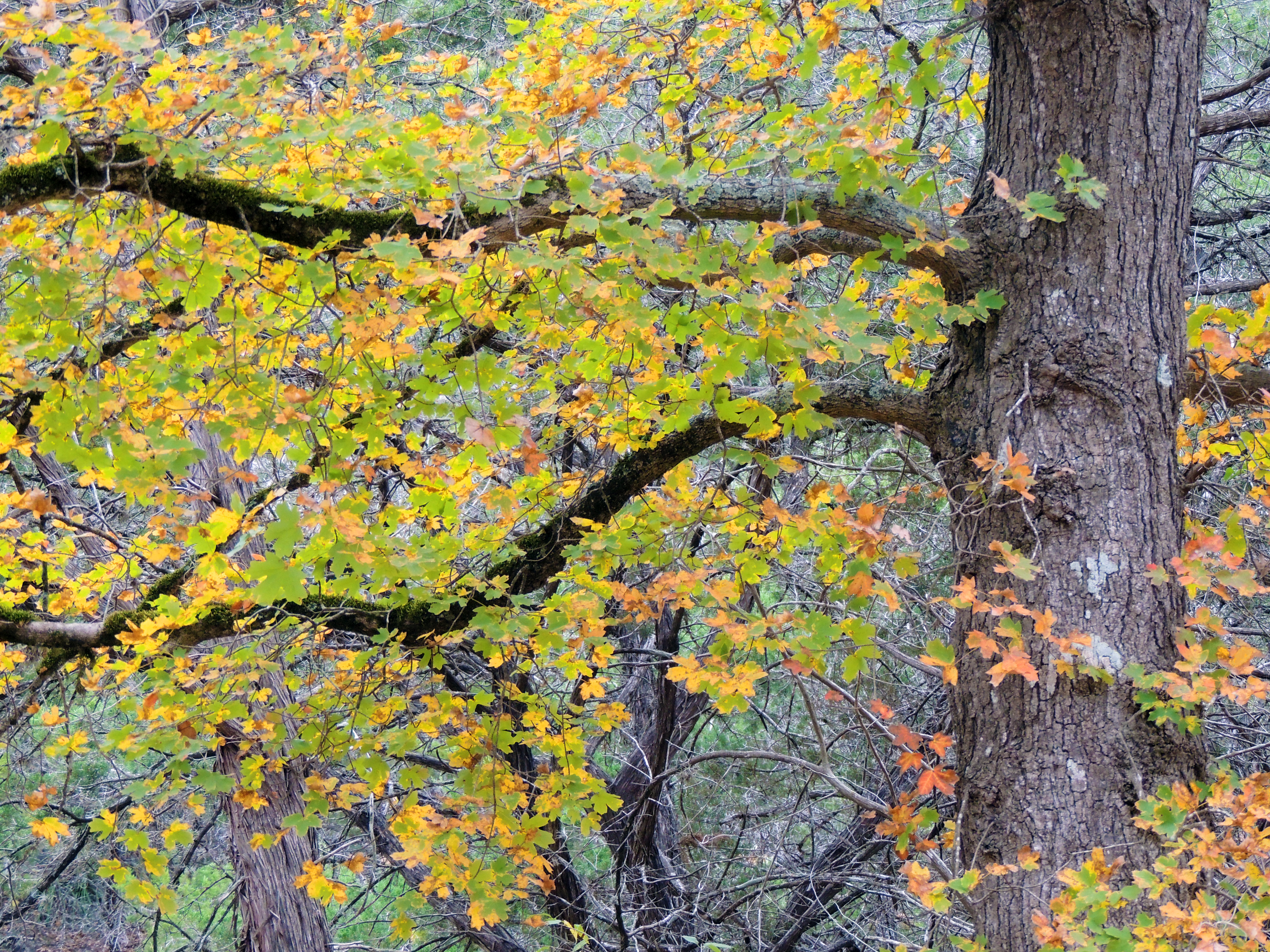
Still…Trunk and leaves
five to seven days, repeated
season after season,
eon after eon,
like Monarchs over virgin continents,
sunsets on primordial waves,
or the cry of the human species
from a cradle endlessly rocking.

“Five to seven days,” I whisper to myself.Single Tree

So brief, yet eternal,
like my life…
like yours.

In memory of Linda Evans, who died far too early of brain cancer on the morning of Thursday, November 9, 2017 – Requiescat in Pace

A Medal for Two

“There must be acceptance and the knowledge that sorrow fully accepted brings its ownMedal for Two photo gifts. For there is an alchemy in sorrow. It can be transmuted into wisdom, which, if it does not bring joy, can yet bring happiness.” – Pearl S. Buck, from The Child That Never Grew, written about her daughter with Down’s syndrome.
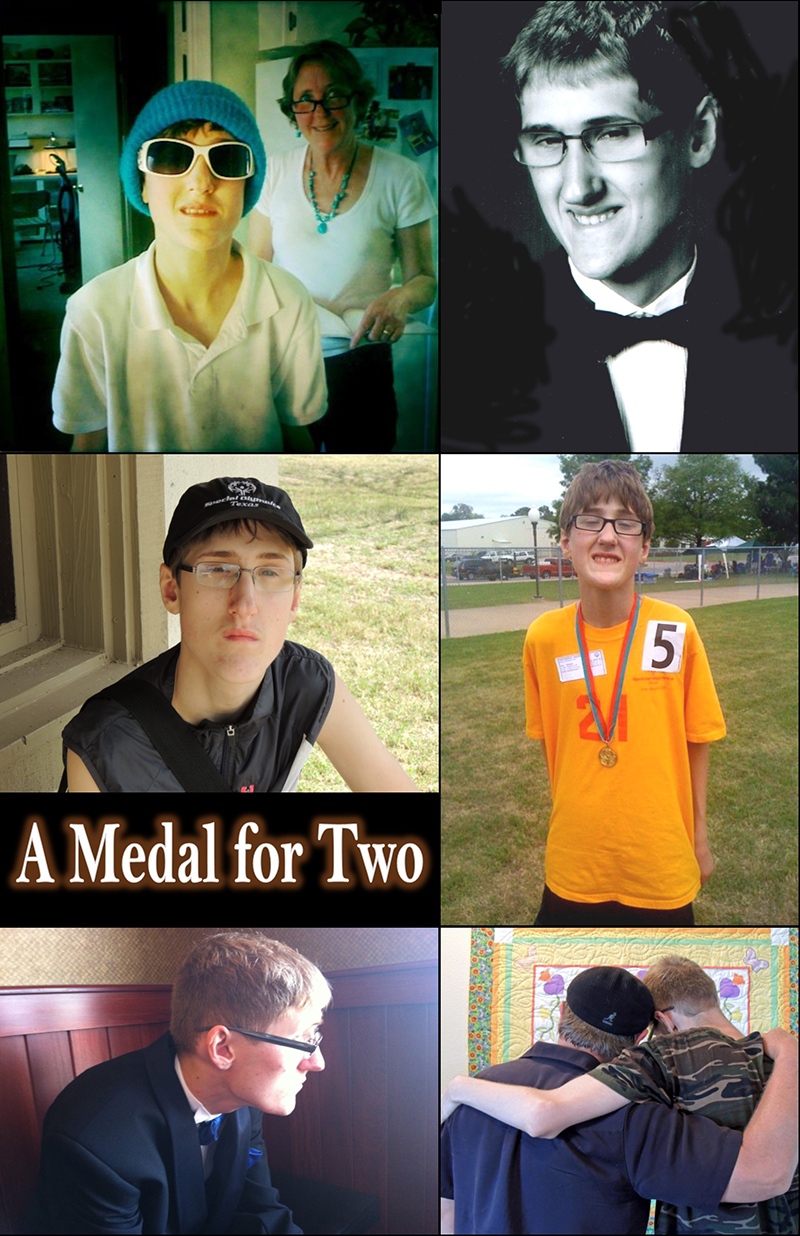
It’s the track and field regional finals of the Special Olympics. The stadium at the University of Texas, Arlington, is electric with the shouts of friends and relatives. An army of compassionate volunteers crowds the field, lining up runners, tracking the winners, cheering contestants in the spirit of the Special Olympics motto: “Let me win, but if I cannot win, let me be brave in the attempt.”

I watch as these cheerleaders position themselves at the finish line of the 100 yard dash, one for each lane. When the gun sounds, they focus raptly on their athlete; for just a divine moment, that boy or girl, man or woman is the most precious human being in the arena.

The diversity is amazing, from preteens through adults, spanning a wide gamut of impairments. We shout our encouragement for all of them, especially a young man in his late 20s. Left in the wake of his peers, he jerks, not walks, towards the tape, his arms clutching a Woody doll from Toy Story. In any other setting his painful progress might be pitiable. But this celebration of life meets him with thunderous applause.

Parents are supposed to remain in the stands, but as the time nears for my son, Kristoffer, to compete, I rebelliously slip onto the field. Smiling like a seasoned volunteer, I elbow my way to the end of his lane. I can see him now, tall and lanky, lane four in a heat of boys that look much stronger, much more substantial than he.

Like most parents, my adrenaline is pumping, nerves on edge. The gun sounds, and with that flash of noise, my mind transports back to Kristoffer’s birth…

October 22, 1997. Even as he emerged for his first breath, it was obvious: Kristoffer was different. The nurses cast surreptitious glances at each other and the doctor, then pasted on smiles for public consumption. But the masks had slipped and I’d seen beneath them. I’d glimpsed the looks of compassion and pity.

Facing the reality that you have a “special needs” child carries all the hallmarks of grief. Denial is pervasive as you await a diagnosis. Kristoffer’s condition was not a known syndrome, which number over 750. He has a chromosomal translocation. I saw the dyed sets of his DNA, the blueprint for his life, so infinitesimally close to symmetrical. But there it was – that microscopic smidgen of genetic material that had broken off one side and attached itself to the other.

It made all the difference.

When the reality started settling in, I felt a wave of grief. I agonized that my child would not have all the possibilities of an “ordinary” life. As a Presbyterian pastor, I tried to buffer this grief, aware of a great paradox within me. The clarion call of my preaching is that the last will be first, and that ultimately the meek will inherit the earth. I have urged others to love outsiders, aliens, the disenfranchised. I have also seen firsthand that children with all their mental capacities are born every day into crushing poverty, intolerance and bloodshed.

But the litmus test of truth, the intimacy of grief, was now mine, and all the glib answers of my preaching failed me. I gave in to what I felt was a selfish reaction. My son would never receive a degree, let alone graduate cum laude. He would never walk the halls of power. He would never discover a scientific breakthrough, play in Carnegie Hall, or step to a podium to give a lecture. He would never start his own business, write a book, or excel in a recognized art.

Heck, I realized he might never learn to talk or read, make friends, or find a suitable woman to share his life with. And work? Where? At a Goodwill Store? Bagging groceries at a sympathetic Safeway? Sweeping floors at a State-run group home?

The geneticist wasn’t encouraging.  With the bedside manner of an IRS agent in need of retirement, he gruffly informed us that the prognosis was very guarded. Kristoffer might have to communicate using pictographs rather than words. Of special concern was the lack of a soft spot on his head, which was already on the border of microcephaly. If his skull did not expand to accommodate brain growth – a condition called craniosynostosis – he would require multiple bone-splitting operations and a plethora of stints.

Donna and I listened in numb silence. At that stage of my life, I was a worrier, conjuring every possible disaster. Though I preached Jesus’ famous “Do not worry” passages from the Sermon on the Mount, I too often succumbed to fear. Donna, on the other hand, cut off dreaded thoughts before the tentacles developed, not because she had learned the art of letting go, but as a survival tactic. She’d been down so many times in her life that she just soldiered on. Somehow we balanced each other.

We needed that balance desperately as we walked through this valley together. I learned to let the expectations of normalcy be cremated in my mind. From the smoke emerged Kristoffer James Van Tatenhove, son of my loins, one of the loves of my life. I began to “Father” him as best I could, slowing down to communicate at the most elemental levels. I began to walk through the grief by walking closer to him.

For personal reasons, I had taken a break from being a pastor. However, I still assisted in mission and outreach at the First Presbyterian Church of Palm Springs, California

God knew we needed that congregation and put us there at just the right time.

Let me explain. In my decades of ministry, I have grieved for people who endure trials in this life without a community of faith to support them. The Palm Springs church wasn’t perfect; it had its own history of divisions and conflict. But they knew how to love us when we craved it the most.

One Sunday fresh after Kristoffer’s diagnosis, I tearfully asked for prayers for our family. The pastor, Jim Griffes, called the four of us – Donna, Kristoffer, my stepson, Keenan, and me – to stand in the center of the sanctuary near the Communion Table. He then called one of the elders, Jayne Humberger, to come forward and lead a laying on of hands.

Jayne was barely five feet tall and carried a lot of extra weight, but when it came to intercessory prayer, the woman was a lightning rod for the Spirit.

I held Kristoffer in my arms as the rest of the congregation flooded unabashedly down the aisles to gather round us. It was a circle of love, the communion of saints, and for the first time in months, I could feel the tightness in my chest begin to dissolve.

I don’t remember Jayne’s exact words as she laid her hands on Kristoffer’s head. But here is what they meant…

Loving God, you are the Great Physician, and anything is possible for you.
…We have heard the human prognosis, now we pray for a miracle.
…We know how much you love Kristoffer; we know you had a plan for his life even while he was in his mother’s womb. Make that plan clear to all of us.
…Most of all, we pray for your will to be done in this family, so that every trial they face will be shaped by your love and grace as a testimony to the world.
…Give them peace, God, not as the world gives, but only as you can.

What constitutes a miracle? Each of us will answer that question for ourselves. But I left that service in a miraculous state of mind, full of conviction that God did indeed have a plan for my son, for me, for our entire family.

This certainty was cemented later in the week as I saw Simon Birch, the film adaptation of John Irving’s A Prayer for Owen Meany. Simon goes to ask a critical question of his pastor. With his stunted growth and obvious disability, he enters the pastor’s study, plops down on the other side of his desk, and speaks.

Simon: Does God have a plan for us?
Rev. Russell: I like to think He does.
Simon Birch: Me too. I think God made me the way I am for a reason.
Rev. Russell: Well, I’m glad that, um, that your faith, uh, helps you deal with your, um…you know, your, your condition.
Simon Birch: That’s not what I mean. I think I’m God’s instrument – that He’s gonna use me to carry out His plan.

Later, when Simon gets discouraged, he goes back to the same pastor.

Simon: I want to know that there’s a reason for things. I used to be certain, but now I’m not sure. I want you to tell me God has a plan for me, a plan for all of us. Please.
Rev. Russell (Finding it difficult to respond with a good answer): Simon…I can’t.

I remember feeling infuriated at that pastor for his lame excuse of a faith. If he had been an actual character with offices nearby, I would have stormed through his door with a stream of invectives. For myself, I clung fiercely to my belief that Kristoffer would exceed the doctor’s predictions. I vowed once again to have the patience and courage to seek out and nurture his gifts, no matter how small. I would help him carve out a unique future despite his limitations!

The spirit is willing, but the flesh is weak. Patience has never been my strong suit. Anyone who knows me will attest to that fact. As I tried to teach Kristoffer basic life skills, my frustration would quickly peak. It was so hard to separate the strands of what was happening. It still is. How much of his learning difficulty was due to his condition? How much was due to his stubborn lack of applying himself? How hard could I push him? How would Donna and I balance our parenting styles? She was prone to over-protection; I was driving him, intent on helping him make the most of himself despite his disability.

Meanwhile, life happened. Like so many other parents around the world, we adapted to the daily realities of our new family constellation, many of which were stressful.

  • Visiting specialists to help with Kristoffer’s slurred speech.
  • Confronting schools so they would not shelve him as hopeless.
  • Searching for friends would who would overlook his disabilities and provide some sense of normalcy.
  • Calming him at night as he cried out in his sleep, always at the crescendo of some crisis he could never articulate.
  • Helping him interpret the onset of sexual feelings with realistic expectations.
  • Gently leading him to basic self-sufficiency while others kids his age were preparing for college.

But there were also the surprises of joy.

  • His vulnerable and fresh way of living in the present.
  • The unexpected hugs he gave to people in churches I served.
  • His impulse to give you a kiss on the cheek when you needed uplifting the most, led by uncanny intuition.
  • His gentleness with other children.
  • The discovery that though he was academically limited, he was nearly an autistic savant when it came to playing XBOX games.

Again I ask you, what constitutes a miracle?

It is now 2017 and Kristoffer has far surpassed that original grim diagnosis. Sure, he can only read at a limited level, but his receptive language – what he understands from others – is nearly at par. He communicates much clearer than we ever hoped for. Recently he graduated from high school and attended the senior prom, milestones we had only dared to believe would occur. He is currently engaged in job training, and his supervisors are hopeful that he will find gainful employment.

But to me, the greatest miracle is how Kristoffer has brought acceptance to our family: acceptance of him, acceptance of others, and acceptance of our own inadequacies. It is deeper and more powerful than resignation. It is that life-affirming acceptance of sorrow that Pearl S. Buck spoke of. It is that acceptance that Kubler-Ross so aptly described as the resting place at the end of grief. And though it may not impart joy, it does pave the way for a new happiness and wisdom.

So, for any of you reading this, I urge you to consider acceptance as a foundation for your life. Listen to these words recorded in one of the stories of AA’s Big Book.

Acceptance is the answer to all my problems today. When I am disturbed, it is because I find some person, place, thing, or situation—some fact of life—unacceptable to me, and I can find no serenity until I accept that person, place, thing, or situation as being exactly the way it is supposed to be at this moment. Nothing, absolutely nothing, happens in God’s world by mistake. Until…I accept life completely on life’s terms, I cannot be happy. I need to concentrate not so much on what needs to be changed in the world as on what needs to be changed in me and in my attitudes.

May I make a few suggestions?

  • If you’ve been focused on trying to change someone else, accept them as they are and see how freeing it is.
  • If you have a heavy load caring for a spouse or parent who is gravely ill, accept the task as a temporary privilege and see how your outlook changes.
  • If you are agonizing over a failure in your past, accept it now as exactly what you needed to shape who you are today.
  • If you are facing an illness of your own, accept the care of physicians, friends, and family. Let God redeem the moments of this precious day you’ve been given.
  • Most importantly, accept the love of God, to whom you are infinitely precious. Let our Creator’s inexhaustible grace give you the peace of self-acceptance, the peace that passes understanding.

Back to that day at the Special Olympics…

Kristoffer is racing towards me, his ungainly legs now striding like a gazelle. Will it be enough? I look to his right and left and it’s impossible to see who is leading. Suddenly I want him to win so badly it’s like an ache in my bones. I want it as vindication, as a justifiable revenge. It unsettles my soul. But just as quickly, the motto of the Special Olympics fills my mind: Let me win, but if I cannot win, let me be brave in the attempt. With a deep breath, I let go and revel in the celebration of life unfolding before me.

Ahhh, my son, my brave son, who has taught me the gift of acceptance, who has blessed me with a new knowledge of being human. Kristoffer, you will always be a winner to me.

He breaks the finish line and I give him a huge embrace.

“Way to go, Kristoffer. That was awesome! You’re the man!”

One of the volunteers takes him from me and moves him towards the ongoing awards presented after each heat. I stand to the side and watch as Kristoffer nears the daises for Bronze, Silver, and Gold. I have no idea how he finished. I am simply basking in the joy of this event that elevates the dignity of being human.

They announce the results for his heat. The Bronze, the Silver…

“And for the Gold, Kristoffer Van Tatenhove.”

He bends down to accept the medal and as he straightens up his eyes search the crowd and lock onto mine. I don’t know who is prouder, him or me. I snap a picture that is now enshrined in my heart.

It’s a medal for Kristoffer. And in ways that are still being revealed, it’s a medal for his Dad as well.

 

Drop the President from 10,000 feet? Really?

Yesterday, a leader in the Presbyterian Church (USA) posted something on Facebook he thought was cute. While on a tour of Washington D.C., the guide mentioned that things were in place for the President’s arrival by helicopter. The guide said that Trump would drop in between the White House fountain and the White House. My Presbyterian brother asked if we could drop him from 10,000 feet. Reportedly, the bus erupted in laughter.

I commented, “Interesting that we live in a culture where someone can joke about killing the president and others just laugh.” He replied, “When the President is a joke, what do you expect?”

What do I expect? Damn good question!

I expect us, as followers of the Prince of Peace, to model something different. I expect us to discipline our tongues as Jesus’ brother James admonished. I expect us to have an allegiance that goes far beyond the corrosive division spreading like cancer in our nation.

I do not support Trump. I am opposed to his policies on the environment, immigration, and health care. I won’t even get into examining his character revealed in one tweet after another. I am working locally and internationally to counter his Administration’s policies.

But his election has had a curious effect on me. Rather than radicalize me, it has drawn me further into the center. Why? Because like never before, I see the toxic underbelly of what we call the “progressives movement.”

It’s too easy to traffic in memes about peace and justice. It’s too easy to fly a banner that quotes Gandhi’s, “Be the change you want to see in the world.”

The real test is to live it out. I have been listening and watching, and here is what I see. We progressives can be just as controlling and insistent about our world views as any fanatic on the right. Our comments, like the one I mentioned above, can be just as incendiary as right-wing bigots. We call for others to repent of their racism, classism, and homophobia, but fail to remove the planks in our own eyes, thus contributing to the disease eating America from its core.

I’ve been guilty of it myself, and I am sorry.

A few weeks back I linked to an article by David Brooks in the New York Times. Here’s an excerpt.

“Some people treat the Trump White House as the ‘Breaking Bad’ serial drama they’ve been binge watching for six months. For some of us, Trump-bashing has become educated-class meth. We derive endless satisfaction from feeling morally superior to him — and as Leon Wieseltier put it, affirmation is the new sex.”

I’m going to work on recovering from my addiction to political controversy and polarization. I can only hope that my other brothers and sisters who are Christian leaders will do the same.

Look! A Cougar!

Can you name something a beloved family member has taught you, a gem of wisdom conferred through words or example?

One of my wife’s many contributions to my life can be summed up in a simple exclamation: “Look! A cougar!”

I first heard it on a drive through the San Jacinto mountains of southern California. We were on an early date, prompted by our mutual love of nature. The highway stretched before us, bathed in thin sunlight, towering Ponderosa Pines and Black Oaks lining the roadside.

We came around a bend just as a squirrel scampered across the pavement. “Look!” Donna said, “A cougar!”

“What?” I responded. “Where? All I saw was a squirrel.”

“Exactly,” she replied with a smile. “If I said, ‘Look, a squirrel,’ you’d hardly be interested. But a cougar? It made you look more closely, didn’t it?”

And here was her lesson in a squirrel’s nutshell: view the ordinary as if it’s extraordinary. Take time to notice and absorb the beauty in life’s small, often stunning, details.

This image has an empty alt attribute; its file name is eee09c36b69932a856b9721088588b52.jpg

Cliché? Perhaps for some of you, but it was a lesson I needed, and she knew it. As a cleric, I had often waxed eloquent about the need to live in the present. “Consider the lilies” was one of my favorite admonitions from Jesus. But my frenetic inner dialogue, fueled by a hyperactive metabolism, compelled me to move too fast. Even my time outdoors was spent cataloging memories, taking photos, “bagging” peaks to add to my list.

Slowing down, luxuriating, settling into this infinity of the present: it wasn’t easy. Sometimes it still isn’t, but inexorably, like drips of water forming a stalagmite, it has changed my life. It’s why I often share this age-old salutation from the Roman poet, Horace: “Carpe diem!”

How about you? How is your mindfulness of each passing day? Lebanese American poet, Kahlil Gibran, once said, “In the dew of little things the heart finds its morning and is refreshed.” This dawning can happen any moment, because it contains all we need to banish preoccupations and experience this Presence that surrounds us.

You may know the story of Brother Lawrence, son of a poor French family in the mid-1600s. His lot in life was so desperate that he joined the Army just to secure hot meals and a bed. Stationed at a lonely outpost in the winter, he had a life-changing experience. He was gazing at a barren tree standing in a field of snow – no leaves or fruit – but the knowledge that it would once again flourish come springtime made him realize that the grace and promises of existence are with us always.

Lawrence later joined a monastery in Paris, and because he lacked formal education, he was told to labor in the kitchen – cooking, washing dishes, mopping floors, scrubbing walls. There, at the bottom of the pecking order, he resolved to experience – once again – the truth he had glimpsed in a frozen French landscape.

The result? A legacy of mindfulness passed on through a compilation called “The Practice of the Presence of God.” I close with his words – overtly Christian, yes – but followed by a simple summation.

“The time of business does not with me differ from the time of prayer, and in the noise and clatter of my kitchen, while several persons are at the same time calling for different things, I possess God in as great tranquility as if I were upon my knees at the blessed sacrament.”

Look! A pot! A mop! A cougar! A moment to be seized and savored!

This (Re)incarnation…This One!

In 1970, George Harrison released his magnum opus All Things Must Pass to universal acclaim. Ben Gerson of Rolling Stone magazine called it an “extravaganza of piety and sacrifice and joy, whose sheer magnitude and ambition may dub it the War and Peace of rock and roll.”

I was 14 years old at the time, and it struck even then that Harrison’s Hindu faith rang out clearly over American airwaves. Driving in our cars, we heard his songs My Sweet Lord that contained chants to Krishna and Give Me Love that prayed “Give me light, give me life, keep me free from birth.”

I love those words, keep me free from birth! Liberate us from the tedium of endlessly starting over. Keep us from being mired in recurring issues that reach no resolution. Release us from character traits that repeatedly undermine our freedom and joy as human beings.

Our most popular notion of karma makes sense – the idea that for every action there’s a reaction. We reap what we sow is a truth found in proverbs around the globe. But does this spiritual axiom echo into eternity? The vast majority of us – even those applauded for our sterling characters – will die as unfinished works of art. We too often take repetitive and destructive behavior patterns to our graves. If there is an afterlife, will we receive a gift of peace and rest? Or are we slated for multiple incarnations until we get it right, fresh opportunities to push our Sisyphean karmic stones up hills of our own invention and finally hurl them into the abyss?

My mind is open to any possibility, but ultimately, I believe this question is more critical for our lives HERE AND NOW. What have we done to secure liberation in this (possibly) one life we’ve been given?

As a pastor for 32 years, I performed hundreds of memorial services. Too many of these were for people who had not done the work required for personal freedom, and I thought, “How sad to live an unexamined life, to tolerate these insanities that dictate our life’s scripts!”

Think about your own life. Are their thoughts and actions that spin you on the hamster wheel of your mind? I certainly have my own: impatience and entitlement, the futile need to exercise control, expectations that ferment into resentments, fears that borrow trouble from the future.

It’s getting better, much better. Assisted by diverse influences – Taoism, the Twelve Steps, the teachings of Jesus and the Buddha, writers like Wayne Dyer – I am experiencing longer reprieves from the madness within and without. But I want this liberty to last, so I resonate with Harrison when he sings keep me free from birth.

Join me! There are so many disciplines to help us recognize and overcome our character flaws on a daily basis. Meditation, centering prayer, recovery programs, therapy, spiritual regimens from many traditions, the counsel of trusted mentors and spiritual guides. We must use our willpower to employ these tools.

If we listen to the still, small voice inside us, it says, “Awaken. Be free NOW, not after you die. Become as self-realized as possible in THIS (re)incarnation. THIS ONE! Learn to shed the cultural and genetic overlays that blind you to the beauty of this present reality that shines with possibility!

Whatever your notion of time, hear these words attributed to Marcus Aurelius and spoken by Maximus to rally his troops in The Gladiator. “What we do now echoes in eternity!”

Yes, give us light, give us life, keep us free from birth!

The Truth Hurts (Especially When It’s Rooted in Love)

When I “came out” clearly in my support of gay ordination and marriage, I was the-truth-hurtsserving as pastor of a conservative, small town church in South Texas. Mind you, I never trumpeted my views from the pulpit. I never used this issue – or any other – as a litmus test to determine the faithful. I abhor fundamentalism.

However, this article circulated widely on the internet. A couple mornings later, one of my favorite members of that church walked into my office with a stricken look on his face.

‘Krin,” he said, “I read your article. I think what’s hardest for me is that even though I disagree with you strongly, I have already grown to love you as a friend. Now, somehow, I have to put those extremes together in my head and heart.”

He smiled ruefully and shook my hand. We remain friends to this day.

The truth hurts, especially when it’s rooted in love.

Our country’s recent elections were the most rancorous I’ve experienced. I heard truths that hurt PRECISELY because they came from people I love. I’m not naïve. I’ve always known that the cultural fault lines in our country zig-zag through my circle of family and friends. Until now, I’ve delighted in the dialogue that has marked these relationships. I like to think I’ve grown from them.

But there was something brutally naked about this latest election cycle. It pulled back the cloaks from ALL OF US. I’m afraid it has underscored our divisions rather than offer a healing path forward.

Why does this hurt more than ever? Because with some of my closest relationships, it’s like living in different worlds. We don’t speak each other’s languages. There are niceties, politeness, but no real connection at the deepest level of our world views. Agreeing to disagree feels like drifting apart.

I struggled to find an analogy, and what came to mind – oddly – is a scene from my youth. I share it with this qualification: I love my father deeply, and I know he loves me.

I was always an avid reader, far more attuned to the humanities than math or science. This confounded my Dad, a successful corporate career man, who would have loved to groom his son for a place in the business world.

One night I was reading The Country of the Blind, a brilliant short story by H.G. Wells. I don’t recall the exact passage that enraptured me, but it gave me wings! I had to share it with someone.

I made my way to Dad’s office. He was seated in front of a ledger and his adding machine, intent on complicated problems.

“Dad,” I said, “you’ve got to read this!”

He looked up, distracted, took the paperback from my hand, then speed read the page I pointed out.

“That’s good writing,” he said, his eyes straying back to his calculations. “Thanks for sharing it.”

Even as a young man, I felt the fissure. What did I know of elegant algorithms or the intoxicating air of high finance? What did he know of the power that words have to transport us into realms of imagination?

And yet, there is love, and it remains…

I took the book back, touched him on the shoulder, returned to my room.

Passing the Torch

(The torch of faith passed on to me from childhood has illuminated corners of existence my family never imagined. Still, early lessons can be powerful! I first shared this in a weekly column I wrote for the “Alice Echo,” then later in a collection of meditations called 52: Weekly Readings for Your Journey)

We all have favorite school teachers who taught us more than subject material; they imparted lessons about life. Yet in the cradles of our journeys, parents remain our earliest, most potent tutors. Their words and actions mold our outlooks from infancy.

My ordination day, September 27, 1987

Clearly, this can be positive or negative. In decades of working with people, I have seen both kinds of parental legacies. Learning to claim the best (and leave the rest) from our families is a healing journey many of us have taken. Some of us still need to.

On this Mother’s Day, I celebrate my Mom. Our relationship hasn’t been easy. Thankfully, over time we discovered a grace that is the cornerstone of our faith. This faith has been my mother’s greatest gift to me, a priceless heirloom. Let me share a memory that clearly highlights this.

My childhood neighborhood swarmed with kids, evidence of the Baby Boom. Like typical children, we often took sides and fought with each other. One day the conflict moved from taunts and posturing to rock throwing and BB guns. On the other side, I could see one of my “enemies.” His name was Gentry and he was a Goliath, heads taller than the rest of us. He was also mean as a snake, channeling anger from a severely abusive family.

Under a bright sun, we lined up in two gangs and advanced toward each other like fronts in a medieval battle. When fists started flying, Gentry singled me out. He had a board with rusted nails that he hurled like a lance. It struck my head, leaving a gash that gushed freely down my neck and onto my shirt.

The sight of so much blood drained the fight from all of us. We halted and scrambled back to our homes.

That night, my stitched head wrapped in Ace bandages, I lay under the sheets. My mother came to my bedside for prayer, a ritual she kept with all her children.

“We have something special to pray for tonight, don’t we?” she asked.

“We sure do,” I replied. “That God would take the pain from my head.”

“That’s not what I’m thinking,” she said. “We should pray for Gentry, that God would take the hatred from his heart.”

I felt an instant wave of resent. Why pray for that jerk? He was the guilty one. He was my enemy.

But with a sudden flash of wisdom beyond my years, I thought about the daily dysfunction Gentry endured in his family – the lack of a love I took for granted. My resent morphed into compassion. My mother waited silently, hoping this would take root in my heart. Finally, I took her hand and we prayed for Gentry and his kin.

One of the core teachings of Jesus is to love our enemies. Do not return evil for evil, but pray for those who persecute you. That night my mother illustrated one of the greatest elements of the faith she was passing on to me. I carry that torch to this day.

Mothers and fathers, your influence is incalculable! Raise your children with love and encouragement. Most importantly, pass on any faith you have that calls us to a higher plain.

And Mom, thanks for doing this with me. I love you!

A View from the Everest of Love

I have friends who are Buddhists, Hindus, Catholics, Jews, Baptists and Sikhs. Others are atheists or agnostics. Still others hate labels of any kind. We are multicolored, multi-talented, multicultural, gay and straight, from all hues
of the political spectrum. I try to understand their journeys and cultivate mutual respect.

Most of us agree that I Corinthians 13 is a Himalayan peak of world literature. Written by the Apostle Paul 2,000 years ago, it is a lofty call to love.

Thankfully, it is not some ethereal standard impossible to emulate. What we find here is deeply practical, a chance for ALL human beings to choose this character trait in our daily lives.

Throughout February – a month long associated with love – I’ve invited friends to reflect on this sublime passage. Please take the time to hear them. Together we’ll get a view from this Everest of Love.

There’s a Benedictine tradition called Lectio Divina. It’s a way of reading and meditating on scripture as living words, not just objects of scholarly study. It requires deep listening and can be applied to the sacred writings of any tradition. Consider Paul’s words again. No matter how familiar they are, let them burrow into your spirit.

If I speak in the tongues of mortals and of angels, but do not have love, I am a noisy gong or a clanging cymbal. And if I have prophetic powers, and understand all mysteries and all knowledge, and if I have all faith, so as to remove mountains, but do not have love, I am nothing. If I give away all my possessions, and if I hand over my body so that I may boast, but do not have love, I gain nothing.

Love is patient; love is kind; love is not envious or boastful or arrogant or rude. It does not insist on its own way; it is not irritable or resentful; it does not rejoice in wrongdoing, but rejoices in the truth. It bears all things, believes all things, hopes all things, endures all things.

Love never ends. But as for prophecies, they will come to an end; as for tongues, they will cease; as for knowledge, it will come to an end. For we know only in part, and we prophesy only in part; but when the complete comes, the partial will come to an end.  When I was a child, I spoke like a child, I thought like a child, I reasoned like a child; when I became an adult, I put an end to childish ways. For now we see in a mirror, dimly, but then we will see face to face. Now I know only in part; then I will know fully, even as I have been fully known.

And now faith, hope, and love abide, these three; and the greatest of these is love.

To show how just a few words of this poetry can challenge us, I choose “Love is patient…”

I’m sure I’m the only one who struggles with patience.  🙂 Perhaps that’s why God deemed me (un)worthy of fathering a special needs son.

Every day, I must draw on subterranean founts of forbearance. Doing so, I now consider Kristoffer my resident guru. He unwittingly teaches me patience on a daily basis…

  • His speech can be hard to decipher. I have to listen carefully, and if I need to hear him again, I gently ask for rephrasing.
  • He perceives reality from a unique vantage point. It takes painstaking effort to enter into his world.
  • He has the autistic trait of repeating his words and actions. I try to accept each version with new interest, or gently redirect him.
  • Though he masters some activities quickly, there are basic skills that take him forever.
  • He moves slowly, oh so slowly…

Patience! Just one aspect of Paul’s lofty call to love,  worthy of a lifetime’s cultivation.

Please check back here and see how others are climbing this Everest of Love in their own lives.

Carpe diem, friends!


Resolve to Start Wondering!

“Every child is an artist. The problem is how to remain an artist once we grow up.” – Pablo Picasso

Lola Wondering

Many years ago, while strolling through the Sacramento Zoo with my granddaughter, Lola, we stopped at a playground. She clambered on top of a frog statue, and I snapped her picture. What still strikes me about this photo is the wonder in her eyes.

She gazes at a world full of possibilities. More importantly, she’s ready to vault into the next adventure with all her attention.

When does this childlike wonder begin to wane? When does it get ironed and pressed out of us? When does the stirring of a breeze lose its tantalizing invitation? When do colors begin to fade to black and white? When do the tyrannies of should and ought cancel the allure of leaping into the full-blooded present? When do we become part of the living dead?

Is it from taking on the harness of duty? Is it the stain of watching countless evils on the evening news? Is it the weight of too many sorrows? Is it our unwillingness to heal from wounds inflicted by others? Is it fear of our own mortality?

Or do we just get jaded?

Some of you remember The Logical Song by Supertramp.

When I was young, it seemed that life was so wonderful,
A miracle, oh it was beautiful, magical.
And all the birds in the trees,
Well, they’d be singing so happily,
Joyfully, playfully watching me.
But then they send me away to teach me how to be sensible,
Logical, responsible, practical.
And they showed me a world where I could be so dependable,
Clinical, intellectual, cynical.

Part of the problem is that we let wonder remain a noun while it longs to be unleashed as a verb. Instead of a passive, fleeting emotion, it wants to be our standard bearer, leading us on a journey of discovery!

I affirm Picasso’s quote. There’s an artist in ALL of us, no matter our Meyers-Briggs Type or Enneagram number. ALL of us. I know so many…

Engineers whose algorithms explore the edges of reality. Parents whose canvas is a nurturing home. Coaches who are Michelangelos of motivation. Travelers with trippy itineraries. Preachers who tell stories that keep us rapt. Quilters with uncanny eyes for color. Photographers who make our jaws drop. Gardeners who turn backyards into oases. Note writers gifted with encouragement. Rembrandts of random kindness. Nurses who exercise the healing power of touch. Cooks with tantalizing recipes. Animal lovers who speak the languages of horses, dogs, and cats. Architects, teachers, musicians, community organizers…I could go on, but I’m breathless!

Haven’t found yourself in this list? Then ask your spouse, a family member, or your closest friend, what do you think I’m good at? They’ll have an answer. Why? Because you, too, are an artist! Use their response as a springboard and let your giftedness vault you into a new life. Begin to wonder just how far your unique abilities can take you!

What if each of us was to test the boundaries of our own creativity in 2023? What if we did so without regard for the criticism of others, simply daring to be fully ourselves.

To all you artists reading this – yes YOU! – let’s turn wonder into wondering!