Resolve 2016: Take Back the Mic!

If you’ve been able to strut through life with unyielding confidence, impervious to criticism, don’t read this. If, instead, you’ve allowed damaging messages to occupy your head, hear me out.

I believe in original innocence, not sin. In ways that matter most, each of us is born a tabula rasa, a fresh soul launched, as Lao Tzu says, into this world of “ten thousand things.” And some of these teeming influences are destructive.

We get placed on a social pyramid based on our looks, intelligence, or aptitude. We may have parents who project their untamed demons onto us. We may become the target of bullies. We may possess a tender spirit that observes the evils of this world and recoils into self-defeating isolation. We may struggle with depression, addiction, or some other malady that makes each day unduly burdensome.

If you, like me, have ever wrestled with doubt, self-judgment, or limiting thoughts, my heart goes out to you. I ask you to whisper a simple prayer with me: “May 2016 be a year in which we learn to be gracious to ourselves.”

This isn’t a new sentiment. It’s just hard to make it real.

I heard a woman teach about “the two great commandments,” Jesus’ summation of the copious Hebrew laws. One, love God will all your heart, mind, soul and strength. Two, love your neighbor as yourself. She focused on that kicker at the end. If we have not learned to love ourselves, our treatment of others will mutate. Our inner incrimination spills over like poisoned wine from a dirty cup.

“By learning to love ourselves,” she said, “I don’t mean pride, egotism, self-flattery, or insistence on our own way. And we can love others even when we don’t treat ourselves kindly. But let me ask you? Do you believe love is our highest calling? (Everyone nodded). Do you believe that grace and forgiveness are a needed balm in this world? (Again, unison nods). Now, do you consistently apply this love, grace and forgiveness to your own soul?” (A deep silence).

While in treatment for alcoholism, I met a cadre of broken men still fighting this disease that doesn’t discriminate. Like flowers in the dustbin, not all their suffering was wasted.

One of them, a prominent lawyer, said to me: “Krin, every day it comes down to this: Who do we let have the microphone in our head? Will it be the Critic, the Doubter, the Deceiver, the Comparer? Or will it be the Encourager, the Affirmer, the Gracious and Loving Voice of our Creator that lives inside ALL of us? Take back the mic!”

Do you still cling to regrets, nurse resentments, or allow the limiting voices of others to rent space in your brain? Are you still unconvinced of your splendid and unique beauty?

If so, may you find the disciplines to dispel these self-defeating lies. Call it the power of positive thinking, Rational-Emotive Therapy, or self-talk. Whatever method you use, take back the mic this year! Let your Original Self/God/the Creator’s Presence speak healing words into your spirit!

If you are reading this, I love you. Please whisper this prayer with me one more time: “May 2016 be a year in which we learn to be gracious to ourselves.”

Selah.

I Dare You To Watch This…

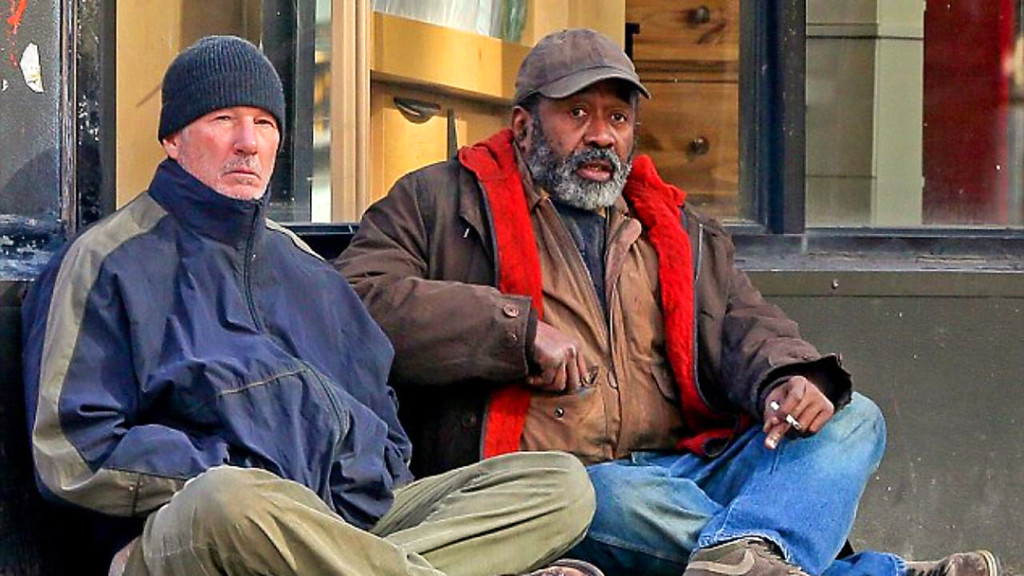
In “Walden and Civil Disobedience,” Thoreau said, “The mass of men (sic) lead lives of quiet desperation. What is called resignation is confirmed desperation. From the desperate city you go into the desperate country…”Time-out-of-mind-1024x576

George (Richard Gere) is homeless on the streets of the Big Apple. He’s already living in his own desperate city, both physically and mentally. Whether he will move permanently to his desperate country remains to be seen. Selling his coat for a few beers, sleeping in a prison-like shelter, dozing on benches, daring to visit his estranged daughter – these are the bleak patterns of his day.

His story, told in the movie “Time Out of Mind,” could touch the core of your humanness. IF you dare to watch it.

Why do I use the word dare? It’s simple.

There is nothing Hollywood about this film. No special effects. No dramatic plot line. No titillating sex scenes. No swelling score. No heroes or heroines. No pandering to our mass appetites.

Even the cinematography challenges our norm. Gere was filmed with hidden cameras, often through windows or doorways on the gritty streets, a cacophony of random voices carrying on in the background. It’s almost clinical, like Italian neorealism, detailing his struggle with inner demons from a dispassionate distance.

And those demons are certainly there. We get no clear, linear explanation of George’s past, but the scant details give a glimpse of his descent. They highlight in painful relief the final, strained connection he has with his daughter, Maggie (Jenna Malone).

Justin Chang, a critic with Variety, called this film “a soulful, fascinating, and haunting piece of urban poetry.”

One of its eeriest elements is the character of Dixon, played with panache by Ben Vereen. He gloms on to George, shadowing him day and night. Is this happenstance or fate? Is Dixon even real? His nonstop talking is a one-sided dialogue with the repressed elements of George’s character, like a split personality given flesh. When Dixon’s fingers hover over the keys of a café’s antique piano, it embodies the last vestiges of hope in George’s spirit. And when the authorities force Dixon from the shelter, he hurls two prophetic phrases at George. “Don’t give in to the demons!” “You owe me an apology!”

If I could petition the Academy of Motion Pictures and Sciences about this film by Oren Moverman, I would say, “Give Gere the Oscar for best performance! Let this low-budget masterpiece, like ‘Leaving Las Vegas,” be lauded as an example of cinema’s potential to explore the edges, to light up the human experience in ways we never imagined.”

Say it any way you want. Black lives matter. Homeless lives matter. All lives matter. If you believe it, I dare you to watch this movie, to get outside your consumer expectations and let it work its magic on you.

I cried as the credits scrolled. I know why. In an unglamorous career as a pastor, I had the privilege of meeting people this world will never celebrate. They let me enter into their desperate cities and walk alongside them for a while.

And sometimes, not always, we found a way out together.

Light up the Darkness!

“It is better to light a single candle than to curse the darkness.” – Chinese proverb.

Every Christmas Eve during my childhood, our family attended the candlelight service at our home church. With the sanctuary festooned in decorations, we sang carols, recited prayers, heard the familiar story of Jesus’s birth. But, to me, the most vibrant moment came at the end. The pastor lit a candle from the Christ flame at the center of the Advent wreath, passing that spark to a few people who passed it on until everyone was aglow. Then we filed outside to the church’s playing field, forming an illuminated circle under the stars of a deep December sky. An elder would recite John 1:5 – The light shines in the darkness, and the darkness has not overcome it. Finally, we all lifted our candles and sang Silent Night.

Even as a boy, I understood the audacity of this tradition. I heard the nightly body counts from the Vietnam War, broadcast on network television. I knew of the geopolitical tensions between the US and USSR. I had seen footage of race riots that had recently torn through our country’s urban streets.

But I also knew the darkness closer to home, the struggles of those in our congregation. As I scanned their faces in the circle of light, I marveled at their courage. I saw the family who lost their daughter to a tragic car wreck. The man praying during a time of unemployment. The woman wearing a wig to hide her head denuded by chemotherapy. The widower tenaciously leaning on his walker, determined to stand tall despite the visceral loss of his wife of over 60 years.

All of them, wicks held high in the crisp darkness. Daring to hope.

I no longer identify with any particular faith, relishing the diversity of meanings in our world. But I’m still a candle lighter. I light them in remembrance and silent prayer. I light them with compassion. I light them as symbols of rebellious hope. As I remaster this post at Christmas time, 2022, I think of some candlelight moments from my past.

  • I had spent the day in a squatter’s settlement of Tijuana, land reclaimed from a garbage dump. The residents had no electricity or water, living in crudely assembled shacks on the dusty streets. We were there to build simple homes, but as a pastor I had double duty, praying for the sick and blessing a newborn baby. That little girl, looking up at me with her shiny dark eyes, seemed to embody human longing. After dinner at a downtown taqueria, I walked to La Catedral de Nuestra Señora de Guadalupe. In an alcove flickering with light and shadow, I lit a candle for those who stand tall in the midst of squalor. A candle for justice.
  • I was wandering the streets of Munnar, India, a unique village in the state of Kerala where equal amounts of Hindus, Christians, and Muslims live in rare harmony. At a roadside shrine to Ganesha, I lit a candle for tolerance in our fractured world.
  • I was on a solo camping trip in the desert of Joshua Tree National Park. That night, the brilliance of the Milky Way was a shimmering glimpse of eternity. I lit a candle for two people whose memorial services I had recently performed. Henry Parra, taken by alcohol at age 39 just moments after a prayed at his bedside. Tony Matrulo, dead at age 13 from a freakish go-cart accident, just months after I helped his troubled family find the embrace of community in our church.

Given the many dark events of these past few years – the pandemic, the right-wing assault on our nation’s Capital, the war in Ukraine – I have a prayer for all of you. Whether you’re lighting candles for Christmas, Hanukkah, Kwanza, or just holiday cheer in general – may you have the audacity to choose hope in the midst of whatever trial you’re facing. May you have a deep and abiding peace!

Two days after being shot by an unknown gunman, Bob Marley performed at a peace rally in Jamaica. Before going on stage, he uttered these famous words: “The people that are trying to make the world worse never take a day off, why should I? Light up the darkness!”

Selah.

A Small Kindness at Christmas

Keith blew in with a cold front, already seated on the front steps of our church as I got to work. His clothes were filthy and threadbare, and the face that peered out from beneath a hooded sweatshirt was reddened by more thanth wind. Body odor and booze fumes tore at my nostrils.

“Can I help you?” I asked.

“I was wondering if you could spare a few dollars,” he said.

“I don’t give out cash,” I answered. “I’m not judging you, but people drink up the money as soon as I give it to them.”

“Yeah, I do drink some beer,” he said with a smile.

I smiled back.

“How about I take you to get something to eat?”

“No thanks. I already had one of those breakfast burritos at McDonald’s.”

“How long have you been homeless?”

“Many, many years.”

“What’s your name?” I asked.

“Keith,” he replied.

“Good to meet you. Mine’s Krin. If you want, I can get you a room at the Rescue Mission. They’re a great outfit, and I know the people in charge. They’ll help you get settled, find work, make a new start.”

“No thanks. I prefer to be on the road.”

“OK. Is there anything else I can do to help you?”

“Actually, I could use some new shoes and a coat.”

What an understatement. His black tennis shoes were nearly sole-less and his flimsy sweatshirt was no buffer to the cold.

“Tell you what,” I said, “Let me take you to the Trash and Treasure Resale store and we’ll see what we can do.”

Friends, never underestimate how the simplest of gifts can make a difference in someone else’s life! Truly one person’s trash can be another person’s treasure. I took Keith to the store, an ecumenical ministry in our town, praying silently they would have what he needed. My prayers were answered. On the shoe shelf was a sturdy set of leather Skechers, his size, barely used. And there on the rack hung a beautiful wool coat with quilted lining and an over-sized hood.

I held out the coat with a flourish, mimicking a sales clerk at Men’s Wearhouse.

“Here you go, sir,” I said. “This looks like just your style.”

He laughed and slipped into it, playing his part. Perfect fit. And the shoes were more than adequate, especially when we added a clean pair of socks.

“I really appreciate your help,” he said.

“No problem,” I replied. “Are you sure you don’t want me to get you a room at the Mission? They’ll help you in ways that I’m not able to.”

“I’m sure. I think I’ll just head down to Kingsville. I once spent a Christmas there. Can’t even remember what year.”

“You’re determined to do the Forest Gump thing, eh? Just keep walking and walking?”

“Guess so.”

We exited to the back alley. You could feel the coming front in the frigid, sharp wind. I shivered, imagining how Keith would fare during the night. He thanked me again as we shook hands. Then he strolled off down the alley, resplendent in his new shoes and coat.

Just before he rounded the corner, he stopped, lifted his arms and shouted “Merry Christmas, everyone!”

All I Want for Christmas Is…

Every year brings the customary question, especially from my wife: “What do you want for Christmas?”

My answer gets clearer every holiday season. I want LESS!

Less clutter, less obligation to purchase, less tinsel and decorations, less calendar frenzy. More serenity, more joy, more commitment to giving the simple gifts ofWhat I want for Christmas love and grace.

My wife nods with a knowing smile, her unspoken response being, “Sure, I’ve heard that one before. But if you don’t get anything, you’ll probably feel unappreciated.”

No I won’t, honey. I want LESS!

Years ago I wrote a booklet called “Have an Authentic Christmas,” my humble attempt to put the Nativity story in its rightful perspective. I asked us to read this ancient tale as a call to humility and universal love, an alternative to the corrosive influences of wealth and worldly power.

I quoted a man named Michael Jessen; his words remain prophetic.

“For a holiday that celebrates the birth of the ultimate, anti-materialistic prophet, Christmas is burdened with stuff. Jesus urged his disciples to simplify their lives, drop all their possessions, and follow him. But as his birthday nears, statistics abound about the extra garbage we produce, the increased stress we endure, the credit card abuse we commit, the additional hoards of food and drink we ingest. Polls repeatedly say we yearn for less commercialization of Christmas, yet we also tell pollsters we expect to spend as much or more than last year during the holidays.”

I write this while the United Nations Climate Change Conference convenes in Paris. CBS coverage included pictures of pollution and global warming effects from around the globe. There were surreal images of Beijing, where smog is so suffocating that people wear face masks to protect their lungs. It’s like smoke moving in from killing fields, or fog from a noxious swamp.

The schizophrenia of our nation struck me immediately. We want a strong economy, driven by consumers. Retail sales on Black Friday, Small Business Saturday, and Cyber Monday are closely watched, causing rises or falls in the financial markets. And so many of the products we purchase are made in China, a nation that continues, like the U.S., to belch fossil fuel residues into our atmosphere, affecting us all.

Our over-consumption and waste cannot continue. It will doom our planet. Just as insidiously, it dooms our spirits by tying them to the crumbling treasures of this earth.

How can any of us, in good conscience, wring our hands about climate change, then continue our current patterns of buying?

Do you care about melting glaciers, dwindling rain forests, or vanishing species? Do you believe this planet is a precious gift to preserve for generations to come?

If so, will you join me this Christmas by committing yourself to 50% less spending? Let our actions be a witness to how each of us can make a small difference.

Maybe you’ll even adopt this simple response to the question of “What do you want for Christmas?”

I want LESS!

Four Keys to Unlock the Narrow Gate

Devoted to asceticism, Mahatma Gandhi died with very few possessions. One of them was a dog-eared copy of Jesus’s Sermon on the Mount found in Matthew chapters 5-7 of the Christian New Testament. The great Hindu leader whose influence has spread across history once said, “Jesus was a supreme artist because he saw and expressed Truth.”

The Sermon on the Mount wasn’t delivered at a single time or setting. Rather, it’s a compilation of the most earth-shattering, soul-piercing teachings of Jesus. It requires immense courage to take these words seriously. Jesus knew this clearly and he warned against casual trips down the spiritual highway. Towards the end of these chapters, he said, “Enter through the narrow gate. For wide is the gate and broad is the road that leads to destruction, and many enter through it. But small is the gate and narrow the road that leads to life, and only a few find it.” (7:13-14)

Unfortunately, hellfire preachers and Christian dogmatists got hold of these words and shook them like wolves grinding rabbits in their jaws. Choose Jesus or you’re cruising the highway to hell! Repent of your sins; embrace the ONLY way to heaven! That fire and brimstone style is mostly history, but its myopic theology lives on in people who believe their interpretation of faith is the only one that matters.

Enough! These verses are not about salvation in some imagined eternity; they are meant to heal our precious time on earth. Jesus knew that too many of us follow pathways that hamper, even destroy, our spiritual health, especially in a culture that is militaristic, materialistic, and focused on self-promotion. He also knew that growth and freedom – what he called life abundant – are qualities we must seek with all our hearts and minds.

So how do we find abundant life? How do we unlock the narrow gate? There are many teachers and multiple spiritual disciplines to help us. I have written about them in numerous books. But in keeping with this post, let’s look at four effective keys suggested by Jesus in the Sermon on the Mount.

Be merciful: Love your enemies, turn the other cheek, refuse to return evil for evil. (Matthew 5:38-48) This may seem impossible in our divided and violent world, but in our daily relationships it’s a great karmic reality. When we react rather than respond, we fan the flames of conflict. When we grow angry, the toxicity affects our whole being. Jesus would have us never forget that we, also, are in need of mercy and forgiveness, a spiritual condition that humbles us and links us to all human beings. Mercy extended to another person is mercy we extend to ourselves.

Learn to trust. “Which one of you, by worrying, can add a single hour to your life?” (Matthew 6:25-34). Fullness of life happens NOW. Learning to trust God, the universe, or providence (whatever your conception) demands immediacy. Does this seem obvious, expressed in countless memes? OK, but learning to live in the present is an art few people master. It’s a narrow gate. Without passing through it, our days remain polluted by regrets, fears, and the stress related to countless issues we can never control.

Practice radical honesty. Jesus called us to cleanse our deepest motives, focusing on our own “rightness” before shifting our gaze to others. In numerous examples – our sexual desires, our anger, our so-called piety – he emphasized unflinching self-awareness. No wonder Gandhi, who famously said, “Be the change you want to see,” respected this Nazarene who asked: “Why do you look at the speck of sawdust in someone else’s eye and pay no attention to the plank in your own eye? First take the plank out of your own eye…” (Matthew 7:1-5)

Invest wisely: It’s amazing that a poor carpenter from Judea has influenced this planet for millennia! I believe it’s because he modeled a higher form of humanity, a counter-cultural set of values. We see this clearly as he says, “Do not store up treasures on earth, where moths and rats destroy, and where thieves break in and steal.  But store up treasures in heaven…For where you treasure is, there you heart will be also.” (Matthew 6:19-21) This isn’t a pie-in-the-sky platitude. It’s about here and now, and it’s brutally frank. If we invest primarily in crumbling possessions rather than our relationships, our character, and our spirit, we miss the narrow gate.

These keys are for everyone, not just those who claim to be disciples of Jesus.

Kurt Vonnegut once said, “Some of you may know that I am neither Christian nor Jewish nor Buddhist, nor a conventionally religious person of any sort. I am a humanist, which means, in part, that I have tried to behave decently without any expectation of rewards or punishments after I’m dead. … But I myself have written, ‘If it weren’t for the message of mercy and pity in Jesus’s Sermon on the Mount, I wouldn’t want to be a human being. I would just as soon be a rattlesnake’.”

Strive to enter the narrow gate today, my friends!

Twitter, a Troubadour, a Falconer

Twitter is a freakin’, shriekin’ bazaar, a riotous mix of people hawking their wares. Buy my book! View my artwork! Listen to my music! Watch my video! Subscribe to my blog! Retweet me!

I see Donkey in Shrek, jumping up and down, shouting “Pick me! Pick me!” I recall marketplaces in foreign countries, the air shrill with merchants’ voices.

There are so many talented individuals in our world. The Indie movement has decentralized the control of artistic enterprises, and people are showing their colors everywhere. But for each person who gets noticed in the online stream of consciousness, there are countless others laboring in obscurity.

That’s why I want to tell you about a troubadour and a falconer. I met them at the Harvest Moon Festival in Comfort, Texas. All the elements for a Lone Star bash aligned perfectly: a dilapidated farm, open field, BBQs TTF Blog shot 2drifting smoke, vendors, music, bales of hay arranged as a rustic amphitheater. The crowd was growing, but small by festival standards.

At a rickety stage, I met Klaus Weiland, a troubadour with a long beard, craggy face, and intense eyes. He was between songs, talking with his deep German accent about the need for people to choose nonviolence, protecting each other and the earth. He seemed oblivious that there were only four us in the audience.

Admirable words, spoken with conviction. My ears perked up. But then he lifted his guitar to sing, and I was transported. Beautiful finger-work, a soulful voice, the notes soaring over our heads into the October sky.

Moments later I met John Karger, a Santa Claus stand-in, complete with oval glasses and squinty eyes. He’s the Director of Last Chance Forever, a nonprofit conservancy for birds of prey in San Antonio.

John and his corps of volunteers presented the best raptor show I’ve seen. Characteristics of hawks, owls, vultures, eagles and falcons became real as each was brought out for display. John directed it all, and every bird on his wrist seemed part of him. When he spoke about reverence for life, like Albert Schweitzer, his intensity was contagious.

When I got home, I researched these men.

Weiland’s refugee mother gave birth to him at Bergen/Belsen, a former Nazi death camp. At age 17 he took up the guitar, and music became his passion, trumping an academic career as a linguist. After some fame in Europe, he traveled the world, partly on his “eco-raft,”  sharing songs these 40 years. Karger, a veterinary technician and lover of falconry, founded his nonprofit in 1978, rehabbing and releasing raptors ever since.

At an obscure festival, probably not retweeted or uploaded, and definitely not viral, I learned a lesson from a troubadour and falconer. THE JOY OF CREATING IS IN THE ACT ITSELF, those moments when something greater than ourselves flows through us. Adulation may never come. And if it does, it may rise and fall depending on the fickle tastes of our world.

Have you embraced your purpose? Are you listening to your muse? As Wayne Dyer once said, “Don’t die with your music still in you!”

Oh yeah, I forgot to mention the first lyrics I heard from Klaus Weiland: Castles in the sand, by evening time are gone…

An Open Love Letter to My Presbyterian Family

Today our national church is calling, once again, for conversation about the future of our denomination. Faced with ongoing, precipitous decline, many of us wonder about our viability. Our uncertainty heightens as congregations continue to leave and affiliate with other bodies, taking their mission dollars with them.

I love our Presbyterian family of faith. I love our connectional ties. I love our democratic polity, our rootedness in history, our balanced approach to the Bible. I love the way we have championed social justice, bravely speaking truth to the powers that be.

What I’m about to lovingly share is not something I’ve kept “in the closet” during my career. It has been a part of my teaching for years. Further, I base it on discussions with many elders and clergy – women and men I respect. And I know it is only one aspect of our national discernment process.

While ordination and marriage issues remain a flashpoint, I believe there’s a far deeper, more organic challenge for our denomination. Many of its leaders at both the local Presbyterians-Reimagining-the-Church-min copyand national level are no longer in synch with any semblance of orthodox Christian creeds and doctrine. Labels are counterproductive, but many of us (myself included) might be described as Universalists.

We have not abandoned Jesus’ teachings. We are not neglecting the Good News of grace. We have not given up our pursuits of peace and justice. But we acknowledge that our Christian tradition – stories we tell based on one set of scriptures – are not the sole pathway to God. We respect the sanctity of other faiths. We recognize that human minds can only approach God’s presence through limited faculties. The innate human desire to experience the Divine finds expression in a richness of myths and cultures. Humanity, not religion, is our focus.

There has been a lot of talk about “claiming scruples” when taking ordination vows. Based on my conversations with Presbyterian sisters and brothers, many would now claim scruples about a question like this: Do you sincerely receive and adopt the essential tenets of the Reformed faith as expressed in the confessions of our church as authentic and reliable expositions of what Scripture leads us to believe and do?

We might say, “Sure, on many levels, but let’s discuss what we now believe about the Trinity, Jesus’ divinity, virgin birth, atonement, the literal resurrection, salvation, or the authority of scripture. Let’s discuss the meaning of ecclesiastical power in a denomination where only ‘pastors’ can currently administer sacraments.”

Why are these scruples critical at this juncture in our history? Because many of our members, clergy, and national leaders seem more attuned theologically to a Unitarian or Quaker perspective. If this is true at a deeper, fundamental level, it will continue to cause conflict. There’s no way around it.

Right now, in Mission Presbytery, one of our flagship churches is attempting to leave the PC(USA). Our Presbytery has appointed an Administrative Commission to enter the fray. Both sides claim they feel abandoned.

There will be a lot of pain. And though the conflict will eventually be resolved through ecclesiastical and secular courts, its resolution will only be on the surface.

The deeper rift is there, and it will not go away.

Grace and peace,
Dr. Krin Van Tatenhove
2016 Chair of the Mission Outreach and Justice Committee, Mission Presbytery

Build an Altar for Dia de los Muertos

Our family has a tradition on Dia de los Muertos. We drive to the festival in downtown San Antonio – a celebration of life through music, food, dance and, of course, death. Especially memorable are the elaborate altars.

Last year, fresh on the heels of Robin Williams’ suicide, local art students assembled a memorial to him. The colorful elements were stunning. You could stand Dia de los Muertosthere and recall the many ways Williams’ comic genius enriched our lives.

Day of the Dead altars transcend mere tombstones inscribed with epitaphs. The art of these paeans is found in the juxtaposition of exquisite details. One woman honored her grandfather, a luchador in Mexico. Alongside intimate family items and photos were antique posters announcing his fights.

As you stand before these tributes, your eyes linger over artifacts and images lovingly arranged. Then it happens: they conjure the presence of ancestors as Day of the Dead resurrects its ghosts.

I was once the senior pastor of a large congregation. On All Saints Sunday, we honored those who had passed into the “communion of saints” during the previous year. Someone slowly read their names. At regular intervals, our tower bell rang out, evoking both the presence of those loved ones and John Donne’s immortal words:

Each man’s death diminishes me,
For I am involved in mankind.
Therefore, send not to know
For whom the bell tolls,
It tolls for thee.

Here’s a suggestion. This Dia de los Muertos, build an altar to a loved one. If you want to make a physical shrine, more power to you. It can be just as meaningful to share detailed memories around the dinner table or over coffee.

I’m building an emotional/spiritual memorial to my paternal grandfather, Kryne Van Tatenhove. My children never knew him, so I want them to hear these memories.

  • Voyaging with his mother from the Netherlands to the U.S., arriving by ship at Ellis Island in 1902.
  • His prowess as a fastball pitcher. But since many games occurred on Sundays, his Dutch Reformed parents forbade his involvement, holding him back from agrandpa possible professional career.
  • His marriage to my grandmother, their wedding photo showing his tall, handsome countenance, complete with a Clark Gable moustache. (Photo of Golden Anniversary to right).
  • His sixth grade education.
  • His struggles to provide for a wife, six boys, one daughter (lost in infancy) during the Depression. This included a failed dairy farm, the herd tragically lost to brucellosis.
  • His late-life move from Wisconsin to California, where he labored as a gardener, hauling tools in a trailer behind his truck.
  • His tearful conversion at a Billy Graham Crusade in the mid-1950s, an experience that forever changed him.
  • His tall, raw-boned stature. When we shook, my hand disappeared into his as if enfolded in a catcher’s mitt.
  • His retirement to a mobile home park outside Palm Springs. There, he built a rock fence surrounding their double-wide. He crowned it with a heart-shaped stone hauled out of the desert, a tribute to my Grandma.
  • His quiet, stoic demeanor. He NEVER complained about his lot in life.
  • His death on Christmas Eve, 1978.

To my Grandpa, and to your loved ones, I lift these simple words found in the Roman catacombs: Mayst thou live eternally among the saints!

And…may you also live in our memories!

Four Questions to Ask Every Pastor/Elder/Spiritual Leader

In any organization, the beliefs and actions of its leaders influence the mission immeasurably. Our world is evolving spiritually in a powerful and positive way. In order to embrace the fullness of this journey, here are some questions we should ALL ask the leaders of our faith communities.

question-everything

1) Do you think our truth/tradition is the only pathway to God? How can religious faith ever present itself as exclusive? There is no greater red flag! It speaks of a narrow, anthropomorphic vision of God. More arrogantly, it assumes that we human beings – with our finite minds – can understand and categorize the full purposes of our Creator. It’s like pinning the butterfly of faith beneath glass. Make sure your faith community is not only open to the truths of other people, but is willing to embrace their images and stories through authentic dialogue. Remember this quote from Karen Armstrong: We can either emphasize those aspects of our traditions, religious or secular, that speak of hatred, exclusion, and suspicion or work with those that stress the interdependence and equality of all human beings. The choice is ours.

2) Is leadership at the highest levels open to ALL people? So many churches describe themselves as “welcoming” on their website or brochures, but here’s the painful truth. Some of us can only enter part way before we hit a wall that excludes the full exploration and offering of our gifts. Women, the LGBTQ community, people of color, addicts, divorcees, those with physical and mental limitations – many of us can tell heart-rending stories of exclusion. This must not be!

3) Is the selection of leaders a democratic or autocratic process? There’s a fancy word – polity – used to describe how decisions are made within a community of faith. Make sure this process isn’t limited to a handful of oligarchs. Make sure your community of faith elects its leaders democratically with a full voice for every member. I once pastored a congregation in a large metropolitan setting. A nearby Megachurch was growing exponentially, applauded for its vibrant worship, youth outreach, even its community involvement. Yet I asked people to look behind the curtains. Who called the shots? They found a close-knit cadre of men – all of them white – appointed by pastors and making every decision. No!

4) What portion of our budget is spent on healing the world beyond our walls? Many a church highlights its expensive building program, the addition of new staff, or investment in cutting-edge technology. Meanwhile, in their community, the poorest of the poor struggle to make ends meet. Nearby prisons are filled, immigrants languish, and the homeless lack adequate services. In the Christian tradition, we frequently pray The Lord’s Prayer, reciting these words by rote: Thy Kingdom come, on earth as it is in heaven. Make sure your church is helping bring God’s justice and mercy to the streets. Make sure it is pouring itself out to the world at large. Make sure it goes far beyond tithing in its mission giving.

Socrates famously said: the unexamined life isn’t worth living. It’s the same with an unexamined church life. Question everything!