The first thing that registered was the smell. Not whiskey or beer, but damp earth. Somewhere nearby, a grackle screeched from a telephone wire and irrigation pumps throbbed in the distance.
Steve opened his eyes to a sideways view of a cotton field, its furrows stretching toward the rising sun. The plants had recently been harvested, leaving remnant puffs littered across the soil. A pair of white-winged doves burst from some roadside weeds, their wings whistling as they passed his line of vision.
For another moment, he lay there, looking at the world askew. Then he sat up painfully and saw that he was on the shoulder of a remote caliche road, buck naked.
“Fuck,” he whispered, the word scraping his dry throat.
His skull pounded, his stomach churned, and every muscle felt as though someone had taken him apart and put him back together with rusty bolts. He pressed both palms against his temples and closed his eyes. Think. What happened?
Nothing at first, and then, like shattered pieces of a mirror rising to the surface of muddy water, fragments returned. Music blaring through his truck speakers. Warm air pouring through open windows. Tossing an empty pint bottle and beer cans into the darkness along with six months of sobriety, his laughter echoing across empty fields.
He swallowed hard.
“Not again…” he whispered, overcome by waves of shame. He forced himself to stand, swaying until his dizziness settled. Looking down the gravel road, he spotted his late model truck about a hundred yards away, sitting with its hood cocked toward the sky.
He started towards it, caliche crunching painfully beneath his feet. Every few yards, he came across another article of his clothing: his underwear, his boots, his socks, his chinos, then his button down shirt hanging from a fence post. It had been neatly folded, and he stared at it for a long moment, shaking his head.
“At least part of me was still neat,” he said with a grim chuckle.
He dressed slowly, his shirt stinking of spilled beer. By the time he reached the pickup, the full extent of his predicament was clear. Its rear wheels were buried deep in a roadside drainage ditch, weeds twisted around the axle. All the windows were wide open, and dried mud blotched the doors and fenders.
Shaking his head again, he climbed inside. The key fob was on the dashboard, but when he tried to start the engine, it was dead, the gas gauge well below empty. He picked up his cellphone from the passenger seat and pressed the power button. Nothing happened.
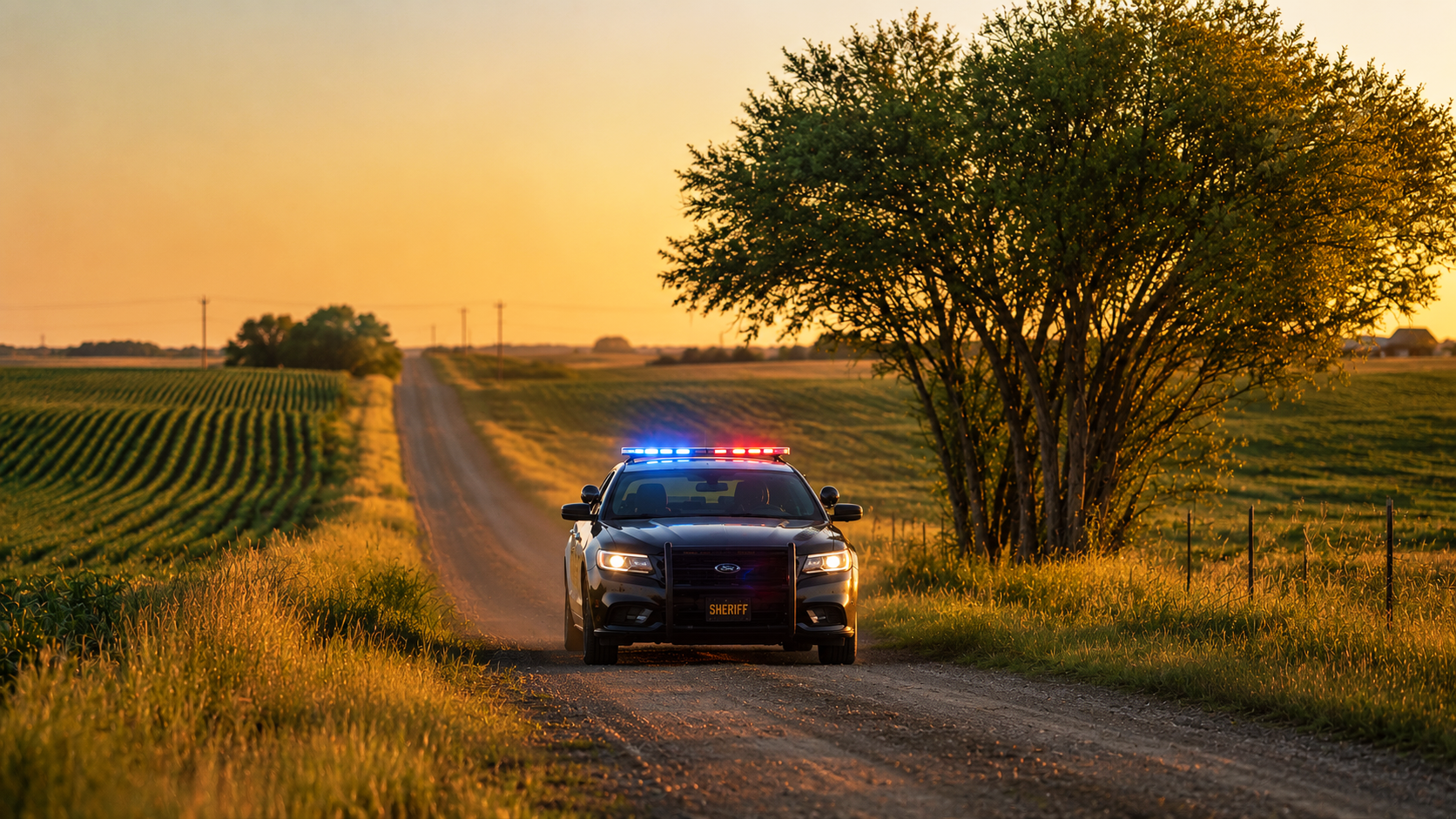
He let out a long, weary breath and rested his forehead against the steering wheel. A moment later, gravel crunched nearby, and he lifted his eyes to see a county sheriff’s cruiser approaching along the road, early sunlight glinting on its windshield. It came to a stop beside the pickup, engine idling as the driver’s door swung open. The man who stepped out appeared to be in his late fifties, wearing his uniform and his years comfortably. Gray touched the edges of his mustache, while the lines around his eyes suggested someone who smiled often despite the seriousness of his role.
The officer looked over the truck before turning his attention to Steve. “Good morning. I’m Deputy Meadows. A rancher driving by about twenty minutes ago spotted your pickup and called us.”
“I figured somebody would,” Steve said in a hoarse whisper.
Meadows walked closer. Even outdoors, the smell of beer and sweat reached him. “Please show me your license and registration.”
Steve’s wallet was still in his back pocket, so he pulled it out, removed the license, then rummaged through the glove compartment, handing both documents through the window. Meadows looked them over carefully.
“You’re a ways from home, Steve Hansen. Mind telling me what happened?”
Steve gave a humorless laugh. “Truck slid off the road.” He paused, looked away from the officer, then back again. “Guess I had a bit to drink.”
Another pause as the officer waited, knowing that silence often uncovered new levels of honesty.
Steve’s shoulders slumped. “Shit, I remember throwing cans and a bottle into the fields like an idiot teenager. Everything after that…it’s gone.”
Meadows nodded slowly. “I think you know what I’m going to say.”
Steve looked at him. “That I was wasted?”
“Obviously. Blackout wasted. More importantly, you could have killed yourself or someone else.”
What struck Steve was that Meadows’ voice remained neutral, just the truth spoken without an incriminating lecture. He rubbed his hands across his face, fully expecting Meadows to cuff him and take him to the station.
“I don’t deserve a break.”
Meadows looked into the distance for a second, as if struggling to decide what to say. Steve noticed a scar running down the side of his face. “I’m not here to decide what you deserve.”
A breeze swept across the fields, carrying the scent of sun-warmed soil and blooming huisache.
“I’ll call a tow truck,” Meadows said.
Steve shook his head. “I’ve caused enough trouble. I’d rather go home. I’ll charge my phone once I get there and make the arrangements myself.”
The deputy raised an eyebrow. “And how do you propose to get there? An Uber?” He chuckled softly. “Is there someone I can call to come get you?”
Steve just shook his head.
Meadows studied him another moment. “Tell you what. I’ll give you a ride home.”
Steve looked into Meadows’ eyes, surprised by the offer.
“Okay. I’d appreciate it.”
Steve closed the truck’s windows, locked the doors, then climbed into the patrol car and they took off. The interior smelled of stale cigarette smoke. For several miles neither of them spoke as the county road wound between cotton fields and sorghum, passing rusted windmills, double-wide trailers, weathered barns, and mailboxes listing to their sides. A tractor worked slowly in the distance, throwing small clouds of dust into the growing heat. Steve watched it all roll by, his head pounding.
“Do you have kids?” Meadows finally asked.
“No.”
“Wife?”
Steve didn’t answer immediately. “Separated.”
“For how long?”
“Eight months.”
Meadows glanced at him. “Because of the alcohol?”
Steve nodded. “She stayed longer than she should have. Years of promises. Years of me swearing this time would be different.”
He looked down at his hands. “The day she left, she packed two suitcases, kissed me on the cheek, and said something I’ll probably hear the rest of my life.”
Meadows waited.
Steve swallowed. “I still love you, Steve, she told me.” He managed a tired smile. “I almost wish she’d been angry. Anger would’ve been easier.” He stared through the windshield. “Then she said, I just can’t stay here and watch you disappear.” His voice grew quieter. “She never filed for divorce. Just gave me one condition.”
Meadows didn’t interrupt.
“When you choose sobriety instead of alcohol, call me.” He gave a humorless laugh. “Then last night.”
Meadows was silent a bit, then started tapping his fingers on the steering wheel. “I was…” He stopped, as if uncertain to continue, then sighed. “I was sober six years before I pinned on this badge. That was fifteen years ago, and I still haven’t touched a drop.”
He didn’t say it in a boastful way. Steve turned fully toward him, the officer’s eyes steady on the road.
“I started drinking in high school.” Meadows continued. “It made me more confident, and I thought it made me funny. Then I thought it made me braver. Eventually it just made me thirsty.” He paused. “I lost my first marriage. I lost a construction business. I almost lost my little girl.”
The patrol car hummed along the pavement. Steve had never expected such a confession. “What happened?” he asked quietly.
“I passed out one afternoon while I was supposed to be watching her.” Meadows swallowed. “My neighbor found her wandering along the highway.”
Steve stared out the windshield. Neither man spoke for nearly a minute as the fields slowly gave way to scattered live oaks.
“I figured my life was over,” Meadows continued. “I honestly believed I’d become the worst thing that had ever happened to the people who loved me.”
“What changed?”
“As they say in the program, I got sick and tired of being sick and tired.” He tapped the steering wheel again. “I finally admitted I couldn’t beat it alone.”
Steve looked down at the caliche dust on his boots. “I hear you. I admitted that powerless thing six months ago. I started going to meetings, got a sponsor, the whole deal. I even became open to there being a Higher Power who could help me.” He paused. “Then last night I flushed it all away.”
Meadows laughed, the last reaction Steve expected.
“You think that’s original?” asked Meadows. “You think you’re the first one to relapse? Believe me, man, relapsing is the main symptom of this disease. You just have to shake off the shame, get back on your feet, and start again.”
‘Yeah,” said Steve, “but now my chances of getting Linda back are pushed to the outer limits.”
The sun had climbed above the horizon, pouring gold across the landscape. In the distance, they could see the rooftops of the housing development where Steve lived, and further away, the skyline of the city where he worked as an actuary for a large insurance firm.
“It sure is a beautiful morning,” Steve murmured.
Meadows gestured toward the windshield. “When I drank, I stopped seeing mornings like this. Everything became about the next drink. The rest of creation just disappeared.”
The patrol car’s GPS was set to Steve’s address, so Meadows followed it into the subdivision, made the requisite rights and lefts, then pulled to the curb in front of Steve’s house.
“This it?”
Steve nodded. His ranch style home had a manicured lawn and a live oak tree in the front yard. The porch swing that Linda loved was creaking slightly in the morning breeze. He reached for the door handle, then paused. “I really appreciate the ride, Deputy Meadows. And the conversation.”
Meadows nodded, again seeming unsure of what to say. “I’ve always been one to bristle at unsolicited advice. People should mind their own damn business. But given the fact that we’re both alcoholics and I just hauled your ass out of a ditch…”
He stopped and looked through the windshield for a moment. “Truth is, I almost kept my mouth shut.”
Steve waited.
“But twenty-one years ago, an old deputy named Flores picked me up after one of the worst nights of my life. He drove me home, parked in front of my house, and talked a whole lot longer than I wanted him to.” Meadows smiled to himself. “I remember sitting there thinking, who asked you?” He shrugged. “But it turned out I needed somebody who didn’t wait to be asked, so I’m going to have my say.”
Meadows rubbed the back of his neck, then looked at Steve. “I’ve arrested judges and janitors. Ranch hands and accountants. Rich people. Broke people sleeping under bridges. Alcohol doesn’t care who you are. We all end up sitting in the same folding chairs, taking it one day at a time. Get back among those folks, Steve. You need them.”
Steve nodded. “I hear you.” Then he started to open the door.
“I’m not done,” said Meadows a bit more forcefully.
Steve turned back toward him, struck by the gentleness in Meadows’ eyes.
“Don’t do this for Linda. She may come back or you may never see her again. Job one is saving your own life. Let the rest sort itself out. And remember, no matter how far you’ve walked into the darkness, you can turn around. Right now. Today.”
Steve nodded. “I think…” His voice cracked. “I think I’m just really scared.”
“Good. It means you’re telling yourself the truth.”
Meadows reached toward his pocket, hesitated, then slipped his fingers into it and pulled out a card. He handed it to Steve. “I don’t usually do this, but you can call me anytime, day or night. I mean it”
They sat quietly for another few seconds while the breeze stirred the oak tree in the yard, scattering patches of sunlight across the hood of the patrol car. Steve opened the door and stepped onto the cement walkway leading to his front door. The swing on the porch moved again. He remembered Linda sitting there on summer evenings with iced tea, watching thunderstorms gather over distant fields. He remembered the smell of her shampoo and the way she laughed so freely. She would often ask him to sit beside her on the porch, but too often he’d chosen the bottle instead.
He turned back to Officer Meadows who was still idling by the curb. “Thanks again.”
The deputy tipped two fingers to the brim of his hat. “I hope the next time I see you, it’s not by the side of a road.”
“So do I.”
Steve watched the patrol car do a U-turn toward the entrance of the subdivision. Then it turned a corner and vanished.
For a long time, he stood without moving. Even in his hungover state, he could appreciate the sound of the wind moving through the oak leaves and the light touch of the breeze on his skin. Tears blurred his vision and he let them come. When they had passed, he walked up the path and reached the porch, its boards creaking beneath his boots. Then he sat in the swing, rocking back and forth. The full light of morning settled over the yard as though it were the second day of creation, the world beginning again.
Getting up stiffly off the swing, he went inside where the house seemed unusually quiet. He found the charger in the kitchen drawer and plugged it into his cell phone. It took almost a minute before the screen came alive.
When it finally lit, he didn’t hesitate. He called AAA. Then he called his sponsor.