It’s just before sunrise. The early spring morning is still cold, seeping through the boards of the shack that Ramón Salazar shares with his family. He awakens to the sound of his father’s stubborn coughing, like an engine that won’t start.
The date is March 17, 1966. Ramón doesn’t know this because it’s written anywhere. He knows it because he’s been counting down to it, each day like a bead on a rosary that he fingers in the dark.
The farmworker’s camp squats at the edge of Delano like something the town spat out. Rows of wooden shacks lean into one another, patched with tar paper and tin. Between them, tents sag with dew, their ropes creaking softly. The ground is a churned-up paste of old mud smelling faintly of human waste. A single spigot stands at the far end, issuing rusty water. That doesn’t deter the women who line up before dawn to fill their dented pots, shawls wrapped around their shoulders.
Ramón sits up on his cot, a slender young man of 17 with dark, sullen eyes. His sister, Ari, is still asleep on the cot next to him, her black hair fanned across her pillow. She dreams with her mouth open, one hand clutching the edge of a blanket that smells of sweat. Their mother lies on the other cot next to their father. She is also awake, staring at the ceiling. When she hears Ramon move, she turns her head.
“Hoy te levantas temprano,” she says softly.
Ramón nods. His chest feels tight from the excitement of the coming day, as if a rope has been pulled a notch tighter every week for months. He puts on his threadbare jacket and steps outside.
In the predawn light, he can see grapevines stretching out in rows into the distance. Most of the workers have been striking for months, leaving clusters of fruit unpicked. At first, Ramón felt the protest would be futile, but now a faint hope has been flickering among the Filipinos and Hispanics. They are daring to believe that a union contract with the growers is possible. This belief has grown stronger because César Chávez and his organizers will arrive this morning to launch a historic march to Sacramento.
As Ramón’s gaze sweeps across the vineyard, his hope mingles with an old, acidic anger. It has burned inside him longer than he can remember. He imagines the juice that has stained his hands since he was a young boy, joining his family on their annual migration through the vineyards and fields of California. He sees his parents’ faces as they wince from the pain in their backs. He visualizes the growers’ foremen squinting at their tally sheets, finding reasons to dock their pay. Gloves. Water. A broken tool that “must have been your fault.” It is always something, and as if this humiliation isn’t enough, there are the low flying planes that spray pesticides on both workers and crops alike.
He swallows the anger like bile, forcibly turning his thoughts to the promise of this day. He hears the laughter of Filipino men nearby. He has learned some of their words by spending time among them. They’ve taught him card games and shared meals of pancit and pinakbet. They’ve been on strike longer than the Mexicans, longer than anyone, and their patience has worn thin. Everyone’s has.
He walks toward a large flatbed truck parked near the edge of camp, a makeshift stage for the day’s event. People are already gathering and he can hear their murmurs: Chávez viene. Hoy es el día. Someone starts a chant, testing it like a drumbeat: “¡Viva la Causa!” It falters, then catches, echoing through the camp.
His father comes up beside him, hands shoved deep into his pockets. José Salazar’s face is lined from sun and constant worry. His eyes seem permanently narrowed against both glare and disappointment. He smells of sweat, tobacco, and the faint metallic tang of blood from a cut on his arm that never quite heals.
“Escucha,” his father says, nodding toward the stage. “Pero no te hagas ilusiones”
Ramón swallows. No illusions? It’s too late! Having taught himself to read with the help of tutors in the camps, he has digested the simple pamphlets distributed by the organizers. He has learned new words: dignidad, justicia, sacrificio. Words that feel like something you can build your life upon. He has listened to Chávez’s organizers in the evenings, stirred by their courage. Illusions? Yes! He has allowed them free rein as this day approached. They have crowded his mind, buzzing like bees.
The crowd continues to swell until Chávez arrives with his entourage, having traveled from his home nearby in Delano. A hush falls over the gathering. In person, Chávez always seems smaller than Ramón expects, his voice not loud but steady. The throng presses closer. Ramon can smell sweat and damp clothing. A baby fusses until its mother presses it against her breast.
“Estamos aquí porque hemos decidido caminar,” Chávez says. “Caminar juntos. De Delano a Sacramento. Para demostrarle a este país que las manos que lo alimentan están cansadas de ser invisibles.”
A cheer runs through the crowd. Ramón’s heart thuds so hard he’s sure the people next to him can hear it. Standing near him is an Anglo sympathizer, one of many who have joined the cause. Ramón can hear his Mexican friend translating for him. We are here because we have decided to walk. To walk together. From Delano to Sacramento. To show this country that the hands that feed it are tired of being invisible.
“Nuestra peregrinación será la chispa que encienda nuestra causa,” Chávez continues. “Pero recuerden esto: caminamos en paz. El verdadero valor no reside en levantar el puño, sino en ofrecer nuestro propio cuerpo, nuestro propio sufrimiento, por el bien de los demás.”
Again, the whispered translation. Our pilgrimage will be the match to light our cause. But remember this: we walk in peace. True courage is not in raising a fist, but in offering your own body, your own suffering, for the good of others.
Ramón thinks of his mother’s cracked hands, of his father’s cough, of Ari’s bare feet in winter. He thinks of the growers’ houses he’s glimpsed from the road with their wide lawns, white fences, and sprinklers ticking like clocks that always tell the right time.
“Sacrificio,” says Chávez. “Unidad. Estas son nuestras armas. ¡Viva la Causa!””
The shout erupts, loud and fierce. “¡Viva la Causa!”
“¡Sí, se puede!” someone yells.
“¡Sí, se puede!” The chant rolls and lifts, like a huge kite whose tail you could grab and ride into the sky.
Ramón feels something click inside him, like a door finally opening. He is seventeen years old and tired of bending. Tired of watching his parents swallow their anger like bitter medicine. Tired of being told to wait, to endure, to be grateful for scraps.
He looks at his father. José’s face is unreadable, as if carved from stone. His mother stands a few rows back, Ari beside her with eyes wide.
When the speech ends and people begin to talk in excited knots, Ramón knows what he must do. He will walk with Chávez. He will do more than move from one field to another, picking crops with nothing to show for it. He will make his life count for something larger than mere survival.
His mother, who seems to know him better than he knows himself, comes to stand near him and his father.
¿Qué te pasa? she asks her son, the trepidation in her voice showing that she already suspects the answer.
He takes a breath. The words feel too big for his mouth. “Voy a unirme a la marcha,” he says finally. “Voy a ayudar al sindicato.”
His father’s jaw tightens and his mother’s face goes slack. Ramón braces himself, anticipating their objections, ready to respond with the speech he has rehearsed a million times in his head. I’m not a child. This matters. I can help.
He expects anger and fear. Instead, his father exhales, long and slow, as if he’s been holding his breath for years.
“Sabía que esto venía,” José says.
His mother reaches for Ramón’s hand. Her fingers are rough and warm. “Tienes miedo?” she asks.
“Si,” Ramón says, surprised by his own honesty. “Pero más miedo tengo de quedarme igual.”
Ari looks between them, confused. “¿Te vas?” she asks, as if she can’t quite believe it.
“Por un tiempo,” Ramón says. He smiles at her, trying to ease her anxiety. “Voy a caminar mucho.”
His father nods once. “No te vamos a detener,” he says. “Pero prométenos algo.”
“¿Que?”
“Que no olvides quién eres,” José says. “Y que regreses.”
Ramón’s throat tightens. No matter how much he has been frustrated by his parents’ submission to the injustice of their plight, he could never forget them and their loving dedication to their family. He will never forget his roots. And returning? Always! No matter how far the time or distance. These are easy promises to make.
He nods. “Claro. Lo prometo.”
___
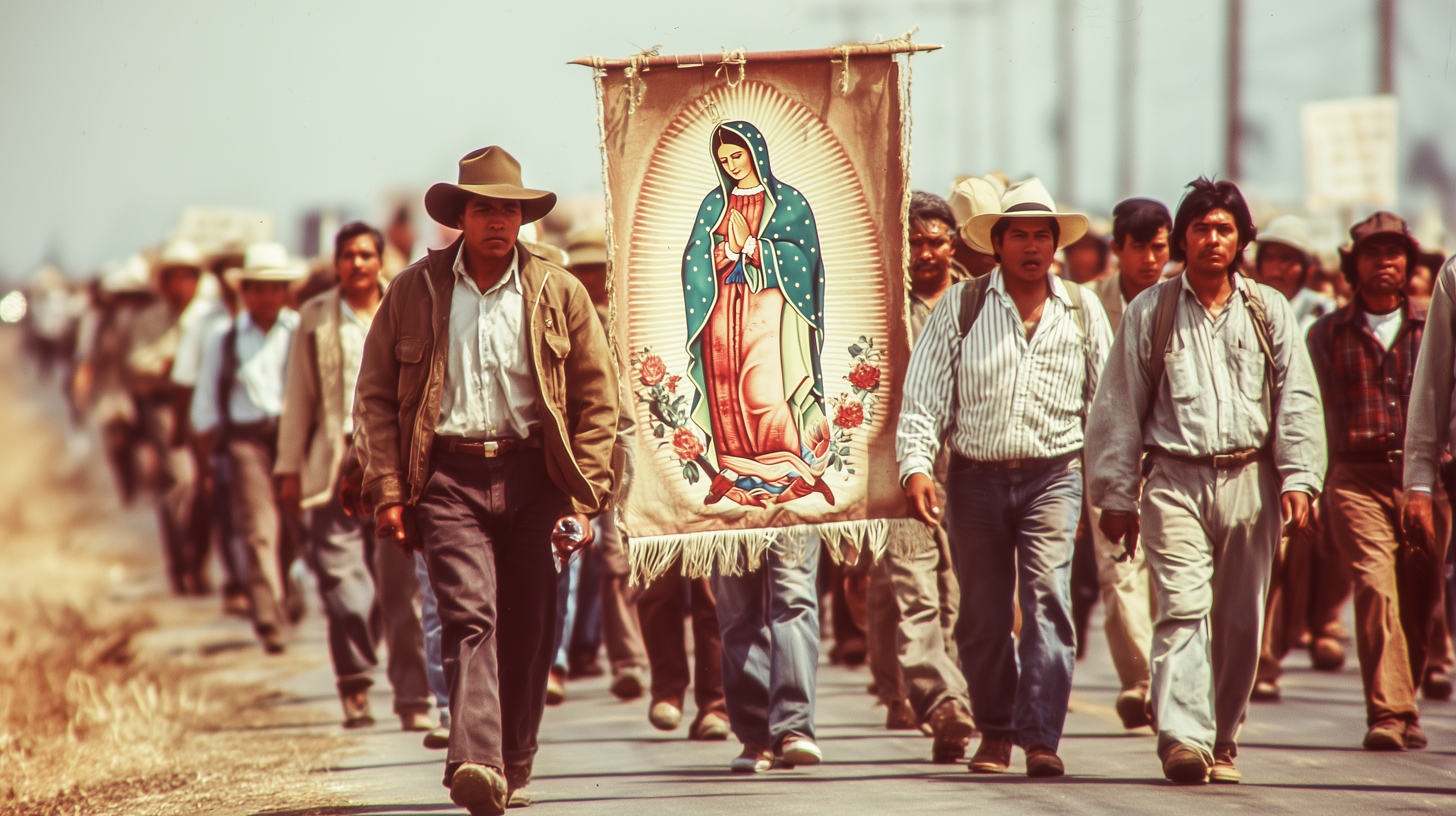
The march begins just as the sun clears the horizon. Feet hit the dirt road that leads out of the camp to the highway, a mixed crowd of Filipinos, Mexicans, and Anglo sympathizers. Chávez leads the way, hoisting a banner emblazoned with the image of the Virgen de Guadalupe, her legendary appearance to Juan Diego invoking an indigenous spirituality.
Days turn into weeks as Ramón walks with strangers that quickly feel like family. They pass through other farmworker camps and small towns in California’s Central Valley. They sleep in churches, on floors, and in fields under the stars. Ramón watches Chávez fast and pray, moved by the man’s dedication and stamina. Ramón carries signs, hands out flyers, and listens to the nightly talks from the organizers. His conviction grows steadily stronger as he learns to speak to people who are angry, afraid, or skeptical, inspiring them with new hope.
Often, they pass police lines and jeering crowds, the opposition Chávez has told them to ignore. Ramón keeps his fists unclenched even when insults fly, spurred by the nonviolent example of Chávez. He learns that suffering shared becomes lighter, and he is moved by the sympathetic people who bring food, water, and blankets to the marchers. He feels something knitting together inside him, pieces of his soul torn asunder by anger that are beginning to heal.
When the march ends in Sacramento, they are greeted by a crowd of 10,000 supporters. During the ensuing rally, Chávez asks the originales to come forward, less than one hundred marchers who made the entire trek of 25 days and 300 miles. Ramon stands among them with tears in his eyes, both proud and humbled by the journey and what it has meant.
But Ramón doesn’t stop. He stays. He becomes an organizer, moving up and down the state, from fields to towns, learning to weave Spanish, English, and Tagalog as he shares words of hope and struggle. He is arrested twice but quickly released. He writes letters home when he can.
And not once does he regret the decision he has made
___
Nearly a year later, Ramón crosses back into Tijuana where his family lives during the months they aren’t picking crops in the US. He walks along familiar streets, some paved, some dirt. The air is warmer, carrying the smell of fried meat and diesel. A stray dog eyes him warily as he turns and walks down the alleyway that was the backdrop to his earliest memories.
His parents’ house is small, but it is home. Ramón and his father, with the help of neighbors, built it piece by piece from cement block. Rebar sticks out from the roof, where the Salazars dream of one day adding a second floor, a dream that has been deferred for a decade.
When Ramón knocks, the door flies open.
His mother pulls him into her, laughing and crying. “¡Mijo!”
Ari seems so much taller as she also joins the hug. His father stands back for a moment, looking him over, as if to be sure he’s real. Then José grins, wide and proud.
They feast that night. There is carne asada, beans in a thick broth, and rice flecked with cilantro. A crowd of neighbors join them, packing the house with a sense of community. Ramon tells stories of the march and his organizing in the days since it ended. But, remembering the example of Chávez, he is careful not to make himself too important. It is la gente, the people, who are the real saviors in la lucha.
He watches his parents listen and sees the way their shoulders straighten.
When they eat, his father lifts a bottle of beer. The room quiets.
“A mi hijo,” José says. “Que caminó por todos nosotros.”
Ramon’s eyes burn. His father raises the bottle even higher. “¡Sí, se puede!”
They echo the cry, their voices filling the room and spilling out into the night.

 Krin Van Tatenhove - Words & Images