Victor Benavides and the Power of Words

Welcome back to our series of interviews with authors in the Story Sanctum family. As I said in the first installment—a conversation with Soter Lucio—it’s a privilege to connect with these writers and learn the backstories to their artistry. This is especially true since they come from vastly different countries and experiences.

This time, meet Victor Benavides, a Texas-based author whose debut short story Carrier the Fisherman appeared on our site on July 1, 2025. It’s a piece dedicated to his grandfather that evokes vivid scenes of war, a brawl in New Orleans, and life along the southern coast of Texas. At the center of it all is Carrier, a larger-than-life presence with an unexpected fate. Take a few moments to read it!

KVT: First, Victor, thank you for taking the time to share with us. I see that you grew up in the Lower Rio Grande Valley (RGV). As a fellow Texan, I’ve spent a lot of time on both sides of the American/Mexican border. Does your family have historic roots in that area?

VB: My father moved here in 1943 when he was fourteen years old. I remember him sharing a story about his first day here—how his brother gave him a pair of canvas shoes that he cherished. He began his career as a radio personality and DJ in the Valley, and later became a writer, producer, director, and actor in several hit films shot locally, such as Treinta Segundos Para Morir and La Banda del Carro Rojo. My mother was born at Mercy Hospital in Brownsville, Texas, and grew up in Port Isabel. She met my father in 1979.

KVT: Your father sounds like a creative character. Do you remember any specific advice he gave you?

VB (chuckling): My dad gave me advice about everything and anything. When it came to writing, he said to write about something that I find truly inspiring. If I get excited with my own words and feel a sense of wonderment and connection, then I have something worthwhile to share with the world. He also told me that whenever I write fiction, add a bit of truth because it will then become greater. Lastly, he told me to write while in the moment. If I feel inspired in the moment and write something down, even if it’s incomplete, I know that one day I will revisit that piece of writing and finish it when inspiration strikes again. 

KVT: Your bio also says that after earning a master’s degree in business administration from the University of Texas Rio Grande Valley, you are now working on a master’s in English. What prompted this shift?

VB: I’m an English teacher here in the RGV, and I decided to pursue a master’s in English Studies to strengthen my skills and broaden my knowledge of the field. I felt that deepening my understanding of rhetoric, literacy, and composition would make me a more effective and impactful teacher for my students.

KVT: I love this quote from you: “I have always been fascinated with the power of words and how they can stir emotions and help a reader transcend into different literary worlds.” Do you have some favorite authors who influenced you?

VB: Authors who have influenced me deeply include Américo Paredes, María Amparo Ruiz de Burton, John Berger, Rudolfo Anaya, Margarita Longoria, Sandra Cisneros, and many others. I’m also drawn to science fiction and admire writers like George Orwell, Ray Bradbury, and others for their ability to expand the imagination and reflect on society.

KVT: Can you share any anecdotes from your teaching when you saw students whose emotions were stirred by the power of words?

VB: There’s a famous story I read to my students called The Appointment in Samarra. It’s about a wealthy merchant who sends his servant to get provisions in the bustling marketplace of Baghdad. The servant returns full of fear. When the merchant asks him why, he says that he saw Death in the image of a cloaked woman and she seemed to make a threatening gesture. The servant asks to borrow the merchant’s horse, then gallops to the faraway city of Samarra to hide and escape from her. Later, the merchant goes down to the marketplace and sees the same cloaked figure “Why did you make a threatening gesture towards my servant?” he asks her. “That was not a threatening gesture,” she says. “I was simply startled to see him in Baghdad, because I have an appointment with him tonight in Samarra.” After reading this, I get a lot of wide-eyed epiphany-induced looks from my students. They realize that the story elicits an emotional response from them because they can identify with the servant’s feelings. No young student really takes into account their own mortality. At that age, they feel invincible. However, the story helps them realize that death is inevitable and that time is a precious resource. Although it’s a bleak story, it helps students appreciate the power of words.

KVT: What are some of your plans for using your writing and your new degree?

VB: I’ve always seen education as a lifelong journey; we’re constantly learning and growing. With my writing, I hope to create literary works that forge emotional connections with readers. I also want to offer more diverse “mirrors” in my work—stories and characters that allow readers from all backgrounds to see themselves reflected and to connect personally with what they read.

KVT: Well, I look forward to reading your work in the future, and I thank you for taking the time to speak with us.

VB: You’re very welcome!

You can find Victor Benavides on Facebook here.

Meet Soter Lucio: Grandmother, Ironer, Horror Fiction Writer

Stories are a communal currency of humanity.Tahir Shah

As Fiction Editor at Story Sanctum Publishing, I have the privilege of reading submissions from around the world. We have featured stories by writers from India, Indonesia, Scotland, Taiwan, and England among others. Through my email correspondence with them, as well as deep dives into their work online, I have broadened my appreciation for Story Sanctum’s diverse family of authors.

Recently, I interviewed Soter Lucio from the Island nation of Trinidad and Tobago. We published her short story The Contract on June 1 of this year. Soter’s background, her chosen genre, and her path to discovering her gift fascinate me.

KVT: Soter, tell me something about your family, past and present.

SL: I have always lived in Trinidad, and my family and ancestors have aways been gardeners. We plant and sell in the market on Fridays and Saturdays. We plant chive, thyme, parsley, and short crops like sweet peppers, tomatoes, cabbage, and ochres. I have four children and six grandchildren, all of whom live on Trinidad.

KVT: The main character of The Contract is a woman who washes clothes along the river. I understand that laundering is a part of your past as well.

SL: I worked as a maid until my girls completed Form 5 so that I could be home in the morning before they left for school and home in the afternoons when they returned. Then I started ironing because we needed more money for university and ironing paid better. That was in 1997. I put advertisements in the newspapers and got enough clients to fill my days. So I ironed from 6.30 am to 8.30 pm, Monday through Saturday, and Sunday between 7 am and 1 pm. I did this from 1997 to 2023. I still iron, but not as much anymore.

KVT: How did you first get interested in writing?

SL: Someone read an essay I’d written in primary school and said, “You know, you could be a writer.” I didn’t say anything because I didn’t know one could even be a writer. Then I read an advertisement in our newspaper about an aptitude test from The Writing School of London. It was a challenge to compose a story based on a photo they supplied. I did. I sent it, passed it, and took their correspondence course. I followed that up with their diploma in writing in 1983. By then I had four children, so writing had to take a backseat until my youngest got her degree in Pharmacy. Then she bought me a laptop and said “Mother go write!”

KVT: Why have you chosen the horror genre?

SL: I think horror chose me. We are from a superstitious community, immersed in a way of life that I now understand to be horror. I grew up with no electricity or indoor plumbing.  I washed and bathed by the river, and I toted water from a spring for all our household duties. Stories about soucouyant, lougaroo, La Diablesse, Papa Bois, and douen were part of our daily fare. Soucouyant are females who suck the blood of women and roll on men in their sleep. Lougaroo shape shift into animals, carrying chains and running about the country scaring people. La Diablesse is a woman who made a deal with the Devil in exchange for eternal beauty. She lures young boys to follow her until they are lost, then she beats them with her razor-sharp hair until they die. Papa Bois protects the animals in the forest. Douen are the babies who die before getting baptized. Stories and characters like these are the root of my horror orientation.

KVT: Wow, those are some scary images to introduce to children. Do you remember an incident from your youth where one of the superstitions seemed to take on a life of its own?

SL: As a child I was told that only devils are in the city. Then, at eleven years old, I passed the Common Entrance Exam for an Intermediate Girl school in Port-of-Spain. I moved there and was scared every day. I was sure my parents hated me because they sent me among the “devils.” I spent my days looking for horns and tails. Where were they hiding them? I never found the answer. I was also told that only devils go to the cinema. When I was about 21 years old, some friends invited me to see a movie. When I got home that night, I actually tried washing away the sin. That shows you how long those superstitions lasted.

KVT: When did you publish your first story? What are some of your writing credits since then?

SL: My first story was published in 2015 by Dark Chapter Press. Then I had others that appeared in Sirens Call Publications, Weird Mask, Wicked Shadow Press, Story Sanctum, and Migla Press.

KVT: If you look back on your work, what is your favorite piece you’ve written?

SL: My favorite is The Last Request of Gladimus McCarran for the simple reason that it was imagined, written, and submitted within a few hours after a long day of ironing.  For me that was quite an accomplishment.  It was published by the now defunct Sirens Call.  A reprint of that story along with others can be found at Metastellar.

KVT: What upcoming projects do you have in the works?

SL: At present, I’m writing a 30,000-word horror novella for Dark Holme Publishing and a short story for Wicked Shadow Press. I’m also attempting a full-length novel that will be based on my life but is not autobiographical.

KVT: Well, I certainly think your fascinating life is worthy of a book. Thanks so much for taking the time to spend with us.

SL: You’re very welcome!

In addition to the links above, you can find Soter on Facebook here.

What Goes Around…

(Dedicated to Tony Morris)
As a man sow, shall he reap. – Bob Marley

You’ve heard the warning. Don’t try this at home. Here’s another one for the list. Detoxing from alcohol.

I already knew that, having endured it enough times to prove every theory of alcoholic insanity. But here I was again, 2:00 a.m., alone in bed. My longtime girlfriend, LeAnne, had deserted months earlier, weary of my lurching trip along the bottom. “Don’t call me,” was her parting salvo, “until you get your act together.”

My act was definitely not together. Sweating, nauseous, dehydrated, I tossed and turned, blood pressure hammering my skull. And I was hallucinating, which was a first. Some ancient script kept scrolling across my bedroom ceiling, like words on a teleprompter. I’m fluent in three languages, and I’ve studied their linguistic histories, but I couldn’t decipher a syllable. Even stranger, I kept hearing lyrics from a Tool song, as if a brain worm had crawled out of my ear canal and was taunting me from the darkness: Why can’t we drink forever? I just want to start this over.

Around four, I got up for water, hungover like a melted corpse in a Dali painting. I tried to orient myself to the date.

Shit, I thought, it’s Thursday morning. I’m going to miss my deadline.

That deadline was my weekly submission for the newspaper where I worked, one of the great holdouts of print media, a standard in our metropolis for 170 years. People read it during the Civil War, the Oklahoma Land Rush, the dawn of the Industrial Revolution, the two great wars designed to end all wars. They read it through McCarthyism, the Bay of Pigs, the assassination of M.L.K., Jr., the rise of the Internet, the toppling of the World Trade Centers. They were still reading it in print and on their devices.

My only remaining pride was to be part of that grand tradition. A few years earlier, my investigative piece on the dreadful conditions in for-profit prisons had been a finalist for the Pulitzer. I was riding the last fumes of that fame, my disease a riptide pulling me into oblivion.

I stood at the window of my fourth-floor apartment, my reflection as dark and featureless as I felt. A panoramic view of the city spread to the horizon—shimmering lights, bright towers, rivers of red and white traffic. I reached into the top drawer of the dresser, my hand coiling around the grip of a Glock 19. I didn’t buy it for home defense. I’d never been to a gun range. It was there for one reason only—to offer a way out if things got too grim.

I lifted it to my head and pressed it above my right ear. As I closed my eyes and tried to suppress my anguish, the only thought I had was, Call Tony.

Tony deserved to know that I’d miss my obligation. He was more than my editor. He had been a friend during my descent, encouraging me to get treatment, never threatening to cut me off.  My cellphone was on the dresser, so I picked it up and dialed his number. After five rings came a groggy response.

 “John…what the hell? Do you know what time it is?”

 “I’m sorry,” I croaked, my voice dry and hoarse. “I won’t be able to get you my article. I’m sorry, Tony.”      

 Silence on the other end.

 “Are you okay, John? Do I need to come get you and finally take you for some help?”

 “I’m just so tired,” I whispered. “I’ve lost LeAnne. I’ve lost my pride. And now I can’t even meet my deadline. I’m going to make it all go away.”

He knew instantly what I meant. “Please don’t do that, John. I still believe in you. I believe in your talent. I believe your words have made a difference to so many people. They are still making a difference. Your gift will remain and you can start over again.”

 “I’m tired of starting over. Just so fucking tired. Tired unto death.”

 Again, a few seconds of silence. My finger tightened ever so slightly on the trigger.

 “John, I’m pleading with you. Get up off your knees and try again, this time in a new way. Let me pick you up and take you somewhere for treatment.”

 I stood there, frozen, staring out at the city, my hand cocked to my head, as tears began to roll down my cheeks.

Two years later

In the break room that day, a colleague asked me, “What’s the greatest lesson you’ve learned in sobriety?” I don’t think he was really interested, just being polite. Non-alcoholics are muggles when it comes to understanding the disease. It was hard to choose an answer, but I used an adage from my Twelve Step meetings. Accepting life on life’s terms. A humble acknowledgement that there’s so much we can’t control. Or, to put it another way, there’s so much we should never even try to control. Control is an addiction all its own. My colleague nodded, then said, “Well, I admire you, John.”

I leaned back in my desk chair and thought of how that answer stemmed from multiple hard lessons. Since that fateful morning when Tony drove me to rehab, I’d gotten ample opportunities to practice letting go. I had called LeAnne, but she had no desire to reunite, having found someone who she said, “was more stable.” Then there was the newspaper continuing its transition to an online presence, hiring freelancers and paying them a pittance. My salary was downsized. Tony and I met for coffee once a week, and he tried to explain it as my friend, but I didn’t blame him. It was the new reality, and he was even questioning the security of his own position. 

To make ends meet, I’d taken a job as an adjunct professor at a local junior college, teaching courses online. It was mildly enjoyable but never fulfilling. I longed for those years when I was hot on the trail of an investigative project, tracking it down and bringing it into focus. That was my passion, my highest calling, and I was afraid my newfound acceptance would turn into toxic regret.

 Then, at one of our weekly confabs, Tony surprised me.

“I have some news, John. I got a call from a midsize paper in the Midwest. Instead of surrendering, they want to try and resurrect their presence. They offered me a job as Editor-in-Chief, hoping I can turn things around.”

Since Tony was my only real friend, my first thought was Here we go again, another thing to accept. But I pushed that aside. “Are you going to take it?”

In his mid-50s, 20 years my senior, Tony still dressed like a hipster. Graphic T-shirts from rock concerts, a leather jacket, pressed chinos, thick-framed glasses of various colors, and one of the many fedoras he collected. He took off his hat, running his hand through his goatee, then over his bald head. I’d seen him do it a thousand times.

“Yeah. I already signed a contract. I would have told you sooner, but the negotiations were touch and go.”

He took a sip of coffee. “It was hard to convince Joanne, but both of us have fantasized about living in a smaller city with less congestion. Plus, my job here isn’t stable.”

I nodded, trying to hide my disappointment. “I’m happy for you. You deserve only the best. Both you and Joanne.”

“Thanks, but there’s more. The paper gave me the latitude to bring in new talent. I’d like to offer you a job as my top journalist.”

Looking back on that moment, there was a shift in me. I’d heard countless people describe their beliefs that some higher power, some God or force, was accomplishing in their lives what they could not do for themselves. It was that instant when I made a baby step towards believing. It was like a puzzle piece snapping into place. I had no prospects, only my wistfulness about the past, and I, too, had grown tired of the impersonal vibes of the city.

 “Let me think about it, Tony,” I said, but I knew in my heart that I was ready.

Summer, two years later

I shut down my computer, pleased with my latest installment in a series on fentanyl trafficking in the Midwest. It featured three families whose lives had been tragically damaged by the substance and were speaking out to make a difference. It wasn’t easy reading, but it was timely and prophetic. The narrative arcs were strong. I was feeling my old mojo.

I looked out the window of my office. The building that housed the newspaper was on the edge of town, bordered by a sweeping expanse of corn fields, the cash crop of the Midwest. Accustomed to urban landscapes, I was surprised by how much I had grown to love the vastness and tranquility of my new home. Sometimes I’d get in my car and drive to the middle of nowhere, clearing my head. Or sit at a roadside picnic table and practice letting my past and present converge into a sense of serenity.

My thoughts turned to Tony. He had overseen great progress at the paper, but I was worried about him. Joanne’s reluctance to move had blossomed into discontent.  She said she missed the cultural opportunities of the big city and complained that their new neighbors were parochial. Finally, she left Tony with an ultimatum that if he didn’t join her within a year, their marriage was over. That deadline had come and gone.

Simultaneously, Tony developed back problems—aggravated by stress and too many hours at a desk. He underwent surgery to fuse three lower vertebrae, and the pain meds they gave him during recovery got their talons into him. He had lost some of his sharpness. I saw it. So did others. It was the proverbial elephant in the newsroom. When I expressed my concern, he thanked me, shifting his gaze to the side, then told me everything would be okay, yet I knew firsthand how addicts minimize their usage.

The irony struck me—my own addiction and denial, his support as a friend, even the fact that I was investigating opioid trafficking. I wanted to help him, and I felt poised to make a difference in his life, but people only change when they’re ready.

On this day, he had phoned in sick. It had happened other times recently, and the staff was getting more suspicious. I waited until late afternoon, then called him. No answer. I waited until nightfall and tried again. Still no answer. Highly unusual.

I decided to drive to his house for a welfare check. He lived on the edge of town near a creek bed bordered by tall trees and a hiking trail. The stream was damned in various spots to create ponds where people could sit and absorb the scenery.

I parked next to his car in the driveway and got out. The streetlights were on, already attracting swarms of bugs. It was a warm summer night and I could smell the creek bottom, damp and mossy. When I got to the front door, it was slightly ajar, stoking my worries. I pushed it open.

“Tony,” I called out. “Are you here? It’s John. I’m just checking on you.”

No answer. I entered and made a quick search of the modest home, noting the decorations that showed Joanne’s sense of style. He wasn’t there. I thought about calling the police; maybe there’d been foul play. But I also knew that Tony liked to hike along the creek to a favorite spot near one of the ponds. I would check there before calling the authorities.

The paved trail along the water had light poles spaced at intervals, but it was still gloomy. Frogs and crickets had begun their evening symphony, accompanied by the gurgling of the creek. I quickened my stride and, sure enough, as I approached the first pond I could see Tony’s unmistakable form, his bald head reflecting light from a pole just above him. He was seated on a bench, and when I slid next to him, he looked at me.

I’ll never forget his eyes. They mirrored my own that night I had pressed the gun against my temple. It was the gaze of a man trapped in his personal purgatory, conceding the doom of a repetitious behavior that would grind him throughout eternity.

He tried hard to focus. “John? What are you doing here?” His voice was soft and raspy.

“I’m here to help you, Tony. I know the pills have taken you down. I know that Joanne leaving is still depressing you.”

He turned away, his breathing labored. The plaintive call of a lonesome owl drifted out of the darkness.

Too much,” he whispered. “Just too much.”

“I know,” I said, “But I want to remind you of some words you said to me a couple years ago. I believe in you, Tony. I believe in your talents. I believe in how you care for other people. Hell, I wouldn’t be sitting her next to you unless you had stayed by me.”

He began to shake, a tremor running through his body. Then he slumped forward, placing his arms on his legs. One of them slipped and I was afraid he would topple over, so I supported him under his armpit.

“Come with me, my friend. Let’s get you the help you need.”

He rubbed his right hand over his head and sighed. “Okay, John. Okay.”

A year later

The hotel’s grand ballroom, with its opulent chandeliers and art deco design, was a splendid choice for our region’s journalistic awards banquet. The tables sported newsprint tablecloths, and large TVs on the walls displayed the year’s best photos and art.

Our staff had carpooled to the capital, an annual trek that we all enjoyed. Seated at our table, my colleagues were drinking wine or cocktails from the open bar as I nursed a ginger ale. Tony sat next to me, sipping a Diet Coke. As I looked around at their faces, I thought of how far afield our life’s paths can take us. We end up in divergent realities we never expected, but when we make them our own, they enrich us immensely.

Just moments before, I had received an award for my series on fentanyl. A far cry from contending for the Pulitzer, but somehow more valuable to me given all that had happened in the past few years. As the evening neared its climax, they were about to announce the ultimate award—Journalist of the Year.

The MC, Editor-in-Chief of the state’s largest newspaper, went to the microphone.

“Ladies and gentlemen,” she said, “thank you for being here. Let me congratulate all those who have received awards this evening. We are a talented group. Together, we’re keeping journalistic excellence alive in a rapidly changing world of sound bites and short attention spans.”

She lifted her glass. “A toast to our continued success in the coming year.”

There was a raucous chorus of “Here! Here!” that died down in anticipation of her announcement.

“And now,” she continued, “we come to tonight’s most prestigious award. I would ask for the envelope, but there isn’t one.”

The crowd tittered.

“With no further ado, let me recognize our journalist of the year, Tony Harris, for your editorial prowess, your sharp wit, and your business acumen.”

The room exploded with applause, and people began to shout, “Speech! Speech!”

Tony looked genuinely surprised. He got up and made his way steadily to the podium, evidence that his physical therapy was making a difference. He took the mic from the MC, then ran his hand through his goatee and over his head before scanning the room in a moment of silence. Everyone quieted down.

“For those of us who have ink in our blood,” he said, “this night is a celebration of that passion that will not let us go. And I can’t thank you enough for this honor.”

He looked down for a moment, clearly emotional.

“I want to share a truth that I’ve learned firsthand. Karma can be a bitch, but it can also be the force that saves our lives. I won’t get into the details of how deeply I understand this, but I just want to say one other thing.”

He’d taken his coke with him to the front.

“I have a personal toast to my friend for many years, John Newcombe.”

He lifted his glass.

“John, what goes around comes around. You know what I mean, brother, and I’m eternally grateful for our relationship.”

Tears welled in my eyes. I lifted my tumbler and toasted not only to Tony, but to every suffering soul, every individual trapped in purgatory, every person teetering on the edge of a decision that was as final as the closing of a coffin lid. And for every last one of them, I poured out a silent prayer of hope and healing.

“Here! Here!” shouted the crowd around me.

High Country Hozho

Flagstaff, Arizona
In beauty, it is restored in beauty. – a Navajo proverb.

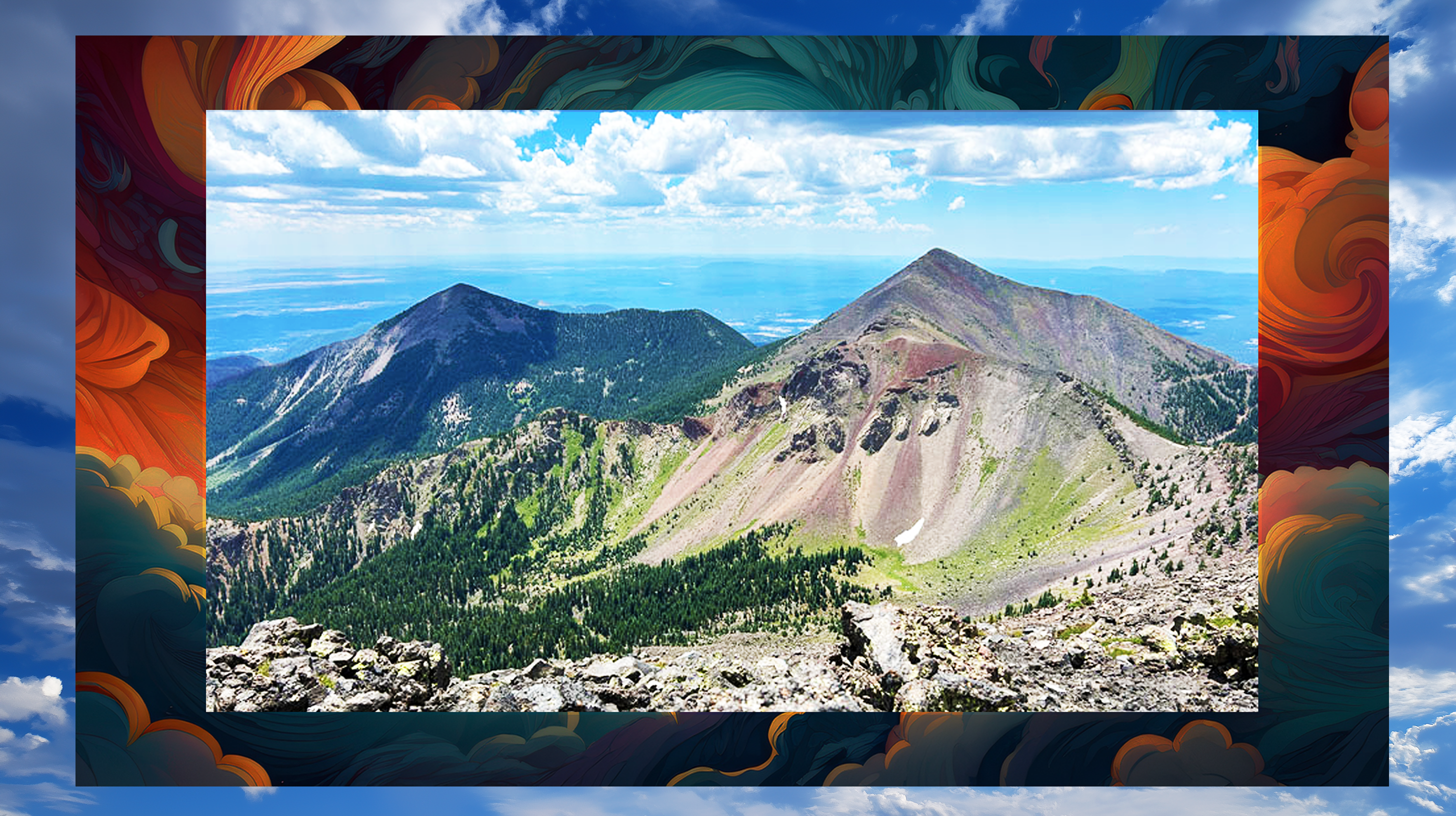
Through the diner’s window, I could see Humphrey’s Peak in the distance. Rising to 12,633 feet, it’s the crown of the San Francisco Volcanic Field, some of North America’s most ancient geology. Andrew A. Humphreys was a Civil War General, so I prefer the Hopi title for the mountain, Aaloosaktukwi, meaning “its summit never melts.”

It was now August and the snowpack was thin, clearing passage to the top on a popular trail. I planned to hike there the next morning.

I sipped my coffee and waited for the breakfast burrito recommended on Yelp. The place was popular, with most of the tables filled, a clatter of dishes and conversation. The smell of bacon and biscuits filled the air.

Two months earlier, my wife, Liz, had seen my restlessness and sour mood. She’d endured my complaints about politics, the economy, and the inept administration at the high school where I taught. FUBAR, I muttered too often. I was out of whack, even more so than usual, and a deeper level of angst was seeping into my dreams at night. Finally, my grumbling was too much for Liz.

“Why don’t you use your summer break to get out of here,” she said. “You’ve always wanted to hit the road like the Jacks. What better time to do it?”

By Jacks she meant Kerouac and Reacher, two wanderers—one real, one fictional—that had always intrigued me. Liz knew that I lived vicariously through too many literary characters, reluctant to act on my own desires. She was laying down a gauntlet.

“You wouldn’t mind holding down the fort?” I asked. We’re childless, so that meant caring for our dog and cat.

She smiled and winked. “Mind? I’d be relieved to get rid of your moping for a while.”

We both laughed and I made my decision. With very little foreplaning, I took our old Nissan Sentra and left our home in Fresno, California. Driving isn’t romantic like hitchhiking, or using trains and buses, but I still let the road guide me. No set route, traveling at whim. I’d been to over a dozen states and seen some remarkable things. Now I was heading home.

But I still felt restless and out of balance, not what I expected after my mobile version of a walkabout. I feared this would be my default mood, and the thought of returning to work gave me claustrophobia. Liz deserved more. My students deserved more.

The server, a young Latina with multiple piercings and a bright smile. brought my breakfast and refilled my coffee. My eyes kept returning to the peak, imagining the next day’s trek, when I had that sense that someone was watching me. I turned towards the dining counter, its swivel chairs lined with customers. There was a tall man wearing jeans, boots, and a Carhartt shirt, his long black hair in a ponytail. He looked to be in his mid-20s, certainly Native American, with high cheekbones and large, slightly almond-shaped eyes. He smiled at me as he slipped off his stool and made his way to my table, coffee cup in hand.

“I hope I’m not being rude,” he said, “but I notice how you keep looking to the mountains.”

Conversations with strangers had been some high points of my travels. “You’re not being rude at all. I’m just thinking about my hike up Humphreys tomorrow morning. I’m looking forward to it.”

He nodded. “It’s a great climb. I was up there a couple weeks ago, something I wanted to do before going home. Now I’ve been to the top of all four sacred mountains.”

“Four?”

“Yes. Mount Blanca to the east. Mount Taylor to the south. Mount Hesperus to the north, and these San Francisco Peaks to the west.

He gestured first through the window, then to the empty seat across from me. “Mind if I join you?”

“Not at all. I’d love the company.”

He settled in and placed his cup on the table.

“My name’s Thomas,” he said, reaching his hand across the table to shake mine.

“Phil,” I responded, returning his strong grip. “You mentioned going home. Where’s that?”

“Shiprock. My family has roots that date back centuries.”

“So, obviously you’re Navajo.”

“Navajo alone,” he said with a wry smile.

“What does that mean?”

 “That both sides of my family have never intermarried with other tribes or races. At least that’s what we claim. It’s a huge point of pride, especially for my mother’s clan. Navajo snobs”

He laughed. “How about you? Where are you from?”

“Fresno, California. I’ve been wandering around the country for a couple months, but I’m heading back. I’m a teacher, so I had a summer break. I’d always imagined taking an unstructured trip.”

He nodded and sipped his coffee. “I’m thinking about teaching, but in a different way. I just graduated from Northern Arizona University with a degree in anthropology. I’d like to be a cultural interpreter, hopefully with the National Park Service.”

“Sounds like a great goal.”

He studied me for a few seconds. “I’m curious. Was all your wandering what you imagined it would be?”

His question felt like a tipping point. How much would I share with a stranger? I decided to let it all out.

“There’s an old saying, ‘wherever you go, there you are.’ I started this trek because I felt unbalanced. I had let so much of the conflict in our country get inside me. I felt powerless and insignificant, despite my wife’s love. I know it sounds self-entered, but it was even hard to sleep at night. I thought that getting away for this time would help clear my head.”

 “But it didn’t?”

“Not really. And now that I’m headed home, I have this depressing feeling that I’ll just pick up where I left off.”

He didn’t say anything. We sat in silence as he turned his eyes to the distant peak. I began to wonder if I’d been too intimate, but I just waited. The breakfast crowd was thinning, with people leaving and cars pulling out of the parking lot.

Finally, he turned his eyes back to me. “Do you know the Navajo word hozho?”

“Vaguely.”

“It’s hard to translate, especially for Western minds. The closest bilagáana words would be balance or harmony. Our right relationship with nature, our community, and our inner selves. You could say it’s the quality that Navajos hold most sacred.”

 I shook my head ruefully. “Harmony is rare in our world. I don’t see it anywhere, and it doesn’t help that I doom scroll too much on the web.”

He chuckled. “I hear you. I can get wrapped up in it also, especially when I return home. There are so many challenges on the reservation and our people have such a painful history in relationship to this country. I have a sister who works as a nurse in one of our medical clinics. She keeps urging me to stay on the res and work to better our conditions, but I don’t think it’s my path. To be honest, I’m searching for a clearer direction.”

I appreciated his candor. “I always encourage my students to find their own calling. The pressure to adopt scripts from our family and society is damn strong.”

He nodded. “That’s another reason I’m going home. To meet with my grandfather. He’s an old sheep farmer but also one of the most respected medicine men on the res. Growing up, whenever he could see I was troubled, he insisted on helping me return to the old ways. Sometimes a sweat, sometimes a sing ceremony, sometimes just a reminder to say my daily prayers.”

“Did it work?”

“Usually,” he said with that wry smile again.

He reached into his pocket and pulled out what looked like a business card. “Anyway, I need to get on the road. Can I leave this with you?”

He handed it to me. “You probably know this famous prayer, the Blessing Way, but I find it helpful when I’m feeling restless or disturbed. I designed these to share with others I meet. A small piece of my culture.”

The printing on the card was embossed, set against an image of a sunrise. It read, With beauty before me I walk, with beauty behind me I walk, with beauty beneath me I walk, with beauty above me I walk, with beauty all around me I walk.

I’d heard the words before, but not for a long time. “Thank you. I’ll remember these few moments we shared.”

He stood and reached to shake my hand. “So will I. I’ll be thinking about you on the trail tomorrow. You’ll probably be near the summit as I pull into Shiprock.”

Then he nodded and left. Through the window, I saw him get into an older Dodge pickup and merge onto the highway. I smiled and turned my gaze once again to the mountains.

________

I left the trailhead at dawn under a clear blue sky, determined to reach the top and return before the weather changed. Afternoon thunderstorms were always a threat, and I didn’t want to be exposed on the peak.

The trail took me through shimmering aspen groves and meadows laced with lupine and columbine. Butterflies drifted among the flowers like blossoms with wings. The air was redolent with the smell of the soil, the grasses, and the trees, an intoxicating mix. At one switchback, just a few feet from the trail, a partridge eyed me with curiosity.

Mid-morning, I broke from the timber line and climbed the craggy volcanic stones of the final ascent, like mounting the stairs of an ancient temple jumbled by earthquakes. To my right, snow still clung to the slope. Swifts arrowed overhead, trapping alpine insects with precision.

The view from the summit was breathtaking. On the northwestern horizon was the rim of the Grand Canyon, carved over eons of time. To the northeast were the mesas of the Hopis who historically believed this peak is where kachinas live, the blessed bringers of rain.

The wind was brisk, buffeting my face. I’m not sure how long I stood there drinking in the vistas, but slowly, thoughts of returning to the workaday schedule of my life began to crowd my mind, like traffic noise or conversation from a distant room that suddenly got louder. I pushed it away, thinking of my brief encounter with Thomas and the prayer he’d left with me.

I took a deep breath and surveyed the splendid view ahead of me. I turned my head to an equally magnificent panorama behind me. I looked beneath me at the multicolored volcanic stones, remnants of primordial eruptions. Then I lifted my eyes to the blue dome of the sky.

Beauty. All around me. Embracing me and moving through me, dissolving resistance to its presence. Time never really stands still, but it surely felt like it as I stood there for moments, for eternity, with only the wind in my ears and the sound of my own breathing.

When I finally began my descent, it was a pivot beyond words, a personal kenshō, and as I fell into my hiking cadence, I thought of some words from a review of Kerouac’s Dharma Bums: “In the end, you won’t remember the time you spent working in the office or mowing your lawn. Climb that goddamn mountain.”

I started laughing so hard that some other hikers approaching me on the trail were startled.

“Having a good time?” one of them asked with a bemused smile.

“The time of my life,” I responded.

Under the Bell Jar with Sylvia

But I wasn’t sure. I wasn’t sure at all. How did I know that someday—at college, in Europe, somewhere, anywhere—the bell jar, with its stifling distortions, wouldn’t descend again? – from “The Bell Jar” by Sylvia Plath

Throughout my career, I walked with the wounded. I communed with those suffering grief, addiction, disease, and mental illness. I’m certain that my personal struggles, so close to the surface, helped me become what Henri Nouwen called a “wounded healer.” It was a privilege to share sacramental moments with fellow human beings.

There’s an incident seared in my memory. Bob, a member of a church I served, had reached the end of what he could tolerate. He took a pistol, walked out to his driveway around midnight, and shot himself. I lived two blocks away, where I was awoken by my phone jangling. It was a police officer. An ambulance was on its way, he said, but Bob, somehow still conscious, was asking for Pastor Krin to come to his side. I got there quickly, where I kneeled next to him, his head haloed by blood. Under the bell jar, our eyes met. I assured him that both his Creator and I loved him, and that nothing could separate him from that reality. I believed it then; I still do.

Miraculously, he survived without brain damage and went on to heal the underlying depression that drew him into the abyss.

My empathy for those who suffer has never subsided. Recently it extended to Esther Greenwood, the main character of Sylvia Plath’s only novel, The Bell Jar, published just before she committed suicide. Set during a single summer, it’s the story of a young woman’s descent into depression. Beginning with a writer’s internship in New York, she plummets through a series of mental asylums, enduring primitive shock treatments along the way.

The novel had been on my radar for years, one of those “must reads” for students of serious literature. I knew about Sylvia’s tumultuous relationship with poet Ted Hughes. I had read some of her poems which really didn’t speak to me, but this novel was both lyrical and terrifying. I will never forget it.

The bell jar becomes a metaphor, a symbol of the pressures Esther faces to conform to societal norms. The conventional paths of marriage and motherhood, held up as ultimate goals for women, feel like chains to her, stifling her ambitions and suffocating her spirit. She yearns for freedom, for the ability to define her own life, yet every attempt to assert control pushes her further into despair.

Esther speaks of this inner turmoil. “I was supposed to be the author of my own life.” “I wanted to be intelligent and popular.” “I wanted to be a perfect person.” “I always believed that if I did or said the right thing, then everything would turn out all right.” “What is the point of this life if we are not living it to the fullest?”

Increasingly, depression dictates her thoughts. “It was as if I were always wearing a mask.” “I felt like I was drowning.” “The world was a big, dark ball, and I was all alone.” “The only thing I could do was stay quiet and let the shadows take me.” “I wanted to disappear.”

Seen through the bell jar’s distortion, Esther’s urge to vanish means ending her life. She contemplates multiple methods. Jumping off a roof. Drowning in the ocean. Then, in her most dedicated effort, taking an overdose of pills.

That final attempt still chills me. Esther makes her way to the family cellar, then to a dugout tucked in its furthest recess. She crawls inside, pulls some firewood against the entrance, and takes every pill in her bottle.

It’s hard to describe how that affected me. I was right there, sitting next to her in the damp darkness, powerless to banish her despair, bearing witness to a life that mattered as preciously as any of ours.

My colleagues and I call it the “ministry of presence.” Simply being with another person during their trials. Refraining from trite platitudes. Offering only love and grace. Over the years, it led me to sit beneath the bell jar with so many people, enduring their pressures with them, believing that the necessary remedies would emerge but that love and empathy come first.

Admittedly, I took this further than many. I remember being at the bedside of an elderly woman in her final days. She had no family left, and her failing heart would soon stop beating. I had been walking with her through all of this like a surrogate son.

She looked up at me, and in a weak voice said, “Pastor Krin, will you lie down next to me?”

Frankly, I didn’t care what the hospital staff felt. There was enough space next to her frail body, so I stretched out alongside her. She turned, laid her head against my shoulder, and softly fell asleep.

As I looked up at the ceiling of the hospital room, listening to her shallow breathing and the echo of voices in the hallway, something transcendent happened. The distortions of the bell jar completely cleared. There was only the present, the connection of two lives, and the omnipresent love that embraces all of us if we let it.