In Search of Higher Power

The longer I live, the more I believe that faith is a miracle. Faith that unflinchingly views our world in all its warring madness, yet still trusts in love. Faith that weathers those nights of existential angst, the abyss yawning, and somehow reorients to hope.

I also believe that each person’s faith journey is unique. Religions proselytize, sharing their versions of absolute truth, but every signpost pointing to Mystery should include a disclaimer: “This is the best approximation we are living with now. We invite you to join the dialogue!”

As a recovering alcoholic, I treasure a cornerstone of Twelve Step fellowships. We share the wisdom that a “power greater than ourselves can restore us,” but we never proselytize. One’s higher power must arise from personal understanding. Otherwise, the relationship lacks authenticity and strength. Spirituality, not religion, is the wellspring of recovery.

Over the years, I have heard some stirring accounts of people’s searches for truth. Here is one of many from my book, The Pattern (freely downloadable here). I hope it increases our sensitivity to the sacred journeys of those around us.

One woman, raised in oppressive church environments, rejected all notions of God or religion. She believed that ever since we crawled out of caves, we have grappled with the question of being born to die, the issues of ultimate meaning, the enormity of mystery surrounding us. She saw the beauty in certain faith systems and philosophies, but if those who practiced them became even slightly insistent that their truth trumped others, she quickly exited the scene. She had forever had her fill of judgment, misguided zeal, and the pressure to conform.

In early recovery, she was forced to confront the truth that her life had led her to anger, cynicism, isolation from others—a state of mind she medicated with prescription drugs.

One morning she was seated on her porch, meditating on a passage of daily reading. The air was cool, the early light soft upon her face, a chorus of birds lilting from the trees. A sense of peace settled over her. It was deeper and more profound than anything she had ever experienced, calming her body, mind, and soul. Though she had always balked at prayer, familiar words echoed in her mind: “Grant me the serenity…”

She says she will never personify this experience, attributing it to a deity, but its power is undeniable, and she believes it is not an outcome of her own thinking. It is something greater than herself. Her Higher Power is this peace, this serenity, and learning to live in the middle of it one day at a time is her program.  

I am eternally grateful to my faith community known as the Presbyterian Church (USA). Raised in a Christian household, I became a wandering soul, searching through many philosophies and faith systems until my friend, Rev. Rex Stewart, invited me to visit his home church, St. Andrew Presbyterian, Albuquerque. I describe what followed in my book Invitation to the Overview (freely downloadable here).

From the moment I entered that church, I experienced a homecoming. This was a community of faith that embraced searchers and encouraged free thinking. They respected the sanctity of individual conscience. My personal beliefs were my territory, not theirs; they simply celebrated the chance to commune with me. Giving people the space to connect to Spirit without the pressure of conformity is a priceless gift. This is one of the meanings of sanctuary.

I feel privileged to be on this journey with all of you!

Colorful hot-air balloons flying over the mountain with with sta

Confession-less or Confession-free?

I chuckled at the media furor over Donald Trump’s choice not to recite the Apostle’s Creed during the funeral of George H. W. Bush in 2018. I laughed for two reasons. First, Americans politicize every action; it’s the bait and fodder of the endless news barrages that polarize us. Second, I laughed because I, too, might have remained silent beside the Donald.

The difference is that unlike Trump, I know every syllable of this ancient Christian creed. It was branded – even seared! – into my memory during two years of Lutheran confirmation classes. In retrospect, that process maddens me. Take a young mind just beginning to think for itself, then tell it to confirm a list of absolute truths passed on from institutional powers. No encouragement to explore other faiths or philosophies. No freedom to broaden one’s search. Just force feed and regurgitate the age-old tropes.

Yes, I know the Apostle’s Creed as readily as I know the American pledge of allegiance. It’s just that I (like many I know and love) no longer resonate with its doctrines: a patriarchal blueprint for god (almighty father, only son), a virgin birth, the descent into hell, a literal resurrection.

I simply don’t believe these things. What I do believe is that we should carefully scrutinize any formulas presented to us. We should ask ourselves if these truths make sense in the laboratories of our own daily lives.

In the introduction to my 2019 book, Neighborhood Church: Transforming Your Congregation into a Powerhouse for Mission (co-authored with Rob Mueller), I quoted my oldest son, Pieter. He speaks here of the spiritual values he shares with his circle of millennial friends.

“We are seekers first, Christians second (if at all). We are reluctant to make statements of faith because they calcify that part of our brain that seeks new understanding.”

For 32 years, I was affiliated with the Presbyterian Church (USA), a branch of Christianity that claims a “confessional heritage.” It’s Book of Confessions – faith pronouncements from key, often turbulent eras of history – provide clinical insights into Western colonial thinking. However, on the level of doctrine, I cannot accept or affirm any of them in totality.

It’s not that I don’t have faith. You could even say I have my own creed, but it’s always evolving. Further, I don’t expect others to describe their journeys in any way that doesn’t make sense to them. Here’s a taste of where I’m at. I would love to hear your own thoughts in response to this post.

I believe in a Presence that humans have variously called God, Spirit, Tao, Higher Self – a mystery at the heart of all spiritual awareness, yet personal in a way that guides my life. I believe in the power of love and how it spurs me to work for justice in nonviolent ways. I believe that the teachings of many spiritual leaders – among them Jesus and the Buddha – call us to counter the cold love, materialism and self-centeredness that plague us as a species. I believe that forgiveness, even of enemies, is a triumph of human evolution. I recorded something similar in my book, Invitation to The Overview.

In my final years as an ordained worship leader, I struggled mightily with that part of the liturgy traditionally called the Affirmation of Faith. How can we affirm the miracle of belief without anthropomorphic boundaries? How can we seek Truth without stumbling over truths as articles of faith?

There is one creed that I do like, almost in its entirety. It hails from the Iona community of Scotland.

“We believe that God is present in the darkness before dawn; in the waiting and uncertainty where fear and courage join hands, conflict and caring link arms, and the sun rises over barbed wire. We believe in a with-us God who sits down in our midst to share our humanity. We affirm a faith that takes us beyond a safe place: into action, into vulnerability and onto the streets. We commit ourselves to work for change and put ourselves on the line; to bear responsibility, take risks, live powerfully and face humiliation; to stand with those on the edge; to choose life and be used by the Spirit for God’s new community of hope. Amen.”

Words like these allow me, in good conscience, to raise my voice with others in corporate worship. They don’t calcify the search but spur me onwards.

Many may call me confession-less; I believe I am confession-free. And for all those classic-rock buffs reading this: freedom tastes of reality.

Foxcatcher and the Power to Bless

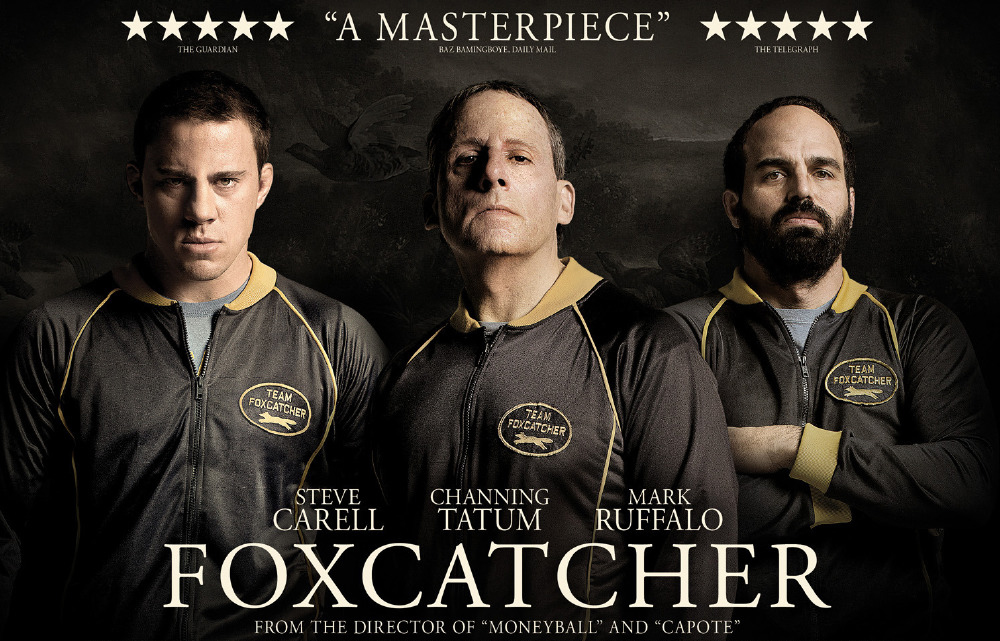
I recently watched Foxcatcher, the award-winning film based on true events. It tells the story of eccentric multimillionaire, John du Pont, and his recruitment of two Olympic gold medalists, Mark and David Schultz, to help coach U.S. wrestlers. It’s a painful tale, especially the tragic ending.

foxcatcher-uk-quad
One of its poignant themes is what I call “a lack of blessing.” Though they come from starkly different classes, both du Pont and Mark Schultz share the same malady. Each of them is searching for an affirmation they never found in their family of origin. Each of them is trying to fill a hole that drives their personalities in unconscious ways.

No family is perfect. Most of us suffer a bit from what R.D. Laing called the “post hypnotic trance induced in childhood.” One sign of maturity is to not only grow beyond the limitations of our upbringing, but to embrace the lessons we learned in that struggle. I deeply admire women and men who overcome troubled beginnings and go on to live productive lives.

However, as a pastor I have also seen the addiction, depression, and grief that stem from early psychic damage. This is why I call all of us to exercise our POWER TO BLESS. Through our words and actions, we can help others slowly heal the scars they carry beneath the surface.

Years ago, Gary Smalley and John Trent wrote The Blessing: Giving the Gift of Unconditional Love and Acceptance. Using Isaac’s Old Testament blessing of Jacob as a model, the book suggests five elements of this treasure that we can shower on others:

  • meaningful touch,
  • words of love and acceptance,
  • attaching high value to them,
  • picturing a special future for them,
  • committing to our part in helping them fulfill that future.

Here is a blessing I recently gave my wife, Donna. Yes, I thought of it ahead of time. Yes, she knew it followed a model. She also knew every word is heartfelt.

After hugging her, I said: “Donna, I love you unconditionally. You have amazing qualities of mercy, patience, perseverance, and an ability to meet people on their terms. I believe that your work to obtain a college degree will not only come to fruition, but give you deep satisfaction. As your partner, I will do everything I can to support you.”

So simple, a mere moment, yet these blessings can make a miraculous difference, especially when others are facing circumstances that erode their trust in themselves, in others, and in God.

Friends, we have the power to bless others! We can wield it in our families, neighborhoods, workplaces, and churches. In this world that continually grades (and degrades) people according to societal standards, we can help them remember that they are created in God’s image, unique children of our Maker.

Early in Moby Dick, Ishmael is dealing with the harsh realities of life on a whaling ship. He says, “…however the old sea-captains may order me about—however they may thump and punch me about, I have the satisfaction of knowing that it is all right; that everybody else is one way or other served in much the same way— either in a physical or metaphysical point of view, that is; and so the universal thump is passed round, and all hands should rub each other’s shoulder-blades….”

So true! Let’s rub each other’s shoulder blades through our power to bless.

Unmoored: A Life Untethered to Places and Things, by Emily Rohrer

“We don’t need more closet space. We need fewer things.” “Don’t get me a gift. Let’s go somewhere.”

IMG_6900

I’ve repeated these statements dozens, if not hundreds of times. And for more than three years now, I’ve been lucky enough to share with my husband a lifestyle that combines both tenets.

In 2015, we downsized out of our 2900-sf house in the suburbs, and into a 355-sf RV.

So now we have way fewer things, and they’re inside a mobile living space that allows us to go.

It is a lifestyle that offers both the joy of simplicity, and the excitement of complications.

Our life is simple in that there is a place for every thing, and every thing has its place. If even a few things are left out of place, our home looks messy in a hurry. Plus, we can’t exactly leave dirty dishes on the countertop when we’re about to tow our kitchen around the corner and down the highway, because that is not where they’ll be when we stop!

Our life is complicated in that there are regular challenges like figuring out where we’re going to stay (RV park, campground, friend’s driveway?), what our water and electrical situation will be (both, one, none?), where to have an online shopping order sent, and our proximity to necessities like a grocery store and a laundromat. There are also unexpected and often expensive challenges like a flat tire (we’ve got ten; odds are high), a mechanical failure, lack of cellular service, weather hazards, poor road conditions, and more.

It’s not for everyone.

And yet, in a consumer culture that screams MORE, we have chosen LESS.

In a society that seems designed for STAY PUT, we have chosen DON’T STOP MOVING.

With a home on wheels, wherever we park — for a night, week, or month — is where we live, and that suits both of us just fine.

For more than two decades, we were a military family, the arc of our lives subdivided by regular changes of duty station. You’d think that after my husband’s retirement, we’d have chosen to settle in one place, and never. move. again.

But we’re not ready yet. And we don’t even know where our place is. We do have favorite towns and favorite people in them. We’re just not ready to trade the freedom and mobility to visit all of them, at the time of year and for the duration we choose, for the commitment of maintaining a permanent residence in one of them.

Sure, we’ll tie ourselves to property again someday, but even that will involve travel — specifically, a strange and curious journey through the items in our storage unit, which, best I can recall, is located at the corner of Why Did I Save This Street and I Forgot We Even Had That Avenue. Now that will be trip!

Emily Rohrer and her husband, Tim, a retired Navy officer, have been living and traveling full time in an RV since 2015. They miss having a bath tub. Find them online at www.ownlessdomore.us, and on Instagram, Twitter, and Facebook.

Even Jesus had to Unlearn Racism and Privilege

Our images of the mystery we call “God” do matter. The ultimate reality that we worship shapes our lives until our final breath. It is important to continually expand our concepts of the Creator, the One in whom we live and breathe and have our being.

No wonder God gave that powerful name to Moses at the burning bush: “I am being what I am being.” Fluid, evolving, free from anthropomorphic boxes of human imagination. Paul tells us in I Corinthians 1:25, “God’s foolishness is wiser than human wisdom.” Even Einstein at the height of his brilliance only touched the floorboards of God’s estate.

I have issues with a certain type of theological box–those who constantly emphasize the divinity of Jesus. You know what I mean: the Cosmic Christ, the Resurrected One, the sinless Son of God, the Ascendant Deity sitting in power on high.

That Jesus holds no appeal for me, and this brings me to a story that I hold dear in my quest to follow the Nazarene’s footsteps. No matter how many times you’ve heard it, the message of this brief incident is prophetic in our fractured world.

canaanite-woman

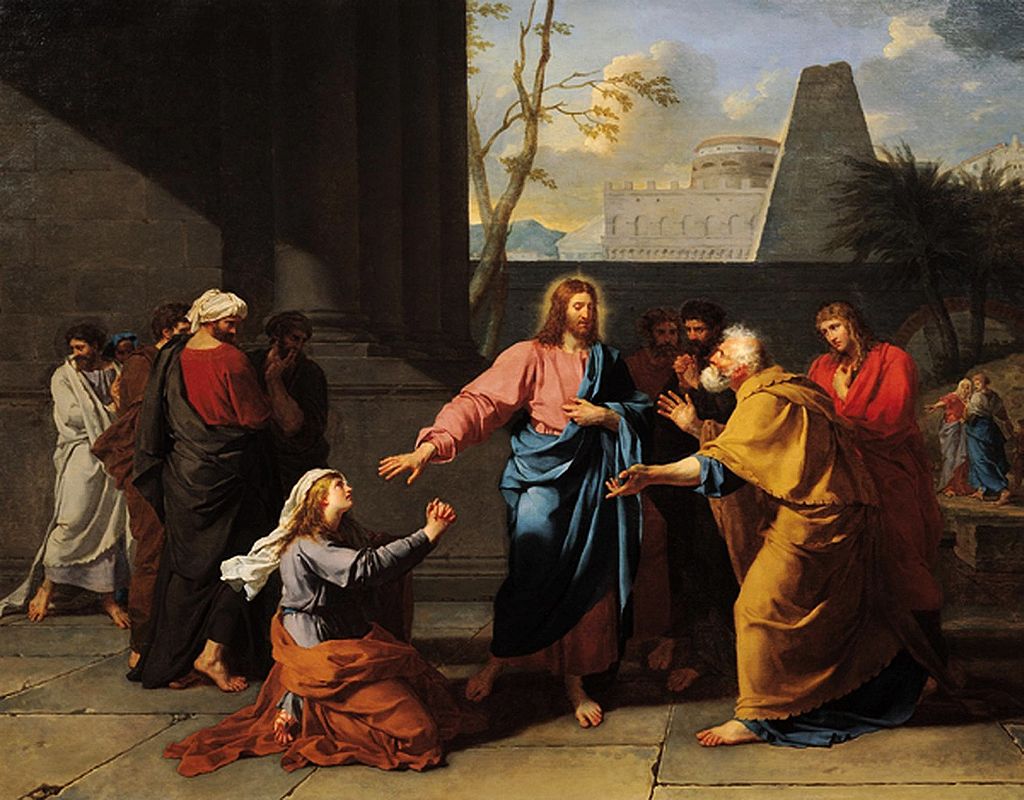
Jesus is travelling in the region of Tyre and Sidon in what is now Lebanon (Matthew 15:21-28). At that time, it was part of the Roman Empire, but had previously been home to the Phoenicians, those legendary seafarers who traded a rare purple cloth dyed from the extracts of a sea-snail.

Jesus encounters a Canaanite woman agonizing over the condition of her daughter, described as “having a demon.” Obviously, Jesus’s reputation as a healer has preceded him because the woman goes to him pleading for help.  But Jesus ignores her, and his disciples mutter, “Send her away; she’s annoying.” Jesus basically agrees, saying, “That’s right; I came only to minster to Israelites, my own people.” Then, in order to brush the woman off, he turns to her and says, “It’s not fair to take the children’s food and throw it to the dogs.”

Ouch! Wait a minute! Jesus just called this suffering woman a dog! Fill in the blank with your most hated racial slur and dog ranks up at the top.

But, what a woman! Driven by loyalty to her child, she perseveres. She throws this incredible line back at him: ““Yes, Lord, yet even the dogs eat the crumbs that fall from their master’s table.”

At that very instant, a miracle happens. I’m not just talking about the healing of the woman’s daughter. I include the conversion of Jesus’s narrow-mindedness. He sees this woman, really sees her, recognizing the imago dei within her. The boundaries of his love stretch to include someone other than the privileged children, the chosen ones of Israel. This Canaanite woman becomes just as worthy of God’s love as any Israelite.

In the end, we must come to this story as the Spirit leads us. Those who insist on the “sinless Jesus” will claim he was only testing the woman’s faith. For me, it is Jesus’s very humanness that endears me to him more. This is a savior who struggled like me, like all of us.

And if a man who called a woman a dog could go all the way to the cross, saying in his final moments, “Father forgive them, for they know not what they do,” then there is hope for humanity.

Selah.


Have a Blessed Trailer Park Christmas, Y’all!

Characters Welcome! That’s the banner that could have waved above every church I served during three decades of ministry. The evidence was clear on any given Sunday.

Musicians from local bars played in our praise bands. An ex-homeless woman with an intellectual disability was our weekly greeter, passing out bulletins. A woman found sleeping in our parking lot became a prominent member of our outreach ministry. Addicts, alcoholics, and the mentally ill discovered that the love of our congregations was a boon to their healing. A recluse who had served as a tunnel rat in Vietnam came out of hiding and made meaningful relationships in our midst. We embraced all colors, classes, and sexual identities of God’s children, a rainbow coalition!

Given my affinity for broken people, born of my personal struggles, I led our members to seek out the poorest in our streets. One place we found them was at dilapidated mobile home parks, pockets of American poverty in our “land of plenty.”

To this day, the faces of precious people I met there are vivid in my memory.

I remember Don and Linda. Don was a Vietnam veteran, suffering from the effects of Agent Orange and his long addiction to alcohol. He finally got sober and was living in a shabby Winnebago in Pomona, California, an inner-city community racked by gang violence. We met him while circulating flyers at his mobile home park. Someone lovingly offered to drive him to church, where he eventually joined our family.

One day, Don met Linda as she was panhandling outside a grocery store. He gave her what he had, then invited her to come to his trailer for a meal. Linda was intellectually disabled, a lost soul, and she ended up moving in with Don. Nothing sexual, just an unlikely companionship, and it was the only stability Linda had known for years. Eventually, as Don’s condition worsened and he was confined to a wheelchair, she became his gentle caregiver. Some would say theirs was a match made in heaven.

One Christmas Eve, our church included their trailer in the route for our offkey but joyous caroling tour. I’ll never forget the sight of Linda wheeling Don onto his flimsy, makeshift porch. In the glow from a single string of lights, I watched their tears of gratitude at our presence. A pit bull on a chain from the next trailer strained to get at us, its barking a crude counterpoint to our tunes.

I remember Jeff, a young man who dreamed of joining a rock band, yet whose marijuana and meth habits drained his meager income and frail health. His lived in a small trailer in the high desert outside Littlerock, California. It was papered with posters from his favorite 80s bands—Depeche Mode, The Cure, New Order—but also classics he had learned to love from his mother, especially The Beatles. Both of them attended our church.

On one of my visits, he asked if he could play Eleanor Rigby during worship. Of course! Backed by our praise band, he offered his gift on a Sunday just before Christmas, a haunting acoustic version that mesmerized us. When he sang Ah, look at all the lonely people it was an admonition to see those who are often invisible on the margins.

I remember a woman and her children living in a squalid trailer park in Alice, Texas. Our congregation was passing out food and toys, and when we knocked, the woman cautiously peered through a crack in the door. The odor of cooking grease and old diapers seeped around her. Were we the police? Immigration officers? In Spanish, we assured her that we were simply bearing gifts. Her children hovered behind her. I looked past them to see that the ancient trailer was sloping. Her youngest boy was seated on a ratty couch. A hole in the floor at his feet revealed mud and debris beneath him.

I can still see that boy’s face. I don’t EVER want him to disappear from my memory!

So, this is my Christmas shout out to all the lonely, struggling, hurting people in our communities who deserve more than FB memes or occasional hit-and-run charity. They long for loving company—the communion of saints—which is the greatest gift any of us can offer.

Have a blessed trailer park Christmas, y’all!

One Church Takes a Stand at the Border

In December 2016, a federal judge in San Antonio, Texas, ordered that hundreds of women and children–most of them refugees from Central America–be released from two south Texas immigration detention facilities. He had deemed the sites unsuitable for holding minors, sending the families into a wet and frigid winter night. Members of the San Antonio Mennonite Church, longtime activists for just immigration, gathered to address the emergency. How could they respond to the crisis? This is part of their story, excerpted from “Neighborhood Church: Transforming Your Congregation into a Powerhouse for Mission.” You can preorder it here.

Ds4IO17VAAAnBkO

As officials released women and children from two detention facilities in response to a court order, hundreds of people suddenly needed temporary shelter and support. On Friday, December 2, 2016, SAMC’s leadership offered its guest house as a shelter. When its two floors filled up, they opened their cavernous fellowship hall, and when even that area overflowed, they opened the doors of their main sanctuary, pushing pews to the walls to provide sleeping space.

At the guest house, a big- screen TV hung from the ceiling announcing departure times for women and children bound for destinations around the U.S. Upstairs was a phone bank for calling lawyers and family members, its long line extending into the hallway. Immigration and Customs Enforcement (ICE) learned of SAMC’s willingness to shelter the released prisoners and began to bus them directly to the church’s front steps. Their numbers continued to swell.

John Garland, pastor of SAMC, reflects on that experience and how its ripple effects continue to shape the congregation’s ministry.

“It’s easy,” he says, “to quote Old and New Testament mandates to care for the least and the aliens in our midst. But real conversion to our neighbors doesn’t begin by declaring ourselves a welcoming space for the homeless or a sanctuary for refugees. It always begins in real, face-to-face relationships. This is the essence of incarnational ministry.”

Garland, like most of SAMC’s members, was at the eye of that human hurricane for a number of days. The experience reaffirmed many of the congregation’s cherished beliefs. For instance, Mennonites strive to live simply, believing God will provide more than we need as we walk the path of faithfulness. This trust in abundance proved warranted during the refugee crisis in a number of ways.

Hundreds of surrounding neighbors rose up to provide support in the way of food, water, and backpacks for the traveling women. Many of them openly said, “I don’t believe in God, but I’m glad you are here and I support what you are doing.”

When the fire marshal got wind of the church’s overcrowded conditions, he threatened to shut everything down. This evoked responses from the mayor, the city council, even a congressional representative, all of them wrangling over what to do. But it was the neighborhood fire station that provided the solution. Its firemen, even after working long shifts, volunteered to patrol the perimeter of the church, providing the emergency coverage necessary to make everything legal.

Not everyone, however, was approving of SAMC’s work. Online threats were frequent, some of them warning of violence, and though Pastor Garland never read the specifics, he was aware of potential danger. So, when a jacked-up truck with a Confederate flag on its rear window rumbled into the parking lot, he was understandably concerned. A burly man stepped down from the cab.

“Is this the place that’s helping the illegals?” he asked in a gruff voice.

“Yes, it is,” said Garland.

“Good,” said the man, “because I have some food in the back I’d like to donate to the cause.”

Garland sees this not only as an example of the abundant response of others, but of the unlikely conversion of one neighbor to another in our midst.

There is another incident dear to his heart. During that onslaught of need, SAMC discovered a child separated from his mother. In all the hubbub, some volunteers had taken the mother to the hospital. Until they located her, Garland took the child home and let him snuggle between his two young daughters, a lasting lesson for him and his girls about the need to protect and love our neighbors no matter how they come to us.

He sums up so much of what he learned in a succinct anecdote.

“On the fullest night of that crisis, with the church packed, I tried to sleep in my office. The building was a cacophony of two primary noises. There was the beeping of the ankle monitors each detainee was required to wear, and the coughing! Most of the women had caught a respiratory bug in the detention facilities, and the coughing was nonstop. Between those signs of sickness and the incessant beeping, I thought I was going to lose my mind.

“Then a beautiful voice rose above the din. It was a mother singing a lullaby to her child. That song had a clear message to me. ‘Sorry, white boy, if you are struggling this evening, but I’m trying to put my child to sleep.’

“I realized right then that none of us responding to this crisis were the heroes in this passion play. It was these women who had left everything—their homes, their countries of origin—to protect their children.”

The overcrowded conditions eventually subsided, but not the regular and ongoing need. Today, SAMC and its partners continue to minister to the women and children who come to them from the detention facilities—these neighbors in a global family—but now their service echoes with an even deeper connection born of those days in December 2016.

UPDATE: SAMC continues to shelter stranded asylum seekers in La Casa de Maria y Marta. They also offer Peacebuilder classes, training people how to respond to those experiencing trauma because of their refugee status.


Buster Scruggs, Babies in Jars, and the Dignity of Frederick Boyce

The Coen brothers are geniuses. Their latest effort, The Ballad of Buster Scruggs, is an anthology of tales set in the Old West that is violent, funny, even profound. It gripped me from the first frame. Peter Travers of Rolling Stone says, “The gallows humor of their fatalistic Ballad allows the filmmakers to do what they do best: laugh in the face of death.”

It is cold laughter, indeed! There are three segments that filled my veins with ice. One of them is “Meal Ticket,” the story of a freak show huckster (Liam Neeson) who sets up his wagon in frontier towns. His attraction is a limbless orator, the “Wingless Thrush.” Neeson props the young man’s torso on a chair, where he proceeds to recite passages that include Shelley’s Ozymandias, the Declaration of Independence, and the Gettysburg Address. It is haunting to hear his eloquence, to watch his rouged cheeks and expressive eyes in the flickering gaslight. It is even more vexing to witness his abject dependence on his handler, a drunk whose only motive is profit. Eventually, the crowds thin. What happens next is not only tragic, but entirely believable.

harry-melling-buster-scruggs
Why did this affect me so deeply? Partly because I have a son whose disability may be different (intellectual), but who could have been born in a crueler era. The fight for “handicapped” civil rights has been long and tortuous. I recently read The Story of Intellectual Disability: An Evaluation of Meaning, Understanding, and Public Perspective, by Michael L. Wehmeyer. With penetrating scholarship and a journalist’s ear for storytelling, Wehmeyer chronicles how intellectually disabled people have been treated throughout history, including:

  • The practice of infanticide, even in “enlightened Athens,” where “defective” children were left in jars near temples in case someone took pity and adopted them.
  • The demeaning theories of both scientists and theologians, who regarded these “idiots, morons, and imbeciles” as part animal or part demon.
  • Nazi concentration camps for flawed children who were ripped from their families, gassed, then incinerated.
  • Mass incarceration and virtual slavery in “institutions for the feeble-minded.”
  • Forced sterilization as a standard practice in many parts of the U.S. until the 1970s.
  • Substandard education and crippling segregation.

Wehmeyer also highlights individuals who championed the cause of dignity for themselves and others.

One of them is Frederick Boyce. In 1942, at age seven, Boyce was confined to the Fernald State School in Waltham, Massachusetts, an institution for “idiots.” He was given mandatory labor, received scant education, and was housed in a dilapidated dormitory ruled by a harsh attendant. Because he was well-behaved, he and a few other boys were invited to join the Science Club, where Quaker Oats and MIT researchers secretly served radioactive oatmeal as part of a study on calcium absorption.

Even with those atrocities, the worst, according to Boyce, was the indignity of being labeled a “moron,” a term that stuck with him as he struggled to find employment after discharge. Finally, he began working at carnivals and fairs, operating games of chance. He bought his own booth and traveled the amusement circuit all his life.

In 2004, Boyce and six other Fernald alumni petitioned Massachusetts Governor, Mitt Romney, to expunge the word moron from their records. They also wanted a formal apology.

In May of 2005, at the age of 63, Boyce received a letter from the Massachusetts Department of Mental Retardation stating that he “was not mentally retarded.”

He died of colon cancer three days later.

Yes, There Is a Plan – A Thanksgiving Shout-Out to Our Creator

In the film Simon Birch, loosely based on John Irving’s A Prayer for Owen Meany, there’s a scene that knifed my heart. Simon, born with dwarfism, goes to his local church seeking spiritual guidance. He enters the pastor’s study and struggles into a chair.

Simon: “Does God have a plan for us?”
Pastor: “I like to think so.”
Simon: “Me too. I think God made me the way I am for a reason.”
Pastor: “Well, I’m glad that, um, that your faith, uh, helps you deal with your, um…you know, your condition.”
Simon: “That’s not what I mean. I think God is going to use me to carry out a plan.”

Later, Simon gets discouraged and returns to the same pastor.

Simon: “I want to know that there’s a reason for things. I used to be certain, but now I’m not sure. I want you to tell me that God has a plan for me, a plan for all of us. Please.”
Pastor (shifting in his seat, obviously uncomfortable): “Simon…I can’t.”

Sitting in the theater, I had deeply mixed reactions to that pastor’s response. Initially, I was angry, even outraged. I felt like saying to him, “Listen, if your doubts have undermined your calling to support the unique destiny of each person, why don’t you take a break or consider a new line of work?”

However, another part of me empathized with his weariness. In my 32 years of ministry, I struggled with tragedies that rocked the foundation of existence. Stillborn children, a young man killed just days before his wedding, suicides, overdoses, floods and fires, cancer that wrenched parents from their children. I always refrained from unsolicited platitudes like “God has a purpose for this.” Those words are hollow, even insulting, as we cry out against injustice or suffer from breathtaking loss. There are questions that simply have no satisfactory answers.

However, I do know this. If Simon came to me with the same query, I wouldn’t hesitate to answer.

Yes, I do believe that God/Creator/Spirit/Tao/Higher Power has imbued our lives with divine purpose, a plan that permeates our days if we embrace it. And though none of us can fully fathom the mystery of this providence, we can experience it in numerous ways. These are some I’ve discovered in my own life.

God’s purpose appears as divine appointments. With deep gratitude, I think of meeting my wife, Donna, when we both needed love and companionship. I look back on how she and I have helped each other through some very dark valleys. I think of counselors and mentors who entered my life exactly when I required their wisdom. I think of how, as a pastor, I was invited into the sanctums of other people’s struggles, offering timely support.

God’s purpose grips us with a love that brings order and healing. God is love, says the famous verse in John’s first letter, and as we move from asking why? to how? this love becomes an experience of life’s design. It drives us to spend ourselves for justice, to comfort the lonely and outcast, to be a conduit for unity and peace. I treasure these simple but profound words from Thích Nhất Hạnh, who died earlier this year after a lifetime of blessing other people: “The more you understand, the more you love; the more you love, the more you understand.”

God’s purpose compels us to exercise our gifts. We all have something to contribute. This is what Simon meant when he said, “I think God made me the way I am for a reason.” Thousands of years ago, David rejoiced with these famous words from Psalm 139: “I praise you, for I am reverently and wonderfully made!” Writers like Wayne Dyer helped awaken me to the unique impulses that arise within me when I connect to Spirit. I enjoy epiphanies that tell me, “This is the purpose for which you were created!” In many ways, including my doctoral work, I have always encouraged people to discover and exercise their gifts and talents. As Dyer famously said, “Don’t die with your music still in you!”

Friends, on this Thanksgiving 2022, I have a shout out to our Creator for all of us. Thank you for not only giving us loved ones on this journey, but for being WITH us, offering purpose that illuminates our paths. May we experience your active presence—and our unique part in your plan—more clearly every day.

Thanksgiving blessings to all of you!

We DESPERATELY Need “The Overview”

A family member calls it my “coming out,” a booklet I wrote years ago about the universalist spirituality evolving in my life. Called Invitation to The Overview, you can freely download it here.

The central image comes from space exploration. Described as the The Overview Effect—a term coined by writer Frank White—it is that moment when space travelers turn and see our planet suspended in the vastness of space. For everyone who experiences it, this vantage point is life-changing, transforming their view of Earth and humankind’s place upon it. Here are some firsthand words from astronauts.

“Before I flew, I was already aware of how small and vulnerable our planet is; but only when I saw it from space, in all its ineffable beauty and fragility, did I realize that humankind’s most urgent task is to cherish and preserve it for future generations.” – Sigmund Jähn, German Democratic Republic

“For those who have seen the Earth from space, and for the hundreds and perhaps thousands more who will, the experience most certainly changes your perspective. The things that we share in our world are far more valuable than those which divide us.” – Donald Williams, U.S.A.

“A Chinese tale tells of some men sent to harm a young girl who, upon seeing her beauty, become her protectors rather than her violators. That’s how I felt seeing the Earth for the first time. I could not help but love and cherish her.” – Taylor Wang, China/U.S.A.

In many countries – my home nation of America included – we no longer have a vision of what unites us within our own boundaries, let alone what binds us to humanity across the planet. Nationalism is ascendant around the globe. Ultimately, this is spiritual regression, a return to tribal thinking, a reversal of our necessary evolution as a species. It could ultimately destroy us.

I love New Zealand President Jacinda Ardern’s first address to the United Nations in 2018. After acknowledging our many international challenges, she said the following.

“If I could distill it down into one concept that we are pursuing in New Zealand it is simple and it is this.  Kindness. In the face of isolationism, protectionism, racism – the simple concept of looking outwardly and beyond ourselves, of kindness and collectivism, might just be as good a starting point as any.”

In his Teachings on Love, Thích Nhất Hạn speaks of upeksha, a Buddhist concept that means equanimity or nondiscrimination. He says, “Upa means ‘over,’ and iksha means ‘to look.’ You climb the mountain to look over the whole situation, not bound by one side or the other. If your love has attachment, discrimination, prejudice, or clinging in it, it is not true love. People who do not understand Buddhism sometimes think upeksha means indifference, but true equanimity is neither cold nor indifferent. If you have more than one child, they are all your children. Upeksha does not mean that you don’t love. You love in a way that all your children receive your love, without discrimination. (This is) ‘the wisdom of equality,’ the ability to see everyone as equal…In a conflict, even though we are deeply concerned, we remain impartial, able to love and to understand both sides.” 

What if we internalized The Overview, tucking it like a pearl of great price into our hearts and minds? What if it caused a fundamental paradigm shift? What if national boundaries remained for governmental purposes, but we saw them from the global vantage point of our human family? What if the current conflicts that divide us were eclipsed by our critical need to create planetary tolerance, to galvanize our collective will and protect this pale blue vessel sailing in space?

Perhaps the deepest lesson I have learned in America’s current climate is that ALL of us—both progressive and conservative—can fall prey to the judgement and hardness of heart that disconnects us from each other. We can ALL become complicit. Repentance and a change of behavior are necessary.

It begins by asking ourselves some hard questions. Do my politics, faith tradition, or life philosophy contribute to unity? Am I compelled to find peaceful dialogue with others, no matter how alien their worldview seems to me? Or am I simply setting myself apart with an air of superiority?

As Thích Nhất Hạn has said, “Through my love for you, I want to express my love for the whole cosmos, the whole of humanity, and all beings. By living with you, I want to learn to love everyone and all species. If I succeed in loving you, I will be able to love everyone and all species on earth. This is the real message of love.”

  We DESPERATELY need The Overview!