My Three Dog Night

3 Dog NightMy wife and I don’t sleep together. One of us snores – I mean suck the roof in snoring – so it’s better we dream apart. Don’t worry. We usually start under the same covers, then part ways.

This arrangement suits us even more because of another household reality: our three dogs. My adjustment to canine companions has been reluctant, especially since my wife brought two of them home without consulting me. One from a roadside puppy stand; the other from the shoulder of a country road.

“How could you?” I asked. “This is like adopting a child! You just don’t do that unilaterally!”

She said nothing, holding up the little fur balls so their irresistible eyes would meet mine. What was I going to do? Call the pound? Go out on a country road and re-abandon them? Show my horns and forked tail?

I accepted our new status quo, grumbling all the while. When there was a mess, I quickly pointed out who needed to clean. I counsel people not to bring up the past in conflicts. I dredged it up in tractor loads.

Over time, these new family members assumed their places. They are:

1. Remy – a male Heeler mix, protective of my wife, a bit grumpy.
2. T-Bone – a male Rat Terrier, perky, affectionate, sticking to humans like Velcro.
3. Pearl – a Golden Lab mix with a sweet disposition, unless she sees a possum or cat.

Back to our nighttime arrangements. All three dogs sleep with my wife, another reason it’s fine that we have separate rooms. I call hers “the lair.” As the Big Dog, I sometimes intrude, but usually I let sleeping dogs lie. :-)

Then, a couple weeks ago, my brother moved in with us. We’re giving him a six-month “leg up” to start a new chapter in his life. The only way to accommodate him was for my wife and me to share a room.

We figured we could deal with the snoring (I’m still not revealing the source.) But the dogs, for me, were a different challenge. How was I going to cope?

In the first few days, they stayed on the floor. Then they took to standing next to the bed, their eyes imploring me for human contact. Oliver himself couldn’t have looked more plaintive as he held up his bowl and said, “More, Sir!”

I guess I’m a softie because I relented, and soon they found places to lounge on our king-sized playground.

But they didn’t stop there. My graciousness emboldened them. The other night I woke up to find T-Bone snuggled under the covers, Pearl’s face draped over my neck, and Remy licking my ear.

Did I scream with anger and frustration, banishing them forever to the carpeted hinterlands? No, I just relaxed in the warmth of a three dog night. I even scratched Remy behind the ear and said, “Good boy.”

After all, my brother has to leave some time. Doesn’t he?

A Pattern for Freedom and New Life, Part Three

We continue examining the 12 Steps as a pattern for living that can help ALL human beings.

Step 3: Made a decision to turn our will and our lives over to the care of God as we understood God.

The walls of most 12 Step rooms are adorned with simple sayings, aphorisms meant to imbed these core principles. There is one that summarizes Step 3 succinctly: Let go and let God.

If you’re like me, you might ask “How can something so simple be so difficult to practice?” How many stressful days have we endured, clinging to worries and resentments, refusing to have our fingers pried free? This slogan seems to taunt us. We may feel like shouting, “Easy for you to say!”

How can we really let go?

First, by remembering that the Steps are cumulative. As we mentally reiterate how they build on each other, we gradually align ourselves with their pattern.

In Step 1 we realize that we engage in unhealthy thoughts and behaviors. They make our lives unmanageable, affecting our health, relationships, and creative potential. Step 1 helps us diagnose our “stinking thinking.”

In Step 2 we realize a two-fold truth. These thoughts and behaviors are insane, an example of doing the same thing over and over, expecting a different result. Perhaps with a tinge of despair, we realize that our attempts to change using our own willpower have been fruitless. We need the help of a power greater than ourselves.

Step 3 asks us to take action. Do we really believe in the unmanageability of our negativities? Do we really believe there is a presence – most often called God – that can assist us with liberation?

If our answer is a soulful YES; if we have truly had enough and desire freedom, Step 3 says “Let go; turn over you will; trust that your higher power will lead you to a new level of consciousness!”

Does this happen in one gigantic catharsis? No! Do we have such a clear and miraculous epiphany that we never return to our old ways. No!

This is a process, a daily turning over, a minute by minute letting go of the thoughts and behaviors that twist our lives. Practice is what leads to serenity. Siddhartha, who didn’t believe in a personal soul or deity, still held to a pattern that he called The Middle Way. It became his higher power.

A friend who hosts the Facebook page Thump recently described it this way.

“I have come to believe that we don’t go find God; we clear space and God fills in. We dissemble the apparatus of a fear-driven, self-centered life…It’s hard – really hard – because it goes against every mother-loving, self-preserving instinct…We break ourselves down. The Steps are self-reduction: addition of God by subtraction of self.”

A favorite way to describe the acronym EGO is Edging God Out. It helps to think of Step 3 in the same way. Our fears and resentments fill the space of our lives with insane, repetitive delusions. Whether we use prayer, meditation, guided imagery, chanting, yoga, self-talk, scripture, the counsel of a friend, or a host of other disciplines, the message is the same…

Let go and let God…Breathe deeply…find freedom…

A Pattern for Freedom and New Life, Part Two


heavens-open4We continue to examine the 12 Steps, a pattern that can help ALL human beings live freer, more joyful lives.

Step 2: Came to believe that a Power greater than ourselves could restore us to sanity.

Let’s take this Step in reverse, starting with the word “sanity.”

Perhaps you know someone who lives with the stigma of mental illness, traditionally called insanity. You see how painful it can be. You may have witnessed the insane descent into misery of an addict or alcoholic.

But how about the rest of us? Do we need to be “restored to sanity?”

The definition for insanity used most frequently in 12 Step programs is familiar: Doing the same thing over and over, expecting a different result. Or, returning again and again to dry wells, determined to find fresh water.

For addicts and alcoholics, this futile activity is painfully clear. Repeated attempts to control our drinking or drugging proved insanely fruitless until we surrendered to our powerlessness. Ironically, in broken submission we found miraculous strength.

But chemical addiction is not the only karmic lunacy. I mentioned others in the first post of this series.

• Trying to predict future outcomes.
• Nursing ANY resentment.
• Regretfully ruminating over past mistakes.
• Worrying about the perceptions others have of us.
• Fretting over finances.
• Obsessively seeking validation externally, rather than internally.
• Stressing about health issues.
• Attempting to change the behavior of another person.

In Step 2 we not only acknowledge that we are practicing these “insane” behaviors, but that our repeated efforts to cease have failed. Quite literally, we need help beyond ourselves.

This is when the 12 Steps suggest a path that is difficult for some. Kierkegaard called it “a leap of faith” – coming to believe in a force beyond us.

12 Step programs are non-sectarian. This power, by whatever name and conception, is up to individual choice. Fundamentalists, especially of the Christian tribe, criticize this freedom, saying it is New Age, unmoored from history or scripture. Some cynically call it BYOG – Bring Your Own God.

But don’t we ALL come to faith this way? Theological gymnastics will never “prove” the objective reality of spiritual revelation. Our tiny minds can only partially grasp the Infinite.

12 Step programs steer away from debate. They point instead to personal experiences of God’s presence. Subjective? Sure. Impervious to the scrutiny of debaters and deniers? No. But let me share the miracles I see every day in those who are recovering.

We were at death’s door step. We knew our insane behavior had taken everything from us except our heartbeats. We had lost hope, and the darkness around us had become what AA describes as “incomprehensible demoralization.”

And then we surrendered. First to the mentoring of those who had trail blazed into the light. Then to our own conception of a Higher Power. This is when miracles began to occur, slowly, then gaining momentum, until we had an epiphany contained in the AA “Promises” – We will suddenly realize that God is doing for us what we could not do for ourselves.

Sound far-fetched to you? Keep reading, because this miracle unfolds through one critical action that each of us can take. It is found in Step 3.

A Pattern for Freedom and New Life

letting-goWorldwide, millions of people embrace The 12 Steps, a pattern for living based on spiritual principles. My own recovery overlaps daily with my role as a pastor, and I can say unequivocally, “This blueprint can be freeing and empowering for everyone!”

Beginning in this blog, I will share the value that I – and countless others – have found in these simple suggestions. I will take liberty with the wording of the Steps to embrace a wider spectrum of experience.

Step #1: We admitted we were powerless over (obsession, worry, compulsion, addiction)—that our lives had become unmanageable.

Don’t recoil from this truth because of the words powerless and unmanageable. The Steps do not deny the efficacy of individual will. Self-directed action is essential to a new way of life. What this Step addresses is the ILLUSION OF CONTROL.

I have attended the bedsides and gravesides of many whose earthly days were over. We spent hours reflecting on life, immersed in the sacramental Shekinah of its brevity.

And there is one truth upon which we all agree: the hours we spend worrying, fretting, and obsessing about things beyond our control are a murder of TIME – life’s most precious commodity.

Jesus once said: Do not worry about tomorrow, for tomorrow will worry about itself. Each day has enough trouble of its own.

Translation: if we want to live fully in the present, pointless ruminations must cease. We must jettison our obsession with things over which we are powerless. These thought patterns do nothing but groove our brains in mutated ways, draining our spiritual lifeblood. We engage in them for the purpose of control, but the great irony is that they make our lives unmanageable. Here are a few.

• Trying to predict the outcome of future events.
• Obsessively regretting past mistakes.
• Worrying about the perceptions others have of us.
• Fretting over finances.
• Stressing about health issues.
• Attempting to change the behavior of another person.

Unless we have the clinical condition called Obsessive-Compulsive Disorder, there are so many ways to release control: counseling, meditation, mental redirection, walks in nature to absorb the beauty of Creation, engagement in creative activities that frees our spirits.

Here is when willpower comes into play. To put it ironically, “We must do everything in our power to rest in the knowledge of our powerlessness.” This is what Thich Nhat Han means when he says, “I vow to let go of all worries and anxiety in order to be light and free.” Vows are kept through daily disciplines and mantras that give us serenity, courage, and wisdom.

This is why 12 Step meetings begin and end with two familiar prayers, setting needed boundaries on our lunacy: The Serenity Prayer and The Lord’s Prayer.

God, grant me the serenity to accept the things I cannot change, the courage to change the things I can, and the wisdom to know the difference.

Our Father, who art in heaven, hallowed be Thy name. Thy will be done…

Dear friends, do what you can; let go of the rest. Savor this precious day!

Thank You for Walking Among the Wounded!

lesotho homeless man B&WLet not Ambition mock their useful toil,
Their homely joys, and destiny obscure;
Nor Grandeur hear with a disdainful smile,
The short and simple annals of the poor. – Thomas Gray, Elegy in a Country Churchyard

So many wasted words, so much wasted breath debating Christ’s Second Coming. First century disciples believed it was imminent in their lifetime. Generation after generation taught that it would come like a thief in the night. Later, the apocalyptic religion of Rastafarianism would claim it DID occur in the birth of Hailie Selassie, Jesus incarnate.

2,000 years later, there are some things of which I’m fairly certain. If such an event happened, there are places I doubt Jesus would appear.

I doubt he would make a guest appearance on Joel Osteen’s TV show. I doubt he would materialize at the Vatican, the White House, or the chambers of the U.N. I doubt you would see him on a podcast from Mars Hill, visiting Billy Graham, or signing copies of the New Testament at a Jeremy Camp concert.

No, I believe he would walk the piss-stained alleys of our inner cities, or the dusty paths of a refugee camp. You might find him in the midst of an Ebola outbreak or tending to the wounded of a village razed by tribal conflict.

How would you know he was there? By the sheer crowds of the broken, the sick, and the poor flocking around him. By joyful Alleluias erupting from the forgotten of this world who – through his words and actions – discovered their eternal worth in the eyes of God.

I take this moment to thank all the brothers and sisters I’ve known who followed Christ’s example without need for recognition or acclaim. Thank you for walking among the wounded. Thank you for creating power spots of love and light in this world’s darkest places. Thank you for bringing heaven to earth. Thank you for seeing that the sacramental moments of shared human love are far more valuable than riches.

Thank you for believing

Blessed are the meek, for they shall inherit the earth.

Free as the Wind!

443ace79885cf7908731fa0811a8d951In The Cost of Discipleship, Dietrich Bonhoeffer said, “When Christ calls a man, He bids him come and die.”

This seems so extreme, especially for non-Christians. It smacks of martyrdom, the do-or-die call of fanatical religions. Even for believers, it suggests the lofty calling of a precious few, men like Bonhoeffer, who left a comfortable teaching position in America to return to Germany during WWII. Organizing against the Nazis, he was arrested and executed at Flossenburg concentration camp. His last words were, “This is the end – for me the beginning of life.”

There’s no doubt Jesus demanded much of his disciples. He asked them to leave home, vocation, and family to follow him. Like Bonhoeffer, their devotion led all of them except John to violent deaths.

This is not our path. Most of us live comfortable existences. If we ascribe to a faith system at all, it is usually to augment our comfort, not to cause sacrifice.

Yet I believe one saying of Jesus, if practiced by people of ANY worldview, can cause an inner miracle. Matthew 16:25 – Whoever wants to save their life will lose it, but whoever loses their life for me will find it.

Think of this loss not in terms of physical death, but the death of the Ego. Whoever dies to false ego will find new life and freedom beyond anything they imagined.

Most often we define Ego as the inflated self-importance of egotism. This is part of the equation. But ego encompasses so much more. Here’s a quote from Ivan Hoffman.

Ego is that which separates our hearts from Eternity, from God. It is our inner voice, what I refer to as “the watcher,” the constant noise inside our heads that, out of fear, keeps us from simply being, from trusting enough to let go and stop watching ourselves. It is this watcher, this censor, which creates the sense that we need to control things, for we feel that if we were just to Be, things would not come out the way we want them to. Ego is the veil through which we see the universe.

Jesus prescribed humility and self-emptying not to cause pain, but to help us dissolve our veils and see what he called the Kingdom of Heaven. So many aspects of Ego get in our way: cultural indoctrination, religion, a need to be noticed, fears about the future, regrets about the past, comparison of ourselves to others. I could go on, but you get the idea.

What part of this inner chatter can we let go of today, allowing us to more fully experience the presence of God’s love?

Late one night, speaking to Nicodemus, Jesus said something beautifully enticing, “The wind blows wherever it pleases. You hear its sound, but you cannot tell where it comes from or where it is going. So it is with everyone born of the Spirit.” (John 3:8)

Translation: as we let go of false ego and surrender to Spirit, we become as free as the wind!

CHECK YOUR VISION, THEN KEEP GOING!

DREAM - VISIONContemplate the miracle of sight. Our retinas receive images that course through the optic nerve to the brain. There the data explodes in 3-D color no manmade device will ever duplicate. And it happens instantaneously!

Vision is just as miraculous in our spiritual lives. Too often we applaud blind faith, groping forward in darkness with no assurance. But this is not God’s way. Our Creator gives us a vision, a picture of our destiny, a goal to motivate us onward.

Take a walk down the hallway of Hebrews, chapter 11. It’s a gallery of Biblical heroes – among them Abraham, Joseph, and Moses. These giants of faith had one thing in common: God gave them a vision of their future.

What are you hoping for? Greater financial security or healing in a relationship? Fruitful retirement or better health? Maybe it’s a chance to transform your art into a career. Perhaps it’s a birthday celebration of sobriety, or the joy of witnessing your grandchildren reach milestones.

If your goal holds the seeds of blessing others, God will make it tangible in your mind’s eye. You will see it in details rich with promise and hope. And God asks only one thing in return: Keep going! Every day – beginning now – take concrete steps toward your dream. This is true even when you face challenges, or suffer through seasons of heartache.

Author Joseph Marshall says, “The weakest step towards the top of the hill, toward sunrise, toward hope, is stronger than the fiercest storm.” This truth has amazing power.

My friend Joe had his life shattered as a drunk driver hurtled through a stoplight and broadsided his vehicle. Paramedics released him with Jaws of Life and rushed him to the hospital. The prognosis was dim: a double cerebral hematoma with significant brain damage. Doctors predicted he would never walk or talk again.

I believe Joe heard that prophecy as he lay in a coma. His response? No way! In his ailing mind, God constructed an alternate vision. It included not only walking and talking, but finishing his degree in early childhood education.

Words can’t convey the painstaking effort Joe made in rehab – countless hours of physical, speech, and emotional therapy. One day I witnessed his first faltering steps between parallel bars. He lifted his head and with a slurred voice said, “Krin! How are you?” Then he slowly gave me a thumbs-up.

Fast forward two years, the day Joe graduated with his Master’s Degree. As I congratulated him, he slowly said, “Krin, meet me at the university track for a run today.”

A run? Sure enough. Under bright sunlight we met at the fifty yard line and began four laps. Joe’s gait was lopsided, but his pace was amazing, fueled by fierce resolve burning in his eyes. When we finished I told him how much I admired him. I’ll never forget his response.

“Don’t be amazed, Krin. God helped me picture this moment years ago. Just remind people of Hebrews 11:1 – Faith is the assurance of things hoped for. Be blessed, my friend.”

Then he gave me his trademark thumbs-up.

(reprinted from 52: Weekly Readings for Your Journey)

Not Even Death Will Separate You

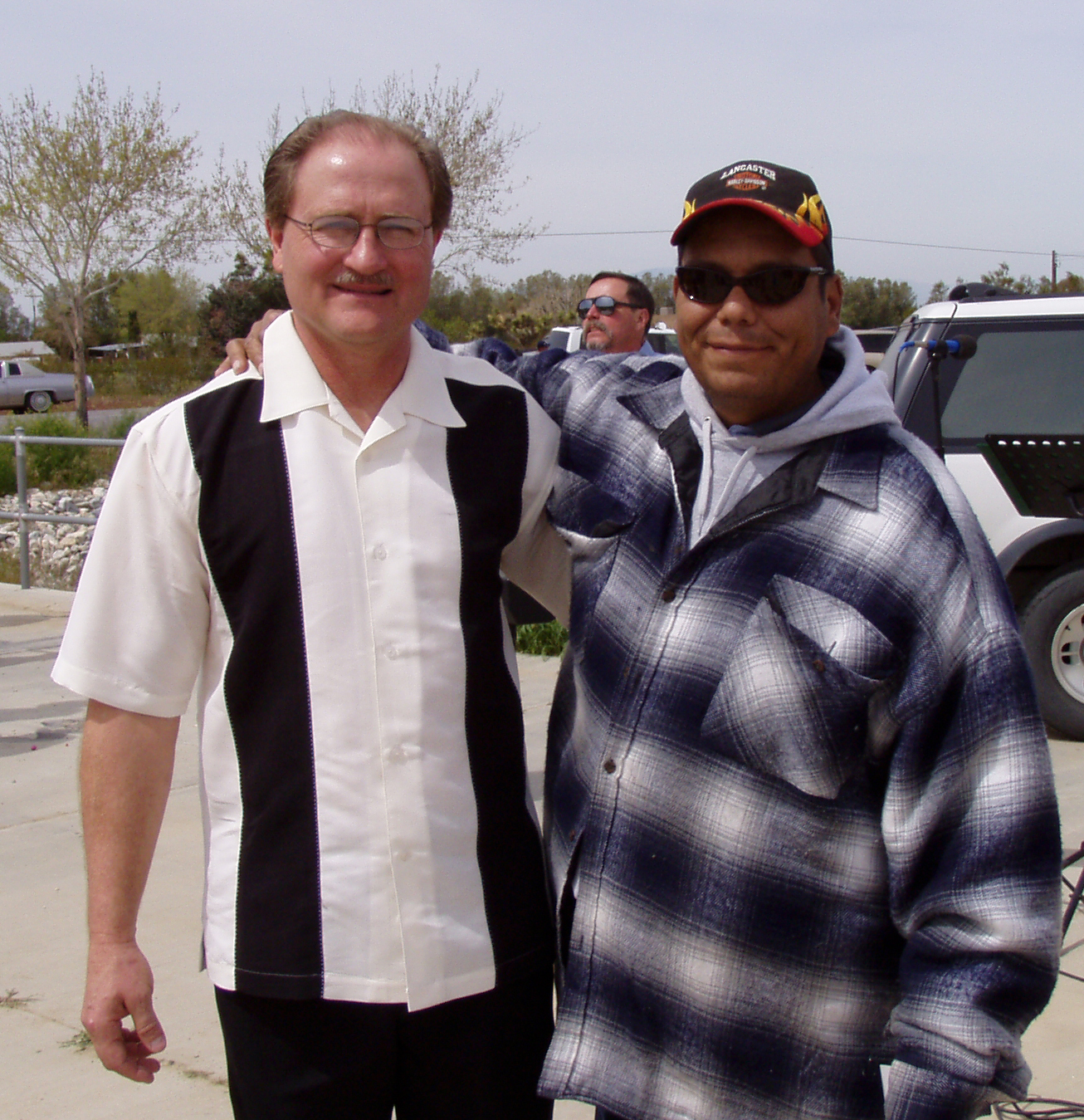
Krin and HenryI first met Henry at a backyard BBQ. He wore baggy jeans, a flannel shirt, a do-rag, and wraparound sunglasses. It wasn’t until he removed those shades that I saw the signs of advanced alcoholism. The whites of his eyes were leopard orange, evidence of his failing liver.

At the end of that first conversation, I invited him to church. “Sure,” he said, nodding absently. To my surprise, he showed up the next Sunday, his attire identical, sunglasses hiding his eyes.

The Spirit so worked on Henry that, in time, he asked if he could be re-baptized. I explained that one immersion was enough, but quickly added that if he wanted to recommit his life publically the next week, we would welcome him with alleluias!

Sunday morning arrived, and Henry was there, his Pendleton shirt pressed neatly. When he came forward, I asked if anyone else would like to join him for a laying on of hands.

About half the congregation formed a circle around us. My eyes scanned their faces, wondering if their acceptance would survive the next few moments.

“Henry,” I said, “you’re among friends here. Would you take off your glasses before I ask these questions?”

He slowly slipped them from his face, those shockingly jaundiced eyes scanning the saints encircling us. I tracked his gaze, wondering what I would see, and my heart soared! There was only love, grace, and hospitality. Romans 15:7 came to mind: “Welcome one another, therefore, just as Christ has welcomed you.” When we prayed, many of us cried.

Henry died shortly thereafter, at age 39. I was at his bedside in the final hours.

“Pastor Krin,” he said, “how can I thank you and our church for all the love you have shown me? I failed in many ways in this life, but you helped me find inner peace.”

“Henry,” I said, “you are a precious child of God, and not even death will separate you from Christ’s love. It has been our privilege to know you.”

I took his hand and we prayed.

God’s Holy Ecosystem

Nature Waterfall ImageStudy any ecosystem and you might agree with King David, “Only fools say in their hearts, ‘There is no God.’”

Everything has its place, its purpose, its niche. Termites demolish logs to enrich the soil. Forest fires crack the hulls of Sequoia seeds. Tiny krill fill the gullets of Blue Whales, earth’s largest creature. Snow that melts on the mountain top wends its way to the heart of the sea.

Our Creator orchestrates it all with breathtaking precision. And one truth is crystal clear: nothing goes to waste!

In our personal lives, this is especially true with hardship. Have you stumbled, made mistakes, gotten off track? Have you squandered relationships, nursed bad habits, or worried needlessly? Do you regret missed opportunities? Did you fail to love because of selfishness? Have you suffered through tragedy, heartache, or illness?

Surely there is pain in this wreckage, but God can employ every piece to expand our spirits. Even more, when we open these wounds to others – unafraid to share our humanity – it releases great healing.

Consider the local church. On any given Sunday, it’s a rich repository of wisdom. So many living sermons sitting in the pews!

Parents who have struggled to raise children. Couples who resurrected troubled marriages. Divorcees who found new love. Survivors of cancer, heart attacks, and strokes. People who are overcoming addiction. Adult children caring for ailing parents. Those who resolved their grief after losing a precious loved one.

I could go on, but you get my drift. The church is a holy ecosystem where nothing need go to waste. As a pastor, it makes me want to shout from the rooftops. “This is what we have to offer! Authentic human beings who have grown from the hard knocks of life. People who can be God’s ambassadors of grace, walking alongside you in your journey. We are not here for religion; we are here for relationships!”

But this only happens, my friends, when we reveal ourselves, when we put our experience at God’s disposal. It happens when we risk vulnerability, allowing our stories to intersect with others.

I think of Marlene, sexually abused by her father throughout childhood. Bitterness and rage consumed her adult life. In our sessions, she finally said to me, “I have to find a way to let go. If I don’t, I’ll be a prisoner ‘til the day I die.”

One winter morning at a windswept Michigan cemetery, Marlene stood before her father’s headstone. She read a letter to him that she had crafted for months: words of resolution, words of hard-won forgiveness only God could give her. As light snowfall began, she shredded the paper, spread it on the grave, turned and walked away.

Months later a young woman joined our congregation. I discovered that abuse had twisted her life as well, so I introduced her to Marlene. On a Sunday morning after Spirit-filled worship, I saw them sitting beneath an oak tree. Marlene had a hand on her new friend’s shoulder. They were praying together, seeking the balm of God’s presence.

In God’s holy ecosystem, even our worst pain can serve the power of redemption. Alleluia!

Tribute To an Unknown Saint

img005He would have been 76 today, January 8, 2015. My mind drifts back…

It’s 1996. A brisk November afternoon in Southern California. Brown leaves skitter across the cemetery grounds, bunching against headstones. Our family has gathered to say goodbye to my uncle Jerry.

I am overseeing this graveside service. As I open my Bible to the text I’ve chosen to share, I look around at our small circle of loved ones, then down at the casket. A deep sadness fills me and a single thought prevails: some people endure far more than their share of pain and struggle.

Jerry was one of six boys, a quiet soul. After a tour in the Army he got married, and shortly afterwards began his descent into mental illness, starting with severe depression. When he sought help at a VA hospital, they submitted him to dozens of shock treatments. The brutal currents ravaged him, permanently rewiring his personality.

For the rest of his life he carried the label “Schizoaffective Disorder.” Heavy doses of Thorazine, Stelazine, and Haldol gradually eroded what was left of him.

I vividly remember Jerry at family events. He was shy, affable, eager to please. He was rarely delusional in conversation, but when you glanced at him from afar, chain smoking cigarettes, you could see his lips moving in dialogue with his inner demons.

As his illness progressed, he would leave home and hitchhike, panhandling across the continent. He would call relatives at ungodly hours, telling us he was at a homeless shelter in some remote city and needed funds for a bus ride home.

Though his wife, Francis, was a saint, their marriage ended. For years he lived with my grandma until his vagrancy left her exhausted. He spent his final days in group homes, some compassionate, others mere human warehouses.

So much pain and struggle.

But the miracle of Jerry was that this crucible of his illness forged a gracious spirit. He was generous and big-hearted, intent on helping those even more unfortunate than he.

Once he visited my home in Las Vegas. Each morning he would bum a few dollars from me, then take to the streets. He said he was going to buy coffee at a nearby restaurant.

One day he didn’t return. Late in the evening, he finally called. Could I pick him up at the Greyhound Station downtown? He was tired and needed a lift.

I parked on the street, scanning the sidewalk and station, finally spotting him through the window of a greasy cafe next door. He was seated with a younger man who looked homeless – unshaven, dirty, a backpack on the chair next to him. Jerry had used my daily donations to not only buy the man a meal, but help him fill a prescription at a nearby drug store. That was my uncle.

Back to the graveside service. Though I’m grateful for Jerry’s witness, I’m heavy with the knowledge of his short life bent by so much pain. I open to Romans 8:26.

“The Spirit helps us in our weakness. We do not know what we ought to pray for, but the Spirit intercedes for us with sighs too deep for words…”