Thank You for Walking Among the Wounded!

lesotho homeless man B&WLet not Ambition mock their useful toil,
Their homely joys, and destiny obscure;
Nor Grandeur hear with a disdainful smile,
The short and simple annals of the poor. – Thomas Gray, Elegy in a Country Churchyard

So many wasted words, so much wasted breath debating Christ’s Second Coming. First century disciples believed it was imminent in their lifetime. Generation after generation taught that it would come like a thief in the night. Later, the apocalyptic religion of Rastafarianism would claim it DID occur in the birth of Hailie Selassie, Jesus incarnate.

2,000 years later, there are some things of which I’m fairly certain. If such an event happened, there are places I doubt Jesus would appear.

I doubt he would make a guest appearance on Joel Osteen’s TV show. I doubt he would materialize at the Vatican, the White House, or the chambers of the U.N. I doubt you would see him on a podcast from Mars Hill, visiting Billy Graham, or signing copies of the New Testament at a Jeremy Camp concert.

No, I believe he would walk the piss-stained alleys of our inner cities, or the dusty paths of a refugee camp. You might find him in the midst of an Ebola outbreak or tending to the wounded of a village razed by tribal conflict.

How would you know he was there? By the sheer crowds of the broken, the sick, and the poor flocking around him. By joyful Alleluias erupting from the forgotten of this world who – through his words and actions – discovered their eternal worth in the eyes of God.

I take this moment to thank all the brothers and sisters I’ve known who followed Christ’s example without need for recognition or acclaim. Thank you for walking among the wounded. Thank you for creating power spots of love and light in this world’s darkest places. Thank you for bringing heaven to earth. Thank you for seeing that the sacramental moments of shared human love are far more valuable than riches.

Thank you for believing

Blessed are the meek, for they shall inherit the earth.

Free as the Wind!

443ace79885cf7908731fa0811a8d951In The Cost of Discipleship, Dietrich Bonhoeffer said, “When Christ calls a man, He bids him come and die.”

This seems so extreme, especially for non-Christians. It smacks of martyrdom, the do-or-die call of fanatical religions. Even for believers, it suggests the lofty calling of a precious few, men like Bonhoeffer, who left a comfortable teaching position in America to return to Germany during WWII. Organizing against the Nazis, he was arrested and executed at Flossenburg concentration camp. His last words were, “This is the end – for me the beginning of life.”

There’s no doubt Jesus demanded much of his disciples. He asked them to leave home, vocation, and family to follow him. Like Bonhoeffer, their devotion led all of them except John to violent deaths.

This is not our path. Most of us live comfortable existences. If we ascribe to a faith system at all, it is usually to augment our comfort, not to cause sacrifice.

Yet I believe one saying of Jesus, if practiced by people of ANY worldview, can cause an inner miracle. Matthew 16:25 – Whoever wants to save their life will lose it, but whoever loses their life for me will find it.

Think of this loss not in terms of physical death, but the death of the Ego. Whoever dies to false ego will find new life and freedom beyond anything they imagined.

Most often we define Ego as the inflated self-importance of egotism. This is part of the equation. But ego encompasses so much more. Here’s a quote from Ivan Hoffman.

Ego is that which separates our hearts from Eternity, from God. It is our inner voice, what I refer to as “the watcher,” the constant noise inside our heads that, out of fear, keeps us from simply being, from trusting enough to let go and stop watching ourselves. It is this watcher, this censor, which creates the sense that we need to control things, for we feel that if we were just to Be, things would not come out the way we want them to. Ego is the veil through which we see the universe.

Jesus prescribed humility and self-emptying not to cause pain, but to help us dissolve our veils and see what he called the Kingdom of Heaven. So many aspects of Ego get in our way: cultural indoctrination, religion, a need to be noticed, fears about the future, regrets about the past, comparison of ourselves to others. I could go on, but you get the idea.

What part of this inner chatter can we let go of today, allowing us to more fully experience the presence of God’s love?

Late one night, speaking to Nicodemus, Jesus said something beautifully enticing, “The wind blows wherever it pleases. You hear its sound, but you cannot tell where it comes from or where it is going. So it is with everyone born of the Spirit.” (John 3:8)

Translation: as we let go of false ego and surrender to Spirit, we become as free as the wind!

CHECK YOUR VISION, THEN KEEP GOING!

DREAM - VISIONContemplate the miracle of sight. Our retinas receive images that course through the optic nerve to the brain. There the data explodes in 3-D color no manmade device will ever duplicate. And it happens instantaneously!

Vision is just as miraculous in our spiritual lives. Too often we applaud blind faith, groping forward in darkness with no assurance. But this is not God’s way. Our Creator gives us a vision, a picture of our destiny, a goal to motivate us onward.

Take a walk down the hallway of Hebrews, chapter 11. It’s a gallery of Biblical heroes – among them Abraham, Joseph, and Moses. These giants of faith had one thing in common: God gave them a vision of their future.

What are you hoping for? Greater financial security or healing in a relationship? Fruitful retirement or better health? Maybe it’s a chance to transform your art into a career. Perhaps it’s a birthday celebration of sobriety, or the joy of witnessing your grandchildren reach milestones.

If your goal holds the seeds of blessing others, God will make it tangible in your mind’s eye. You will see it in details rich with promise and hope. And God asks only one thing in return: Keep going! Every day – beginning now – take concrete steps toward your dream. This is true even when you face challenges, or suffer through seasons of heartache.

Author Joseph Marshall says, “The weakest step towards the top of the hill, toward sunrise, toward hope, is stronger than the fiercest storm.” This truth has amazing power.

My friend Joe had his life shattered as a drunk driver hurtled through a stoplight and broadsided his vehicle. Paramedics released him with Jaws of Life and rushed him to the hospital. The prognosis was dim: a double cerebral hematoma with significant brain damage. Doctors predicted he would never walk or talk again.

I believe Joe heard that prophecy as he lay in a coma. His response? No way! In his ailing mind, God constructed an alternate vision. It included not only walking and talking, but finishing his degree in early childhood education.

Words can’t convey the painstaking effort Joe made in rehab – countless hours of physical, speech, and emotional therapy. One day I witnessed his first faltering steps between parallel bars. He lifted his head and with a slurred voice said, “Krin! How are you?” Then he slowly gave me a thumbs-up.

Fast forward two years, the day Joe graduated with his Master’s Degree. As I congratulated him, he slowly said, “Krin, meet me at the university track for a run today.”

A run? Sure enough. Under bright sunlight we met at the fifty yard line and began four laps. Joe’s gait was lopsided, but his pace was amazing, fueled by fierce resolve burning in his eyes. When we finished I told him how much I admired him. I’ll never forget his response.

“Don’t be amazed, Krin. God helped me picture this moment years ago. Just remind people of Hebrews 11:1 – Faith is the assurance of things hoped for. Be blessed, my friend.”

Then he gave me his trademark thumbs-up.

(reprinted from 52: Weekly Readings for Your Journey)

Not Even Death Will Separate You

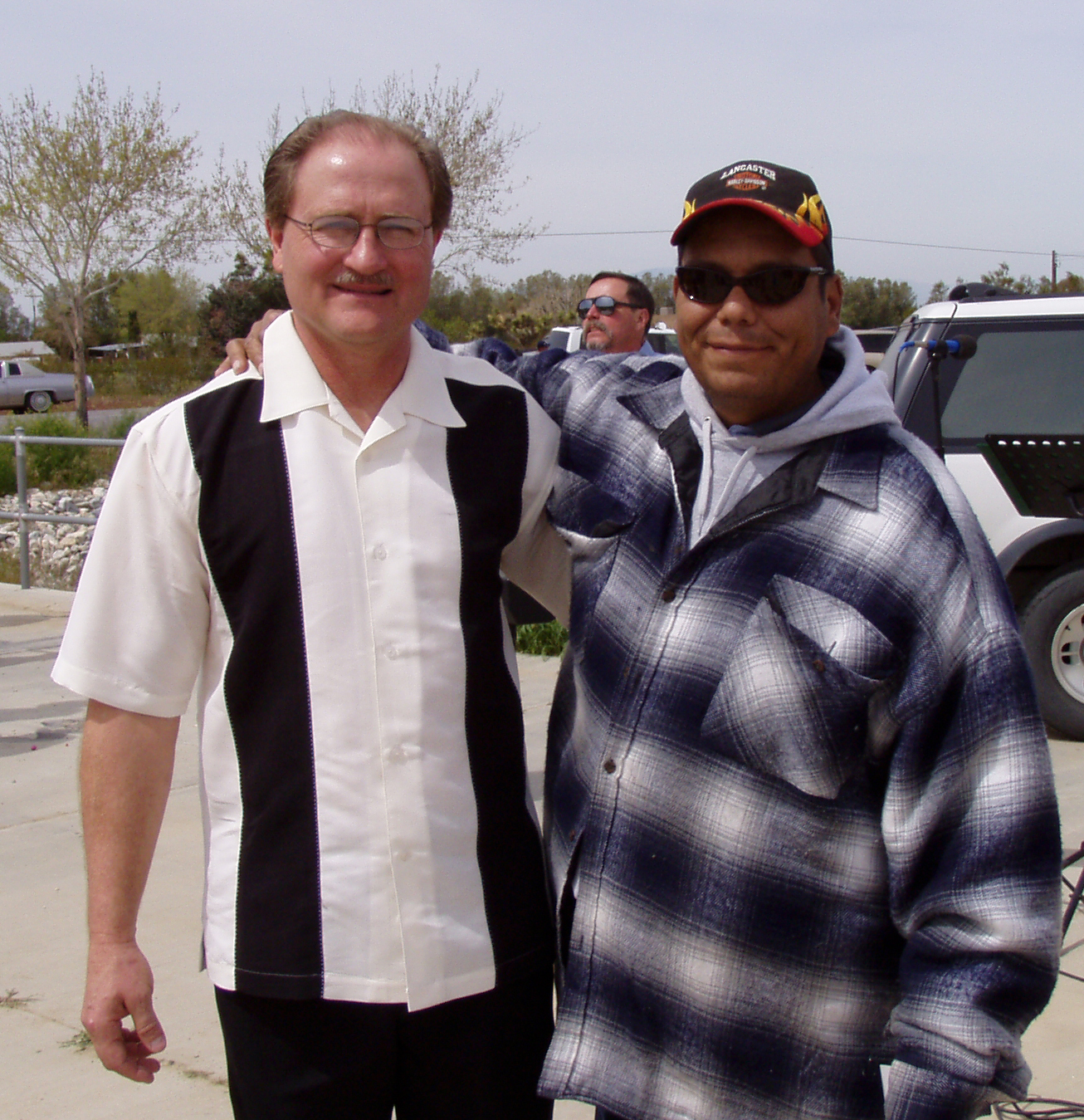
Krin and HenryI first met Henry at a backyard BBQ. He wore baggy jeans, a flannel shirt, a do-rag, and wraparound sunglasses. It wasn’t until he removed those shades that I saw the signs of advanced alcoholism. The whites of his eyes were leopard orange, evidence of his failing liver.

At the end of that first conversation, I invited him to church. “Sure,” he said, nodding absently. To my surprise, he showed up the next Sunday, his attire identical, sunglasses hiding his eyes.

The Spirit so worked on Henry that, in time, he asked if he could be re-baptized. I explained that one immersion was enough, but quickly added that if he wanted to recommit his life publically the next week, we would welcome him with alleluias!

Sunday morning arrived, and Henry was there, his Pendleton shirt pressed neatly. When he came forward, I asked if anyone else would like to join him for a laying on of hands.

About half the congregation formed a circle around us. My eyes scanned their faces, wondering if their acceptance would survive the next few moments.

“Henry,” I said, “you’re among friends here. Would you take off your glasses before I ask these questions?”

He slowly slipped them from his face, those shockingly jaundiced eyes scanning the saints encircling us. I tracked his gaze, wondering what I would see, and my heart soared! There was only love, grace, and hospitality. Romans 15:7 came to mind: “Welcome one another, therefore, just as Christ has welcomed you.” When we prayed, many of us cried.

Henry died shortly thereafter, at age 39. I was at his bedside in the final hours.

“Pastor Krin,” he said, “how can I thank you and our church for all the love you have shown me? I failed in many ways in this life, but you helped me find inner peace.”

“Henry,” I said, “you are a precious child of God, and not even death will separate you from Christ’s love. It has been our privilege to know you.”

I took his hand and we prayed.

God’s Holy Ecosystem

Nature Waterfall ImageStudy any ecosystem and you might agree with King David, “Only fools say in their hearts, ‘There is no God.’”

Everything has its place, its purpose, its niche. Termites demolish logs to enrich the soil. Forest fires crack the hulls of Sequoia seeds. Tiny krill fill the gullets of Blue Whales, earth’s largest creature. Snow that melts on the mountain top wends its way to the heart of the sea.

Our Creator orchestrates it all with breathtaking precision. And one truth is crystal clear: nothing goes to waste!

In our personal lives, this is especially true with hardship. Have you stumbled, made mistakes, gotten off track? Have you squandered relationships, nursed bad habits, or worried needlessly? Do you regret missed opportunities? Did you fail to love because of selfishness? Have you suffered through tragedy, heartache, or illness?

Surely there is pain in this wreckage, but God can employ every piece to expand our spirits. Even more, when we open these wounds to others – unafraid to share our humanity – it releases great healing.

Consider the local church. On any given Sunday, it’s a rich repository of wisdom. So many living sermons sitting in the pews!

Parents who have struggled to raise children. Couples who resurrected troubled marriages. Divorcees who found new love. Survivors of cancer, heart attacks, and strokes. People who are overcoming addiction. Adult children caring for ailing parents. Those who resolved their grief after losing a precious loved one.

I could go on, but you get my drift. The church is a holy ecosystem where nothing need go to waste. As a pastor, it makes me want to shout from the rooftops. “This is what we have to offer! Authentic human beings who have grown from the hard knocks of life. People who can be God’s ambassadors of grace, walking alongside you in your journey. We are not here for religion; we are here for relationships!”

But this only happens, my friends, when we reveal ourselves, when we put our experience at God’s disposal. It happens when we risk vulnerability, allowing our stories to intersect with others.

I think of Marlene, sexually abused by her father throughout childhood. Bitterness and rage consumed her adult life. In our sessions, she finally said to me, “I have to find a way to let go. If I don’t, I’ll be a prisoner ‘til the day I die.”

One winter morning at a windswept Michigan cemetery, Marlene stood before her father’s headstone. She read a letter to him that she had crafted for months: words of resolution, words of hard-won forgiveness only God could give her. As light snowfall began, she shredded the paper, spread it on the grave, turned and walked away.

Months later a young woman joined our congregation. I discovered that abuse had twisted her life as well, so I introduced her to Marlene. On a Sunday morning after Spirit-filled worship, I saw them sitting beneath an oak tree. Marlene had a hand on her new friend’s shoulder. They were praying together, seeking the balm of God’s presence.

In God’s holy ecosystem, even our worst pain can serve the power of redemption. Alleluia!

Tribute To an Unknown Saint

img005He would have been 76 today, January 8, 2015. My mind drifts back…

It’s 1996. A brisk November afternoon in Southern California. Brown leaves skitter across the cemetery grounds, bunching against headstones. Our family has gathered to say goodbye to my uncle Jerry.

I am overseeing this graveside service. As I open my Bible to the text I’ve chosen to share, I look around at our small circle of loved ones, then down at the casket. A deep sadness fills me and a single thought prevails: some people endure far more than their share of pain and struggle.

Jerry was one of six boys, a quiet soul. After a tour in the Army he got married, and shortly afterwards began his descent into mental illness, starting with severe depression. When he sought help at a VA hospital, they submitted him to dozens of shock treatments. The brutal currents ravaged him, permanently rewiring his personality.

For the rest of his life he carried the label “Schizoaffective Disorder.” Heavy doses of Thorazine, Stelazine, and Haldol gradually eroded what was left of him.

I vividly remember Jerry at family events. He was shy, affable, eager to please. He was rarely delusional in conversation, but when you glanced at him from afar, chain smoking cigarettes, you could see his lips moving in dialogue with his inner demons.

As his illness progressed, he would leave home and hitchhike, panhandling across the continent. He would call relatives at ungodly hours, telling us he was at a homeless shelter in some remote city and needed funds for a bus ride home.

Though his wife, Francis, was a saint, their marriage ended. For years he lived with my grandma until his vagrancy left her exhausted. He spent his final days in group homes, some compassionate, others mere human warehouses.

So much pain and struggle.

But the miracle of Jerry was that this crucible of his illness forged a gracious spirit. He was generous and big-hearted, intent on helping those even more unfortunate than he.

Once he visited my home in Las Vegas. Each morning he would bum a few dollars from me, then take to the streets. He said he was going to buy coffee at a nearby restaurant.

One day he didn’t return. Late in the evening, he finally called. Could I pick him up at the Greyhound Station downtown? He was tired and needed a lift.

I parked on the street, scanning the sidewalk and station, finally spotting him through the window of a greasy cafe next door. He was seated with a younger man who looked homeless – unshaven, dirty, a backpack on the chair next to him. Jerry had used my daily donations to not only buy the man a meal, but help him fill a prescription at a nearby drug store. That was my uncle.

Back to the graveside service. Though I’m grateful for Jerry’s witness, I’m heavy with the knowledge of his short life bent by so much pain. I open to Romans 8:26.

“The Spirit helps us in our weakness. We do not know what we ought to pray for, but the Spirit intercedes for us with sighs too deep for words…”

Shortening Our Time Lags of Trust

A friend said to me recently. “Does it strike you that we often look back and see how God helped us overcome the worst obstacles in our lives? At the time, things seemed impossible. But we emerged and were wiser and stronger for the experience.”

How true! And you know what it comes down to? Learning to trust our Higher Power in the moment – this instant – not at some point in the future!

I have a vivid memory. It’s a summer day. I’m standing high on a mesa in New Mexico, looking out over painted cliffs towards Pedernal, the peak where Georgia O’Keefe’s ashes reside. A storm is approaching, the underside of its dark clouds level with my line of sight. On the horizon, lightning strikes in bright dendrites. A few seconds later, like an aural tsunami, booms of thunder roll over me.

Many of us have this in common. We can look back at extremely difficult times in our lives. We felt stressed, frightened, even desperate. We prayed for God’s help, but dread lingered in our hearts and minds. Friends said trite things like this too shall pass, but we wanted it to be over instantly!

Now we can see how God not only answered our prayers and brought us through those trials, but made us more mature because of them.

Do you see? The presence of God – like a lightning strike – was there in the moment, but it took a while for us to experience the power. I call it the time lag of trust.

Let me share a candid example from my own life.

When I went into treatment for my alcoholism, it was the darkest day of my life. I woke up to meet my new peer group – men who were transferred from prison, or were dumpster-diving the day before. The great leveler of our disease bonded us as one.

During my minimal free time, I would go out to a dirt circle at the back of the facility. It wasn’t a real track, just a path worn smooth by countless men and women working out their anxieties, repeating mantras of recovery, trying desperately to let go and let God.

As I made those circles, I prayed about three potent fears crowding my mind and heart. They spanned my vocation, finances, and dearest relationships. Every day I tried to release them with an attitude of trust. I made minimal progress.

Now, looking back on that valley of the shadow, it’s clear how God was there every second, working out a plan far better than I imagined. The evidence rolls over me in waves of thunderous gratitude.

I have a New Year’s resolution. I resolve to shorten the time lag of trust. I resolve to believe today, not later, that I am in God’s hands. I will welcome the peace this gives to my life as I seek to love and serve.

Will you join me, my friends?

Are We Seekers or Settlers?


For those who have spiritual beliefs, as well as those who don’t, here’s a question for the New Year: are we seekers or settlers?charting a course

By settlers, I don’t mean putting down physical roots. Remaining in one place can have long term benefits as we develop relationships and increase our influence.

I’m talking about our journeys toward actualization. Are we continuing on with the belief that there is more wisdom, joy, & purpose to be found in this short life? Or have we settled for a conventional existence, a Reader’s Digest version of typical human endeavors?

I urge us to be seekers in 2015, to press on to new liberation, new compassion, new ideals.

In the Christian tradition, this is the season of Epiphany, and there are a couple things we can learn from those three iconic Wise Ones who followed the star.

First, they recognized their inner thirst. The Magi were priestly nobles in Persia. This meant they had prestige, influence, and wealth. But ephemeral trappings were not enough. They longed for something deeper, and when that legendary star in the west appeared, they did not ignore their thirst. They set out on a quest.

During this Christmas season, with its annual barrage of ads, I reflected on the underlying premise of our commercial culture. We are encouraged to covet. And not just to covet the baubles that pass across our screens: cars, jewelry, tech gadgets. Clever Madison Avenue language whispers a more pernicious message. In his book “Wake Up, America,” Tony Campolo put it this way. “In all of this media hype, things are sold to us on the basis that our deepest emotional and psychological needs will be met by having the right consumer goods.”

Things, accomplishments, ego gratification – these are all pleasant, but ultimately fleeting. Most of us wake up to this truth some time in our lives. How sad if we don’t. We are meant for something far more than material gain or Self. Recognizing our deeper thirst is vital. It’s the first step for lifelong seekers.

The second thing we see in the Magi is their willingness to leave their comfort zones. The journey from Persia to Palestine was 1,000 miles, most of it through enemy territory. And this wasn’t travel by plane, train, or automobile. It was by camel, a decidedly uncomfortable ride, exposed to the elements.

We all like our comforts, but I like the saying a seeker friend of mine posted on Facebook: The New Year means nothing if you’re still in love with your comfort zone.

Despite what motivational speakers, fitness coaches, and positive thinking preachers say, change isn’t easy. It isn’t easy in our faith lives, our relationships, or our vocation. It requires a letting go, a moving into uncertain territory, and a persistence towards goals through whatever obstacles.

But this is what seekers do, because we believe there is more freedom, more purpose, more love and unity on the horizon.

This year, let’s be seekers, not settlers.

Merry Christmas, Righteous Liberals!

I always teach the difference between righteous and self-righteous anger.

Righteous anger is a God-given, empathetic response to injustice. It sees the harm visited upon the innocent and rises up to protest. Its purpose is restorative, aiming to bring about change in solidarity with others.

Self-righteous anger usually stems from our egos, our pride, our need to be right. We can cloak this reaction any way we want, but it often comes down to US – our smugness and superiority.

One of the things that fascinates me is the constant barrage of rhetoric that flows across Facebook on any given day. Since I have friends on both ends of the political and theological spectrum, the words get super-heated.

As a self-proclaimed liberal, it’s easy for me to shake my head at conservative diatribes. How narrow-minded! How short-sighted! How un-evolved! I find the tone of their words to be harsh, judgmental, morally superior.

Yet here’s the thing. Too often, when I – or my liberal friends – have responded, our tone is pretty much the same. This has been especially throughout the turmoil of 2014. One liberal rant after another.

I have three dogs at home. They can’t understand my words. Instead they tune into my tone. I can say, “Come over here. I’m going to throw you out in the freezing cold with no food or water.” But if I say it in a soothing, loving voice, my canines wag their tails. If I say, “Come here. You are such a good, good dog!” but my tone is harsh, they cringe warily.

Does our tone matter? YES! The entire notion of nonviolence calls us to model the change we want to see in the world. When our words are devoid of love, when our righteous anger crosses the border into self-righteousness, we undermine the unity we say we long for in this world. At that moment, Paul reminds us we are like noisy gongs and clanging cymbals. We perpetuate the cycle of action/reaction.

Listen, liberal friends. I see the systemic evils of racism. I see the patriotic cloaking of militarism and the abdication to torture. I see the American Jesus used to justify homophobia and intolerance. I am doing what I can, serving with the wonderful folks of my church to help the addicted, feed the hungry, welcome the lonely, advocate for refugees and immigrants.

But there’s an old adage that has proven rock-solid throughout my life as a pastor. People don’t want to know that you have to say until they know you love them.

Our tones can speak so loudly that our words fall only on the ears of compatriots. This is not the inclusive love Jesus championed on the cross.

So, Merry Christmas to all, but especially my righteous liberal friends. As we celebrate Christ’s birth, let’s remember these words from Ephesians 2:14 – “For he himself is our peace, who has made the two groups one and has destroyed the barrier, the dividing wall of hostility…”

My Best Nightmare

Have you had recurring dreams?

In my youth it was nocturnal flying. With carefully calibrated movements of my arms and legs, I maneuvered vertically, horizontally, even hovered like a hummingbird. I dove like a Peregrine Falcon, my supernatural vision bringing every inch of ground into sharp relief. I soared over vast, lush landscapes, galloping on currents of wind. Breathtaking! I would awaken with this great sense of promise, the future looming luminous with hope.

Somewhere over the years that Technicolor glory got cancelled by my subconscious and replaced with a shabby rerun, a black and white nightmare that always has the same basic components.

I’m on my way to church, obliged to preach and lead worship, but I’m sorely unprepared. I don’t know my topic; it’s a meager outline, something I haven’t practiced. I try to tell myself I can just open my mouth and “let it rip” through the Holy Spirit. Then I remember that the Spirit has always flowed most freely when I’ve lived in the message, internalizing its points, its illustrations, its contextual drama.

I arrive at the Sanctuary, always a slightly Cubist version of a place I’ve actually served. My feelings of inadequacy inflame when I look around. Hardly anyone is in the pews. The sound system isn’t on. The musicians aren’t in their places. I try my best to pull it together, but to no avail. Then there’s a flutter of hope. Maybe this time my message will rise with those wings Isaiah spoke of. I open my mouth and the words are like noisy gongs and clanging symbols; or if Paul were writing today, traffic noise from the freeway, the hissing of a tire slowly deflating. People start to leave in the First Act.

My counselors have had field days interpreting these icons. A self-centered need to be affirmed. Old feelings of shame, of being “found out” and left alone. The eternal footman holding my coat and snickering. A persistent fear of failure, unable to shoulder the great responsibility I promised to uphold with my ordination vows.

But let me tell you what happened the other night. The nightmare began with sickening familiarity. But this time the sanctuary is full. The Praise Band is waiting eagerly, primed by heavenly sound checks. They launch into Spirit-filled worship that fills the space and our hearts, inviting me to bring the Good News.

I look down at my outline. NOT AGAIN! It’s more meager than ever. But suddenly I’m not afraid. I begin, and every time there’s an awkward gap, someone from the congregation says, “Yes, it’s like…” or “That reminds me of…” or “This is what faith has taught me…” or “The word of God is alive for today!”

We’re in dialogue as a community, letting the Spirit bind us as we share discoveries on our mutual journey of faith.

And how do I describe the atmosphere in the Sanctuary? Simple. Love.

I’m hoping those flying dreams will return from their winter migration. Stay tuned.