London, 1853
The morning fog was cold and sour, stinking of low tide. It curled in damp skeins over the Thames, swallowing the far bank so completely that the world seemed to end just past the water’s edge. Sixteen-year-old Alice Larkin knew the smell by heart: rotting wood, fish scales, and the faint sweet stench of something dead in the mud.
The tide had gone out before dawn, baring the river’s underbelly. Black mud flats stretched into the fog, shiny and treacherous, dotted with shards of pottery, broken bottles, and the occasional rib of a long-lost boat.
Alice was ankle-deep in the muck, her skirt bunched high and tied at her waist. Her fingers were cracked from the cold, but she worked the mud with a stick, prying free whatever the Thames would surrender. She found some frayed rope, a pewter spoon, and an iron spike that left orange rust streaks on her palm.
Every scrap was worth a small bit. Rope could be sold to a rag-and-bone man. The spoon would perhaps fetch a shilling from Bill Scully. And all of it meant another day her family might keep from going hungry.
She had been mudlarking since she was eight, just one of hundreds of souls, many of them children, who combed the banks each day, gambling their lives against the river’s moods. Sometimes the water rose quick and fast, cutting you off. Sometimes it hid a sinkhole beneath its surface, and you were gone before anyone could shout your name.
Alice ignored the cold, the ache in her back, and the gnawing in her belly. She had learned at an early age that whining to others or an indifferent god had no effect. It was all about survival, and only the strong would make it.
A glint caught her eye, a pale object lodged near a large stone. She crouched and scraped away with her stick until her fingers closed around something substantial. The mud was reluctant to give it up, but she tugged until it came free with a sucking sound.
It was a dagger. The blade, though blackened, was still intact, tapered to a sharp point. The handle was carved from either bone or horn, with marks that looked like an ancient script carved deep into its surface.
Alice’s breath fogged in front of her as she examined it closely. She had found knives before, but nothing like this. It was heavy and solid, the sort of artifact that had weight not only in her hand but in the world that had first produced it.
Then, as her fingers wrapped tighter around the hilt, she felt a preternatural shift in the fog. It thickened into smoke, acrid and stinging, filling her nose and mouth. The river suddenly appeared at high tide, and through it came a shape: a long, low ship, its hull dark, its prow carved into the head of some beast with teeth bared. A single square sail bellied in the wind, driving it forward.
It moved down the Thames towards the sea, water slapping at its flanks. Behind it, she could see buildings burning in the distance. The men who stood on the deck were tall and broad-shouldered, dressed in dark tunics, armed with swords as they surveyed the passing shore. One of them trained his eyes on Alice, a look of recognition lighting up his face. She gasped and stumbled backward, breaking whatever spell had seized her. The vision faded, and the damp grey fog of London returned.
Her hand was shaking, and her heart was racing. The dagger was warm now, almost hot, and it seemed to pulse in her grip, as though it were breathing with her. Was it cursed? She wondered if she should throw it back in the water, but her curiosity about its value was stronger than her fear. She wrapped it quickly in a torn scrap of cloth from her sack and shoved it deep inside.
___
That night, their one-room lodging in Shad Thames smelled of boiled cabbage, damp wool, and the odor of the sewer running through the street. Alice’s three half-siblings were crammed together on wooden pallets, the youngest sniffling in the corner. The space was suffocating to her, but as the eldest child, she felt compelled to stay and contribute. Her older brother had fled their poverty a year earlier, and they hadn’t seen him since. Alice was tempted to do the same, but where would she go? How would she support herself? Too many young women turned to prostitution to survive on the streets, and she rejected that darkness.
Her stepfather father wasn’t home yet, likely still at the docks, begging for work that wasn’t there. Their mother, her skin stretched tight over her cheekbones, sat near a crude hearth, mending a shirt by firelight.
“What did you bring, Alice?” she asked without looking up, her tone showing her low expectations.
Alice emptied her day’s finds onto the table: the rope, the spoon, a colored bottle, and a few scraps of copper wire. She didn’t reveal the dagger. She was still unnerved about what had happened when she held it, but she was determined to investigate its worth more fully. It was one of those discoveries that mudlarks dreamed of, potentially life changing. For now, it was her secret.
Her mother’s eyes tiredly scanned the few scraps. “It’ll do,” she said, though they both knew it wouldn’t.
Alice went to her corner of the room, hiding her bag with the dagger under some straw. Her plan for the next day was formulating in her mind when she suddenly heard the rattle of carriage wheels from the street outside. She went and peered through the shutters, where a pair of gas streetlamps lit a lacquered black carriage rolling toward the affluent West End, the spokes of its wheels flashing gold in the light. Inside, swaddled in fur and velvet, sat a woman with a man in a dark suit at her side. Cocooned inside their Victorian-era privilege, they looked at the city the way one looked at a painting: detached and safe. The woman’s eyes slid across Alice as if she wasn’t even there.
Alice’s lips curled. She knew their type: rich enough to never see the mud, to never smell the river up close, to never watch a baby cough itself to death because medicine cost more than a month’s rent. Cocooned inside their Victorian-era privilege, they looked at the city the way one looked at a painting: detached and safe.
Alice recalled a day when she and a fellow mudlark named Nancy had skipped their scavenging and walked two miles to the West End. Though their cheap clothing made them stand out from the rest of the crowd, they explored freely. They strolled around Leicester Square and Picadilly Circus, then on to Covent Garden with its many stalls where vendors sold fine handcrafted goods. They stopped at a stand to get cups of tea, splurging with a few shillings, then sat at a nearby table. For a few moments, it felt like they were light years from the slums of Shad Thames. They fantasized with each other about attending school and belonging to more affluent families.
Then a middle-aged woman dressed in a colorful brocaded dress came near their table. She paused and looked down her nose.
“Shouldn’t the two of you return to the place you crawled out of?” she said disdainfully.
Alice felt fury surge from her gut.
“Go to hell, you miserable bitch!” she exclaimed, beginning to rise from her seat until Nancy put a hand on her shoulder to restrain her.
The woman’s head snapped back as if she’d been struck. She turned to the keeper of the tea stall. “Sir, quickly call the Bobbies and have them remove these urchins!”
The proprietor turned and whistled over his shoulder, and in the distance Alice and Nancy could see a police officer turn his head towards them. They needed no further prompting, but got up quickly and disappeared into the crowd.
Alice remembered the look on that woman’s face when she’d been insulted, the way her head snapped back, and it still brought her a sense of pleasure. She saw again the smug face of the woman in the carriage that had just passed. Then she thought of the ship in her vision as she had held the dagger—its fierce, hungry shape—and it left her with a strange pull in her chest.
___
The next morning, she went to see Bill Scully. He was an institution along the river, having been a mudlark longer than Alice had been alive. His hovel by the river was stacked with jars of nails, broken clay pipes, beads, and buckles. He bought and traded with scavengers of all ages, a man who was shrewd but fair. He invited her in, and Alice waited until his door was shut before she unwrapped the dagger.
Bill’s one good eye went wide. “Christ Almighty,” he muttered. He ran a finger over the letters etched in the handle. “These carvings are runes. Where’d you find this?”
“Down past the bridge,” she said. “Near low tide.”
He leaned closer. “This is Viking work, girl. I’ve only ever seen drawings. A thousand years ago, they came up this river before London was the London we know. They burned and pillaged and took booty and slaves back with them.”
Alice traced the runes with her thumb. “What do these mean?”
“I have no idea. Could be a name. Could be a curse. I know this is valuable to the right people, but these things also carry their own luck, and often it’s not good. Be careful. Be very careful.”
Even as Bill spoke, Alice’s mind wandered to the vision of those raiders, their ship sliding through the water, the firelight on their faces, the city trembling around them. And despite Bill’s caution, she wondered what it would feel like to be feared rather than judged or ignored.
___
The next day, Alice returned to the shore at high tide, when the river swelled nearly to the top of the embankment, its water brown and restless. Mist curled from it in slow, wraith-like shapes.
She had planned what she would do, resigned to whatever would happen regardless of Bill’s warning. She unwrapped the dagger, this time holding it in both hands, and the vision came almost instantly.
London lay before her but, as Bill had said, not the London she knew. The skyline was low, the bridges narrow and crowded. Smoke smeared the sky and flames leapt from thatched rooftops. Church bells rang, and the air was thick with frantic shouts.
Once again, a Viking longship surged downriver, its sail streaked with soot. Its crew were wild-haired and barrel-chested, their eyes bright with victory. As they neared the spot where Alice was standing on the wall, a voice rang out, deep and warm with relief.
“Astrid! We thought we had lost you!”
Somehow, she knew the language, even though she had never heard it before. Looking down at herself, she saw that she was dressed not in a ragged skirt but a leather tunic and fur leggings, a shield strapped to her back. The dagger now hung from her belt. Her arms were stronger, her stance solid, her breath steady.
The man who had yelled to her had a beard plaited in gold rings. He leaned over the gunwale as the ship slowed and veered towards her. “Come, shield-maiden! The sea is calling us home! We have more than enough spoils from this raid!”
It was a risk, but without hesitation, Alice leapt into the water, swimming towards the vessel. Rough hands seized her wrists, pulling her over the side until she landed on the deck.
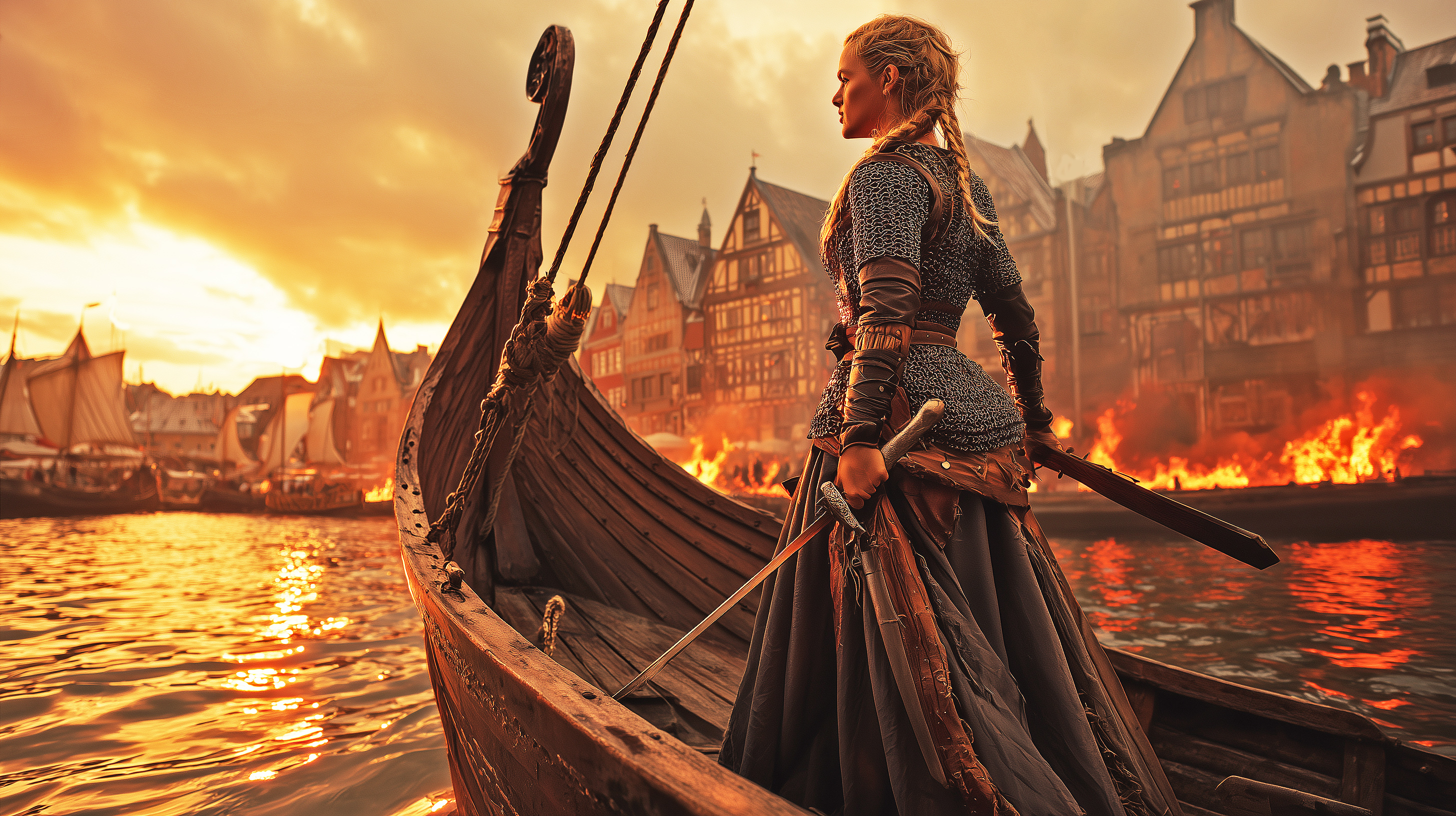
The ship swung out into the middle of the river. Behind them, medieval London burned, its firelight dancing in the smoke. The men lifted their voices, shouting “Til Valhalla! Til Valhalla!” Alice—now Astrid—stood on the stern. She drew the dagger, lifted it high, and laughed, a fierce sound full of an exultation she had never known before. “Til Valhalla!” she screamed with the others.
As the longship carried her and the others toward the North Sea, the city that would one day scorn her receded in the distance. For an instant, Astrid felt a tinge of wistfulness, but then relief and vindication lifted her spirits.
The dagger in her hand felt natural, and she gripped it with full acceptance of her new life.
 Krin Van Tatenhove - Words & Images
You are such a wonderful writer Krin? Have you thought of writing a novel? (Or maybe you have) I don’t know if Hilly has shared with you that my brother and nephew are published writers 😊 I so respect people who have that gift! It’s not easy! Keep writing!! 💕
Get Outlook for iOShttps://aka.ms/o0ukef
I thought you read my novel “The Bridge at Dawn” and that we talked about it. Maybe my memory is failing. Lol! Here’s the link. https://a.co/d/8q6RnNY
Once again, thanks for the encouragement.
Oh no!!! I did read it and we did talk about it!! 🙄 I’m sorry…I am losing it lately 🤦♀️
My only excuse is that I read a lot of books and short stories (and news etc) But I do love reading the short stories you send me 🙏
Get Outlook for iOShttps://aka.ms/o0ukef