We must learn to regard people less in the light of what they do or omit to do, and more in the light of what they suffer. – Dietrich Bonhoeffer
December 2010, near the Mexican/American border
It was early morning, the cold winter air tinged with smoke from trash fires. Our crew of volunteers was inspecting construction sites in a colonia on the outskirts of Reynosa, Mexico. The neighborhood was mostly shacks cobbled together from old wood, tin, and cardboard. No running water or electricity. Many of its residents were migrants from Chiapas, lured to jobs in maquiladoras along the border. They weren’t squatters. They had purchased their tiny lots with a mortgage and now were laboring with us to build 500 square-foot, cement block structures with two bedrooms and a living space that included a kitchen. Latrines remained outside. These modest homes would usually shelter large families.
I was looking forward to a day of laboring alongside new homeowners, a fellowship of shared purpose, but first I was called elsewhere. News had rippled through the dirt streets that a pastor was present, and I’d received an invitation from a family to bless their newborn child.
I was willing, even though I knew my words would be a clumsy mixture of English and Spanish. A member of the community guided me to the family’s shelter, a one-room shack for two adults and three children. Its walls were scrap plywood, its roof rusted tin over a floor of barren earth. Outside was a cooking fire and a pit latrine.
An old bench seat from a bus sat near the entrance, listing slightly, its surface torn to reveal the springs beneath. The parents, Oscar and Claudia Salazar, thanked me for coming and asked me to sit. Then they brought their tiny daughter to me, only three weeks old.
“Que preciosa,” I said. “Come se llama ella?”
“Perla,” was the answer.
I cradled the infant in my arms, bundled in a blanket. She was quiet, her dark eyes staring up at me, and though I knew she would never remember that moment, it was sacramental for me.
I made the sign of the cross on her forehead and prayed for our Creator’s guiding hand to be upon her and her family, giving them strength, safety, and abundance for this new life they sought to establish.
Then I hold her against my chest for a moment, encircled by her family and smiling neighbors. I could hear dogs barking in the distance.
July 2025, San Antonio, Texas
It was mid-morning. I was sitting in my office when my phone buzzed. I didn’t recognize the number.
“This is Alex,” I answered.
“Alex, it’s Peter Banks. It’s been a while, amigo.”
Peter’s nonprofit had organized the housing projects in Reynosa, partnering with Habitat Para la Humanidad. I knew that the rise of violence with the Gulf Cartel had forced him to shift his focus to immigration advocacy in the U.S. Meanwhile, I’d left my life as a cleric a decade earlier. When people asked me why, I told them it wasn’t due to a crisis of faith. It was an expansion of faith that could no longer be contained by organized religion. I now worked for a nonprofit that oversaw grants for people living with disabilities.
“What’s it been?” I said. “Eight or nine years?”
“That sounds about right.”
“Good to hear from you, Peter. To what do I owe the pleasure?”
“Do you remember the Salazar family?”
The memory of that day returned, as well as its aftermath. The Salazars had sent a picture to me a year later. They were standing in front of their cement block home, Perla supported by her mother’s hand. The photo was in an envelope scrawled with the words “Al Padrino de Perla.” Godfather? I thought. I was a bit embarrassed that my momentary gesture could be held in such high esteem. I felt unworthy.
“How could I forget?”
“Well, you won’t believe this, but they’re here in the city. They found a way to enter illegally and they’ve sought refuge and help from our center.”
“All five of them?”
“No, just Perla and her parents. Her older brothers struck out on their own. One lives in Matamoros, the other in Monterrey.”
Immediately, the danger of their situation was clear. Our city, like so many in the US, had ICE agents raiding businesses, homes, and public parks, arresting people without legal papers and transporting them to detention centers.
“I’m confused,” I said. “The last time I heard from them, they had a built a small home. Why did they leave?”
“I think it would be better if you heard from them firsthand. Could you come to our offices by the back door this afternoon? There’s some urgency here.”
We set a time for 4:00 p.m.
***
The room Peter chose for our meeting was tucked in the back of his headquarters, one of three homes his operation used on our city’s impoverished South Side. The window blinds were drawn tight. Claudia and Oscar Salazar sat on a couch with Perla beside them. The parents rose and greeted me with warm hugs, as if we were long lost relatives. Perla remained seated, watching me with a distant expression. She was now 15, but she looked older, an attractive young woman with a touch of hardness about her. I nodded at her and smiled, but she simply held my eyes with a flat stare.
“Let’s get started,” said Peter, turning to Oscar. “Por favor, cuéntale a Alex la historia de por qué estás aquí.”
“Claro,” said Oscar, fixing his eyes on mine and beginning his explanation in rapid Spanish.
I caught most of it and Peter translated the rest. It was painful to hear. Claudia and Oscar had secured jobs at the LG Electronics factory in Reynosa, assembling TVs for international distribution. They staggered their shifts so that one of them could always be home to watch over the three children. When the boys moved out, Perla began to associate with peers that had a negative influence on her. She hooked up with a boyfriend who had ties to Los Metros, a faction of the Gulf Cartel that controls northern cities in the Mexican state of Tamaulipas. He became possessive, then physically abusive, and when she tried to pull away, he threatened her and her family. Oscar and Claudia hoped it would simmer down over time, but it grew worse. Twice during the night, their home was struck with rocks, and guns were fired over their roof.
“Dios mío,” I said. “Did you go to the police?
Clauda and Oscar smiled tolerantly, and Perla made a scoffing noise, speaking up for the first time.
“The police are corrupt. If we went to them for help, it would only have made things worse.”
I was surprised by her English fluency, arching my eyebrows.
“The Salazars paid for an ESL tutor at Perla’s request,” Peter explained. “On both sides of the border, being bilingual opens a lot of doors.”
I nodded and looked at her. “I admire that. Can you tell me what happened next?”
She continued in English that was a bit stilted but understandable. She said their family had a cousin in Houston who had emigrated many years ago. He secured his citizenship and now ran a string of small businesses in the Second Ward, a strong Latino enclave. The Salazars pleaded for his help. Even though human smuggling was mostly controlled by the cartel, he knew a man who drove an independent produce truck between Reynosa and McAllen, Texas. He had designed a hidden chamber in the flatbed, and with so many pallets of produce stacked on top, he had never had border agents discover it. For a steep price, he could get them across.
“I have never been so scared,” said Perla. “Not even when Los Metros attacked our home. We were lying flat on our backs. It was so dark. I could hear traffic and the inspectors speaking to the driver. I thought they would find us. I thought they would arrest us and take us to a Centro de Detención.”
I could still hear the fear in her voice. My heart went out to them, confirming a truth that is central to my life. No matter how different someone’s experience is from ours, when we enter into their stories, we have a chance to practice love and hospitality.
“We have a couple drivers who transport people from the border to San Antonio,” said Peter, “but no one available to get them to Houston. Is there any chance you could help, Alex?”
I looked at the expectant faces of the Salazars. Even Perla’s expression was now softer.
“Of course,” I said. “They can come home with me now and we’ll leave early in the morning. I’ll take a personal day.”
“Gloria a Dios,” said Claudia, tears streaming down her cheeks.
***
I had made a snap decision without consulting my wife, Yasmin, but her reaction didn’t surprise me. A second generation Mexican American, she managed a gallery at a local arts complex that specialized in exhibits of Latinx artists. Politically, she was further left than I am. At her insistence, we’d just attended a protest against the ICE raids that were rampant since the new administration took office. The experience moved me deeply. We chanted and sang with a crowd of thousands, and Yasmin described the vibe of the crowd as el Espiritu Santo del pueblo.
Yasmin greeted the Salazars with open arms and helped them get settled, using our guest bedroom and a pull-out sofa bed in the living room. Our two daughters were away at college, so we had ample room. Then the five of us shared a simple dinner. Fluent in Spanish, Yasmin engaged the Salazars, drawing out more of their story. What struck me was the bravery of these parents who had left everything behind at great risk to protect their only daughter.
I told the Salazars that we would leave before dawn, then we all went to our rooms to get rested for the trip.
***
At 2:10 a.m., I heard loud knocking on our front door. Expecting the worst, I got up and went to the entrance. It was wise to have home security in our neighborhood, and because I’m a bit of a techie, I had installed a larger than normal screen near the door. It showed a view all the way to the street. Perla stirred from the nearby sofa bed, but I gestured with my hand for her to stay back.
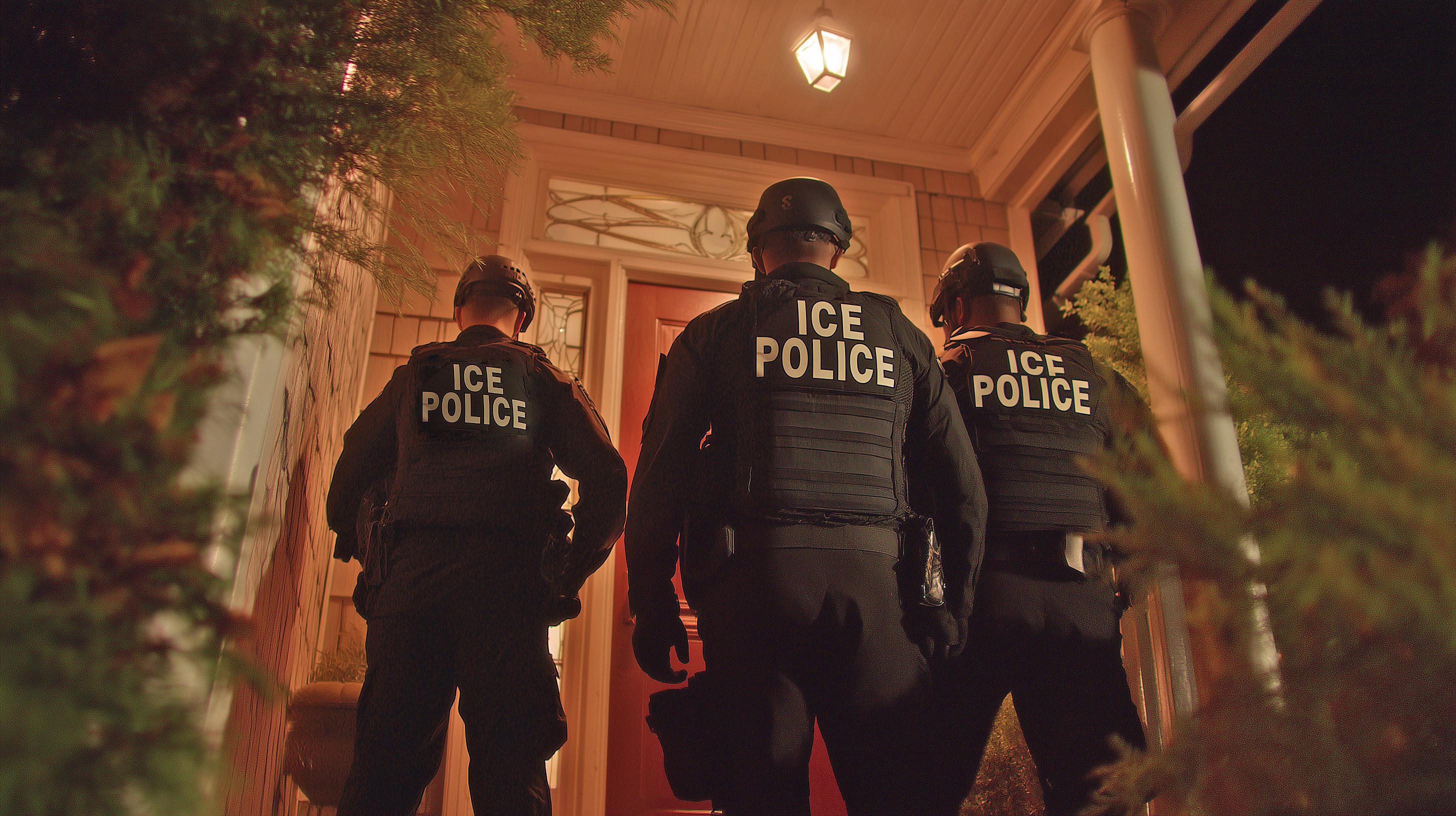
Three ICE agents were standing in the glow of our porch light, one slightly in front of the others. They were dressed in black with bullet proof vests. Pistols, radios, and handcuffs hung from their utility belts. Emblazoned on their chests in white block letters were the words ICE POLICE. They wore dark masks.
“I know you can see us,” said the man in front. “We have reason to believe that you are sheltering illegal immigrants. Open the door.”
My anxiety was replaced by a growing anger, especially at their anonymity.
“Do you have a warrant?” I asked.
“No,” said the leader, “but it would be wise for you to cooperate.”
“I’m not letting you in my house without a warrant.”
The leader turned and whispered something to his comrades that I couldn’t decipher. Then he turned back to me.
“I must insist that you open the door.”
“You can insist all you want, but without a warrant I will not let you in my home.”
He snorted in frustration, letting his hand drop to his gun. It only pissed me off further.
“And while you’re standing there,” I said, “why don’t you take off your mask? What’s the matter? Afraid to let me see your face?”
He stood frozen for a moment, then reached up and removed it. He was young, Latino, with a beard and dark eyes.
“There. Satisfied?”
I looked into his eyes and the same truth I had applied to the Salazars filled my mind. Who was this young man who had once suckled at his mother’s breast? What was his story? What were his hopes, his dreams, the challenges he faced?
“Well, fellow American,” I said, “we may be on opposite sides of this door, but we aren’t enemies. We share the same country and the same constitutional rights. Without a warrant, I won’t let you past my threshold.”
He just shook his head. “This isn’t over, sir. Not by a long shot.” Then he turned and the three of them walked out to the street and vanished.
I let out a deep breath, realizing only then how much adrenaline was coursing through me. Yasmin and the Salazars had gathered in the hallway, listening to the discussion.
Yasmin came up behind me and placed her hand on my shoulder. “My husband,” she said, “thank you for that. I have an idea for what to do next.”
***
A few hours later, we implemented Yasmin’s plan. Since she and I both drive SUVs, she suggested that she leave our garage into the rear alleyway before dawn, using my vehicle with its darker window tinting. If we were under surveillance, perhaps she could act as a decoy. A short time later, I could leave in her car with the Salazars. It was still risky, but it was the best shot we had.
Yasmin left at 5:00 a.m. A half hour later, I loaded the Salazars into Yasmin’s car. It has three back seats, so I instructed them to lie down, one to a seat, until we were clear of the city.
I pulled out and made my way to Interstate 10 for our three-hour drive to Houston. I was only nervous now, no anger, and I obsessively checked the rearview mirrors to see if we were being followed. It wasn’t until we got past Seguin that I began to relax, telling the Salazars they could sit up in their seats.
Perla was right behind me, staring at me through the rearview mirror. I looked into her eyes, remembering that distant day when I held her on a broken bus bench, the smell of smoke surrounding us.
“Gracias, padrino,” she said.
“Es mi privilegio.”
And we smiled at each other as we hurtled towards the next chapter of her life.




 Krin Van Tatenhove - Words & Images