December 29, 1890, South Dakota
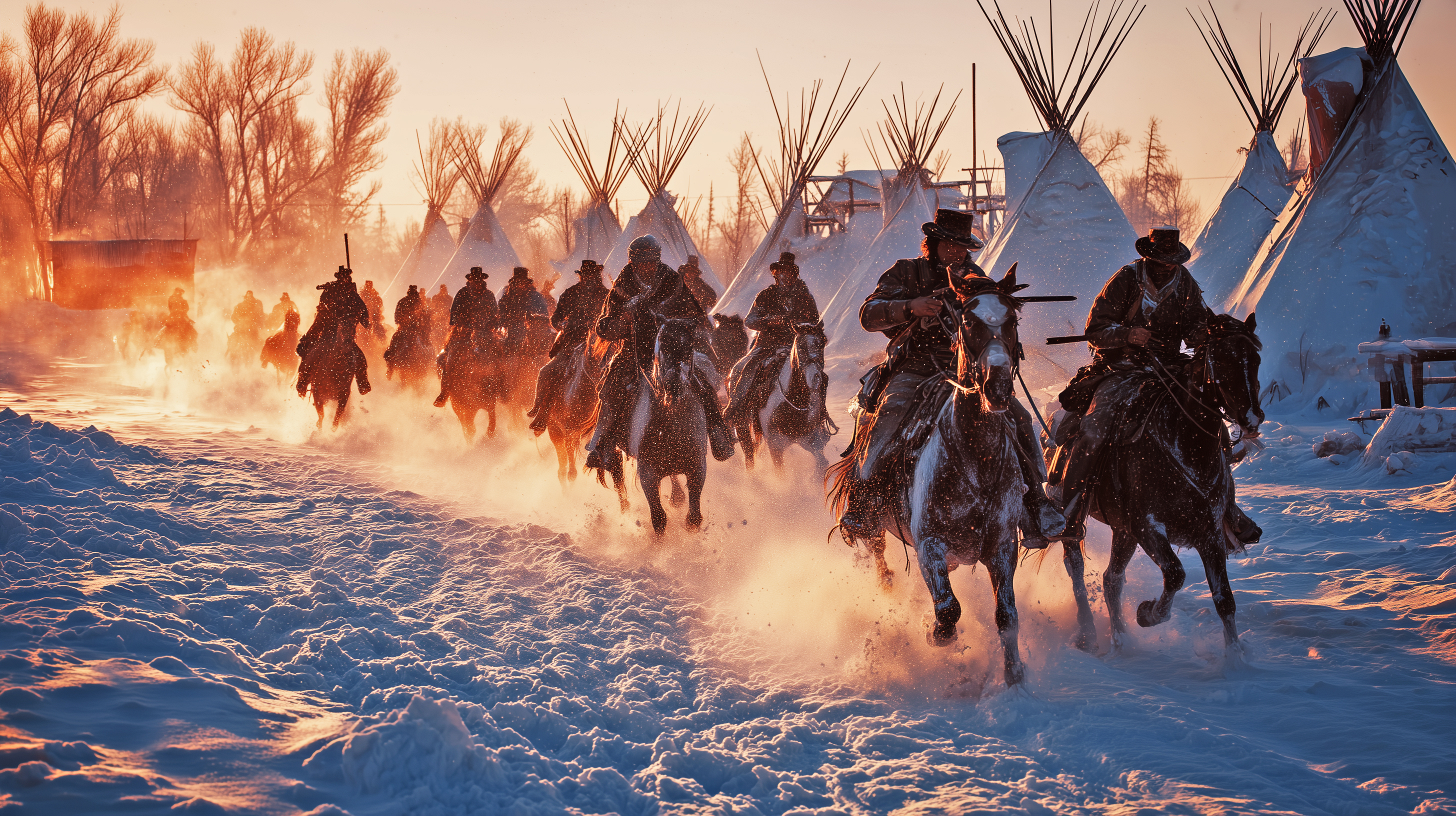
Snow lay thick over the plains. At the edge of Wounded Knee Creek, the air crackled with a cold that bit through wool and leather. Private Edward Dutton adjusted his overcoat, stamping his feet to keep warm. The rising sun offered little comfort, its light sharpening the outlines of the Lakota camp below. He could hear their distant voices, punctuated by barking dogs and the neighing of horses.
The 7th Cavalry had encircled the camp under orders to disarm the Miniconjou Sioux, but the regiment’s formation felt more like a noose than a peacekeeping gesture. To fortify their plan, they had positioned four Hotchkiss guns on the ridge, cannons able to fire 68 rounds a minute. Dutton, eighteen years old and only a few months into his enlistment, felt dread twisting in his gut. He had realized he would see armed action, but he hadn’t expected it like this. Tension thrummed in the air.
The Lakota, numbering about 350, knew that the US Army, spurred by settlers in nearby towns, were fearful of their participation in the Ghost Dance, a ceremony sweeping through tribes of the plains, promising an apocalyptic end to the white invaders. Now, with the cavalry perched above them, anxiety rippled through their ranks.
The order came to move down from the ridge. Dutton heard Colonel Forsyth, using an interpreter, order the surrender of weapons. The cavalry began confiscating rifles and knives, placing them in a pile, but a Lakota medicine man named Yellow Bird started to harangue the native warriors in a loud voice.
“Do not be afraid of them,” he shouted in their language. “Be brave and resist! The Ghost Shirts you are wearing will stop their bullets!”
Then came a single shot. No one knew who fired it, but chaos erupted, gunfire bursting like thunderclaps and screams piercing the air as soldiers fired indiscriminately into the tribespeople. Edward raised his Springfield rifle almost unconsciously, the instinct of his training fueled by fear, and it bucked against his shoulder with each discharge.
Most of the Lakota fled in panic—men, women, and children—but some tried to fight back by grabbing rifles from the pile. The Hotchkiss guns roared from the ridge, spewing death in iron bursts. Explosions ripped through the tipis, flinging bodies into the snow.
Edward watched as a young boy ran past him, his cheeks flushed with terror. The soldier beside him, Sergeant James Ward, pulled his trigger. The boy crumpled face-first into the snow as Edward’s breath caught in his throat. Then he saw a woman clutching a baby scurry from behind a tipi. Ward discharged his rifle. The woman dropped and the infant rolled from her arms, mewling in the bloodied snow.
Edward lowered his weapon. He couldn’t move. Couldn’t breathe. His mind screamed for this madness to stop.
“Keep firing, son!” ordered Ward, and Dutton did, zombie-like, contributing to the bloodbath, each bullet chipping away at his humanity.
By mid-morning, the field was a massacre. Nearly three hundred Lakota lay dead. Their bodies froze where they had fallen, limbs twisted, faces caught in final moments of agony. Soldiers walked among the corpses, collecting weapons, overturning bodies. One trooper laughed as he pulled a necklace from a dead woman’s neck. Another prodded the body of a warrior with his bayonet, checking for movement. The young brave lay still, wrapped in his buckskin Ghost Shirt with its fringed collar. Edward stood in the middle of it all, his rifle limp at his side, his eyes hollow.
In the weeks that followed, Edward received the Certificate of Merit for “gallantry in action.” His citation praised his “steadfastness and courage under fire.” He accepted it with a blank face, unable to meet the eyes of the officer handing him the parchment. He wondered to himself, had no one else doubted their actions that day?
He kept that certificate rolled tight and locked in a cabinet, until years later when his new wife insisted that he hang it in his study.
He spoke rarely of that fateful morning, but the nightmares stayed with him for decades, persistent images of red snow, the cries of women and children, and the echoes of gunfire.
Edward became a clerk, then a station manager for the railways in Denver. He lived a quiet life, raising his family. He drank very little, but when he did, he drank alone, and every year on December 29th he would take the day off, retreating into his study and not emerging until the next morning.
Denver, Colorado, 1928
Dad’s house always smelled of pipe smoke and oiled wood. He was mostly a quiet man, but I knew some of his history, including his time with the 7th Cavalry. Occasionally, I sat with him in his study where his Certificate of Merit hung on the wall, framed in mahogany, its edges curled with age. Because he spoke so rarely of that event, I filled in the gaps as a child, imagining a glorious battlefield, my dad a hero among men.
To his credit, he never encouraged those fantasies. When my mother died, he became even more withdrawn.
Now, in the spring of 1928, he was dying from throat cancer—a slow, rasping decay. I was with him in his study, where he sat in a chair by the window, thinner than I’d ever seen him, a blanket over his knees. His eyes, however, were still sharp, filled with something I couldn’t name.
“Will,” he said, “I need you to take me to South Dakota.”
I raised an eyebrow. “To see someone?”
He shook his head. “No. To do something I should’ve done a long time ago.”
When he told me the destination—the site of Wounded Knee—I didn’t pry any further. If this was his dying wish, I felt privileged to grant it, especially since my other siblings had moved far away from the family home.
We left two days later in my Ford Eifel, the engine humming steadily as we drove across the plains. He didn’t talk much on the first day of our trip, just stared out the window at the endless horizon. But the land seemed to be drawing something out of him, something buried deep. He spoke a little on the second day, telling me of his enlistment in the Army at age 18, how the promise of adventure and romance in the West had seemed infinitely more enticing than living in hardscrabble poverty on the family farm in Kansas. Then he went silent again.
As we crossed into South Dakota, his posture stiffened, and his breathing grew shallower. The reservation settlements were quiet and somber. Children played in the dust, and elders watched us with unreadable expressions. Since it had been so many years, Dad asked directions to Wounded Knee, where a monument had been erected in 1903. No one spoke much, but they pointed the way.
The monument stood alone on a slight hill, a granite obelisk reaching toward the sky. Dad stepped out of the car slowly, leaning on my arm as we walked toward it. Wind whispered through the grass, as if the land was alive with memory. Dad stood before the monument, shoulders hunched, hat in hand. I stayed a few paces behind him, but I could still read the inscription on the marker.
This monument is erected by
surviving relatives and other
Ogallala. and Cheyenne River Sioux
Indians in memory of the
Chief Big Foot Massacre
December 29, 1890
Col. Forsyth in command
U.S. troops
Big Foot was a great chief of the
Sioux Indians. He often said, I will
stand in peace till my last day
comes. He did many good and brave
deeds for the white man and the
red man. Many innocent women and
children who knew no wrong
died here.
Dad stayed there a long time, the grass moving in small waves around his feet. Then, from his coat pocket, he pulled out the Certificate of Merit. I didn’t realize he had it with him. The edges were browned, the ink faded. He held it up, staring at it as if it were a stranger’s face.
“They gave this to me for killing people who couldn’t fight back,” he whispered. “I’ve kept it for thirty-seven years and it has never stopped haunting me. “
His hands trembled slightly. He took out the fancy inlaid lighter he used to stoke his pipe, flicked it once, and held it to the paper. The flame caught, then danced along the edge until the certificate curled and blackened, flakes drifting to the earth.
When it was nearly consumed, he let the ashes fall from his hand at the base of the monument. Then he knelt and touched the earth with his palms. He whispered something I couldn’t hear, but it streamed out of him with a vitality that belied his illness.
He remained like that for many moments, then stood to his full height.
“Please take me home, Will,” was all he said.
We didn’t speak much on the drive back. but I could see that something in him had eased. His hands trembled less, and in a small motel near Cheyenne, he slept without coughing.
Two weeks later, he was gone.
We buried him with a stone cross and little fanfare, just our small family, a few friends, and the wind at his gravesite. I thought about the Certificate of Merit, how it too had found its final resting place in the soil of a land soaked in blood and finally, perhaps, forgiveness.
Epilogue
In the years since, I returned to that hill and its mournful monument. I stood where Dad stood, the sky stretching wide over the plains. I listened, and I swear I could hear his whispers once again.
Some days, sitting in my own study, I wonder what kind of man I would have been in his place. I knew that 20 soldiers had received Medals of Honor for their action at Wounded Knee. Would I have been one to gloss over the massacre? Or would I have tried to resolve my grief as Dad did, burning a certificate that others would say was sacred?
Now and then, when I close my eyes, I imagine Lakota women and children running terrified through the snow, and I see Dad again as he knelt on that hallowed ground. It’s not his guilt I carry—it’s something older, something quieter. A kind of witness. A kind of vow to remember, to return, to always listen.
The pain he carried never fully left him, but he gave me something that day, and it was more lasting than history books or war medals. He gave me the truth. And the truth, I think, is what finally gave him partial peace.
When I teach my children about him, I tell them not just of Edward Dutton, but of the Lakota. I teach them not what was written in the official reports, but what was felt by those who suffered so much. Just as the monument still stands, weathered but firm, so does the vow of so many to never forget what happened there.
It’s a vow I now share, and I believe this is the real merit—the courage not just to fight, but to face the truth when it comes calling.
 Krin Van Tatenhove - Words & Images