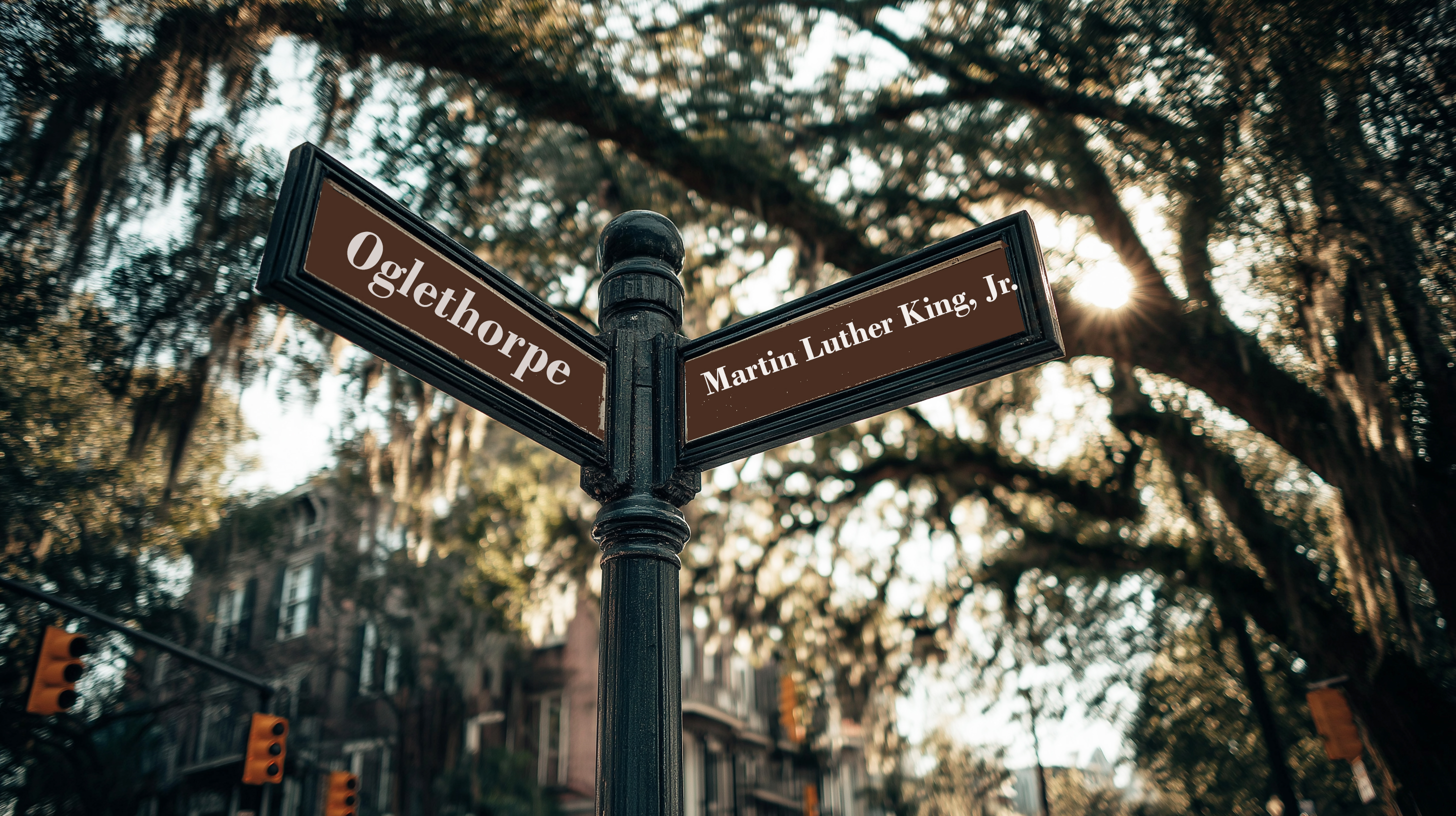
At the Corner of Oglethorpe and Martin Luther King, Jr.

Last week, on a trip to Savannah, Georgia, I found myself standing at the corner of Oglethorpe Avenue and Martin Luther King Jr. Boulevard. Late afternoon sun cast long shadows across the intersection, and I felt the weight of history pressing down on that spot. The street names are a metaphor in one of America’s oldest cities, where the past is never far from view. In Savannah’s history, beauty and brutality entwine like the Spanish moss that drapes its live oaks.

Oglethorpe founded Georgia in 1733. He was initially complicit in systems of oppression, including the Atlantic slave trade. Savannah was one of the most active ports receiving prisoners at the end of their “middle passage.” But later, after witnessing the moral rot that slavery inflicted, Oglethorpe became one of the earliest advocates for abolition. King, born two centuries later, dedicated his life to dismantling the structures of oppression that had calcified into American bedrock.

Standing there, I couldn’t help but see this street corner as a physical manifestation of our national paradox, the constant tension between our worst impulses and our highest ideals.

We all know how this contradiction runs through every chapter of our story. Thomas Jefferson penned words about equality and inalienable rights while enslaving over 600 human beings throughout his lifetime. The Thirteenth Amendment abolished slavery in 1865, yet within a decade, Black Codes and convict leasing created new systems of forced labor. We fought a world war against fascism with a segregated military, then returned home to a nation where those same soldiers couldn’t sit at lunch counters beside the people they’d fought to protect.

The GI Bill opened pathways to college and homeownership for millions, but discriminatory implementation meant Black veterans were systematically excluded from these opportunities, creating a wealth gap that reverberates today. We built the Interstate Highway System to connect our nation while bulldozing thriving Black neighborhoods to do it.

Our contradictions are brutally visible in our treatment of Native peoples. The ideals of liberty coexisted with policies of forced removal, such as the Trail of Tears that passed through the state of Georgia. Under the banner of divine providence, we displaced entire nations, stripping them of their lands and cultures. Later, federal programs sought to “assimilate” Native children by removing them from their families and erasing their languages in boarding schools.

Many immigrant stories reveal similar paradoxes. The Statue of Liberty promised refuge — “Give me your tired, your poor, your huddled masses yearning to breathe free” — yet waves of newcomers faced hostility and exclusion. We celebrated Ellis Island and the Statue of Liberty while turning away ships of Jewish refugees. Chinese laborers who helped build the transcontinental railroad were later targeted by the Chinese Exclusion Act of 1882. Irish and Italian immigrants were met with suspicion and violence. During World War II, Japanese Americans were interned behind barbed wire, not for crimes but for ancestry. Each generation of immigrants, it seems, has had to fight to prove its belonging in a nation supposedly founded on welcome.

Even our progress reveals the pattern. Brown v. Board of Education declared school segregation unconstitutional in 1954, yet decades later, our schools remain deeply divided by race and opportunity. The Voting Rights Act of 1965 protected ballot access, yet we’re still fighting over voter ID laws, polling place closures, and redistricting schemes designed to dilute minority votes. We elected our first Black president, then watched as hate crimes and white nationalist organizing surged in response.

And the gap between the haves and have-nots continues to widen. Federal Reserve data shows that the richest 10 percent of American households now own over two-thirds of the nation’s total wealth. Even more telling, the top 1 percent holds 31% percent of our total wealth, just slightly less than the entire bottom 90 percent of U.S. households.1

And yet, I remain hopeful, because America has always been a story of striving. The arc of our history may be jagged, but it bends toward justice when enough of us pull together. From abolitionists and suffragists to civil rights marchers, from modern activists for climate justice to the organizers for LGBTQ+ rights, we continue to strive.

I felt this strongly in my recent participation at a No Kings protest. Progress has never been a gift from the powerful and wealthy. We who believe in a more perfect union must demand it! This is vital to remember at our current juncture in American history, when oligarchs are more brazenly exerting their influence over every aspect of our culture.

As I stood at that intersection in Savannah, the hum of traffic surrounding me, I imagined Oglethorpe and King in conversation, two men separated by centuries yet ultimately united by conscience. Perhaps they would agree that the true test of a nation is not whether it avoids hypocrisy, but whether it keeps pushing toward redemption.

We are still standing at that intersection between what America has been and what it can yet become. And if we listen closely, we will hear Dr. King’s voice reminding us that the dream is not dead.  

It is waiting for us to live it out.

1 – Wealth Inequality – Inequality.org
Protestin’ in the Wind

Spittin’ in the wind, pissin’ in the wind, protestin’ in the wind. Call it what you want, but that’s what it felt like on a recent Sunday.

I was visiting the care facility where my parents live in Las Vegas, so I decided to join them at their church, hitching a ride in the medical transport van. I don’t adhere to a religion, so it’s hard to sit through any worship service. But this conservative Lutheran version was especially dissonant, like a cheese grater across my brain. Every element of the liturgy made me wince.

  • Hymns that spoke of Jesus coming again in clouds of glory to gather only “the faithful.”
  • Multiple promises of being in heaven rather than working to bring justice on earth.
  • A unison confession of sin that magnified our abject condition apart from Jesus’s saving grace.
  • The Apostle’s Creed, that patriarchal relic with its Trinitarian formula and insistence on superstitious miracles.

What tweaked me the most, however, was the sermon. I had foolishly hoped that the pastor might be hip, since I noticed the motorcycle boots he wore under his alb. It was clearly part of his drip. When I asked, “you ride?” he responded, “yep, it’s the only time I feel free.”

Then came his homily. Its central illustration came from a memorial service he’d attended for a teen who died of a drug overdose. There were two preachers that day. One railed about how the girl didn’t “know Jesus,” and that everyone in attendance should be forewarned about their own salvation. The other preacher was more magnanimous. He revealed a private conversation in which he discovered that the girl had indeed “accepted the Lord.”

That assurance rankled me even more!

I know I should have restrained myself. I chose to be there, live and let live, avoid the landmines of religion and politics. Yeah, yeah. But if there’s anything remaining from my former religious leanings, it’s that I’m a protestant, emphasis on protest.

I approached the pastor after the service.

“Do you mind if I share a reaction to your message?”

“Not at all,” he replied.

I calmed my voice. “Your own scripture says that God is love. God loved this girl before she was born, during every painful hour of her addiction, and even now in whatever awaits us after death. That’s true whether or not she followed your religious formula. Do you really believe that if she hadn’t accepted Jesus, she would be banished into darkness?”

His expression changed. His smile grew tighter. His eyes narrowed.

“Yes, God is love. And God gives us free will to either accept or reject the promises of Jesus.”

It was a standard feint, not a real answer, so I continued.

“On the cross, Jesus said ‘it is finished.’ That applies to all of humanity. It’s a love so inclusive that no human mind can fully understand it.”

His smile slipped further, frown lines forming on his brow.

“You must be a universalist,” he said.

And there it was. Spittin’ in the wind, pissin’ in the wind, protestin’ in the wind. Nothing I said would change his world view; nothing he said would alter mine. In this polarized world—with our moats of doctrine, politics, and privilege—hasn’t this become the norm?

When Bishop Mariann Edgar Budde recently exhorted Donald Trump to have mercy and understand the apprehension felt by many Americans, my friends and I applauded her bravery. Face to face, speaking truth to power. Social media blew up with her image, her words, and profile pics that proclaimed, “I’m with her.”

But Trump and his allies, encamped on el otro lado del rio, were unmoved. They demanded an apology, accusing Budde of being woke, radical left, and mannish.

Spittin’ in the wind, pissin’ in the wind, protestin’ in the wind. It’s the norm, and the fact that our online news streams are shaped by predatory AI only makes the problem worse. As Paul Simon said in The Boxer, “A man hears what he wants to hear and disregards the rest.”

(Flashback. On May 4, 1970, Allison Krause, a student at Kent State University, was one of four unarmed students shot and killed by soldiers of the Ohio Army National Guard. The shootings occurred as students protested against both the invasion of Cambodia and the National Guard presence on their campus. The day before her death, Krause observed a single lilac within the barrel of a guardsman’s gun. An officer ordered the soldier to remove it, and Krause caught the flower as it fell to the ground, stating, “Flowers are better than bullets.” This quote—inscribed on her gravestone—has become synonymous with her legacy of peace activism.)

Return to the present. The US continues to arm countries around the world, especially Israel as it carried out its genocide against the Palestinians. And Donald Trump threatens troop deployment to quell domestic demonstrations.

Can you hear the wind whistling, loud and clear?

The Human Rights Champion You’ve (Probably) Never Heard of

In my decades as a cleric, I heard the stories of people from many walks of life. Sometimes their memories opened portals to dramatic moments in history, like this one from a homeless man who came to my office early one morning. He smelled of alcohol and had slept in his car all night. I still salute him!

Lately, I’ve been thinking about Ernestine (Ernie) Glossbrenner and the short time our lives intersected. Ernie was a member of First Presbyterian Church, Alice, Texas, where I served for a season. She was well-known in the community, not only for her years of teaching in local schools, but for her eight terms (1977-1993) as a Texas State Representative. In that role, she was an advocate for lower income families, abortion rights, the ERA, worker safety, and education reform.

Ernie was suffering severe health problems by the time we met, coping only through the assistance of her companion. Still, when I visited her, she enlivened our wonderful conversations. We shared our commonality as Democrats in a deeply red region of Texas, our universalist view of religion, and our love of literature.

In her final days, Ernie required regular dialysis at a facility in Corpus Christi. Her companion called me one day and said that Ernie would like me to bring communion to her during one of those treatments. I gladly packed up my kit and drove to that city on the Gulf.

The room at the facility was sterile and smelled of antiseptic. A number of patients were simultaneously receiving therapy, most of them staring blankly at the ceiling. Ernie looked up at me, smiled weakly, and nodded. She was near the end; we both knew it. Her voice was a hoarse whisper and her skin ashen-colored. As we partook of the bread and the cup, I reminded her of the untold number of witnesses who gathered with us in that sacramental moment.

When we had finished, I held her hand. “Ernie, thank you for your years of service to so many people. You have left a rich legacy. When you look back over your career, is there an accomplishment that gives you special satisfaction?”

I was surprised at how quickly and decisively she answered, her voice suddenly rising above a whisper and hinting at her lifetime of boldness.

“Legislation to banish the short-handled hoe,” she said.

I confess that later I had to educate myself with some online research. Here’s the summary.

Part of the United Farm Workers’ movement in the late 1960s and early ‘70s was a call to ban the short-handled hoe used by braceros working in the fields. Called el cortito or el brazo del diablo, it was only 18-24 inches long, requiring laborers to bend over or work on their knees. This often led to lifelong back deformities, beginning even with children. The tool was also a clear means of oppression, because if someone took a break and stood up, field foremen would immediately notice and order them back to work.

In their book The Fight in the Fields: Cesar Chavez and the Farmworkers Movement, Susan Ferriss and Ricardo Sandoval say, “(El Cortito) was the most potent symbol of all that was wrong with farm work in California.”

Thank God, this devil’s arm was finally banned in California in 1975, the first state to enact such legislation. When the movement spread to Texas, Ernie was cosponsor of a bill to do the same.

Ernie died with specific instructions for her memorial gathering, including a mariachi band that was to stand in the balcony of our church and play De Colores. People packed the sanctuary that day, and as I walked down the aisle, I carried a long-handled hoe, lifting it above my head with both arms to signify the beginning of the service. Numerous politicians and educators gave eulogies – testimony to Ernie’s wide-ranging influence.

It was truly a celebration of life. But it was more than that. It was a call to all of us to care about the lives of every person. Like this woman, this champion, who had empathy for every migrant worker bending low in a furrow.

As I heard these final lyrics of De Colores, I whispered my own “thank you” to Ernie for her example of service to others.

And this love
This great love of all the colors
Is very special to me

Should You Take It Personally?

It was one of those conversations with a friend that I crave—wide-ranging, both intimate and global, drawing on our interests in literature, history, and current events. During the course of it, a philosophical question arose: “Should we take things personally?”

You may have an immediate answer but stay with the question for a moment.

In his popular book, The Four Agreements: A Practical Guide to Personal Freedom, Don Miguel Ruiz talks about the “domestication of humans.” From the moment we are born, he says, “outside” information is transferred to us internally, creating the “agreements” we make about ourselves and our place in the world. This transfusion comes through tribes, families, schools, and religions.

Given this maze of conflicting and often capricious viewpoints, Ruiz proposes the second of his four agreements. Don’t take anything personally. “Whatever you think,” he says, “and whatever you feel, I know is your problem and not my problem. It is the way you see the world. It is nothing personal, because you are dealing with yourself, not with me. Others are going to have their own opinion according to their belief system, so nothing they think about me is really about me, but it is about them.”

OK. There’s some truth here. How many of us have allowed our self-worth to be dragged through the muck of other people’s judgments? How many of us have allowed them to lease space in our heads, squandering our precious time and our unique destinies?

Wayne Dyer, a thinker I admired, steadfastly refused to take a side in conflicts, believing that the very act of aligning ourselves fuels the power of dualistic madness tearing our planet apart. He called us to stay centered in a place of unity and compassion for all of creation, including every single person who disagrees with us, even our enemies

Again, great value here. Many an enlightened spiritual teacher—among them the Buddha, Jesus, and Baháʼu’lláh—walked this higher plain in their teachings and actions.

But let’s go back to that conversation with my friend. Why? Because, to refute Ruiz, the decisions that people make, especially those in power, go far beyond just dealing with themselves. They affect all of us!

In our dialogue that morning, my friend and I turned to the current political scene, especially the rise of Christian Nationalism, that cult that misappropriates the teachings of Jesus and cloaks itself in American Exceptionalism. We lamented the erosion of a woman’s reproductive rights, the backlash against the LGBTQ population, the disregard for global warming, the demonization of immigrants and protestors, the undermining of public healthcare and education, and the threats leveled at social security.

Should we take this personally? Hell yes! Even if it causes some anger and angst? Hell yes! Read, really read, the background and content of Project 2025, a list of legislative and policy proposals that is ready to roll if Trump gets reelected.

Should we take the defeat of this agenda personally? Absolutely!

My friend is Jewish, and he recalled a famous poem by Martin Niemöller, a German theologian and Lutheran pastor during the rise of Nazism. It exists in many versions, but the one featured on the United States Holocaust Memorial reads: “First they came for the socialists, and I did not speak out – because I was not a socialist. Then they came for the trade unionists, and I did not speak out – because I was not a trade unionist. Then they came for the Jews, and I did not speak out – because I was not a Jew. Then they came for me – and there was no one left to speak for me.” For his opposition to the Nazis’ state control of churches, Niemöller was imprisoned in the Sachsenhausen and Dachau concentration camps from 1938 to 1945. He narrowly escaped execution.

It reminded me of words from Martin Luther King, Jr. that have informed my activism for decades. “In the end, we will remember not the words of our enemies, but the silence of our friends.”

Within the wider circle of my Christian friends, there’s a lot of talk about respecting the voices of those who disagree with us. Instead of red or blue, they champion the color purple. Listen; I agree that we need to reach across the boundaries of our differences. As Jesus so powerfully said, If you love only those who love you, what good is that? Even scoundrels do that much. If you are friendly only to your friends, how are you different from anyone else?” (Matthew 5:46-17a, Living Bible Translation). Can we champion the causes of justice nonviolently, opposing those who would erode our freedoms without disrespecting them? Harder, much harder, but yes!

However, if our efforts to be conciliatory cause us to muzzle ourselves and cease speaking truth to power, I object! If they lead us to accommodate the principles outlined in White Nationalist movements like Project 2025, I object!

I wholeheartedly support Kamala Harris as our next President of the United States. When I scroll through the many memes circulating around her candidacy, I love the one that says, “Rosa sat, so Ruby could walk, so Kamala could run.”

Did Rosa Parks take it personally when she was ordered to sit in the back of Montgomery, Alabama buses? Certainly! Did those who fought for school desegregation take it personally? Of course!

Parks once commented, “People have said over the years that the reason I did not give up my seat was because I was tired. I did not think of being physically tired. My feet were not hurting. I was tired in a different way. I was tired of seeing so many men treated as boys and not called by their proper names or titles. I was tired of seeing children and women mistreated and disrespected because of the color of their skin. I was tired of Jim Crow laws, of legally enforced racial segregation.”

Today, I am personally saying that I am sick and tired of Christian Nationalism and its idolatry. It’s not only an aberration; it’s a dangerous mutation. I will do everything in my sphere of influence to defeat those forces that seek to form a theocratic government in America.

And if you have made it to the end of this piece, I hope that you, too, will take this election and its repercussions PERSONALLY!

Rosa sat, so Ruby could walk, so Kamala could run!