Remember When, by David Clear

(Note: on both this site and the one for Second Shore Publishing, I will occasionally post responses to writing prompts I give to the Second Shore family of authors. The current one: Is there a story, theme, character, experience, or question that keeps finding its way into your writing? Why do you think you keep returning to it?)

Without a doubt, the story that has absorbed my consciousness into journals, short stories, poems, essays and novel drafts; the story that I can’t, won’t, and will likely never stop telling, or try to stop telling better, is the quest for spiritual understanding.

It began at a young age when I was barely able to read and write. A death in the family, an out of body experience, vivid, unexplainable dreams…

Reaching adolescence in the late 1960’s, the subjects of New Age spirituality and higher consciousness were quite prevalent. Psychedelic drugs played a large part. Had the opportunity presented itself, I would have tried them but I like to think divine intervention blocked me from going down that road. I was able, however, to enthusiastically pursue the topic in books.

After a lot of philosophy, psychology and nonfiction metaphysics, I discovered an author within the fiction genre that inspired me and set me in a revelatory writing direction. The lyrical prose of Thomas Wolfe in Look Homeward Angel resonated with my soul. Higher consciousness was potentially all around in everyday life.

Five years earlier, I’d had a profound spiritual experience that I had been struggling to make sense of. The DaVinci Code and The Celestine Prophecy were bestsellers at the time. It occurred to me that attempting a fiction format in a similar vein might be how I could best reach a greater understanding of the growth of consciousness in my life.

And so began in earnest the story I have not been able to stop telling. I almost feel as if, like Leaves of Grass, it has become, and will be, my one and only true story, evolving and expanding from a basic origin as years go by.

I worked on Dreaming at the Speed of Sound for thirteen years before self-publishing. It was a labor of love to try to create an intriguing plot within both realistic and surrealistic settings, and characters of depth struggling for a transformation of consciousness.  

I enjoy scholarly, educational prose that can scientifically dissect and detail higher consciousness structures, but Thomas Wolfe can take a description of delivering newspapers in the predawn and transform it into prose poetry which transports the reader equally well, if not better, into higher realms of meditative musings. There are more and more such writers to be found online, and I heartily encourage and recommend them.

If there is a story you can’t stop telling, even if only to yourself, it is a story that very much needs to be told.

In her essay, The Site of Memory, Toni Morrison sums up beautifully what I am saying her.

“You know they straightened out the Mississippi river in places to make room for houses and livable acreage. Occasionally the river floods these places. ‘Floods’ is the word they use, but in fact, it is not flooding; it is remembering. Remembering where it used to be. All water has a perfect memory and is forever trying to get back to where it was. Writers are like that; remembering where we were, what valley we ran through, what the banks were like, the light that was there and the route back to our original place.”

About David Clear: “I’m a New England writer; plainly a hobbyist rather than a professional. I had no formal writing education, but many great writing teachers, from office jobs to heartbroken relationships, and even convenience store clerks. I am retired, and I guess I’m still seeking my great writing whale. David’s recent collection of short stories called The Role of a Lifetime: Stories of Reincarnation in the Theater of the Soul is available for free download here, courtesy of the author and Second Shore Publishing.

SO, YOU WANT TO BE A WRITER? – by David Clear

Mrs. Blythe’s 2nd grade class, 1962: The Magical Letters on the Wall

They were posted above the blackboard. All 26 of them, upper and lower case, neatly drawn on lined paper and large enough to see from a distance. They were designed to be a chore to learn and to copy, but to my seven-year-old eyes they seemed to radiate a light, an energy of some sort, different from everything else in the room.

When I reflect on this memory, one truth emerges—I was in love with the alphabet, with the words it could create, and with the worlds those words could fashion.

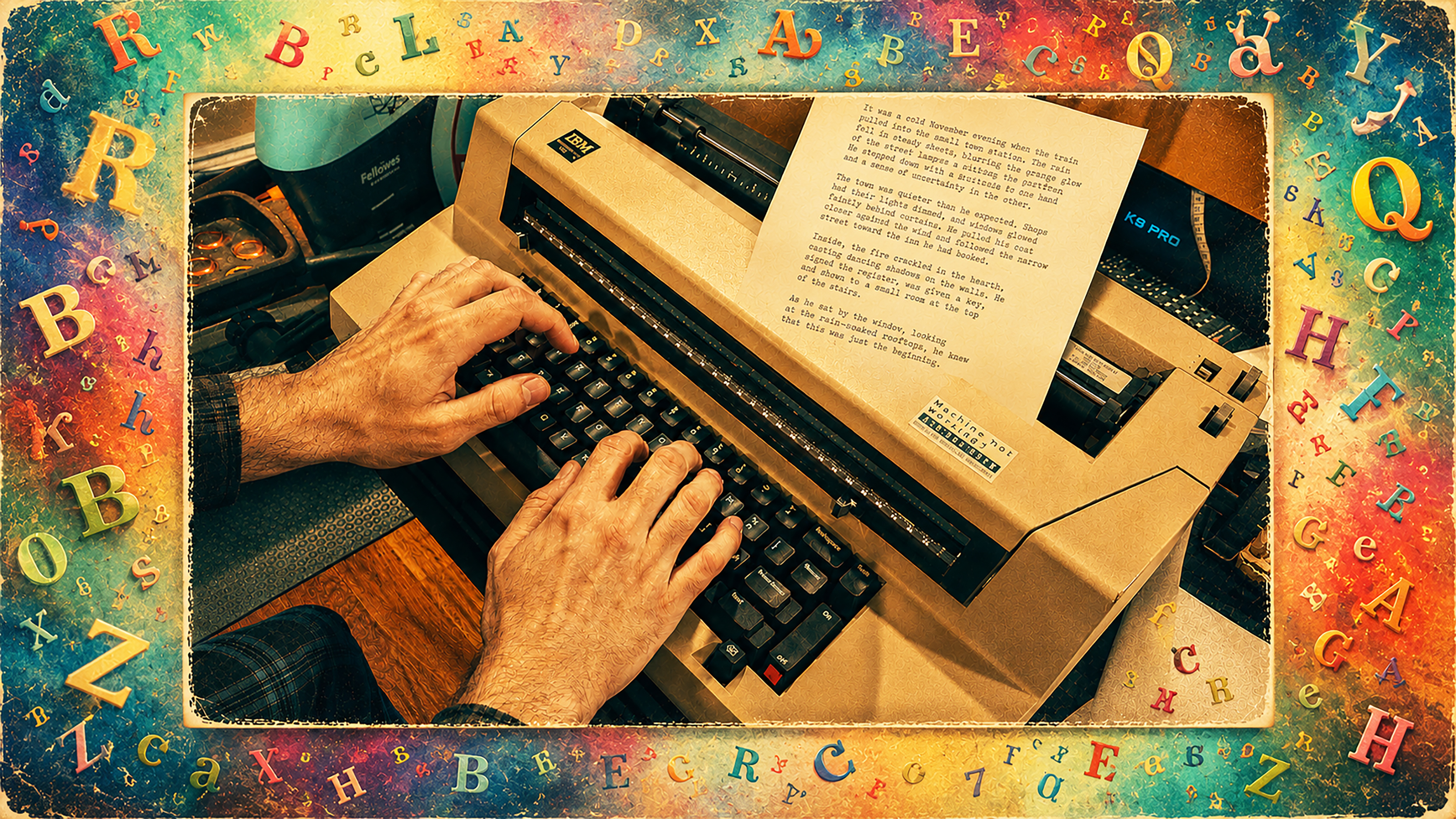
My mother bought me the World Book Encyclopedia while I was still in my single digits. I fell further in love with words, ideas, and stories. I am most thankful to my mother for encouraging me to learn how to use a typewriter and buying me one of my own. After the slow and cumbersome world of cursive writing, it was like being catapulted to the 24th century of Star Trek.

And then, when I was able to upgrade to an electric typewriter, I was officially lost forever in the So You Want to Be a Writer nebula.

I started my first novel length story at 14 years old, a mishmash of romance, adventure, Beatle’s music, and psychic phenomenon. I experimented with sci-fi and espionage scenarios but burned up the most typewriter ribbon ink and paper on classic adolescent angst journals.

I was a scribbling prospector wandering the bookstores by day and thinking, by night, that golden nuggets were rolling off my electric typewriter. Just a matter of time before the world found out about them.

“Writers are only successful after they’re dead,” my dad told me. I disagreed, of course. After all, I saw writers like Gore Vidal, Norman Mailer, Richard Bach, Erica Jong, Stephen King, and others being interviewed on nighttime talk shows, an obvious sign of success.

Nevertheless, it didn’t take me long to realize that the arduously slow task (by 21st century standards) of sending in stories on a typewritten piece of paper with a self-addressed stamped envelope, only to receive a rejection, wasn’t going to earn me any money to pursue it as a career.

To write, perchance to dream of making money at it; ay, there’s the rub.

It would be interesting (and likely depressing) if the ratio of wannabe paid writers to actual paid writers could be calculated. And when I say paid, I don’t mean utilitarian authors who write for newspapers, ad copy, or technical journals. I mean bestsellers like Jonathan Livingston Seagull, Harry Potter, the DaVinci Code, The Celestine Prophecy, or The Andromeda Strain.

Herman Melville had explosive success with his first two books, Typee and Omoo. But then, Moby Dick. The readers of his time didn’t get it. It sold only about 3700 copies in his lifetime. But the fact that it stands today as a masterpiece of American literature redeems Melville’s inner drive and vision to create something that went beyond the commercial market and challenged the consciousness of the reader. Melville, like F. Scott Fitzgerald and others, died well before their work achieved iconic status. I would suspect by then they were dispassionate about becoming earthly literary legends and were on to working on other, more universal projects.

I think the most important lesson I’ve learned about writing over sixty years is that the passion for it and practice of it is, first and foremost, its own ultimate and eternal reward. At age 92, the famous cellist Pablo Casals was asked why he still practiced. “Because I think I’m making progress.”

Being an author may seem to have greater cachet than being an HVAC repairman. Having lived in the south for many years, I can tell you honestly that the HVAC repairmen were equally, if not more, essential to my well-being than A Farewell to Arms. My interaction with the HVAC repairman is as valid and important in its own way as a reader’s interaction with what I have written. The difference, of course, is utilitarian versus personal. By sharing my inner worlds through my words, I am becoming more open to another human being than were I just the repairman who says, “well, the system is out of freon.”

But people connect and share with each other in many ways all the time. In that sense, writing is just another aspect of the nature and rules of human life: there’s much to learn, and doing it well takes regular study and practice.

At this very moment, millions of people are, like me, hovering over keyboards trying to channel what is percolating within them. Many others are “just” doing their jobs, raising their children, exercising, meditating, or traveling. All of them are drafting their stories by being. Whether in the form of a New York Times bestseller, or in a child’s eyes, I believe everyone’s story is heard, read, and felt.

So, paraphrasing Twain, it would seem the difference between being a writer and being a highly paid successful writer is the difference between lightning and a lightning bug. And who’s to say which is more rewarding?

Kurt Vonnegut wrote the following words in a letter dated November 5, 2006, addressed to students at Xavier High School in New York City. He had been approached by five students whose assignment was to write to their favorite authors. He was the only one to respond. I think his words capture the gist of what I’m saying.

“Practice any art, music, singing, dancing, acting, drawing, painting, sculpting, poetry, fiction, essays, reportage, no matter how well or badly, not to get money and fame, but to experience becoming, to find out what’s inside you, to make your soul grow” 

About the author: David Clear’s novel, Dreaming at the Speed of Sound, is available at this link. He has also had the following stories published by Story Sanctum: Cresting WaveThus Spake Alan, and The Overdue Library Book. David’s collection of short stories entitled The Role of a Lifetime: Stories of Reincarnation in the Theater of the Soul has just been released by Second Shore Publishing. Here is a downloadable PDF copy.