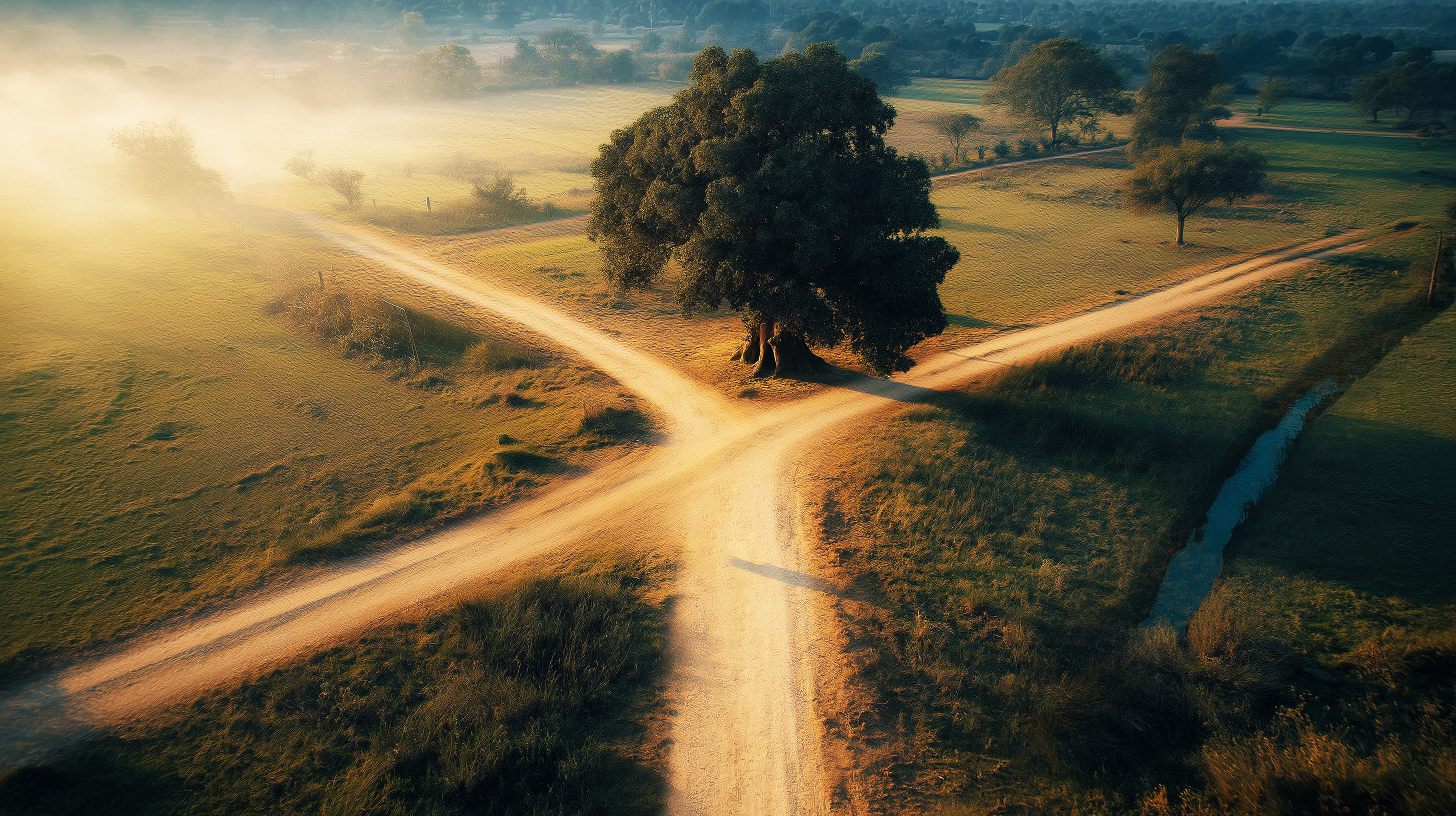
In a parallel dimension of time, the first light of dawn revealed a bucolic landscape. Morning fog lifted from green fields. Silhouettes of scattered oak trees were like ink strokes in the mist. A nearby brook murmured over stones as birds offered their first notes of the day.
At the center of this suspended countryside, two dirt roads converged at a crossroads beneath an ancient sycamore. Its leaves caught droplets of dew like sequins, and a faint breeze carried the scent of wet grass.
That’s when the meeting occurred.
From the western path came the sound of sandals brushing loose gravel. A hooded figure, dressed in a robe of simple linen, walked with an unhurried pace. Simultaneously from the east, another figure approached. This one wore a saffron cloak with its hood tied loosely at his throat.
Just as the sun had cleared the horizon, their paths intersected beneath the tree and they stopped.
The one in linen pulled back his hood. His beard was full but trimmed, his dark hair falling to his shoulders. His eyes were warm and alert, and he smiled with a grace that could disarm the hardest heart.
“Peace to you, traveler,” he said.
The saffron-robed man lifted his own hood and returned the smile. His face was calm, and his eyes held the serenity of mountain lakes. He bowed his head slightly.
“And peace to you, also.”
They regarded each other for a moment, wind stirring the leaves above them.
“It seems,” said the man in linen, “that even though we came from opposite directions, we were meant to meet at this exact moment. Even more curious, we understand each other’s native tongues.”
“Perhaps these paths are not what they appear,” the other replied.
The man in linen chuckled softly. “They rarely are.”
The other studied him carefully, recognition lighting his features. “I know of you. The stories of your compassion travel far beyond time. You are Yeshua of Nazareth.”
“And you,” Yeshua answered, his voice touched with reverence, “must be Siddhartha Gautama, the one they call the Buddha, the Awakened One.”
The fog thinned as if to give their meeting more space. The men stared deeply into each other’s eyes.
“Will you sit with me?” said Yeshua, motioning to a massive log beside the crossroads.
Siddhartha nodded. “It will be my pleasure.”
They sat beside each other on bark worn smooth by weary travelers. For a while, neither one spoke as the morning settled warmly around them.
At length, Siddhartha broke the silence.
“It is rare,” he said, “to meet one whose words have shaped the hearts of so many, not only in the past but for ages to come. Your teachings have been transmitted across every continent of this earth.”
Yeshua tilted his head, thoughtful. “Hundreds of earth years separated our lives, but I have also heard of your far-reaching influence. Your path of liberation, your understanding of suffering and how to end it. I know that countless people have been healed because of your teachings and example.”
Siddhartha folded his hands in his lap. “I simply gave witness to what I discovered in my own struggles. I found that freedom begins within. If our mind is tangled, the world appears tangled as well. If our heart is bound up by chasing illusions, no external revolution, no remedy of any government, can loosen its knots.”
Yeshua nodded thoughtfully. “I understand. And yet, societies can crush even the most open hearts with their oppression and violence. Like you, I tended to the wounds of my followers’ souls, but I also challenged systems of oppression. Sometimes the sickness is personal. Sometimes it is communal.”
A soft rustle of wings sounded overhead as a raven landed on one of the sycamore’s branches, cocking its head at them with curiosity.
“I would like to know,” said Siddhartha. “How did you learn the compassion that shaped your path?”
Yeshua took a deep breath. “It started early. My parents taught me that our Creator fashioned every one of us in the divine image. They encouraged me to see this divinity in each person, no matter how low their condition. Later, as I walked from town to town, I looked into the eyes of the poor, the broken, the shunned, and I recognized them as my kin.”
He paused, the memory of dusty Galilean roads flickering in his eyes. “I touched the lepers when others fled. I ate with tax collectors and prostitutes. I tried to help them heal not only their bodies, but their sense of worth in the eyes of God. I saw beauty where others saw disgrace. But please know this. It wasn’t just an effort of my own will that caused this. It was a gift from my Heavenly Father, a calling that I embraced.”
A smile warmed Siddhartha’s face. “I have no belief in deities, but my earthly father surely affected me. He raised me to take my place in the upper class of Brahmins. I still remember his anger and disappointment when I left the palace where I had been raised. I threw off the privileges that shielded me and sought to understand suffering by witnessing it firsthand. I came across the sick, the aged, the dying, and each encounter shaped me.” He turned his head to gaze down the eastern road. “I saw that compassion is not merely a virtue. It is a law of nature. I taught my disciples to love all beings as a mother loves her only child.”
Yeshua leaned forward slightly, intrigued. “Yes. To love beyond all the conditions taught to us by the world. Even to forgive those who wound us.”
Siddhartha’s eyes softened. “You forgave even as you suffered greatly.”
Yeshua nodded and lowered his gaze. “It was hardest thing I ever did, but I saw that those who harmed me were trapped in their own fear and ignorance.” He paused. “And you, my new friend, renounced the wealth of a kingdom. I merely left a carpentry practice that I shared with my father.”
Siddhartha chuckled. “You make it sound superhuman, but it was a matter of my own survival. I was suffocating in gilded bondage. Silk chains are still chains. I knew that my contentment would never be found in luxury.”
Yeshua nodded. “I also taught that the love of wealth blinds us. This earth’s riches exist to be shared with the poor, not hoarded by the powerful.”
“Tell more about your notions of generosity.”
Yeshua shrugged. “My words are simple. I teach that wealth is not measured by possessions but by giving. I once encountered a widow who offered two small coins to the temple treasury. They were worth less than a cup of water. Yet she gave more than all the wealthy combined, because she offered everything she had out of love.”
“Intent over quantity,” said Siddhartha. “Purity over display.”
“Exactly.”
“In my own teachings,” Siddhartha said, “I spoke of dāna, the perfection of giving without the attachment of expecting a reward. As we practice dāna and grow more enlightened, there is a sublime offering we have for others. I call it the gift of fearlessness. To me, this is perhaps the highest form of generosity because it helps ease the anxiety and turmoil of others.”
Yeshua looked moved. “I mostly agree. But a hungry person would much prefer a loaf of bread over a philosophical truth. Either way, I taught that when we comfort others, we become a light in the darkness.”
The raven took wing, drifting gracefully over the countryside towards the horizon. Both men followed its flight with their eyes.
“Our teachings align in many ways,” said Siddhartha. “Compassion, nonviolence, and generosity. Yet there is that difference you already mentioned. Perhaps it is rooted in the worlds from which we came.”
Yeshua turned to him. “Yes. I feel it too.”
Siddhartha’s voice grew introspective. “I would like to discuss this more fully if you are willing,”
“Of course,” said Yeshua.
“My path focuses on the individual,” Siddhartha continued. “I teach that if each person frees themselves from desire and delusion, then suffering decreases in the world. A tree grows strong when each root is healthy, not when we try to force the whole forest into harmony.”
Yeshua’s eyes shone with understanding. “Go on, please.”
“I believe that a liberated consciousness radiates outward naturally. Peace in one person becomes a lantern for those nearby.”
Yeshua gazed down the western road. “While I agree with you in many ways, I walked among people who were burdened by more than their own desires. They suffered under a conquering empire, unjust rulers, and a religious structure that was burdensome rather than uplifting. So I spoke directly to those powers. I confronted corruption. I overturned tables in the temple. I challenged those who used their sacred laws to exploit the vulnerable.”
A gust of wind stirred the leaves above.
Siddhartha considered this. “Your liberation was both inner and outer.”
“Yes,” Yeshua said. “Because a society can trap a soul as surely as craving can.”
“And yet you carried no weapon.”
“Love was my only force,” Yeshua replied simply. “The moment we harm another, we harm ourselves.”
Siddhartha smiled. “In this, we are brothers, even though I question if societal structures will ever truly change. One only needs to view the entirety of human history to see how oppression continues from generation to generation, how violence begets violence.”
Sunlight slanted across their faces. For a moment the men seemed less like historical figures and more like long-term companions sharing memories.
Yeshua clasped his hands together. “Siddhartha,” he said gently, “your path turned inward to heal the roots of suffering within the heart.”
“Yes,” the Buddha said. “That was my way.”
“I also sought a kingdom of the heart,” Yeshua said, “but one that actively confronted the unjust structures of the world.”
Siddhartha breathed in the scent of the fields surrounding them, “I often wondered if my path should have addressed the world more directly. But I feared that confronting systems would drag me into the very entanglements I sought to dissolve. How can you uproot a poisonous tree while remaining free from the toxin?”
Yeshua gazed upward as the sunlight gathered strength. “I wondered the opposite. Sometimes confronting those forces only made them more determined to strike back. It also sharpened my tongue and my approach. Perhaps my willingness to challenge them so openly hastened not only my own suffering, but that of others as well. Yet I felt compelled to name injustice wherever I saw it.”
Siddhartha bowed his head in recognition. “Different approaches. Neither of them easy.”
“Yes,” Yeshua murmured, “very different methods. But we both sought peace.”
“And unity among all beings,” Siddhartha added. “A world where compassion is like the air that people breathe.”
They looked at each other with quiet, profound understanding.
Siddhartha looked up at the branches of the sycamore. “Sitting here reminds me of the most important night of my life. I had tried one form of meditation and asceticism after another. Finally, weary that I would ever experience full awakening, I sat beneath an enormous tree, determined to break through or die on that spot.”
Something caught in Yeshua’s voice. “I, too, found my greatest moment of victory with my back against a tree’s wood. It was only then, in the depths of my worst suffering, that I was able to embrace the fullness of what I had taught.”
They both fell into silence, recalling the pathways that led to this moment outside of time.
Finally, Yeshua rose to his feet. Siddhartha followed. They stood facing one another.
Siddhartha said, “The world is large, Yeshua. Too large for one method alone.”
“You speak the truth,” Yeshua replied. “The world needs multiple invitations toward wholeness.”
Siddhartha’s eyes brightened. “Then may our teachings be like two rivers flowing toward the same sea.”
The wind picked up again, rustling their robes. Yeshua extended his arms and embraced Siddhartha. The Buddha returned the embrace without hesitation.
When they stepped back, Siddhartha placed his palms together at his heart and bowed. “May all beings find the end of suffering. May you walk in peace, my friend Yeshua.”
Yeshua lifted his right hand in blessing. “Shalom aleichem. Peace be upon you, Siddhartha, wherever your steps lead.”
They smiled like two old friends on that road between worlds, joined for a moment where past and future dissolve.
Then, with no further words, they turned. Siddhartha headed westward to new horizons, the sun casting his shadow before him. Yeshua walked eastward with a new understanding, his shadow following behind him.
The crossroads was quiet, except for the wind in the sycamore and birdsongs echoing over the fields.
And for a breath of time outside of time, the world felt a bit more whole.


 Krin Van Tatenhove - Words & Images