Super Bowl Ad a Warning?

That damn Ram ad! Using some of MLK, Jr.’s most inspiring words about selflessness—borrowedRAM, MLK from Jesus—for promoting trucks “built to serve.”

I was immediately offended. And I wasn’t the only one. Angry tweets circled the globe.

“Black people can’t kneel and play football but MLK should be used to sell trucks during the Super Bowl? Unbelievable.” –  writer and comedian Akilah Hughes.

“MLK who died striking with workers decrying militarism & imperial war makers – used to sell shiny trucks with marching soldiers – corporate America NBC NFL should be ashamed.” -actor John Cusack

There were other shameless examples during the Super Bowl.

  • Toyota vaunting interfaith understanding by piling Christian, Buddhist, Jewish and Muslim clerics into one of their cars.
  • Monster headphones like a “Savior” that will turn your world from B&W to Technicolor.
  • Budweiser truly caring about clean water supplies in developing nations.
  • Hyundai so deeply concerned about victims of cancer.

Folks, this is nothing new.

27 years ago, in his book Wake Up, America, Tony Campolo warned of this trend—the selling of goods that supposedly satisfy our deepest needs. He mentioned ads that promised spiritual fulfillment, like one shot from an aerial view, panning across a throng of people gathered on a hill. They represent all races and colors of the world, joining hands and singing in a unity this planet has never seen. Was it a symbol of the Kingdom of God? Was it a call for racial reconciliation? No, it was a commercial for the Pepsi Generation. Similar soda ads ran during Super Bowl LII.

Corporate encroachment like this is so insidious. Campolo put it this way. “In our TV ads, it is as though the ecstasy of spirit experienced by a Saint Theresa or a St. Francis can be reduced to the gratification coming from a particular car, and the kind of love that Christ compared to His love for His church can be expressed by buying the right kind of wristwatch ‘for that special person in your life.’ In all this media hype, things are sold to us on the basis that our deepest emotional and psychological needs will be met by having the right consumer goods.”

The ultimate result of these ads is the tragic reverse of their promises. Materialism causes a decay of spiritual contentment. It increases our alienation from God and each other. Jesus knew this. It is why he said, “Do not store up for yourselves treasures on earth, where moth and rust consume and where thieves break in and steal; but store up for yourselves treasures in heaven, where neither moth nor rust consumes and where thieves do not break in and steal. For where your treasure is, there your heart will be also.” – Matthew 6:19-21

Maybe we really are living in that “inverted totalitarianism” that Chris Hedges, Pulitzer Prize winning journalist and Presbyterian minister has pointed to for years. In his book, Days of Destruction, Days of Revolt, written with Joe Sacco, he defines the term as “a system where corporations have corrupted and subverted democracy, and where economics trumps politics. Every natural resource and living being is commodified and exploited to the point of collapse, as the citizenry is lulled and manipulated into surrendering their liberties and their participation in government through excess consumerism and sensationalism.”

Wake up, America!

My Faith Boiled down to One Word

Excuse my simplicity, but this is what I believe.

After all the clashing of religious truths, after the endless verbiage of theologians, and at the end of every spiritual quest, there are three immortal words spoken by the Apostle John: “God is love.”

26993637_1752941528069796_2062889683675727005_n

Could it really be this simple? Yes! Love. But what kind of love? We see romantic love,  love of Self, love of money, love of power, love of our own family, tribe, or political party at the exclusion of others. In February, a month equated with love, it behooves us to recall some words from the New Testament, that collection of writings that rise like a hymn of God’s love sung to all of us.

The first were spoken by Jesus, part of the accumulated sayings we call The Sermon on the Mount. I have chosen Eugene Peterson’s The Message version because of its bold freshness.

       You’re familiar with the old written law, “Love your friend,” and its unwritten companion, “Hate your enemy.” I’m challenging that. I’m telling you to love your enemies. Let them bring out the best in you, not the worst. When someone gives you a hard time, respond with the energies of prayer, for then you are working out of your true selves, your God-created selves. This is what God does. He gives his best—the sun to warm and the rain to nourish—to everyone, regardless: the good and bad, the nice and nasty. If all you do is love the lovable, do you expect a bonus? Anybody can do that. If you simply say hello to those who greet you, do you expect a medal? Any run-of-the-mill sinner does that.
           In a word, what I’m saying is, Grow up. You’re kingdom subjects. Now live like it. Live out your God-created identity. Live generously and graciously toward others, the way God lives toward you.” – Matthew 5:43-48

The second selection is from the Apostle Paul, a man who “breathed hatred” towards Jesus’ followers, then had a conversion so dramatic that he climbed what I call the Everest of Love. From that lofty vantage point, he wrote the timeless words of I Corinthians 13, a Himalayan peak of world literature. Here are a few of its verses, again from The Messageso applicable to our lives today!

     If I speak with human eloquence and angelic ecstasy but don’t love, I’m nothing but the creaking of a rusty gate.  If I speak God’s Word with power, revealing all his mysteries and making everything plain as day, and if I have faith that says to a mountain, “Jump,” and it jumps, but I don’t love, I’m nothing. If I give everything I own to the poor and even go to the stake to be burned as a martyr, but I don’t love, I’ve gotten nowhere. So, no matter what I say, what I believe, and what I do, I’m bankrupt without love.
      Love never gives up. Love cares more for others than for self. Love doesn’t want what it doesn’t have. Love doesn’t strut, doesn’t have a swelled head, doesn’t force itself on others, isn’t always “Me first,” doesn’t fly off the handle, doesn’t keep score of the sins of others, doesn’t revel when others grovel. Love takes pleasure in the flowering of truth, puts up with anything, trusts God always, always looks for the best. Love never looks back, but keeps going to the end.

I pray that the depth and quality of our love for all people will grow, not only this month of February 2018, but throughout our allotted days. God is love and love is our highest calling.

Danger or Opportunity? You Decide…

A jailhouse tattoo on the forearm of a San Quentin inmate: that’s when I first saw theChineseSymbol word. We were in a visiting room, seated under harsh fluorescent light as I interviewed him for an article.

“What does that mean?” I asked.

“It’s the Chinese character for crisis,” he said, “but it’s made up of two symbols, one meaning danger, the other opportunity.”

“Why did you put it there?” I asked.

His smile said, I was hoping you’d ask.

“Because the events that led to my incarceration, along with the danger in a place like this, actually gave me the opportunity to turn my life around.”

Since then I’ve learned that this translation of  危机, wēijī, is incorrect. But the cultural trope remains, especially in America, popularized in speeches by John F. Kennedy, Condoleeza Rice, Al Gore, and scores of motivational speakers.

On New Year’s Eve, 2017, I thought of wēijī as a loved one said to me, “Krin, I want to talk with you about my crisis of faith.”

Nothing stirs me more than discussing spiritual matters. These are messages from the deepest fronts of our Selves, struggles that reflect the essence of why we are created. I was all ears.

She told me that she is increasingly skeptical of her traditional Christianity. It began with simple questions about other religions. How could she claim that hers was the only valid path, especially when she saw that happenstance of birth and culture clearly mold our beliefs?

Her thinking crystallized after she saw The Book of Mormon. She considered the fantasies of that faith: a soothsayer translating golden plates, Jesus appearing to Mesoamericans after his resurrection, a lost tribe of Israel that flourished in North America but left no shred of archaeological evidence.

“How can people believe such bizarre events?” she said with a laugh. “Then I thought about my own tradition with Jesus: a virgin birth, miracles like walking on water, the supposed need for blood shedding, resurrection from the dead.”

When I asked why she used the word crisis, she talked about the shifting ground beneath her feet, the potential judgement of others, her anxiety about the future. Would faith remain in any form at all?

When she was finished, I recalled some words from the late James Fowler: “When we are grasped by the vision of a center of value and power more luminous, more inclusive and truer than that to which we are devoted, we initially experience the new as the enemy or the slayer—that which destroys our ‘god.’”

Then I shared my journey, one human being to another. I talked about my grasp of Fowler’s Stages of Faith, especially the movement from 3 to 4. It’s a time to emerge from the spoon-fed acculturation of family and nation. A time to step outside our boxes and see the beauty of other beliefs. A time of both/and, not either/or. A time of release from the creeds and doctrines that too often calcify our brains and spiritual development. A time to join the pilgrimage of all people in our common humanity. This is the ancient way mentioned in Psalm 139:24 of the Hebrews.

“I deeply admire your courage,” I told her. “And I believe that what you label a crisis is actually a beautiful opportunity. It’s a calling to experience the universal love that lights the path of all our journeys. Let’s keep talking. I, and countless others, are with you!”

On the cusp of a new year, what a joy to be part of this birthing!


Blowin’ in the Christmas Wind

Keith blew in with a cold front three days before Christmas, already seated on the front1297630843288_ORIGINAL steps of our church as I got to work. His clothes were filthy and threadbare, and the face that peered out from beneath a hooded sweatshirt was reddened by more than wind. Body odor and booze fumes tore at my nostrils.

“Can I help you?” I asked.

“I was wondering if you could spare a few dollars,” he said.

“I don’t give out cash,” I answered. “I’m not judging you, but people drink up the money as soon as I give it to them.”

“Yeah, I do drink some beer,” he said with a smile.

I smiled back.

“How about I take you to get something to eat?”

“No thanks. I already had one of those breakfast burritos at McDonald’s.”

“How long have you been homeless?”

“Many, many years.”

“If you want, “I said, “I can get you a room at the Rescue Mission. They’re a great outfit, and I know the people in charge. They’ll help you get settled, find work, make a new start.”

“No thanks. I prefer to be on the road.”

“OK. Is there anything else I can do to help you?”

“Actually, I could use some new shoes and a coat.”

What an understatement! His black tennis shoes were soleless and his flimsy sweatshirt was no buffer to the cold.

“Tell you what,” I said, “Let me take you to the Trash and Treasure Resale store and we’ll see what we can do.”

Friends, never underestimate how the simplest of gifts can make a difference in someone else’s life! Truly one person’s trash can be another person’s treasure. I took Keith to the store, an ecumenical ministry in our town, praying silently they would have what he needed. My prayers were answered. On the shoe shelf was a sturdy set of leather Skechers, his size, barely used. And there on the rack hung a beautiful wool coat with quilted lining and an over-sized hood.

I held out the coat with a flourish, mimicking a sales clerk at Men’s Wearhouse.

“Here you go, sir,” I said. “This looks like just your style.”

He laughed and slipped into it, playing his part. Perfect fit.

“I really appreciate your help,” he said.

“No problem,” I replied. “Are you sure you don’t want me to get you a room at the Mission? They’ll help you in ways that I’m not able to.”

“I’m sure. I think I’ll just head down to Kingsville. I once spent a Christmas there. Can’t even remember what year.”

“You’re determined to do the Forest Gump thing, eh? Just keep walking and walking?”

“Guess so.”

We exited to the back alley. You could feel the coming front in the cold, sharp wind. I shivered, imagining how Keith would fare during the night. He thanked me again as we shook hands. Then he strolled off down the alley, resplendent in his new shoes and coat.

Just before he rounded the corner, he stopped, lifted his arms and shouted “Merry Christmas, everyone!”

You’re Thankful for THAT?

Everyone agrees that thankfulness is a banner of victorious living. We elevate gratitude into-the-light21to a cardinal virtue, especially at this time of year, our voices rising in song: “Give thanks with a grateful heart!” and “Come, ye thankful people come!”

If we count our blessings instead of sheep (kudos, Irving Berlin), most of us begin with obvious gifts: food, shelter, loved ones. It’s like stepping up Maslow’s ladder of need, relishing the view from each rung. We may even do so with a prayerful awareness that these basic needs are lacking in the lives of others. A colleague of mine, Rev. Traci Smith, calls this Gratitude 101.

I, too, am thankful for this surface abundance in my life. Yet, on this Thanksgiving 2017, I am grateful for treasures born of deeper struggles.

I love this quote from Anthon St. Maarten (an unlikely reference). “If we never experience the chill of a dark winter, it is very unlikely that we will ever cherish the warmth of a bright summer’s day. Nothing stimulates our appetite for the simple joys of life more than the starvation caused by sadness or desperation. In order to complete our amazing life journey successfully, it is vital that we turn each and every dark tear into a pearl of wisdom, and find the blessing in every curse.”

Today, I hold two of these pearls—these blessings—in my hands. Jesus would call them pearls of great price.

One represents my recovery from alcoholism. Early on, as I attended meetings and absorbed the wisdom of others, I heard a phrase that startled me: “My name is ________, and I’m a grateful alcoholic.” What?! You’re grateful for a disease that causes blackouts, ravaged relationships, poisoned bodies, the suffering of incarceration and rehab? How could those two words—grateful and alcoholic—be spoken in the same breath? Now I know. The Twelve Steps brought me to my knees, offered rebirth through surrender, and today I am eternally grateful for a path that leads to serenity.

The other symbolizes my journey in parenting a special needs son. It requires herculean doses of patience, a quality that was never my forte. But today I am abundantly grateful, not only for this daily character shaping, but for the privilege to see life through Kristoffer’s eyes, to affirm forever the dignity and worth of every human being in the Kingdom of God.

Last month, I shared a classic of Christian literature at a men’s breakfast: Corrie Ten Boom’s story of the fleas in Barracks 8 at Ravensbruck, a Nazi concentration camp for women. Corrie and her sister, Betsy, were imprisoned for harboring Jews. Betsy taught her sister to be thankful even for the fleas that infested their cramped and filthy quarters. Why? You can read the story and its stinger ending here.

What I didn’t share with those men, but do so now, are some of Betsy’s final words before she died in that squalid prison. They shout to me across the decades.

“We must tell people what we have learned here. We must tell them that there is no pit so deep that God is not deeper still. They will listen to us, Corrie, because we have been here.”

I ask you a question, my friends. When you count your blessings, are there some that would cause people to say “You’re thankful for THAT?”

I hope so.


Five to Seven Days: Lost Maples State Natural Area, 11/9/17

One in water“Five to seven days,” says the park ranger,
a time for peak foliage,
autumn leaves in their nova.

So brief…so limited…
like a Monarch’s sole migration,
or a sunset lost at sea,
or my daughter’s first breath,
her tiny fist held in my grasp.

Still…Trunk and leaves
five to seven days, repeated
season after season,
eon after eon,
like Monarchs over virgin continents,
sunsets on primordial waves,
or the cry of the human species
from a cradle endlessly rocking.

“Five to seven days,” I whisper to myself.Single Tree

So brief, yet eternal,
like my life…
like yours.

In memory of Linda Evans, who died far too early of brain cancer on the morning of Thursday, November 9, 2017 – Requiescat in Pace

A Medal for Two

“There must be acceptance and the knowledge that sorrow fully accepted brings its ownMedal for Two photo gifts. For there is an alchemy in sorrow. It can be transmuted into wisdom, which, if it does not bring joy, can yet bring happiness.” – Pearl S. Buck, from The Child That Never Grew, written about her daughter with Down’s syndrome.
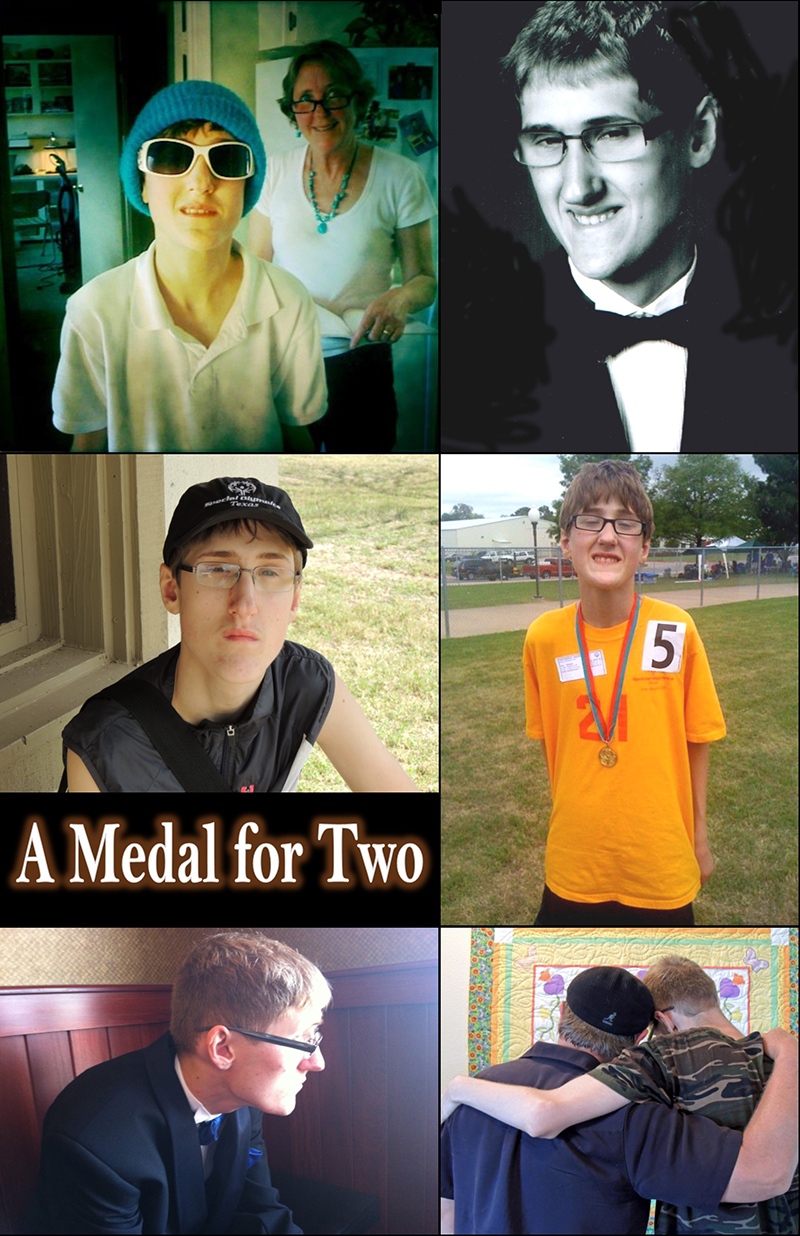
It’s the track and field regional finals of the Special Olympics. The stadium at the University of Texas, Arlington, is electric with the shouts of friends and relatives. An army of compassionate volunteers crowds the field, lining up runners, tracking the winners, cheering contestants in the spirit of the Special Olympics motto: “Let me win, but if I cannot win, let me be brave in the attempt.”

I watch as these cheerleaders position themselves at the finish line of the 100 yard dash, one for each lane. When the gun sounds, they focus raptly on their athlete; for just a divine moment, that boy or girl, man or woman is the most precious human being in the arena.

The diversity is amazing, from preteens through adults, spanning a wide gamut of impairments. We shout our encouragement for all of them, especially a young man in his late 20s. Left in the wake of his peers, he jerks, not walks, towards the tape, his arms clutching a Woody doll from Toy Story. In any other setting his painful progress might be pitiable. But this celebration of life meets him with thunderous applause.

Parents are supposed to remain in the stands, but as the time nears for my son, Kristoffer, to compete, I rebelliously slip onto the field. Smiling like a seasoned volunteer, I elbow my way to the end of his lane. I can see him now, tall and lanky, lane four in a heat of boys that look much stronger, much more substantial than he.

Like most parents, my adrenaline is pumping, nerves on edge. The gun sounds, and with that flash of noise, my mind transports back to Kristoffer’s birth…

October 22, 1997. Even as he emerged for his first breath, it was obvious: Kristoffer was different. The nurses cast surreptitious glances at each other and the doctor, then pasted on smiles for public consumption. But the masks had slipped and I’d seen beneath them. I’d glimpsed the looks of compassion and pity.

Facing the reality that you have a “special needs” child carries all the hallmarks of grief. Denial is pervasive as you await a diagnosis. Kristoffer’s condition was not a known syndrome, which number over 750. He has a chromosomal translocation. I saw the dyed sets of his DNA, the blueprint for his life, so infinitesimally close to symmetrical. But there it was – that microscopic smidgen of genetic material that had broken off one side and attached itself to the other.

It made all the difference.

When the reality started settling in, I felt a wave of grief. I agonized that my child would not have all the possibilities of an “ordinary” life. As a Presbyterian pastor, I tried to buffer this grief, aware of a great paradox within me. The clarion call of my preaching is that the last will be first, and that ultimately the meek will inherit the earth. I have urged others to love outsiders, aliens, the disenfranchised. I have also seen firsthand that children with all their mental capacities are born every day into crushing poverty, intolerance and bloodshed.

But the litmus test of truth, the intimacy of grief, was now mine, and all the glib answers of my preaching failed me. I gave in to what I felt was a selfish reaction. My son would never receive a degree, let alone graduate cum laude. He would never walk the halls of power. He would never discover a scientific breakthrough, play in Carnegie Hall, or step to a podium to give a lecture. He would never start his own business, write a book, or excel in a recognized art.

Heck, I realized he might never learn to talk or read, make friends, or find a suitable woman to share his life with. And work? Where? At a Goodwill Store? Bagging groceries at a sympathetic Safeway? Sweeping floors at a State-run group home?

The geneticist wasn’t encouraging.  With the bedside manner of an IRS agent in need of retirement, he gruffly informed us that the prognosis was very guarded. Kristoffer might have to communicate using pictographs rather than words. Of special concern was the lack of a soft spot on his head, which was already on the border of microcephaly. If his skull did not expand to accommodate brain growth – a condition called craniosynostosis – he would require multiple bone-splitting operations and a plethora of stints.

Donna and I listened in numb silence. At that stage of my life, I was a worrier, conjuring every possible disaster. Though I preached Jesus’ famous “Do not worry” passages from the Sermon on the Mount, I too often succumbed to fear. Donna, on the other hand, cut off dreaded thoughts before the tentacles developed, not because she had learned the art of letting go, but as a survival tactic. She’d been down so many times in her life that she just soldiered on. Somehow we balanced each other.

We needed that balance desperately as we walked through this valley together. I learned to let the expectations of normalcy be cremated in my mind. From the smoke emerged Kristoffer James Van Tatenhove, son of my loins, one of the loves of my life. I began to “Father” him as best I could, slowing down to communicate at the most elemental levels. I began to walk through the grief by walking closer to him.

For personal reasons, I had taken a break from being a pastor. However, I still assisted in mission and outreach at the First Presbyterian Church of Palm Springs, California

God knew we needed that congregation and put us there at just the right time.

Let me explain. In my decades of ministry, I have grieved for people who endure trials in this life without a community of faith to support them. The Palm Springs church wasn’t perfect; it had its own history of divisions and conflict. But they knew how to love us when we craved it the most.

One Sunday fresh after Kristoffer’s diagnosis, I tearfully asked for prayers for our family. The pastor, Jim Griffes, called the four of us – Donna, Kristoffer, my stepson, Keenan, and me – to stand in the center of the sanctuary near the Communion Table. He then called one of the elders, Jayne Humberger, to come forward and lead a laying on of hands.

Jayne was barely five feet tall and carried a lot of extra weight, but when it came to intercessory prayer, the woman was a lightning rod for the Spirit.

I held Kristoffer in my arms as the rest of the congregation flooded unabashedly down the aisles to gather round us. It was a circle of love, the communion of saints, and for the first time in months, I could feel the tightness in my chest begin to dissolve.

I don’t remember Jayne’s exact words as she laid her hands on Kristoffer’s head. But here is what they meant…

Loving God, you are the Great Physician, and anything is possible for you.
…We have heard the human prognosis, now we pray for a miracle.
…We know how much you love Kristoffer; we know you had a plan for his life even while he was in his mother’s womb. Make that plan clear to all of us.
…Most of all, we pray for your will to be done in this family, so that every trial they face will be shaped by your love and grace as a testimony to the world.
…Give them peace, God, not as the world gives, but only as you can.

What constitutes a miracle? Each of us will answer that question for ourselves. But I left that service in a miraculous state of mind, full of conviction that God did indeed have a plan for my son, for me, for our entire family.

This certainty was cemented later in the week as I saw Simon Birch, the film adaptation of John Irving’s A Prayer for Owen Meany. Simon goes to ask a critical question of his pastor. With his stunted growth and obvious disability, he enters the pastor’s study, plops down on the other side of his desk, and speaks.

Simon: Does God have a plan for us?
Rev. Russell: I like to think He does.
Simon Birch: Me too. I think God made me the way I am for a reason.
Rev. Russell: Well, I’m glad that, um, that your faith, uh, helps you deal with your, um…you know, your, your condition.
Simon Birch: That’s not what I mean. I think I’m God’s instrument – that He’s gonna use me to carry out His plan.

Later, when Simon gets discouraged, he goes back to the same pastor.

Simon: I want to know that there’s a reason for things. I used to be certain, but now I’m not sure. I want you to tell me God has a plan for me, a plan for all of us. Please.
Rev. Russell (Finding it difficult to respond with a good answer): Simon…I can’t.

I remember feeling infuriated at that pastor for his lame excuse of a faith. If he had been an actual character with offices nearby, I would have stormed through his door with a stream of invectives. For myself, I clung fiercely to my belief that Kristoffer would exceed the doctor’s predictions. I vowed once again to have the patience and courage to seek out and nurture his gifts, no matter how small. I would help him carve out a unique future despite his limitations!

The spirit is willing, but the flesh is weak. Patience has never been my strong suit. Anyone who knows me will attest to that fact. As I tried to teach Kristoffer basic life skills, my frustration would quickly peak. It was so hard to separate the strands of what was happening. It still is. How much of his learning difficulty was due to his condition? How much was due to his stubborn lack of applying himself? How hard could I push him? How would Donna and I balance our parenting styles? She was prone to over-protection; I was driving him, intent on helping him make the most of himself despite his disability.

Meanwhile, life happened. Like so many other parents around the world, we adapted to the daily realities of our new family constellation, many of which were stressful.

  • Visiting specialists to help with Kristoffer’s slurred speech.
  • Confronting schools so they would not shelve him as hopeless.
  • Searching for friends would who would overlook his disabilities and provide some sense of normalcy.
  • Calming him at night as he cried out in his sleep, always at the crescendo of some crisis he could never articulate.
  • Helping him interpret the onset of sexual feelings with realistic expectations.
  • Gently leading him to basic self-sufficiency while others kids his age were preparing for college.

But there were also the surprises of joy.

  • His vulnerable and fresh way of living in the present.
  • The unexpected hugs he gave to people in churches I served.
  • His impulse to give you a kiss on the cheek when you needed uplifting the most, led by uncanny intuition.
  • His gentleness with other children.
  • The discovery that though he was academically limited, he was nearly an autistic savant when it came to playing XBOX games.

Again I ask you, what constitutes a miracle?

It is now 2017 and Kristoffer has far surpassed that original grim diagnosis. Sure, he can only read at a limited level, but his receptive language – what he understands from others – is nearly at par. He communicates much clearer than we ever hoped for. Recently he graduated from high school and attended the senior prom, milestones we had only dared to believe would occur. He is currently engaged in job training, and his supervisors are hopeful that he will find gainful employment.

But to me, the greatest miracle is how Kristoffer has brought acceptance to our family: acceptance of him, acceptance of others, and acceptance of our own inadequacies. It is deeper and more powerful than resignation. It is that life-affirming acceptance of sorrow that Pearl S. Buck spoke of. It is that acceptance that Kubler-Ross so aptly described as the resting place at the end of grief. And though it may not impart joy, it does pave the way for a new happiness and wisdom.

So, for any of you reading this, I urge you to consider acceptance as a foundation for your life. Listen to these words recorded in one of the stories of AA’s Big Book.

Acceptance is the answer to all my problems today. When I am disturbed, it is because I find some person, place, thing, or situation—some fact of life—unacceptable to me, and I can find no serenity until I accept that person, place, thing, or situation as being exactly the way it is supposed to be at this moment. Nothing, absolutely nothing, happens in God’s world by mistake. Until…I accept life completely on life’s terms, I cannot be happy. I need to concentrate not so much on what needs to be changed in the world as on what needs to be changed in me and in my attitudes.

May I make a few suggestions?

  • If you’ve been focused on trying to change someone else, accept them as they are and see how freeing it is.
  • If you have a heavy load caring for a spouse or parent who is gravely ill, accept the task as a temporary privilege and see how your outlook changes.
  • If you are agonizing over a failure in your past, accept it now as exactly what you needed to shape who you are today.
  • If you are facing an illness of your own, accept the care of physicians, friends, and family. Let God redeem the moments of this precious day you’ve been given.
  • Most importantly, accept the love of God, to whom you are infinitely precious. Let our Creator’s inexhaustible grace give you the peace of self-acceptance, the peace that passes understanding.

Back to that day at the Special Olympics…

Kristoffer is racing towards me, his ungainly legs now striding like a gazelle. Will it be enough? I look to his right and left and it’s impossible to see who is leading. Suddenly I want him to win so badly it’s like an ache in my bones. I want it as vindication, as a justifiable revenge. It unsettles my soul. But just as quickly, the motto of the Special Olympics fills my mind: Let me win, but if I cannot win, let me be brave in the attempt. With a deep breath, I let go and revel in the celebration of life unfolding before me.

Ahhh, my son, my brave son, who has taught me the gift of acceptance, who has blessed me with a new knowledge of being human. Kristoffer, you will always be a winner to me.

He breaks the finish line and I give him a huge embrace.

“Way to go, Kristoffer. That was awesome! You’re the man!”

One of the volunteers takes him from me and moves him towards the ongoing awards presented after each heat. I stand to the side and watch as Kristoffer nears the daises for Bronze, Silver, and Gold. I have no idea how he finished. I am simply basking in the joy of this event that elevates the dignity of being human.

They announce the results for his heat. The Bronze, the Silver…

“And for the Gold, Kristoffer Van Tatenhove.”

He bends down to accept the medal and as he straightens up his eyes search the crowd and lock onto mine. I don’t know who is prouder, him or me. I snap a picture that is now enshrined in my heart.

It’s a medal for Kristoffer. And in ways that are still being revealed, it’s a medal for his Dad as well.

 

Drop the President from 10,000 feet? Really?

Yesterday, a leader in the Presbyterian Church (USA) posted something on Facebook he thought was cute. While on a tour of Washington D.C., the guide mentioned that things were in place for the President’s arrival by helicopter. The guide said that Trump would drop in between the White House fountain and the White House. My Presbyterian brother asked if we could drop him from 10,000 feet. Reportedly, the bus erupted in laughter.

I commented, “Interesting that we live in a culture where someone can joke about killing the president and others just laugh.” He replied, “When the President is a joke, what do you expect?”

What do I expect? Damn good question!

I expect us, as followers of the Prince of Peace, to model something different. I expect us to discipline our tongues as Jesus’ brother James admonished. I expect us to have an allegiance that goes far beyond the corrosive division spreading like cancer in our nation.

I do not support Trump. I am opposed to his policies on the environment, immigration, and health care. I won’t even get into examining his character revealed in one tweet after another. I am working locally and internationally to counter his Administration’s policies.

But his election has had a curious effect on me. Rather than radicalize me, it has drawn me further into the center. Why? Because like never before, I see the toxic underbelly of what we call the “progressives movement.”

It’s too easy to traffic in memes about peace and justice. It’s too easy to fly a banner that quotes Gandhi’s, “Be the change you want to see in the world.”

The real test is to live it out. I have been listening and watching, and here is what I see. We progressives can be just as controlling and insistent about our world views as any fanatic on the right. Our comments, like the one I mentioned above, can be just as incendiary as right-wing bigots. We call for others to repent of their racism, classism, and homophobia, but fail to remove the planks in our own eyes, thus contributing to the disease eating America from its core.

I’ve been guilty of it myself, and I am sorry.

A few weeks back I linked to an article by David Brooks in the New York Times. Here’s an excerpt.

“Some people treat the Trump White House as the ‘Breaking Bad’ serial drama they’ve been binge watching for six months. For some of us, Trump-bashing has become educated-class meth. We derive endless satisfaction from feeling morally superior to him — and as Leon Wieseltier put it, affirmation is the new sex.”

I’m going to work on recovering from my addiction to political controversy and polarization. I can only hope that my other brothers and sisters who are Christian leaders will do the same.

Look! A Cougar!

Can you name something a beloved family member has taught you, a gem of wisdom conferred through words or example?

One of my wife’s many contributions to my life can be summed up in a simple exclamation: “Look! A cougar!”

I first heard it on a drive through the San Jacinto mountains of southern California. We were on an early date, prompted by our mutual love of nature. The highway stretched before us, bathed in thin sunlight, towering Ponderosa Pines and Black Oaks lining the roadside.

We came around a bend just as a squirrel scampered across the pavement. “Look!” Donna said, “A cougar!”

“What?” I responded. “Where? All I saw was a squirrel.”

“Exactly,” she replied with a smile. “If I said, ‘Look, a squirrel,’ you’d hardly be interested. But a cougar? It made you look more closely, didn’t it?”

And here was her lesson in a squirrel’s nutshell: view the ordinary as if it’s extraordinary. Take time to notice and absorb the beauty in life’s small, often stunning, details.

This image has an empty alt attribute; its file name is eee09c36b69932a856b9721088588b52.jpg

Cliché? Perhaps for some of you, but it was a lesson I needed, and she knew it. As a cleric, I had often waxed eloquent about the need to live in the present. “Consider the lilies” was one of my favorite admonitions from Jesus. But my frenetic inner dialogue, fueled by a hyperactive metabolism, compelled me to move too fast. Even my time outdoors was spent cataloging memories, taking photos, “bagging” peaks to add to my list.

Slowing down, luxuriating, settling into this infinity of the present: it wasn’t easy. Sometimes it still isn’t, but inexorably, like drips of water forming a stalagmite, it has changed my life. It’s why I often share this age-old salutation from the Roman poet, Horace: “Carpe diem!”

How about you? How is your mindfulness of each passing day? Lebanese American poet, Kahlil Gibran, once said, “In the dew of little things the heart finds its morning and is refreshed.” This dawning can happen any moment, because it contains all we need to banish preoccupations and experience this Presence that surrounds us.

You may know the story of Brother Lawrence, son of a poor French family in the mid-1600s. His lot in life was so desperate that he joined the Army just to secure hot meals and a bed. Stationed at a lonely outpost in the winter, he had a life-changing experience. He was gazing at a barren tree standing in a field of snow – no leaves or fruit – but the knowledge that it would once again flourish come springtime made him realize that the grace and promises of existence are with us always.

Lawrence later joined a monastery in Paris, and because he lacked formal education, he was told to labor in the kitchen – cooking, washing dishes, mopping floors, scrubbing walls. There, at the bottom of the pecking order, he resolved to experience – once again – the truth he had glimpsed in a frozen French landscape.

The result? A legacy of mindfulness passed on through a compilation called “The Practice of the Presence of God.” I close with his words – overtly Christian, yes – but followed by a simple summation.

“The time of business does not with me differ from the time of prayer, and in the noise and clatter of my kitchen, while several persons are at the same time calling for different things, I possess God in as great tranquility as if I were upon my knees at the blessed sacrament.”

Look! A pot! A mop! A cougar! A moment to be seized and savored!

This (Re)incarnation…This One!

In 1970, George Harrison released his magnum opus All Things Must Pass to universal acclaim. Ben Gerson of Rolling Stone magazine called it an “extravaganza of piety and sacrifice and joy, whose sheer magnitude and ambition may dub it the War and Peace of rock and roll.”

I was 14 years old at the time, and it struck even then that Harrison’s Hindu faith rang out clearly over American airwaves. Driving in our cars, we heard his songs My Sweet Lord that contained chants to Krishna and Give Me Love that prayed “Give me light, give me life, keep me free from birth.”

I love those words, keep me free from birth! Liberate us from the tedium of endlessly starting over. Keep us from being mired in recurring issues that reach no resolution. Release us from character traits that repeatedly undermine our freedom and joy as human beings.

Our most popular notion of karma makes sense – the idea that for every action there’s a reaction. We reap what we sow is a truth found in proverbs around the globe. But does this spiritual axiom echo into eternity? The vast majority of us – even those applauded for our sterling characters – will die as unfinished works of art. We too often take repetitive and destructive behavior patterns to our graves. If there is an afterlife, will we receive a gift of peace and rest? Or are we slated for multiple incarnations until we get it right, fresh opportunities to push our Sisyphean karmic stones up hills of our own invention and finally hurl them into the abyss?

My mind is open to any possibility, but ultimately, I believe this question is more critical for our lives HERE AND NOW. What have we done to secure liberation in this (possibly) one life we’ve been given?

As a pastor for 32 years, I performed hundreds of memorial services. Too many of these were for people who had not done the work required for personal freedom, and I thought, “How sad to live an unexamined life, to tolerate these insanities that dictate our life’s scripts!”

Think about your own life. Are their thoughts and actions that spin you on the hamster wheel of your mind? I certainly have my own: impatience and entitlement, the futile need to exercise control, expectations that ferment into resentments, fears that borrow trouble from the future.

It’s getting better, much better. Assisted by diverse influences – Taoism, the Twelve Steps, the teachings of Jesus and the Buddha, writers like Wayne Dyer – I am experiencing longer reprieves from the madness within and without. But I want this liberty to last, so I resonate with Harrison when he sings keep me free from birth.

Join me! There are so many disciplines to help us recognize and overcome our character flaws on a daily basis. Meditation, centering prayer, recovery programs, therapy, spiritual regimens from many traditions, the counsel of trusted mentors and spiritual guides. We must use our willpower to employ these tools.

If we listen to the still, small voice inside us, it says, “Awaken. Be free NOW, not after you die. Become as self-realized as possible in THIS (re)incarnation. THIS ONE! Learn to shed the cultural and genetic overlays that blind you to the beauty of this present reality that shines with possibility!

Whatever your notion of time, hear these words attributed to Marcus Aurelius and spoken by Maximus to rally his troops in The Gladiator. “What we do now echoes in eternity!”

Yes, give us light, give us life, keep us free from birth!