A Meeting at the Crossroads

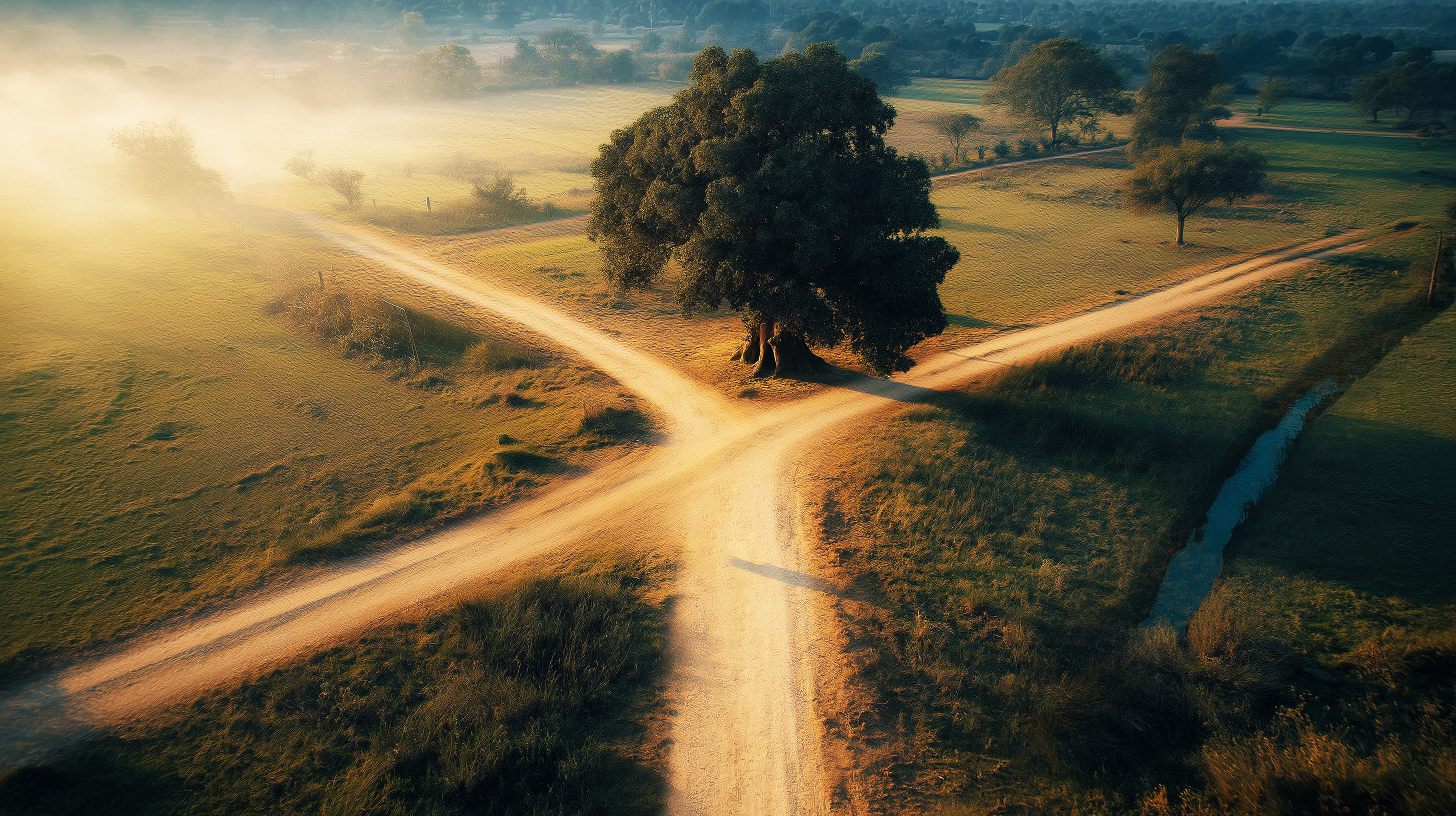
In a parallel dimension of time, the first light of dawn revealed a bucolic landscape. Morning fog lifted from green fields. Silhouettes of scattered oak trees were like ink strokes in the mist. A nearby brook murmured over stones as birds offered their first notes of the day.

At the center of this suspended countryside, two dirt roads converged at a crossroads beneath an ancient sycamore. Its leaves caught droplets of dew like sequins, and a faint breeze carried the scent of wet grass.

That’s when the meeting occurred.

From the western path came the sound of sandals brushing loose gravel. A hooded figure, dressed in a robe of simple linen, walked with an unhurried pace. Simultaneously from the east, another figure approached. This one wore a saffron cloak with its hood tied loosely at his throat.

Just as the sun had cleared the horizon, their paths intersected beneath the tree and they stopped.

The one in linen pulled back his hood. His beard was full but trimmed, his dark hair falling to his shoulders. His eyes were warm and alert, and he smiled with a grace that could disarm the hardest heart.

“Peace to you, traveler,” he said.

The saffron-robed man lifted his own hood and returned the smile. His face was calm, and his eyes held the serenity of mountain lakes. He bowed his head slightly.

“And peace to you, also.”

They regarded each other for a moment, wind stirring the leaves above them.

“It seems,” said the man in linen, “that even though we came from opposite directions, we were meant to meet at this exact moment. Even more curious, we understand each other’s native tongues.”

 “Perhaps these paths are not what they appear,” the other replied.

The man in linen chuckled softly. “They rarely are.”

The other studied him carefully, recognition lighting his features. “I know of you. The stories of your compassion travel far beyond time. You are Yeshua of Nazareth.”

“And you,” Yeshua answered, his voice touched with reverence, “must be Siddhartha Gautama, the one they call the Buddha, the Awakened One.”

The fog thinned as if to give their meeting more space. The men stared deeply into each other’s eyes.

“Will you sit with me?” said Yeshua, motioning to a massive log beside the crossroads.

Siddhartha nodded. “It will be my pleasure.”

They sat beside each other on bark worn smooth by weary travelers. For a while, neither one spoke as the morning settled warmly around them.

At length, Siddhartha broke the silence.

“It is rare,” he said, “to meet one whose words have shaped the hearts of so many, not only in the past but for ages to come. Your teachings have been transmitted across every continent of this earth.”

Yeshua tilted his head, thoughtful. “Hundreds of earth years separated our lives, but I have also heard of your far-reaching influence. Your path of liberation, your understanding of suffering and how to end it. I know that countless people have been healed because of your teachings and example.”

Siddhartha folded his hands in his lap. “I simply gave witness to what I discovered in my own struggles. I found that freedom begins within. If our mind is tangled, the world appears tangled as well. If our heart is bound up by chasing illusions, no external revolution, no remedy of any government, can loosen its knots.”

Yeshua nodded thoughtfully. “I understand. And yet, societies can crush even the most open hearts with their oppression and violence. Like you, I tended to the wounds of my followers’ souls, but I also challenged systems of oppression. Sometimes the sickness is personal. Sometimes it is communal.”

A soft rustle of wings sounded overhead as a raven landed on one of the sycamore’s branches, cocking its head at them with curiosity.

“I would like to know,” said Siddhartha. “How did you learn the compassion that shaped your path?”

Yeshua took a deep breath. “It started early. My parents taught me that our Creator fashioned every one of us in the divine image. They encouraged me to see this divinity in each person, no matter how low their condition. Later, as I walked from town to town, I looked into the eyes of the poor, the broken, the shunned, and I recognized them as my kin.”

He paused, the memory of dusty Galilean roads flickering in his eyes. “I touched the lepers when others fled. I ate with tax collectors and prostitutes. I tried to help them heal not only their bodies, but their sense of worth in the eyes of God. I saw beauty where others saw disgrace. But please know this. It wasn’t just an effort of my own will that caused this. It was a gift from my Heavenly Father, a calling that I embraced.”

A smile warmed Siddhartha’s face. “I have no belief in deities, but my earthly father surely affected me. He raised me to take my place in the upper class of Brahmins. I still remember his anger and disappointment when I left the palace where I had been raised. I threw off the privileges that shielded me and sought to understand suffering by witnessing it firsthand. I came across the sick, the aged, the dying, and each encounter shaped me.” He turned his head to gaze down the eastern road. “I saw that compassion is not merely a virtue. It is a law of nature. I taught my disciples to love all beings as a mother loves her only child.”

Yeshua leaned forward slightly, intrigued. “Yes. To love beyond all the conditions taught to us by the world. Even to forgive those who wound us.”

Siddhartha’s eyes softened. “You forgave even as you suffered greatly.”

Yeshua nodded and lowered his gaze. “It was hardest thing I ever did, but I saw that those who harmed me were trapped in their own fear and ignorance.” He paused. “And you, my new friend, renounced the wealth of a kingdom. I merely left a carpentry practice that I shared with my father.”

Siddhartha chuckled. “You make it sound superhuman, but it was a matter of my own survival. I was suffocating in gilded bondage. Silk chains are still chains. I knew that my contentment would never be found in luxury.

Yeshua nodded. “I also taught that the love of wealth blinds us. This earth’s riches exist to be shared with the poor, not hoarded by the powerful.”

“Tell more about your notions of generosity.”

Yeshua shrugged. “My words are simple. I teach that wealth is not measured by possessions but by giving. I once encountered a widow who offered two small coins to the temple treasury. They were worth less than a cup of water. Yet she gave more than all the wealthy combined, because she offered everything she had out of love.”

“Intent over quantity,” said Siddhartha. “Purity over display.”

“Exactly.”

“In my own teachings,” Siddhartha said, “I spoke of dāna, the perfection of giving without the attachment of expecting a reward. As we practice dāna and grow more enlightened, there is a sublime offering we have for others. I call it the gift of fearlessness. To me, this is perhaps the highest form of generosity because it helps ease the anxiety and turmoil of others.”

Yeshua looked moved. “I mostly agree. But a hungry person would much prefer a loaf of bread over a philosophical truth. Either way, I taught that when we comfort others, we become a light in the darkness.”

The raven took wing, drifting gracefully over the countryside towards the horizon. Both men followed its flight with their eyes.

“Our teachings align in many ways,” said Siddhartha. “Compassion, nonviolence, and generosity. Yet there is that difference you already mentioned. Perhaps it is rooted in the worlds from which we came.”

Yeshua turned to him. “Yes. I feel it too.”

Siddhartha’s voice grew introspective. “I would like to discuss this more fully if you are willing,”

“Of course,” said Yeshua.

“My path focuses on the individual,” Siddhartha continued. “I teach that if each person frees themselves from desire and delusion, then suffering decreases in the world. A tree grows strong when each root is healthy, not when we try to force the whole forest into harmony.”

Yeshua’s eyes shone with understanding.  “Go on, please.”

“I believe that a liberated consciousness radiates outward naturally. Peace in one person becomes a lantern for those nearby.”

Yeshua gazed down the western road. “While I agree with you in many ways, I walked among people who were burdened by more than their own desires. They suffered under a conquering empire, unjust rulers, and a religious structure that was burdensome rather than uplifting. So I spoke directly to those powers. I confronted corruption. I overturned tables in the temple. I challenged those who used their sacred laws to exploit the vulnerable.”

A gust of wind stirred the leaves above.

Siddhartha considered this. “Your liberation was both inner and outer.”

“Yes,” Yeshua said. “Because a society can trap a soul as surely as craving can.”

“And yet you carried no weapon.”

“Love was my only force,” Yeshua replied simply. “The moment we harm another, we harm ourselves.”

Siddhartha smiled. “In this, we are brothers, even though I question if societal structures will ever truly change. One only needs to view the entirety of human history to see how oppression continues from generation to generation, how violence begets violence.”

Sunlight slanted across their faces. For a moment the men seemed less like historical figures and more like long-term companions sharing memories.

Yeshua clasped his hands together. “Siddhartha,” he said gently, “your path turned inward to heal the roots of suffering within the heart.”

“Yes,” the Buddha said. “That was my way.”

“I also sought a kingdom of the heart,” Yeshua said, “but one that actively confronted the unjust structures of the world.”

Siddhartha breathed in the scent of the fields surrounding them, “I often wondered if my path should have addressed the world more directly. But I feared that confronting systems would drag me into the very entanglements I sought to dissolve. How can you uproot a poisonous tree while remaining free from the toxin?”

Yeshua gazed upward as the sunlight gathered strength. “I wondered the opposite. Sometimes confronting those forces only made them more determined to strike back. It also sharpened my tongue and my approach. Perhaps my willingness to challenge them so openly hastened not only my own suffering, but that of others as well. Yet I felt compelled to name injustice wherever I saw it.”

Siddhartha bowed his head in recognition. “Different approaches. Neither of them easy.”

“Yes,” Yeshua murmured, “very different methods. But we both sought peace.”

“And unity among all beings,” Siddhartha added. “A world where compassion is like the air that people breathe.”

They looked at each other with quiet, profound understanding.

Siddhartha looked up at the branches of the sycamore. “Sitting here reminds me of the most important night of my life. I had tried one form of meditation and asceticism after another. Finally, weary that I would ever experience full awakening, I sat beneath an enormous tree, determined to break through or die on that spot.”

Something caught in Yeshua’s voice. “I, too, found my greatest moment of victory with my back against a tree’s wood. It was only then, in the depths of my worst suffering, that I was able to embrace the fullness of what I had taught.”

They both fell into silence, recalling the pathways that led to this moment outside of time.

Finally, Yeshua rose to his feet. Siddhartha followed. They stood facing one another.

Siddhartha said, “The world is large, Yeshua. Too large for one method alone.”

“You speak the truth,” Yeshua replied. “The world needs multiple invitations toward wholeness.”

Siddhartha’s eyes brightened. “Then may our teachings be like two rivers flowing toward the same sea.”

The wind picked up again, rustling their robes. Yeshua extended his arms and embraced Siddhartha. The Buddha returned the embrace without hesitation.

When they stepped back, Siddhartha placed his palms together at his heart and bowed. “May all beings find the end of suffering. May you walk in peace, my friend Yeshua.”

Yeshua lifted his right hand in blessing. “Shalom aleichem. Peace be upon you, Siddhartha, wherever your steps lead.”

They smiled like two old friends on that road between worlds, joined for a moment where past and future dissolve.

Then, with no further words, they turned.  Siddhartha headed westward to new horizons, sun casting his shadow before him. Yeshua walked eastward with a new understanding, his shadow following behind him.

 The crossroads was quiet, except for the wind in the sycamore and birdsongs echoing over the fields.

And for a breath of time outside of time, the world felt a bit more whole.
Lucid Reunion

Dreams are the touchstones of our character.  – Stephen LaBerge

The sign on my office door says John Longfellow, PsyD – Individual and Family Counseling. I’ve been a psychologist for 20 years, helping people unravel their burdens and find resolution.

About three years ago, my enthusiasm flagged. Call it a midlife crisis, but listening to others grew tedious, especially with clients who took little responsibility for their healing. I nodded my head and kept appropriate eye contact, but I felt like a bobble-head toy. My wife noticed that I’d lost my lost my passion.

“You’re just not yourself,” she said, kindly but with an edge of exasperation. “I don’t have a prescription, but you need to find a way to connect with your old zest. You still have a lot of years ahead of you. We still have a lot of years ahead of us.”

She was right. I needed a new spark, a fresh avenue of exploration.

That direction came unexpectedly. I was listening to a podcast on my way to work called Wake Up Inside Your Dreams, a fascinating overview of lucid dreaming. The podcaster said, “It’s possible to step into our minds with our eyes open. We begin to see the architecture of our fears and our longings. We realize that we’ve built every wall and horizon ourselves.”

I’ve always had vivid dreams, but their meanings evaporate as I awaken. I knew a little about lucid dream theory, but the podcast spurred me to sharpen my research. I devoured everything I could find, from Jung’s Red Book to LaBerge, Bogzaran, Holziner, Aspy, and every article archived by The Lucidity Institute.

I began to experiment in my own life, keeping detailed dream journals and using practices like reality testing and mnemonic induction. It paid off. I could stay longer in my visions, understand more symbols, and even translate a few simple lessons into my waking world.

But still, something eluded me, something deeply connected to that sense of joy I’d been lacking for so long.

Gradually, I integrated this new focus into my practice, becoming a guide for others in their nightly walkabouts. Word got out through the therapeutic community. New referrals sought me out for release from night terrors, recurring guilt dreams, or lost loves who visited frequently like ghosts. I taught them to stay calm, to recognize the subtle distortions of the dream world: a light switch that doesn’t work, a clock whose hands refuse to move, words that rearrange themselves when you blink. These are the cues, I told them. The seams of the dream world. Pull at them, and you can wake up inside your own story.

I never imagined the fullness of what my own subconscious was preparing for me.

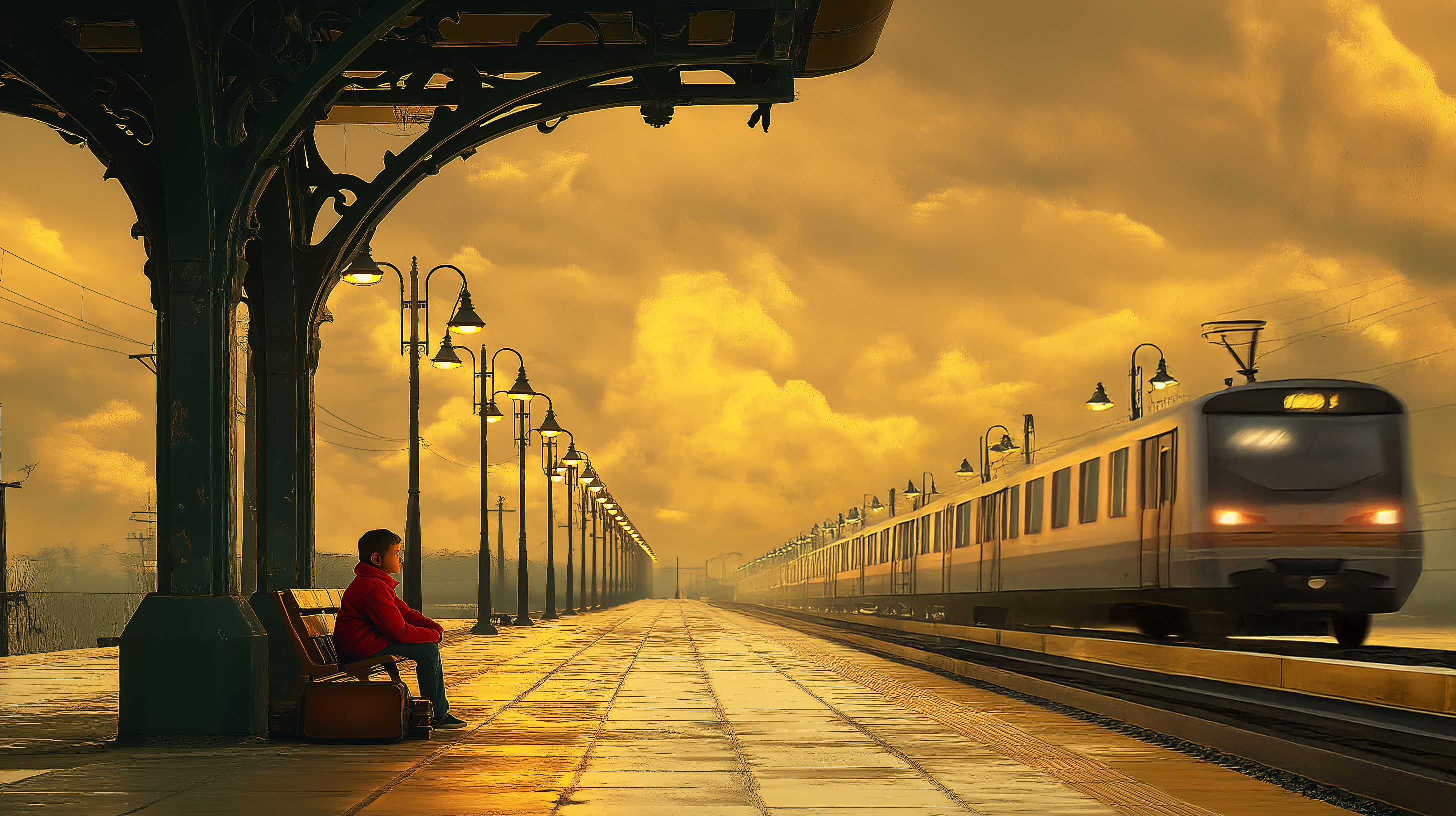
It began one winter night after an exhausting day of sessions. I’d just finished with Claire, a woman haunted by a recurring nightmare of drowning in a river that looked suspiciously like the one outside her childhood home. That night, perhaps still affected by her angst, I dreamed of a place I’d never been, an old train platform under a sky the color of brass.

It was still at first. No wind, no movement, just a suspended hush. The platform stretched endlessly in both directions, lined with benches and antique lamps that cast faint halos of light. A few people milled about, blurred, like they were painted in watercolor.

And then I saw him in sharp focus.

Across the tracks, on a bench opposite mine, sat a boy. He was swinging his legs and rolling a toy car from the palm of one hand to the other. I didn’t need to guess who he was. I knew instantly that I was looking at myself at eight years old.

The shock of recognition was almost physical. Inside the dream, I felt my chest tighten and my breath quicken. He looked exactly as I remembered myself. Thin, serious, with that same stubborn cowlick that refused to lie flat no matter how much my mother spat on her palm. He was wearing a red windbreaker I hadn’t thought about in decades.

I called out his name—my name—but even as the sound left my mouth, a train thundered between us, all smoke and screeching metal. When it passed, the bench was empty.

I woke up with my heart hammering. The clock read 3:14 a.m. My sheets were twisted around me, damp with sweat. I sat up, rubbed my eyes, and tried to tell myself what I’d tell a patient: it’s just an image, a projection of memory, nothing more. But I couldn’t shake the feeling that something in me had been waiting for this encounter.

The dream came again the next night.

This time the station looked older, like a faded photograph. The air shimmered with sunset light. The boy was there again, farther away, walking along the opposite platform. I shouted, but my voice came out thick, like a sound underwater. He turned his head slightly, enough for me to see his eyes. There was no surprise in them, only recognition and something else I couldn’t name.

Then the scene shifted, as dreams often do. The tracks vanished. I was standing in a field outside my grandparents’ farm, the one I hadn’t visited since childhood. The boy was near the tree line, still holding that toy car. I started toward him, but the ground turned to mud. I slogged forward, desperate to reach him, until the earth pulled at my ankles like quicksand. Just before I sank, I woke up gasping.

By the end of that week, the dreams were nightly appointments. Sometimes I’d find the boy in places I hadn’t thought about in years. The hallway of my elementary school, the corner of our old backyard where I set up battlefields for my toy soldiers, my childhood bedroom as sunlight streamed through the window. Each time, I was a step closer to him, but each time, something intervened.

The researcher in me cataloged every detail in a notebook: dates, colors, emotional tones. The therapist in me found it thrilling to be recording pure, personal data. But the man in me felt a form of grief. There was something I’d lost in the past, and it was still slipping through my fingers.

I began to see small echoes of those dreams in my waking life. A boy on the bus holding a toy car. A poster in a coffee shop showing a train steaming into the horizon. It was eerie enough that I called a colleague I trusted and explained what was happening.

“I hear you, John,” he said. “Do you know Jung’s theory of synchronicity?”

“A bit. Describe it to me.”

“He said that sometimes events coincide in time and appear meaningfully related, but they lack any real causal connection. That sounds like what’s happening to you.”

I muttered an agreement as we hung up, but I knew better. I knew that my subconscious was breaching the border between worlds. And I began to understand the exasperation of my patients. As one of them had said about his recurring nightmares, “If there’s a lesson here, just fucking teach it to me and get out of my mind! You’re driving me crazy!”

I tried all the techniques I taught others, but none of them stopped the dreams. If anything, the lucidity deepened. I could feel the texture of the air. I could smell dust and rain. I could hear my own heartbeat, quick and young, as if borrowed from the boy I pursued.

Three weeks in, the dream took a new turn.

I found myself in a park I knew intimately. It was where my father taught me to ride a bike. The grass was impossibly green, the air full of the smell of lilacs. My father wasn’t there, but the boy was sitting beneath a tree, his knees drawn up, that toy car in his hands.

For a moment I couldn’t move. After all my pursuing, it now felt wrong to approach him, like I was intruding on sacred ground. But the boy looked up, and I saw no confusion or fear in his face, just patience.

“You took long enough,” he said. His voice was clear and even, nothing ghostly about it.

“I’ve been trying to reach you,” I said.

He smiled, my own smile softened by time. “No. You’ve been trying not to.”

Those words cut through me. I wanted to ask what he meant, but he stood and started walking toward the swings, motioning for me to follow. The scene wavered, colors bleeding at the edges. I fought to stay asleep, to hold the moment.

“Why are you here?” I asked.

He stopped and looked back over his shoulder. “Because you finally are.” And then he walked right up to me and handed me the toy car. I looked down and recognized it instantly, a Matchbox green Camaro that had been one of my favorites. Our eyes locked and he smiled in a way that filled my body with light and warmth.

“I lost this years ago,” I said.

He shrugged and sighed. “You stopped looking.”

When I woke, my hand was open, my palm warm, as if I’d been holding something small and solid. There were tears on my cheeks. For the first time in years, I didn’t feel tired. I felt lighter, as though some long-frozen part of me had started to thaw.

Still, I’m a scientist at heart. I spent the morning journaling and cross-referencing symbols. The park. The train. The toy car. All anchors of memory, all pointing toward one obvious conclusion: the boy represented my unintegrated childhood self, the part I’d buried under professionalism and adult control. I regained my usual clinical detachment.

That afternoon, during a session, one of my patients—a middle-aged woman suffering grief after the loss of her mother—told me she’d dreamed of chasing her mom through endless corridors, never quite reaching her. Normally, I would have guided her toward strategies for confronting the dream figure. Instead, I said, “Maybe she’s not running from you. Maybe she’s leading you somewhere.”

She stared at me, wide-eyed, and nodded slowly, as if I’d just offered her a map.

In truth, I was offering one to myself.

The dreams didn’t stop after that, but they softened. The boy would appear beside me now instead of across some impassable barrier. Sometimes we’d sit quietly together on a curb, a hill, or the roof of a house. He never said much. It was like communion, and it lasted longer than any other dream experience I’d had, time rolling out ahead of us.      

Changes seeped into my waking life. I started taking walks with my wife after dinner instead of falling asleep at my desk. One night she held my hand and said, “I like this new spring in your step.” I called my sister, whom I hadn’t spoken to in months. I even dug through an old storage box in the attic and found a Polaroid of myself at eight, sitting under that same tree in the park. My father had written on the back: To my brave boy. Keep going.

That night, the dream came again, but this time there was no boy. I was standing alone in the park, dusk settling around me, the air thick with that lilac scent. The toy car lay in the grass at my feet. I picked it up, turned it over, felt its weight. From somewhere distant, I heard laughter—mine, but younger. Then everything faded into light.

I woke before dawn, not startled this time, just awake. Truly awake.

Since then, my dreams have changed in tone. Sometimes the boy appears, older now, walking beside me through unfamiliar cities. On other nights, he’s absent entirely, but I feel his presence like a hand at my back. I no longer chase him. We’re walking in the same direction, a deep, lucid reunion between who I was and who I’ve become.

A few weeks ago, a patient asked me, “Dr. Longfellow, what happens when we master lucid dreaming and can control everything?”

I smiled. “I’ve learned in my own dreams that control isn’t the point. It’s more important to listen and let the dream speak its own strange language.”

She nodded and looked down with tears on her cheeks.

These nights, when I drift toward sleep, I feel an exciting flicker of anticipation. I know that somewhere in that vast theater of my mind, a child version of me might still be sitting beneath a tree, turning a toy car in his hands.

And he’s not waiting anymore.

The Necessity of Wildness

(Click here to download my expanded compilation of text and photos called The Necessity of Wildness. Best viewed as a two-page spread in Adobe Acrobat)

John Muir once said that “wildness is a necessity.” I agree, and it’s a truth that stands as an indictment of our current society. We live in a culture that multiplies distractions. We confuse convenience with meaning. We mistake consumer goods for necessities. Against the backdrop of this noise, wild places call to us—not as optional luxuries, but as lifelines to our truest selves. This call has echoed through my life since childhood, sometimes quietly, sometimes like an alarm.

I grew up in the Los Angeles Basin, a hazy expanse of freeways, stucco homes, and constant motion. In those early years, before the Clean Air Act of 1970 curbed the worst pollution, Smog Alerts were frequent. Our teachers sometimes kept us indoors for recess, because the outside air literally burned our lungs.

My childhood could easily have been devoid of natural beauty. But my father, at the considerable sacrifice of commuting long hours, insisted on something different. He moved us to an area of the Los Angeles Basin that still held remnants of old Southern California: chapparal covered hills, orange and avocado orchards, creeks running through ravines.

My brothers and I roamed those hills as if they were our personal kingdom. We named special places, caught lizards and toads, and wandered stream beds that smelled deeply of loam. I can close my eyes even now and see the silhouette of a great horned owl gliding over our house at twilight, taking its place in the eucalyptus trees that bordered our property. I remember falling over backwards, not to make a snow angel, but to carve an outline of my body in a field of tall wild mustard, gazing at the blue sky above, listening to the buzz of pollinating bees.

As I grew older, Boy Scouting deepened my relationship with wildness. Our troop hiked the John Muir Trail, rafted the Colorado River, and camped in the Mojave Desert surrounded by Joshua trees. I began to understand Muir’s belief that these places were “fountains of life.” I felt that fountain rising in me. Still, as adulthood encroached with work, ambition, and responsibilities, I sometimes forgot to return to the source.

Years later, emerging from one of the most difficult periods of my life, a spiritual guide got my attention. “As you piece together this new beginning,” he told me, “reserve time alone in nature. This isn’t just nostalgia about your childhood. It’s a portal to the serenity your soul is seeking.” That simple truth rang like a bell. I listened. Since then, immersing myself in nature is no longer a casual hobby; it is woven into my schedule as an essential practice. If I neglect it, I feel the restlessness immediately, a tug from the wild reminding me of what I’ve forgotten.

Once I’m there, these three necessities impress themselves on my soul.

The Necessity of Stillness

Stillness in nature is not the absence of sound. Anyone who has walked in a forest knows its constant music. Stillness is the presence of something deeper, a rootedness. Nature invites us into this realm, and if we let it work its magic, it loosens the grip that multitasking and digital overload exert on our spirits.

I once took a group of inner-city boys from Los Angeles on a backpacking trip into the San Gorgonio Wilderness. It required days of preparation just to get them ready. We had to borrow gear, teach some basic skills, and coax parental signatures from families who had rarely ventured beyond their barrios.

On the trail, the boys kept up a steady stream of macho joking until I stopped them with a challenge. “For the next half hour,” I said, “let’s walk like the Serrano People, the earliest inhabitants of this area. No talking. Just listen.”

They were skeptical, but they fell silent to indulge me. Almost immediately, the forest honored our reverence. Soft wind whispered through the Ponderosa pines. Scrub jays chattered nearby. We saw a family of mule deer browsing in the undergrowth.

Then, a rabbit emerged on the trail ahead. I held up my hand and we paused. Suddenly—almost mythic in its timing—a huge red-tailed hawk swooped down, seized the hare, and lifted it into the sky. We could hear the flapping of its strong wings.

The boys gasped. These hardened kids who had seen too much violence and too little beauty now stood in awe of something vast, powerful, and humbling. In their eyes I saw something I will never forget. Wonder. Pure, undiluted wonder.

The Necessity of Wonder

Wonder expands us. It loosens the grip of our egos, reminding us that we are a small but precious part of a vast, intricate universe. Though I’ve often shown the Hubble Telescope’s eXtreme Deep Field photo to illustrate this point, it’s far better to experience it firsthand. Find a dark sky preserve and lie on your back beneath the Milky Way. Let your eyes drift across the heavens, realizing that some of the “stars” above you are entire galaxies, each holding billions of suns.

So often, when our minds stretch, our spirits follow.

And wonder isn’t reserved for the cosmic. It pulses through ordinary experiences when we pay attention: the scent of creosote after desert rain, the echo of thunder over a plateau, the iridescent shimmer of a dragonfly’s wings. I once awoke in a bamboo hut on Maui to a series of booming sounds. Only later did I learn that it was humpback whales, joyfully slapping their tails in the dark waters of the bay. Wonder like that stays with you, a quiet ember you can relight repeatedly.

The Necessity of Gratitude

If we stay with it, wonder evolves naturally into gratitude, one of the most stabilizing forces in human life. Meister Eckhart once said, “If the only prayer you ever said was ‘thank you,’ that would suffice.”

Gratitude opens our eyes not only to the gifts we receive but to the responsibility these gifts confer upon us. When we understand that wildness is a necessity, we feel compelled to protect it, to become stewards of the land and advocates for species that cannot speak for themselves.

This can begin simply with recycling, conserving energy, or planting a pollinator garden. And for some of us, it goes much further. As a Texas Master Naturalist, I have seen ordinary people become extraordinary guardians of the earth. They clean the rivers, remove invasive plant species, and help restore native trees and prairies. They remind me of my own responsibility to help protect the fragile web of life.

Returning to the Wild

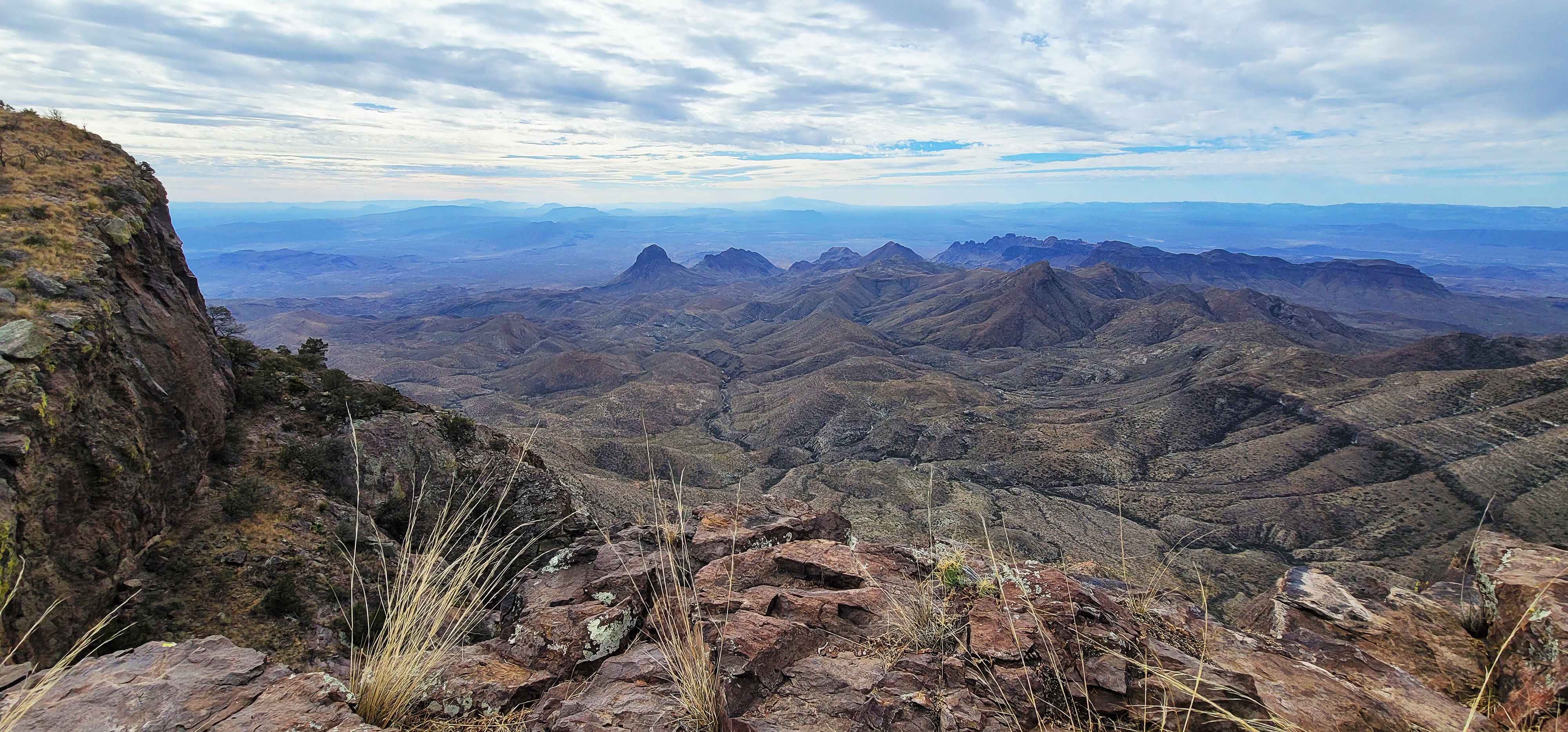
A few years ago, on the Pinnacles Trail in Big Bend National Park, I sat beside some ancient rock spires. The noise of modern life, engrained in my chattering thoughts, faded away. Technology, politics, identity, worry, all of it dissolved in the beauty of that place. What remained was a profound stillness. It was an epiphany, both humbling and energizing, connecting me not only with the earth, but with all human beings who have transcended their conditioning and embraced the natural world.

And so, I will always return to the trail, because Muir was right: wildness is not optional. It is a necessity for stillness, for wonder, for gratitude, and ultimately, for becoming whole.

Happy trails to all of you!

At the Corner of Oglethorpe and Martin Luther King, Jr.

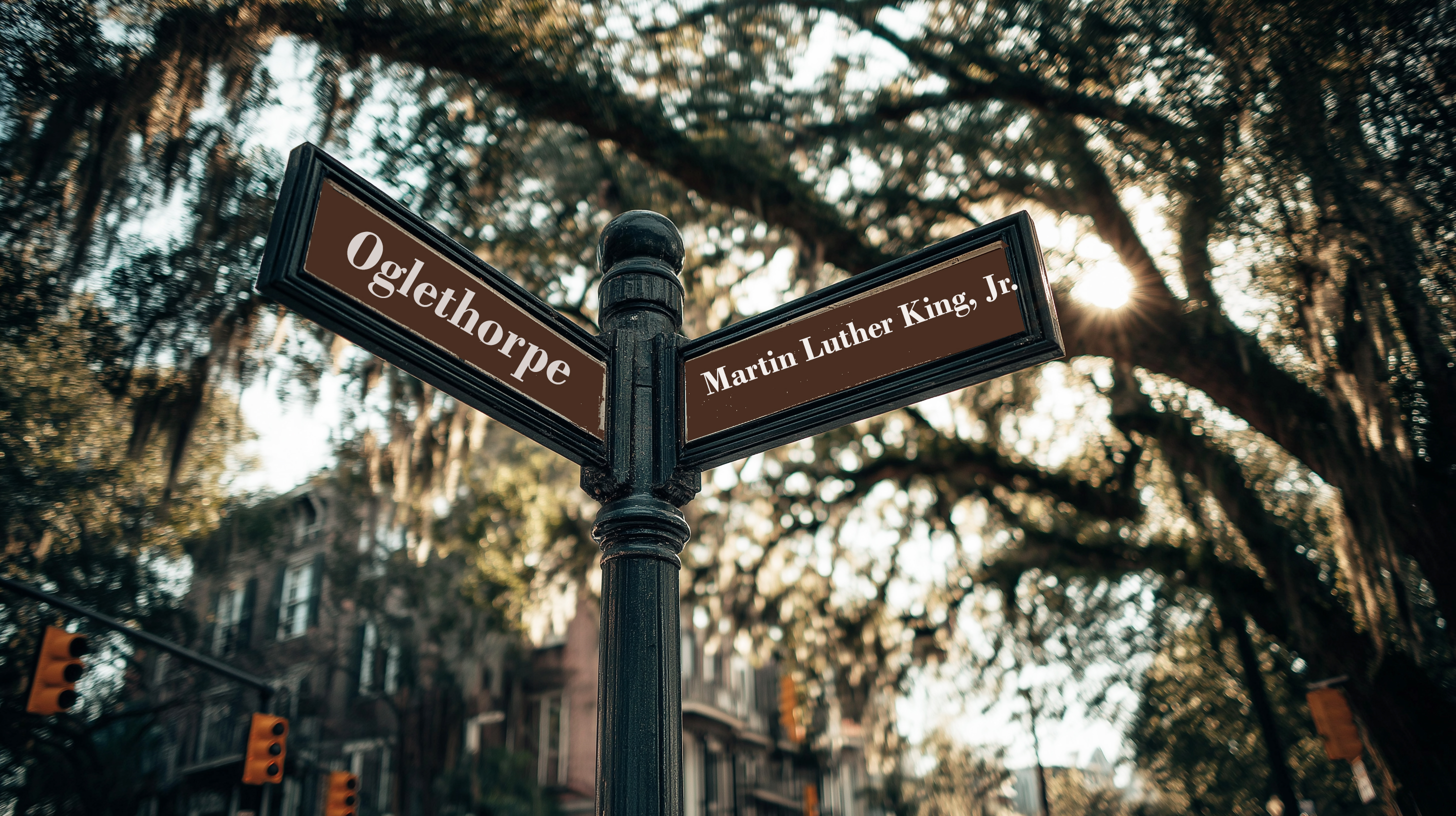
Last week, on a trip to Savannah, Georgia, I found myself standing at the corner of Oglethorpe Avenue and Martin Luther King Jr. Boulevard. Late afternoon sun cast long shadows across the intersection, and I felt the weight of history pressing down on that spot. The street names are a metaphor in one of America’s oldest cities, where the past is never far from view. In Savannah’s history, beauty and brutality entwine like the Spanish moss that drapes its live oaks.

Oglethorpe founded Georgia in 1733. He was initially complicit in systems of oppression, including the Atlantic slave trade. Savannah was one of the most active ports receiving prisoners at the end of their “middle passage.” But later, after witnessing the moral rot that slavery inflicted, Oglethorpe became one of the earliest advocates for abolition. King, born two centuries later, dedicated his life to dismantling the structures of oppression that had calcified into American bedrock.

Standing there, I couldn’t help but see this street corner as a physical manifestation of our national paradox, the constant tension between our worst impulses and our highest ideals.

We all know how this contradiction runs through every chapter of our story. Thomas Jefferson penned words about equality and inalienable rights while enslaving over 600 human beings throughout his lifetime. The Thirteenth Amendment abolished slavery in 1865, yet within a decade, Black Codes and convict leasing created new systems of forced labor. We fought a world war against fascism with a segregated military, then returned home to a nation where those same soldiers couldn’t sit at lunch counters beside the people they’d fought to protect.

The GI Bill opened pathways to college and homeownership for millions, but discriminatory implementation meant Black veterans were systematically excluded from these opportunities, creating a wealth gap that reverberates today. We built the Interstate Highway System to connect our nation while bulldozing thriving Black neighborhoods to do it.

Our contradictions are brutally visible in our treatment of Native peoples. The ideals of liberty coexisted with policies of forced removal, such as the Trail of Tears that passed through the state of Georgia. Under the banner of divine providence, we displaced entire nations, stripping them of their lands and cultures. Later, federal programs sought to “assimilate” Native children by removing them from their families and erasing their languages in boarding schools.

Many immigrant stories reveal similar paradoxes. The Statue of Liberty promised refuge — “Give me your tired, your poor, your huddled masses yearning to breathe free” — yet waves of newcomers faced hostility and exclusion. We celebrated Ellis Island and the Statue of Liberty while turning away ships of Jewish refugees. Chinese laborers who helped build the transcontinental railroad were later targeted by the Chinese Exclusion Act of 1882. Irish and Italian immigrants were met with suspicion and violence. During World War II, Japanese Americans were interned behind barbed wire, not for crimes but for ancestry. Each generation of immigrants, it seems, has had to fight to prove its belonging in a nation supposedly founded on welcome.

Even our progress reveals the pattern. Brown v. Board of Education declared school segregation unconstitutional in 1954, yet decades later, our schools remain deeply divided by race and opportunity. The Voting Rights Act of 1965 protected ballot access, yet we’re still fighting over voter ID laws, polling place closures, and redistricting schemes designed to dilute minority votes. We elected our first Black president, then watched as hate crimes and white nationalist organizing surged in response.

And the gap between the haves and have-nots continues to widen. Federal Reserve data shows that the richest 10 percent of American households now own over two-thirds of the nation’s total wealth. Even more telling, the top 1 percent holds 31% percent of our total wealth, just slightly less than the entire bottom 90 percent of U.S. households.1

And yet, I remain hopeful, because America has always been a story of striving. The arc of our history may be jagged, but it bends toward justice when enough of us pull together. From abolitionists and suffragists to civil rights marchers, from modern activists for climate justice to the organizers for LGBTQ+ rights, we continue to strive.

I felt this strongly in my recent participation at a No Kings protest. Progress has never been a gift from the powerful and wealthy. We who believe in a more perfect union must demand it! This is vital to remember at our current juncture in American history, when oligarchs are more brazenly exerting their influence over every aspect of our culture.

As I stood at that intersection in Savannah, the hum of traffic surrounding me, I imagined Oglethorpe and King in conversation, two men separated by centuries yet ultimately united by conscience. Perhaps they would agree that the true test of a nation is not whether it avoids hypocrisy, but whether it keeps pushing toward redemption.

We are still standing at that intersection between what America has been and what it can yet become. And if we listen closely, we will hear Dr. King’s voice reminding us that the dream is not dead.  

It is waiting for us to live it out.

1 – Wealth Inequality – Inequality.org

The Sacred Journey Beyond Religion

In 2024, the Pew Research Center found that 28% of Americans check “none” as their choice of religion.

So many of us have stepped away from organized faith, not out of rebellion, but from a courageous honesty with ourselves that we could no longer ignore. For some of us, the rituals had grown hollow, the dogmas too small for the vastness of our questions. Others of us saw how our institutions had become rigid or exclusionary.

Here’s a hard-won truth that many of us share. When we trade wonder for certainty, our souls begin to suffocate. As Jesus said in one of his most enduring metaphors, you can’t place new wine into old wineskins. It will only cause further rupture.

Have you ever walked out of a sanctuary you once felt was sacred, wondering if you were leaving behind not just your faith, but the language of your soul? If so, take heart. We are not losing our spirituality. We are rediscovering it in a deeper and freer form.

The Quiet Hunger Within

All of us carry a hunger for meaning that no amount of success, pleasure, or distraction can fill. We want to know that our lives matter, that we belong to something greater than ourselves. This longing stirs in the silence before dawn, in the tears we can’t explain, in the beauty that takes our breath away. It is not a problem to be solved. It is an invitation.

So where do we turn when we yearn for the sacred, but no longer fit inside the old containers?

The Open Path

First, we realize that spirituality was never confined to human temples, effigies, or sacred texts. It is written into the fabric of existence itself. The same Presence that inspired prophets and poets is alive in each of us, waiting for us to notice.

You might glimpse it in a forest trail glowing with morning light.
You might sense it in the deep stillness of meditation, or in the laughter of a friend who sees you fully.
You might feel it in moments of awe, when the boundaries between “you” and “everything else” dissolve.
You might see it looking back at you through the eyes of your child or grandchild.

Each of these is a doorway into the same mystery.

Spiritual satisfaction doesn’t come from subscribing to the right belief, but from cultivating awareness. And as our consciousness grows, so does our compassion, our sense of unity, and our capacity for joy. We begin to live not from fear, but from connection.

Companions on the Road

Our quest for meaning is not a solo expedition. We belong to a vast community of people asking similar questions, struggling with uncertainties, and finding revelations they never imagined. Each of our companions along the way carries a spark of the mystery we seek. When we share our stories, we participate in a sacred exchange. We remind each other that the search itself is holy.

Some of us find this connection through contemplative circles, mindfulness groups, or creative communities. Others of us find it through feeding the hungry, tending the earth, or comforting the lonely.

Wherever we practice love, spirit is present. As the timeless Persian poet, Rumi, once said, “In every religion there is love, yet love has no religion.”

Evolving Notions of the Divine

Words are simply pointers. This is a crucial realization. God, Tao, Source, Beloved, Mystery, Great Spirit are all terms intimating something we can never fully capture in language. The immensity of the cosmos and its origin are better experienced through awe. Over time, we find that the divine becomes less a being “out there” and more a living presence within and around everything. We come to see that spirituality is not about believing, but about being fully awake to the sacred dimension of everyday existence.

As our understanding expands, so does our compassion. We stop worrying about who’s right and who’s wrong in matters of faith. We start asking: What helps me love more deeply? What helps me live with gratitude? What helps me serve the wholeness of life?

The Great Thrills of the Journey

The spiritual journey beyond religion may begin with a sense of loss, but discoveries soon fill that void in myriad ways. Imagine:

  • The thrill of realizing that every sunrise, every act of kindness, every moment of awareness is a form of prayer.
  • The freedom of knowing that you no longer need to pretend certainty; that questions themselves are sacred.
  • The joy of feeling at home in the universe, even without a map.

Looking back, we see that we are not exiles. Instead, we have found a calling, an invitation to grow beyond the boundaries of old beliefs and into the spaciousness of wonder.

The Infinite Yes

If you find yourself wandering beyond the walls of religion, trust the journey. Follow the tug of your own curiosity. Keep your heart open to beauty, mystery, and love. The sacred has not abandoned you. It has simply changed its address, moving from the altar to the open sky, from the sermon to the beating of your own heart.

You are still on holy ground.

A Tale of Two Orphanages

It’s always this way. Call it the vagaries of chance or the randomness of an indifferent universe. Ten soldiers are in a convoy struck by mortar rounds; only two survive. A fire rips through a mountain village; dozens of homes burst into flame while others remain unscathed. A plane makes a crash landing in a cornfield, killing most passengers; a handful walk away from the wreckage. The Guadalupe River in Texas floods a girl’s summer camp, killing dozens; just a week earlier, similar campers had the time of their lives.

Please don’t say it was your god’s will that some lived while others perished. That’s a cruel heaping of insult on injury, and it paints a ghastly picture of your capricious deity.

No. It’s always this way. And so it was with two orphanages in Galveston, Texas on September 8, 1900.

But first, some context.

In 1900, Galveston was at the zenith of its heyday, a bustling port with a population of 38,000, known as the “Wall Street of the Southwest” for its concentration of banks, businesses, and wealthy entrepreneurs. It boasted being the third richest city in the United States in proportion to population. All major railroads connected there, and it exported 60% of the state’s cotton crop, rivaling New Orleans. Its grand Victorian mansions and beachfront attractions earned it the nickname the “Queen City of the Gulf.”

Galveston also had more than its share of orphans, being the last stop for so-called “orphan trains.” Operating between 1854 and 1929, this social experiment transported 200,000 children from crowded Eastern cities to foster homes in the rural Midwest that were short on farming labor. The co-founders of the movement claimed the children were abandoned, abused, or homeless. They were mostly the offspring of immigrants living in urban slums. The movement garnered widespread criticism for its ineffective screening of caretakers and its insufficient follow-ups on placements. In some cases, the children were no better off than slaves after adoption.

By the time these trains rolled into Galveston, the children on board were those found less desirable. They ended up in one of two places: St. Mary’s Orphanage Asylum or the Galveston Orphan’s home. There they shared quarters with orphans whose parents had succumbed to a yellow fever epidemic.

Then came the fateful day of September 8, when a hurricane dubbed the Great Storm of 1900 made landfall on Galveston Island. With sustained winds up to 145 miles per hour and a storm surge reaching 12 feet, it decimated the city. Exact death tolls vary, but some estimates say up to 12,000 perished. Another 10,000 were homeless. The storm is still the greatest natural disaster in terms of its death toll to ever strike the United States. Massive funeral pyres burned everywhere in the aftermath, and barges carried stacks of the dead into the Gulf of Mexico for burial at sea.

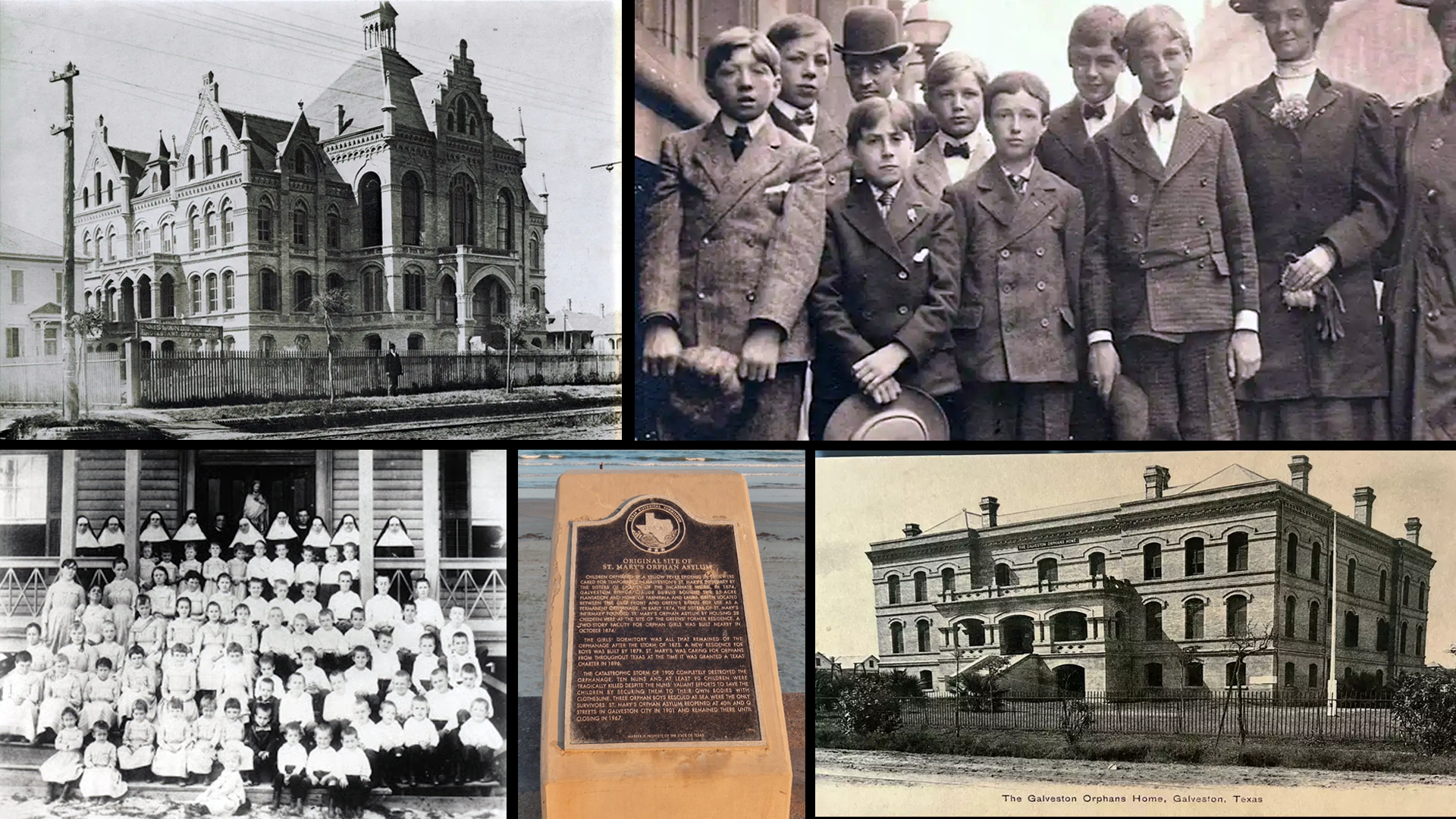
St. Mary’s Orphan Asylum housed 93 children aged 2-23, cared for by 10 sisters of the Charity of the Incarnate Word. As the storm began to rage, the nuns, in a desperate attempt to save their young charges, relocated them from the boys’ dormitory to the newer girls’ dorm. From there, they watched the boys’ section collapse under the wind and tide. They offered prayers and sang hymns to comfort the terrified group, but by nightfall, the winds raged at 150 mph. The nuns tied a piece of clothesline around each of their waists and then around the wrists of some of the children, binding their fates together. The mighty storm finally lifted the girls’ dorm off its foundations. The bottom fell out and the roof crashed down. Only three boys survived by clinging to a nearby tree. They were later rescued at sea by some fisherman in a small boat.

Galveston Orphans’ Home had only been in its new structure for five years when the storm hit. Though the central part of the building collapsed, the rest remained stable. Staff and children, as well other residents, took refuge in the stronger sections and all of them survived the cataclysm.

On the anniversary of the storm in 1994, Galveston dedicated a marker at 69th Street and Seawall Boulevard, honoring the former site of St. Mary’s. The hymn Queen of the Waves, which had been sung by the sisters to calm the children, was part of the ceremony.

The Galveston Orphan’s Home was rebuilt with help from generous donors. Today it houses the Bryan Museum, which I recently visited. In its basement are artifacts found at the home after the storm. Among them is a small slipper once worn by a young child.

Two orphanages, two vastly different outcomes. When this happens in life, what can we do?

We can remember.

Victor Benavides and the Power of Words

Welcome back to our series of interviews with authors in the Story Sanctum family. As I said in the first installment—a conversation with Soter Lucio—it’s a privilege to connect with these writers and learn the backstories to their artistry. This is especially true since they come from vastly different countries and experiences.

This time, meet Victor Benavides, a Texas-based author whose debut short story Carrier the Fisherman appeared on our site on July 1, 2025. It’s a piece dedicated to his grandfather that evokes vivid scenes of war, a brawl in New Orleans, and life along the southern coast of Texas. At the center of it all is Carrier, a larger-than-life presence with an unexpected fate. Take a few moments to read it!

KVT: First, Victor, thank you for taking the time to share with us. I see that you grew up in the Lower Rio Grande Valley (RGV). As a fellow Texan, I’ve spent a lot of time on both sides of the American/Mexican border. Does your family have historic roots in that area?

VB: My father moved here in 1943 when he was fourteen years old. I remember him sharing a story about his first day here—how his brother gave him a pair of canvas shoes that he cherished. He began his career as a radio personality and DJ in the Valley, and later became a writer, producer, director, and actor in several hit films shot locally, such as Treinta Segundos Para Morir and La Banda del Carro Rojo. My mother was born at Mercy Hospital in Brownsville, Texas, and grew up in Port Isabel. She met my father in 1979.

KVT: Your father sounds like a creative character. Do you remember any specific advice he gave you?

VB (chuckling): My dad gave me advice about everything and anything. When it came to writing, he said to write about something that I find truly inspiring. If I get excited with my own words and feel a sense of wonderment and connection, then I have something worthwhile to share with the world. He also told me that whenever I write fiction, add a bit of truth because it will then become greater. Lastly, he told me to write while in the moment. If I feel inspired in the moment and write something down, even if it’s incomplete, I know that one day I will revisit that piece of writing and finish it when inspiration strikes again. 

KVT: Your bio also says that after earning a master’s degree in business administration from the University of Texas Rio Grande Valley, you are now working on a master’s in English. What prompted this shift?

VB: I’m an English teacher here in the RGV, and I decided to pursue a master’s in English Studies to strengthen my skills and broaden my knowledge of the field. I felt that deepening my understanding of rhetoric, literacy, and composition would make me a more effective and impactful teacher for my students.

KVT: I love this quote from you: “I have always been fascinated with the power of words and how they can stir emotions and help a reader transcend into different literary worlds.” Do you have some favorite authors who influenced you?

VB: Authors who have influenced me deeply include Américo Paredes, María Amparo Ruiz de Burton, John Berger, Rudolfo Anaya, Margarita Longoria, Sandra Cisneros, and many others. I’m also drawn to science fiction and admire writers like George Orwell, Ray Bradbury, and others for their ability to expand the imagination and reflect on society.

KVT: Can you share any anecdotes from your teaching when you saw students whose emotions were stirred by the power of words?

VB: There’s a famous story I read to my students called The Appointment in Samarra. It’s about a wealthy merchant who sends his servant to get provisions in the bustling marketplace of Baghdad. The servant returns full of fear. When the merchant asks him why, he says that he saw Death in the image of a cloaked woman and she seemed to make a threatening gesture. The servant asks to borrow the merchant’s horse, then gallops to the faraway city of Samarra to hide and escape from her. Later, the merchant goes down to the marketplace and sees the same cloaked figure “Why did you make a threatening gesture towards my servant?” he asks her. “That was not a threatening gesture,” she says. “I was simply startled to see him in Baghdad, because I have an appointment with him tonight in Samarra.” After reading this, I get a lot of wide-eyed epiphany-induced looks from my students. They realize that the story elicits an emotional response from them because they can identify with the servant’s feelings. No young student really takes into account their own mortality. At that age, they feel invincible. However, the story helps them realize that death is inevitable and that time is a precious resource. Although it’s a bleak story, it helps students appreciate the power of words.

KVT: What are some of your plans for using your writing and your new degree?

VB: I’ve always seen education as a lifelong journey; we’re constantly learning and growing. With my writing, I hope to create literary works that forge emotional connections with readers. I also want to offer more diverse “mirrors” in my work—stories and characters that allow readers from all backgrounds to see themselves reflected and to connect personally with what they read.

KVT: Well, I look forward to reading your work in the future, and I thank you for taking the time to speak with us.

VB: You’re very welcome!

You can find Victor Benavides on Facebook here.

Meet Soter Lucio: Grandmother, Ironer, Horror Fiction Writer

Stories are a communal currency of humanity.Tahir Shah

As Fiction Editor at Story Sanctum Publishing, I have the privilege of reading submissions from around the world. We have featured stories by writers from India, Indonesia, Scotland, Taiwan, and England among others. Through my email correspondence with them, as well as deep dives into their work online, I have broadened my appreciation for Story Sanctum’s diverse family of authors.

Recently, I interviewed Soter Lucio from the Island nation of Trinidad and Tobago. We published her short story The Contract on June 1 of this year. Soter’s background, her chosen genre, and her path to discovering her gift fascinate me.

KVT: Soter, tell me something about your family, past and present.

SL: I have always lived in Trinidad, and my family and ancestors have aways been gardeners. We plant and sell in the market on Fridays and Saturdays. We plant chive, thyme, parsley, and short crops like sweet peppers, tomatoes, cabbage, and ochres. I have four children and six grandchildren, all of whom live on Trinidad.

KVT: The main character of The Contract is a woman who washes clothes along the river. I understand that laundering is a part of your past as well.

SL: I worked as a maid until my girls completed Form 5 so that I could be home in the morning before they left for school and home in the afternoons when they returned. Then I started ironing because we needed more money for university and ironing paid better. That was in 1997. I put advertisements in the newspapers and got enough clients to fill my days. So I ironed from 6.30 am to 8.30 pm, Monday through Saturday, and Sunday between 7 am and 1 pm. I did this from 1997 to 2023. I still iron, but not as much anymore.

KVT: How did you first get interested in writing?

SL: Someone read an essay I’d written in primary school and said, “You know, you could be a writer.” I didn’t say anything because I didn’t know one could even be a writer. Then I read an advertisement in our newspaper about an aptitude test from The Writing School of London. It was a challenge to compose a story based on a photo they supplied. I did. I sent it, passed it, and took their correspondence course. I followed that up with their diploma in writing in 1983. By then I had four children, so writing had to take a backseat until my youngest got her degree in Pharmacy. Then she bought me a laptop and said “Mother go write!”

KVT: Why have you chosen the horror genre?

SL: I think horror chose me. We are from a superstitious community, immersed in a way of life that I now understand to be horror. I grew up with no electricity or indoor plumbing.  I washed and bathed by the river, and I toted water from a spring for all our household duties. Stories about soucouyant, lougaroo, La Diablesse, Papa Bois, and douen were part of our daily fare. Soucouyant are females who suck the blood of women and roll on men in their sleep. Lougaroo shape shift into animals, carrying chains and running about the country scaring people. La Diablesse is a woman who made a deal with the Devil in exchange for eternal beauty. She lures young boys to follow her until they are lost, then she beats them with her razor-sharp hair until they die. Papa Bois protects the animals in the forest. Douen are the babies who die before getting baptized. Stories and characters like these are the root of my horror orientation.

KVT: Wow, those are some scary images to introduce to children. Do you remember an incident from your youth where one of the superstitions seemed to take on a life of its own?

SL: As a child I was told that only devils are in the city. Then, at eleven years old, I passed the Common Entrance Exam for an Intermediate Girl school in Port-of-Spain. I moved there and was scared every day. I was sure my parents hated me because they sent me among the “devils.” I spent my days looking for horns and tails. Where were they hiding them? I never found the answer. I was also told that only devils go to the cinema. When I was about 21 years old, some friends invited me to see a movie. When I got home that night, I actually tried washing away the sin. That shows you how long those superstitions lasted.

KVT: When did you publish your first story? What are some of your writing credits since then?

SL: My first story was published in 2015 by Dark Chapter Press. Then I had others that appeared in Sirens Call Publications, Weird Mask, Wicked Shadow Press, Story Sanctum, and Migla Press.

KVT: If you look back on your work, what is your favorite piece you’ve written?

SL: My favorite is The Last Request of Gladimus McCarran for the simple reason that it was imagined, written, and submitted within a few hours after a long day of ironing.  For me that was quite an accomplishment.  It was published by the now defunct Sirens Call.  A reprint of that story along with others can be found at Metastellar.

KVT: What upcoming projects do you have in the works?

SL: At present, I’m writing a 30,000-word horror novella for Dark Holme Publishing and a short story for Wicked Shadow Press. I’m also attempting a full-length novel that will be based on my life but is not autobiographical.

KVT: Well, I certainly think your fascinating life is worthy of a book. Thanks so much for taking the time to spend with us.

SL: You’re very welcome!

In addition to the links above, you can find Soter on Facebook here.

Heaven is Now: Adjust Your Vision, Find Balance – Conclusion

If you missed the first parts of this series, you can find them there: Part One, Part Two, Part Three, Part Four.

Conclusion

It should be clear now that this series is about experimenting with our sense of time to find more balance. Many of us, me included, can too easily live our days out of whack. Worry, regret, judgments of ourselves or others, and the unwillingness to surrender our illusion of control can get us off track.

Whatever the origin, we can do something about this suffering. We can develop mental tools and disciplines that lead us to more harmony. 

There are stories, especially in Eastern traditions, which feature spiritual masters who attained a final form of nirvana. Think of the myth of Buddha sitting beneath the Bo Tree. Weary of his endless experiments to achieve enlightenment, he sat down and reportedly said, “Let my skin and sinews and bones dry up, together with all the flesh and blood of my body! I welcome it! But I will not move from this spot until I have attained the supreme and final wisdom.” Throughout that night, enshrined in legend, he battled the final illusions that kept him ensnared.

I’m sure such transcendent victories exist. Their ripple effects are undeniable in history. However, in most of our lives the desire (and struggle) to awaken happens in the fray of daily living—while we’re working, caring for our family, or carving out leisure time from our schedules. This is why I resonate with a quote from the Alcoholics Anonymous Big Book: What we have is a daily reprieve contingent on the maintenance of our spiritual condition.

Reprieve may sound like a harsh word, meaning the postponement of punishment. But think about it. When our lives are out of balance, it punishes us physically, mentally, and emotionally. A liberating three-dimensional vision of time helps restore balance and release our self-punishment.

Also, the words “our spiritual condition” won’t resonate for some of you. Substitute a word or phrase of your choice. I’ve heard others use “a balanced state of mind,” “emotional equilibrium,” or “my connection to higher self.” Whatever works to bring more balance into your life!

I’m on the email list for Hay House publications, and I receive regular ads about their eBooks for sale. I mean no disrespect to the many authors, but it reminds me of a booklet I cowrote with my friend, Heiwa no Bushi, The Six Medicines of BodhiChristo. The introduction begins with these words.

     A friend and I were recently discussing our favorite inspirational books. He and I are co-explorers, coloring outside the lines of conventional spirituality, testing every truth in the laboratories of our own lives. We had a good belly laugh as we recited the steps, secrets, and keys touted by various writers. So many of these maxims are similar, recycled and refreshed to make them seem trendy.

     In reality, this is age-old wisdom transmitted to us by a myriad of cultures and teachers. The ancient Hebrews called it derek olam, the everlasting way inscribed in our genes since the beginning of time. It is dharma, Tao, the cosmic order, a river wending its way to the ocean and inviting us for a swim.

I hope you know that right now I’m laughing at myself for contributing yet another title to this endless stream of literature. Why do it? Because if there’s a chance that even one person receives some assistance in liberating his/her mind from these posts, it will have been eternally worthwhile.

Please know that I, like you, am a human being in progress. I work every day to get my reprieve, and I assure you, it does get easier!

I close with a string of greetings gleaned from various spiritual traditions around the world. I have used them in many of my books.

Namaste! God bless you! As-salamu alaykum!Mitákuye Oyás’iŋ! May the Force be with you! Keep on truckin’!

Heaven is Now: Adjust Your Vision, Find Balance – Part Four

If you missed the previous parts of this series, find them here: Part One, Part Two, Part Three.

The Harmony of Action and Surrender

Here are some adages that summarize this chapter.

Know what to pick up and what to put down.
Do your best, release the rest.
Let go and let God.

Sure, you might think, but no matter how true a saying may be, putting it into practice is the challenge! Balancing action and surrender is an artform that is difficult to master. This is especially true in our world that idolizes willful accomplishments. We consider it a high compliment when someone calls us a “person of action.” Our achievements can take many forms. We may know how to see a problem, analyze its component parts, then choose an effective strategy to solve it. We may write to-do lists on a daily basis and summon the energy to accomplish most of them. We may set goals for our fitness, our business, or our relationships, then work tirelessly to achieve them.

All of this is admirable. Most of us have little patience for people who complain about their lot in life but don’t get off the couch to make a change. Hard work isn’t only effective; it’s also its own reward, shaping our characters and providing an example to others.

But inevitably there’s that still point, that boundary that all of us eventually encounter. We come to the end of what we can control through our willfulness, and our continued efforts only create stress and anxiety. At this critical juncture, if we choose to spin our wheels, we squander a precious opportunity for personal growth.

As one who has benefited over time from a Twelve Step perspective, I hear repeated admonitions to practice acceptance. There’s a seminal passage in the Big Book of Alcoholics Anonymous that circulates endlessly through the rooms of recovery.

Acceptance is the answer to all my problems today. When I am disturbed, it is because I find some person, place, thing or situation—some fact of my life—unacceptable to me, and I can find no serenity until I accept that person, place, thing or situation as being exactly the way it is supposed to be at this moment. Nothing, absolutely nothing, happens in God’s world by mistake… Unless I accept life completely on life’s terms, I cannot be happy. I need to concentrate not so much on what needs to be changed in the world as on what needs to be changed in me and my attitudes.

It’s easy to see the appeal here. So many of us wrap our lives around the axle by trying to control things outside our purview. It’s another form of addiction, and it undermines our physical and mental health. Instead, when we turn to transforming ourselves, not the world around us, serenity rises like water from an inner aquifer.

Certainly, there are obvious exclusions to this truth.

  • Times when we witness injustice. To accept those moments as “exactly the way they are supposed to be” means to acquiesce, to allow the oppression to proceed unchecked. Choosing to join the struggle for liberation is a heartfelt expression of our compassion and love. In my book, The Smile on a Dog: Retrieving a Faith that Matters, I examine how to do this without perpetuating the vicious cycle of action/reaction. I suggest going to Chapter Five if you’re interested.
  • Times when we mustered the energy to try one more solution to a problem and by going that extra mile, we were successful. Looking back, we know that exercising a final bit of “control” made all the difference.

Despite these exceptions, there’s eternal wisdom in knowing when to surrender. Here is how writer Nancy Collier puts it.     

Surrender happens when…we know that we cannot think or see our way through where we are…All we know is that we can’t do it this way, the way we’ve been doing it, a moment longer. The moment of surrender itself is easy; it happens when it’s ready. Control falls away and takes us with it. It’s the path to surrender that’s excruciating. But what’s amazing is that when surrender does arrive, it’s accompanied by a great sense of ease, relief, and peace. It’s not like the situation remarkably gets better or easier, but we feel better and more easeful when we know in our bones that we cannot fix or figure it out, when we know that it’s truly not up to us, and we simply can’t. In this moment of surrender or grateful defeat, there’s clarity. And oddly, something deep within us relaxes when we acknowledge that we don’t know how to do it, don’t know the way. More effort, more doing, more thinking, more plans won’t work. We feel an inner softening when we agree to turn it over to anything else, whatever is not us, the unknowable, or perhaps to just the truth of not knowing. From our knees, paradoxically, we feel a remission from the suffering.

Sometimes the courage to let go seems almost superhuman. I have seen this (and experienced it!) when we must allow a self-destructive person in our orbit to make their own decisions without intervening on their behalf. Letting go is a nod to the sovereignty of their choices, and it’s essential for our own mental health.

I vividly remember counseling a woman whose young adult daughter was addicted to drugs. The mother had done everything in her power for her child—arranging counseling and multiple stints in rehab, repeatedly showing her love and support on every level possible. Yet, gripped by the disease of addiction, her daughter continued her descent into self-destruction.

The woman tried attending Nar-Anon meetings, which helped somewhat, but she was still struggling when she came to my office. Here’s a version of the conversation we had that day. For the sake of anonymity, I will call the woman Jan and her daughter, Carrie.

“Krin,” said Jan, “I went to a therapist about this, and she diagnosed me as codependent. She claimed that I’m addicted to someone who is also addicted. She says that the root of my suffering is my need to be needed, my own form of obsession.”

“And you don’t buy that?” I asked.

“Not really,” she said with a tinge of anger. “What parent wouldn’t do anything possible to save their child? Even give their own life! This isn’t an addiction. It’s the natural reaction towards my own flesh and blood. I don’t want to look back someday and feel that I didn’t go the extra mile.”

I knew Jan was speaking her truth. I had observed her in other situations, and I always considered her a balanced person. I also knew that now she was killing herself with worry and that she needed to come to the end of what she could control. I empathized deeply with her, drawing upon a similar experience in my own family.

“I hear you,” I said. “Theories are theories. Even with the best counselors, we have to choose what applies to our own lives. Ultimately, we have to face these challenges in ways that make sense to us. And I agree with you. Sometimes comments from people who have no authentic point of reference can seem glib, even dismissive.”

“Exactly,” she said. “I know they all mean well, especially the folks in Nar-Anon, but they still have this disease model about codependency. I’ve never been obsessed with caregiving or trying to control other people in the past. Not in my extended family, not in my marriage, not with my coworkers. It’s just this situation with Carrie.”

I let some silence permeate our session.

“You know some of my story,” I said. “I confronted the same issue. I can only share what I learned in my own life if you want to hear it.”

“Please,” she said. “It’s why I came to see you.”

I took a moment to find the right words and voice tone. “The hardest thing with surrendering in this situation is accepting that the other person might indeed choose death rather than life. The disease of addiction is powerful. Carrie knows you love her. She’s been in rehab. She knows there are tools she can use to stay clean.”

“True,” said Jan, looking down into her lap.

“So, the stark and difficult truth I had to face—which I believe is the same for you—is that we must be willing to surrender to the knowledge that we ultimately have no power to prevent our loved ones from killing themselves. This is not giving into cold defeat. It’s not a dereliction of our duty. It’s a sober realization of reality, and as much as it stings, it’s truth is unavoidable.”

She looked up at me, then down at her lap again, wringing her hands. I’m sure she had heard similar versions of this from others, but as the saying goes, “we get there when we get there.”

Softly, she began to release a torrent of tears. When her eyes met mine again, she nodded, and in that gesture I heard the full force of the well-known Serenity Prayer: “God, grant me the serenity to accept the things I cannot change; courage to change the things I can; and wisdom to know the difference.”

We don’t have to be in a dire situation to see how we need a balance of both certainty and surrender in our daily lives. Here are some examples.

  • We’re certain of our love for our family, and we also see our need to accept their longstanding character traits without criticism. After all, they put up with us!
  • We vote, even protest, to make our point in the political arena, but we also learn to let go so that we can sleep in peace at night.
  • We do everything we can for our health, and we also realize that the rest is in the hands of our Creator.
  • We plan for our financial future, and we also realize that our world and its finances are unpredictable.

In one of my short stories entitled Path of the Monarch, a man has a reverie in which a butterfly leads him through fantastical landscapes—a meadow, a desert, and finally up a mountain. There, he encounters his doppelganger whom he calls D. Let’s pick up the story at that point.

     I stared at him sitting in the sunlight. I saw the wrinkles that had formed on his forehead. In his eyes—my eyes—I saw a mix of sadness and resignation, and it pierced my heart.

     “You see it, don’t you?”

     I nodded.

     “Will you do something for me?”

     I nodded again.

     “Tell me—tell yourself—those lessons you know are true but seem unwilling to actualize.”

     The words came faster than I expected, as if an inner treasure chest burst open, every phrase springing into the light.

     “Live in the present,” I said. “Focus on the gifts of each day, rather than regrets or fears. Hold my loved ones close. Practice kindness towards everyone. Do the things that bring me joy. Remember that I will die and seize each day with gratitude.”

     D slid down from the rock and started towards me, stopping a few feet away. He started to clap. “Bravo! No more self-help books! No more gurus! But there’s one more thing, grasshopper, one more piece of advice from yourself to you.”

     I felt stumped. No words came to mind.

     “Let go,” he said. “Let go, let go, let go, until it’s as natural as breathing.”

     He placed his hands on my shoulders and moved so close that our noses were nearly touching.

     “Practice with me,” he said. “Each time we breathe out, whisper let go.”

     We tried it, over and over, the two us inhaling, exhaling, and whispering together.

Practice

Take time today to embody the Serenity Prayer in your life. Bring to mind any current challenges that might be causing stress in your life because you can’t predict the outcomes. Then use the prayer’s suggestions by speaking words like this out loud.

1. I affirm that I have done my best today to change these things that are within my power (name them).
2. I see that the following people, events, and circumstances (name them) are beyond my control.
3. I will rest in the wisdom of knowing what I should pick and what I should put down. I will let go of the rest and let the universe have my back.

As you fuse these aspects of action and surrender into this present moment, remember this:

Heaven is here. There is nowhere else.
Heaven is now. There is no other time.

The conclusion of this series will post on June 19.