Krin Van Tatenhove is a writer, visual artist, and spiritual adventurer. His 40 years of professional writing experience have led to countless articles and 17 books. You can freely download most of his work—including art collaborations—by visiting krinvan.com. Currently, he is the fiction editor at Story Sanctum publishing. He is married, has four children, and lives with his wife and disabled adult son in San Antonio, Texas.
Every day the bucket a-go-a well. One day the bottom a-go drop out. – Bob Marley
It was a misty morning on the family farm, cardinals and wrens calling from the junipers, my father in his bib overalls, performing his morning chores while I milked the goats, their moist muzzles pressing against my forearms.
“Son, come over here,” Dad called. He was near the weathered barn, a tall Dutchman, his hands the size of catcher’s 0mitts. When I got to his side he was standing over a wooden bucket filled with water, its surface as placid as a cavern pool.
He plunged one arm into the liquid, then removed it. The water rippled, quickly regaining its stasis. “If you ever think you’re indispensable,” said Dad, stick your hand in a bucket of water, then pull it out. Go ahead, son. Try it.”
I followed his example, in and out, the brief interlude returning to stillness. Dad laughed and ruffled my hair, his palm nearly engulfing my head.
The other day, I looked at his picture on the mantle, the one we displayed at his funeral. He was dressed in his Army uniform, his eyes already fixed on a distant battlefield.
And for an instant, the water stirred before settling again, as if a pebble had been dropped in a midnight lake, no witnesses but darkness and time.
Every day the headlines scream. Tariffs, deportations, inflation, layoffs, violence in Europe and the Middle East, political infighting! It’s a litany of doom and conflict, and it’s no wonder that for many people, these are fearful times.
Or maybe your unease is closer to home. A pending medical test. A legal entanglement. A relationship falling apart. Insecurity over your employment and financial status.
Here’s a question that should be central to each of our lives. As challenges arise, both near and far, how do we stay sane?
There’s a profound truth grasped by people from many walks of life, forged in their own crucibles. If their words seem repetitious, let them offset the repeated negativity that barrages us daily.
You hold the key to love and fear All in your trembling hand Just one key unlocks them both It’s there at your command – Chester Powers (from lyrics of the Youngbloods song, Get Together
May your choices reflect your hopes, not your fears. — Nelson Mandela
If you want to tap into what life has to offer, let love be your primary mode of being, not fear. Fear closes us down and makes us retreat. It locks doors and limits opportunities. Love is about opening to possibilities. Seeing the world with new eyes. It widens our heart and mind. Fear incarcerates, but love liberates. — John Mark Green
There are two basic motivating forces: fear and love. When we are afraid, we pull back from life. When we are in love, we open to all that life has to offer with passion, excitement, and acceptance. – John Lennon
Fear is the darkroom where negatives are developed. – Zig Ziglar
There is no fear in love; but perfect love casts out fear, because fear involves torment. – I John 4:18b
I’m sure you’ll agree. Fear is toxic to our souls, an acid wash on our brains, a slayer of peace and relationships. So how do we learn to gradually banish it from our lives?
Start like this. Look back over the past century and see how many times we have faced uncertainty as a nation. Similarly, in the arc of your personal life, think of the trials you’ve survived, all the turbulent rivers you crossed to stand where you are today.
Does the universe have your back? Is there a force looking out for you? Is there a higher power, a god that is protecting you in ways you can only imagine? You will answer these questions for yourself, but for what it’s worth, let me share a glimpse into my recent struggles.
In the past year, our family has weathered three deaths, two cancer diagnoses, the failing mental capacity of parents, and legal challenges that are still pending. It’s hard for me. I’ve always found it difficult to let go. I’m energetic and I can efficiently tackle any problem, so when events are out of my control, I too often let stress—then fear—invade my spirit.
When this happens, there’s a coping mechanism I use. I recall the darkest hours of my life, those times when my alcoholism led me to contemplate suicide. I think of the path my wife and I have trodden with our intellectually disabled son—the grief at his original diagnosis, then all the effort to secure the services he needs. I remember all the financial rollercoasters we’ve survived.
Yet here I am at this moment. Alive. Housed, fed, supported by the love of my family and friends. Able to pursue my advocations of writing and visual art. In touch with that Force that lives and breathes through all of us—call it what you will—and recognizing that it wants only my wholeness and freedom. Thank you, Spirit, God, Higher Power, Tao. Thank you, Mystery!
As this gratitude infuses my life, I’m determined to decrease the lag time. I don’t want to look back weeks, months, or years from now and realize that I came through this season as a more mature human being. I want to claim RIGHT NOW the truth that this too shall pass. That I am OK and will be OK. That I will evolve and grasp more of the meaning for which I was created.
Whatever you’re going through, my friends, I truly empathize. My prayer is that you won’t deepen your malaise by choosing fear rather than love. So, I close with these words from Lisa Nichols.
“When you can’t control what’s happening, challenge yourself to control the way you respond to what’s happening. That’s where your power lies.”
Spittin’ in the wind, pissin’ in the wind, protestin’ in the wind. Call it what you want, but that’s what it felt like on a recent Sunday.
I was visiting the care facility where my parents live in Las Vegas, so I decided to join them at their church, hitching a ride in the medical transport van. I don’t adhere to a religion, so it’s hard to sit through any worship service. But this conservative Lutheran version was especially dissonant, like a cheese grater across my brain. Every element of the liturgy made me wince.
Hymns that spoke of Jesus coming again in clouds of glory to gather only “the faithful.”
Multiple promises of being in heaven rather than working to bring justice on earth.
A unison confession of sin that magnified our abject condition apart from Jesus’s saving grace.
The Apostle’s Creed, that patriarchal relic with its Trinitarian formula and insistence on superstitious miracles.
What tweaked me the most, however, was the sermon. I had foolishly hoped that the pastor might be hip, since I noticed the motorcycle boots he wore under his alb. It was clearly part of his drip. When I asked, “you ride?” he responded, “yep, it’s the only time I feel free.”
Then came his homily. Its central illustration came from a memorial service he’d attended for a teen who died of a drug overdose. There were two preachers that day. One railed about how the girl didn’t “know Jesus,” and that everyone in attendance should be forewarned about their own salvation. The other preacher was more magnanimous. He revealed a private conversation in which he discovered that the girl had indeed “accepted the Lord.”
That assurance rankled me even more!
I know I should have restrained myself. I chose to be there, live and let live, avoid the landmines of religion and politics. Yeah, yeah. But if there’s anything remaining from my former religious leanings, it’s that I’m a protestant, emphasis on protest.
I approached the pastor after the service.
“Do you mind if I share a reaction to your message?”
“Not at all,” he replied.
I calmed my voice. “Your own scripture says that God is love. God loved this girl before she was born, during every painful hour of her addiction, and even now in whatever awaits us after death. That’s true whether or not she followed your religious formula. Do you really believe that if she hadn’t accepted Jesus, she would be banished into darkness?”
His expression changed. His smile grew tighter. His eyes narrowed.
“Yes, God is love. And God gives us free will to either accept or reject the promises of Jesus.”
It was a standard feint, not a real answer, so I continued.
“On the cross, Jesus said ‘it is finished.’ That applies to all of humanity. It’s a love so inclusive that no human mind can fully understand it.”
His smile slipped further, frown lines forming on his brow.
“You must be a universalist,” he said.
And there it was. Spittin’ in the wind, pissin’ in the wind, protestin’ in the wind. Nothing I said would change his world view; nothing he said would alter mine. In this polarized world—with our moats of doctrine, politics, and privilege—hasn’t this become the norm?
When Bishop Mariann Edgar Budde recently exhorted Donald Trump to have mercy and understand the apprehension felt by many Americans, my friends and I applauded her bravery. Face to face, speaking truth to power. Social media blew up with her image, her words, and profile pics that proclaimed, “I’m with her.”
But Trump and his allies, encamped on el otro lado del rio, were unmoved. They demanded an apology, accusing Budde of being woke, radical left, and mannish.
Spittin’ in the wind, pissin’ in the wind, protestin’ in the wind. It’s the norm, and the fact that our online news streams are shaped by predatory AI only makes the problem worse. As Paul Simon said in The Boxer, “A man hears what he wants to hear and disregards the rest.”
(Flashback. On May 4, 1970, Allison Krause, a student at Kent State University, was one of four unarmed students shot and killed by soldiers of the Ohio Army National Guard. The shootings occurred as students protested against both the invasion of Cambodia and the National Guard presence on their campus. The day before her death, Krause observed a single lilac within the barrel of a guardsman’s gun. An officer ordered the soldier to remove it, and Krause caught the flower as it fell to the ground, stating, “Flowers are better than bullets.” This quote—inscribed on her gravestone—has become synonymous with her legacy of peace activism.)
Return to the present. The US continues to arm countries around the world, especially Israel as it carried out its genocide against the Palestinians. And Donald Trump threatens troop deployment to quell domestic demonstrations.
Every family has stories told so often that they’re part of our collective legacy. When older relatives do the retelling, we might roll our eyes. Not this one again…
In my family, there are many. The time my mother caught a 95-pound Nile perch at Lake Victoria. My father setting a senior track record for the mile in his early 40s. My brother catching trout in the Sierra Nevada on a scouting trip, using only a stick, some line, and a bare hook. The time I defied my parents’ warnings and snuck into a screening of Kubrick’s A Clockwork Orange while it still had an X rating.
But there’s no tale as powerful and poignant as the one told by my father about an incident in his childhood. Even now—at age 95—that moment can emerge from his dementia and stir the waters of his memory. In 2019, he preserved the episode as a letter to my brothers and me, claiming he recalled it on a daily basis throughout his life.
Here’s the outline.
It was the summer of 1935, midway through the Great Depression, and Dad was five years old. On a bucolic day in the countryside, he was with his mother at the Wisconsin farm of some relatives. While she attended a quilting party, Dad went to a swimming hole with his cousin, Sally. Not unlike Dad, he boasted to her that he had just learned to swim. To prove it, he would take a raft to the middle of the pond, which was about 11 feet deep. Then he would let go and paddle back to her, putting his cockiness to the test. I’ll let him tell you what happened next.
“When I reached a spot close to the bank, I gave the raft a shove. However, I was so tired getting it to this spot, and the raft was now moving away from me so that I could not swim to it. As I began to sink underwater, I said a prayer to God: ‘Please do not let my parents blame themselves for my drowning. It was all my fault!’ As I sank, I made one last attempt to breath, but all I got was a mouthful of water. As I passed out, I was floating with white light all around me. This went on for quite some time until I sensed that someone was placing their hands on my hips and lifting me up, setting me in shallower water. When I opened my mouth, water flowed out. I began to breathe but I was blind. Then I heard Sally shouting at me, ‘Why were you down so long? What happened?’”
I won’t idealize my father. Like all of us, he had his faults, especially his workaholism that kept him from spending more quality time with us. That addiction left a vortex at the center of our family.
But in this story—what Dad always called a miracle—I see some of the core beliefs that informed the arc of his life, truly a Horatio Alger story, rising from poverty to the upper echelons of corporate America. If you are agnostic or atheistic like some of my friends, suspend your judgment for a moment and just encounter this human being I call my father.
Notice that he didn’t ask God to save him for his own benefit. His petition was to spare his parents from blaming themselves that he had drowned. This sense of other-centeredness and duty was a hallmark of his character. One of six boys, he was the only one that cared for his parents in their final years, providing for them physically and financially. He showed that same kind of devotion to our nuclear family.
He saw his near-drowning as the proverbial second chance in life. God had rescued him for a purpose, and he wanted to honor God for that reprieve.
After that day, he says he sought God’s guidance at key junctures in life, especially before critical decisions. Though he and I have faith perspectives that are widely divergent, I resonate with the need to find direction from a power greater than myself.
Do you have a childhood memory that lays hold to your mind and heart? Does it still act as a lodestar for your life’s journey? If so, have you shared it with others?
Here are the final words of Dad’s recollection as he transcribed it in 2019.
“When my sight came back, I walked up to the house where mother was attending the quilting party. As she saw me coming in the door, she came to me and said, ‘What has happened to you?’ (There must have been something about my face that she would ask that question). I said, ‘Mom, I just want to take a nap.’
“I kept this miracle to myself for many decades because I didn’t want my parents to worry about me. I told my mother only after she was older.
Players’ salaries will total 10.5 billion in 2024.
Revenue will be 13 billion.
The top five stadiums cost 11.5 billion to construct.
The average cost for a family of four to attend a game is $800 but varies widely by team.
Why mention all this in the heat of the current season? Because I’m not the only one who wonders how we could use these enormous sums for other purposes. I’m not the only one who thinks that Dak Prescott’s $240 million contract is freaking obscene.
Yet, like a good little plebe at the Roman Colosseum in 80 A.D., I lustily enjoy these gladiatorial spectacles. Football flows deep in my blood; it’s timestamped throughout my history. I vividly remember Rams’ games at the L.A. Coliseum with my father, screaming with other rabid fans for our home team. I enjoyed my time as a wide receiver in high school before an injury sidelined me. And I admit that during my decades as a pastor, I often rushed home after services to worship at an altar of a different type.
Now I live in Texas, the land of Friday night lights, where football is truly an obsession—from high school to college to the pros. As the Houston Chronicle once said, for many Texans, football is as much as part of them as their heartbeat.
Any fan will tell you: we LOVE a goal stand, those moments when our team sets up a wall of determined human flesh, denying entrance to the end zone.
It reminds me of a goal line stand I made for our family. Let me explain.
Kristoffer, my intellectually disabled son, is now 27 years old. All his life, my wife and I have been his caretakers, caseworkers, and primary advocates. We appreciate professionals along the way who lightened our load, but there’s an unavoidable truth for parents of disabled children. Unless we stand up for them, the system can easily cast them aside.
Case in point. Kristoffer once attended a small (unnamed) high school in Texas. The teacher of his special education class was good-hearted. We were grateful for her care, which included her advocacy for the kids to get involved in Special Olympics. Each year, the school provided transportation to the state finals held at the University of Texas, Arlington, covering hotel accommodations and a stipend for food. This was the district’s sole annual support.
Then, in our third year at that school, we heard they had canceled their funding for this event. Simultaneously, they announced they would spend an enormous sum retrofitting their football team with new uniforms, equipment, and upgrades to the playing field.
Hell no! Not in my lifetime!
I quickly huddled with my family and a lawyer friend who agreed to provide pro bono help. We got a copy of the district’s proposed budget for the next year, verifying the facts. Then we called the school board and demanded a place on their docket for the next meeting. I had a reputation in town, not only as a pastor, but as a regular columnist for the local newspaper. We were given a spot on the agenda.
The night of the meeting, sitting in a spectator seat along the wall, I kept my game face. Just another concerned parent. But when I got my chance to speak, I hit them like a player on steroids slamming the practice sled. I have no recording of those moments, but here’s the gist.
“Thanks for allowing me to speak,” I said, “Before I begin, please know that I have retained legal counsel who is here with me this evening.”
I nodded to my friend who, as planned, glared at them like a barely restrained pit bull.
“Let me cut to the chase. My son, Kristoffer, attends your high school. He’s intellectually disabled, and the only outlet he has for organized sports is Special Olympics. My wife and I drive him many miles around South Texas to give him these opportunities.
“Now listen. The ONLY support your school provides is annual transportation, food, and lodging so that he and a few of others can attend the state finals in Arlington. We just found out that you cut this funding.”
At that point, a couple of the board members looked away, unable to meet my gaze.
“At the same time, you allocated a huge amount to revamp your football program, a sum that makes the money for my son and his classmates seem like a tip or an afterthought.”
I raised my voice a few decibels.
“Make no mistake. If you don’t reinstate your support for Special Olympics, I will not only take legal action. I will use my journalistic connections to make sure that this travesty gets highlighted in every newspaper from here to Corpus Christi to San Antonio to Dallas.”
There was dead silence. The chairperson of the board cleared his throat and tried to act nonplussed.
“Thank you, Mr. Van Tatenhove. We will take this under advisement.”
I grinned satirically. “Don’t think for too long.”
Then my friend and I left without a backward glance.
Months later, our family joined a few others in an air-conditioned bus on our way to Arlington. I looked around at Kristoffer’s classmates and their parents who, like us, would forever be the most important advocates for their children.
I put my arm around Kristoffer’s shoulders. “Hey buddy, I hope you get a gold medal. But no matter how you do, I want you to know that I love you and support you.”
Kristoffer did something he rarely does. He leaned over and kissed me on the cheek.
The following is one of the stories contained in Street Saints: Voices of Hope from the Hopeless, a book I wrote in 2010 and just recently revised. As a veteran, I offer it to you on Veteran’s Day, 2024.
It was my first day on the job in Alice, Texas—August 2010. A short Black man with a warm smile and very few teeth came through the front door. “Are you the new pastor here?” he asked. I nodded. “What can I do for you?” “I’m wondering if you could help me get a room for the night. I’m a bit down on my luck. Lost my job, been sleeping in my car. I’m looking for work, but nothing yet.” I sighed inside but kept my poker face. Do you know how many times I’ve heard that line? The need to reconnect with grace as the foundation of our world view is essential on a daily basis. Without it, we are sorely diminished. “What’s your name?” I asked. “William.” “Well, William. First of all, I rarely give out cash. Second, I haven’t been around here long enough to check out your story with other folks. You know what I mean? To see if you are conning me about looking for work. I’m always willing to help, but I hate being lied to. How long have you been on the street?” To William’s credit, he didn’t get defensive. His warm smile remained, natural, not ingratiating. “About a month.” I stared at him; he held my gaze without flinching. My defensiveness wilted. “OK. I’ll write a check for you from my discretionary fund for one night’s lodging. And I’m going to try an experiment. I’ll give you some cash. When you get your job, I expect you to pay me back.” “Yes, sir,” he said, his posture straightening. It was then that I saw it – the instinctive military bearing in his shoulders. I heard it in the respect of his voice tone. “Are you a veteran?” I asked. “Yes, sir. I served in Desert Storm with the first mechanized infantry unit that entered Iraq for mop-up operations.” “I was an Army chaplain during that time,” I said, “supporting you guys stateside from Fort Jackson, South Carolina. Thank you for serving, William.” “You, too, sir.” We had an instant bond, but first impressions are often deceiving. I wrote him a check for a local flophouse hotel, handed him some cash, and we said goodbye. I doubted I would ever see him again, but I knew that if I did, I was going to ask him for his story. I don’t much believe in coincidences anymore. God’s timing is perfect, with more divine appointments for us than we usually recognize through the veil of daily life. A month later, William returned. He’d found work at a local nursing home and had my cash for me. I arranged the following interview. I include it in this book because in so many ways it defies the stereotypes we have of those who end up homeless. William is not shiftless, nor lazy, nor deceitful, and his homelessness lasted a very short time. Further, as you will see in the following paragraphs, he is a living piece of American history—one that just happened to walk through my front door at the very moment I was writing this book. William Howard Milburn, III, was born in Salem, New Jersey, where he grew up in a family that he claims was constant and supportive. “I was always proud,” he said, “that I had both a mother and father who stuck together. Most of my friends grew up in single-parent families.” From the time he was a child he wanted to enter the military, inspired by one of his cousins who flew fighter jets in Vietnam. “As kids we always looked up to him. He had his uniform and his medals. He had been around the world and served his country. That meant something to me and my family. Besides (he grins), I watched all those John Wayne movies! I knew I wanted to be a tank driver.” As part of the Army National Guard, William finished basic training between his junior and senior year of high school, then after graduation in 1984, went on to advanced training at Fort Knox for the summer. On the civilian side of his life, William moved to Cleveland, where he worked first as a diesel mechanic, then as a laborer in a glass factory. But when he got laid off, he decided to check with a recruiter about transferring to active duty in the Army. They gladly processed the paperwork and sent him to his first duty station in Germany. “I loved Germany,” he says. “The countryside was beautiful and the people I met were really nice. I got to see where the Berlin Wall had come down and I suddenly got this idea. I was always fond of my history teacher, a bright guy who cared about his students. So, I thought, I’ll bring him a piece of the Berlin Wall. I thought that would be cool. I bought a piece as a souvenir, and when I went home to New Jersey on 30 days leave I went back to my old high school. I had my uniform on. He loved it. He stopped class and had me talk to the kids. Then I handed him the piece of the wall and told him what it was. I said Germany is going to be one country again. He loved it!” I could see it clearly; William found pleasure in serving the needs of others. It was part of his make-up. I imagined the warmth that probably filled that teacher’s heart every time he laid his eyes on that unique curio of the Cold War. After his leave, William was transferred to Fort Bliss outside San Antonio, Texas, part of the 3rd Armored Calvary Regiment. Now a buck sergeant, he had a chance to go to the NCO academy and continue his training. He was at Bliss when Allied Forces amassed for the repulsion of Saddam Hussein from Kuwait, the world conflict we would come to know as the Gulf War. William didn’t blink. He felt it was his duty to be there. He volunteered to go to Saudi Arabia as part of an advance wave unloading tanks off C-130s and preparing them for combat. “We would drive them off, park them, check the radios, load them with live ammunition, do the necessary maintenance. These were brand new M1A1 heavies with the solid, silent tracks. These vehicles were awesome. Flat out, they could catch you on the highway for sure. When you started them up, the gas turbines sounded like jet engines. They had 11,000 rounds for the tank itself, and of course many more for the 50-caliber machine gun on top. “By now we could hear the cluster bombs exploding across the border in Iraq, a constant background in the distance. You have to imagine this—explosions coming at the speed of a machine gun, but each one as loud as a crack of thunder. It made you tremble, especially because we knew they were miles and miles away. We would look up and see our fighter jets soaring overhead. It boosted our morale. Sometimes we’d be out getting chow and a pilot would come down low, then hit his afterburners, fire coming out the rear as the jet headed straight up. We would cheer, thinking, Man, that’s some awesome stuff. Them boys are bad!” Anticipation grew among the ranks and in William’s heart. Like countless veterans before him, they knew that this was what they had trained for, but the reality was stark, almost surreal. As the bombing campaign continued, they trained and trained, the alert level rising, waiting, waiting, adrenaline and tension palpable. Suddenly, the orders came to move out from Saudi Arabia into Iraq. “We drove through the desert all night, 300 miles until we came early in the morning to our position points. We gassed up, checked our ammo. And still the B-52s and F-16s passed overhead. As a last-minute preparation for our final march, they brought in some MLRS rocket launchers and pounded the distance ahead of us.” Then they got word: make the final push. Apache helicopters screamed overhead. At first, nothing much happened, a strange anticlimax, but then they began to see Iraqis in their jeeps with AK-47s. When they were within range, William’s tank commander told him to man the 50-caliber machine gun and fire. These were his first killings, and as they advanced, these little skirmishes continued until they encountered the first tanks of the Republican Guard. William could see them on scopes from far away. He would lock them in his crosshairs as the computer in the tank loaded the round. When the order to fire came, he’d pull the trigger and see the explosion in the distance, knowing he’d accomplished his deadly task. “With one explosion I saw the entire turret come of the enemy tank before it went up in a ball of fire. At this point, I was proud of the tools we had. I was proud of being a soldier carrying out my orders, doing what both the president and my officers told me to do. It was exciting, but I was anxious. Firing from a tank on some jeeps is one thing, but now we were within range of artillery that could do us real damage.” He pauses. His easy smile becomes more circumspect. “Pastor I’m not going to lie about it. I wasn’t just anxious. I was scared. Really scared. And that’s when I called upon the Lord. I went to Sunday School, and I believe. I asked God to forgive me for my sins in case I died, so that I could sleep in Jesus and wait on him. It’s funny how your early home training in the faith remains with you. I said, Lord please give me the strength that you gave David when he slew Goliath. Just a little bit of courage to see me through. I would really appreciate it.” That prayer, like a calming breastplate, centered him and helped him focus. From then on, his training came naturally and carried him through the ensuing battle with all his comrades at his side. They devastated the Republican Guard in their path. Then, only 30 miles from Baghdad, they got the orders to halt. “Remember,” he says, “this was Desert Storm. If they would have let us complete what we were doing then, we wouldn’t have had to go back. I knew it! Most of us did. We just knew we would have to go back. And now we’ve lost another 4,000 brothers.” The fighting stopped with an eerie calm. They turned and drove back through the battlefield, collecting data on the content and numbers of what they’d destroyed. “We saw trucks and tanks, of course, but then the mangled bodies, blackened, petrified on the ground, in their trucks, in their jeeps. The smell of death is terrible, pastor. It’s like burnt BBQ. That’s the best way I can describe it. I tried to distance myself, but these were human figures. I know I’m a soldier, but as a Christian, any loss of life is a terrible thing. I remember looking at one blackened body draped from a jeep and thinking man, that guy had a family. It was war. I did my duty. But it was still sad.” “William,” I said. “I’m glad you felt that sadness. As a chaplain, I had a message that sometimes was not real popular with my commanders. I told them that in the middle of the hell that is war, I was a non-combatant. Sure, I was there to comfort and support our troops, but also to remind them that God loves the enemy as much as God loves us. These are not gooks or rag heads; these are human beings. And until that day that we stop believing in the myth of redemptive violence, until that day we realize that war never ultimately solves anything, I will boldly proclaim this message.” “Amen, pastor.” William received two bronze stars for his valor and calmness under fire during the battle. When he returned stateside to Fort Bliss, he received an offer to go to the NCO academy. Simultaneously things were heating up in Bosnia, America wading into a civil war marked by horrendous genocide and ethnic cleansing. “I talked to my Mom,” says William. “I said, Mom, I’ve fought in one war. I’ve done my duty and served my country. I really don’t want to be sent to another.” William left the Army in April ’92, moved to Waco, Texas and got trained as a Certified Nursing Assistant. He lived there for 15 years, working in various convalescent centers. He once owned a home but lost it. Though he was engaged a couple times, he never got married, never had children. He described himself as very careful, reticent to make any commitments. He wanted to make absolutely sure that if he took on the responsibility of a wife and family, he would be able to fulfill his duty. After 28 years of marriage, his parents divorced, and his father moved to south Texas. In 2007, his mother died—a deep blow to his spirit. When his dad also got sick, he felt moved as the oldest child to go south and take care of him. It was his duty, and there was more to it. “Losing my mother caught me up in the brevity of life. It made me realize I wanted to get closer to my dad. I had only seen him about once a year, so I moved south. I lived with him for a while here in Alice, working in a nursing home. But I lost that job and living with my dad just didn’t work out due to his need for privacy. That’s how I ended up on the streets, sleeping in my car. Yeah, I was down for a little bit. But I still counted my blessings, because it could have been worse. Besides, I was always taught that if you fall down, pick yourself up again and try harder.” After two months of homelessness, William found a new job at a nursing home in San Diego, Texas. Most of us have been to places like these. Even in the best of them, the pall of old age and death is palpable, almost suffocating. For many of us, it could lead to depression. Listen to how William describes it. “I love my residents. It’s an honor to care for them. They tell me they miss me until I come back to work. When I get there, they say, where you been. I say, well, they do give me a couple days off. (He grins). It means a lot to me that they care about me that much. I give my best all day. I make them feel special. I show them dignity, always remembering that these are my elders and I was raised to show them respect. Yes, Ma’am, Yes Sir. I make sure my men are shaved, and I put a little cologne on them, you know, so they feel like men. I try to do any little thing I can do to enrich their lives. I’m determined to make them smile if it takes all day. And I’m the one who gets the most blessings in return—smiles and hugs.” I ask him if those memories from long ago in Iraq still plague him. “I don’t have as many nightmares as I used to. Sure, there are certain triggers. If I smell burnt meat, my mind flashes back instantly to that time in the desert. But I have asked God to soften these memories, even take them away. Being able to help other people has been part of my rehabilitation. It keeps me calm and level-headed. I’m responsible for my residents. It’s my duty to make sure they eat right and that they are safe.” Very few of us have motives that are completely pure. Only God has final, intimate knowledge of the inner workings of our hearts and minds. But I can tell you this: as my interview with William concluded, I felt a moment of pure clarity. I thought about the concept of duty—for country, family, church, my neighbor, the homeless man or woman who might walk through my office door the very next day. My calling crystallized inside me and gave me a sense of purpose and dignity. William had blessed me mightily and I told him so. He rose from the chair on the other side of my desk and straightened his bearing. Though he was not in uniform, I could see it. “My privilege, sir,” he said. “I hope to see you again soon. Then he did an about-face and left.
In my decades as a cleric, I heard the stories of people from many walks of life. Sometimes their memories opened portals to dramatic moments in history, like this one from a homeless man who came to my office early one morning. He smelled of alcohol and had slept in his car all night. I still salute him!
Lately, I’ve been thinking about Ernestine (Ernie) Glossbrenner and the short time our lives intersected. Ernie was a member of First Presbyterian Church, Alice, Texas, where I served for a season. She was well-known in the community, not only for her years of teaching in local schools, but for her eight terms (1977-1993) as a Texas State Representative. In that role, she was an advocate for lower income families, abortion rights, the ERA, worker safety, and education reform.
Ernie was suffering severe health problems by the time we met, coping only through the assistance of her companion. Still, when I visited her, she enlivened our wonderful conversations. We shared our commonality as Democrats in a deeply red region of Texas, our universalist view of religion, and our love of literature.
In her final days, Ernie required regular dialysis at a facility in Corpus Christi. Her companion called me one day and said that Ernie would like me to bring communion to her during one of those treatments. I gladly packed up my kit and drove to that city on the Gulf.
The room at the facility was sterile and smelled of antiseptic. A number of patients were simultaneously receiving therapy, most of them staring blankly at the ceiling. Ernie looked up at me, smiled weakly, and nodded. She was near the end; we both knew it. Her voice was a hoarse whisper and her skin ashen-colored. As we partook of the bread and the cup, I reminded her of the untold number of witnesses who gathered with us in that sacramental moment.
When we had finished, I held her hand. “Ernie, thank you for your years of service to so many people. You have left a rich legacy. When you look back over your career, is there an accomplishment that gives you special satisfaction?”
I was surprised at how quickly and decisively she answered, her voice suddenly rising above a whisper and hinting at her lifetime of boldness.
“Legislation to banish the short-handled hoe,” she said.
I confess that later I had to educate myself with some online research. Here’s the summary.
Part of the United Farm Workers’ movement in the late 1960s and early ‘70s was a call to ban the short-handled hoe used by braceros working in the fields. Called el cortito or el brazo del diablo, it was only 18-24 inches long, requiring laborers to bend over or work on their knees. This often led to lifelong back deformities, beginning even with children. The tool was also a clear means of oppression, because if someone took a break and stood up, field foremen would immediately notice and order them back to work.
In their book The Fight in the Fields: Cesar Chavez and the Farmworkers Movement, Susan Ferriss and Ricardo Sandoval say, “(El Cortito) was the most potent symbol of all that was wrong with farm work in California.”
Thank God, this devil’s arm was finally banned in California in 1975, the first state to enact such legislation. When the movement spread to Texas, Ernie was cosponsor of a bill to do the same.
Ernie died with specific instructions for her memorial gathering, including a mariachi band that was to stand in the balcony of our church and play De Colores. People packed the sanctuary that day, and as I walked down the aisle, I carried a long-handled hoe, lifting it above my head with both arms to signify the beginning of the service. Numerous politicians and educators gave eulogies – testimony to Ernie’s wide-ranging influence.
It was truly a celebration of life. But it was more than that. It was a call to all of us to care about the lives of every person. Like this woman, this champion, who had empathy for every migrant worker bending low in a furrow.
As I heard these final lyrics of De Colores, I whispered my own “thank you” to Ernie for her example of service to others.
And this love This great love of all the colors Is very special to me
Whether it’s verses from your religious tradition, or memes from public figures, proof texting is precarious. We all see it: social media flooded with words out of context, warped by prejudice and politics.
Still, there are times when ancient wisdom jibes EXACTLY with both its origin and the present moment, shedding eternal light. Here’s a case in point, but first some background.
My parents grew up during the Great Depression with clear scripts for their futures. Get married, settle down, work hard, have kids. They labored tirelessly, my father as a financial wizard, my mother as a capable homemaker. Eventually, Dad became CFO of a large, publicly traded company, quite a feat for a boy raised on a Wisconsin farm.
In their later years, my parents built two trophy homes, filling them with expensive decorations. My mother had become a part-time antique dealer, purchasing items she claimed she would resell. Instead, she hoarded them. They seemed to multiply like ferrets on fertility drugs. The garages, closets, and drawers were jammed with acquisitions, and every room was decorated to the point of clutter. Mom was no fan of feng shui.
When they finally sold one of those homes, I helped clear a two story “carriage house,” watching as local nonprofits carted away truckloads of items for two days.
Fast forward to now. Mom and Dad currently live together in a group home for the elderly in Las Vegas, Nevada. It was a tough transition, but they seem content to be with each other as they approach their 74th anniversary. That’s right, 74 years!
I’ve taken many trips to visit them, handle their affairs, and monitor their care. This included the task of tending to their empty home, something that became so impractical that my brother and I convinced them to put the house on the market.
Which brings me to those promised verses.
One afternoon, I took our 33-year-old realtor to visit my parents and get the papers signed. He’s a Filipino guy with amazing energy, a great knowledge of the market, and a flair with technology. He also dresses like a fashion plate, drives an expensive car, and participates in the World Series of Poker. He embodies much of the glitz of Vegas culture. All that said, he’s very personable, and I like him immensely.
As we sat around a small table, the finality of the decision weighed on Mom’s countenance. Dad was also nodding, but with more resignation
“It’s the end of an era,” Mom said with a sigh. “Tell me again what you plan to do with all my collections.”
We’d gone over this numerous times, a sign of her failing memory.
“We will disperse the items you earmarked for family members,” I said gently and patiently. “Then we’ll have an estate sale when the home goes into escrow. The items that remain will be moved to a consignment store.”
She nodded and sighed again. “So many things, so many memories…”
At the center of the table was a Bible my parents use for their morning devotions. I opened it and turned to Matthew 5:19-21 – words of Jesus collected in what we call the Sermon on the Mount. I noticed the realtor listening intently.
“I know it’s hard,” I said, “but you and Dad have had more years to enjoy your accomplishments than the average person. And because your faith is so important to you, listen to these words.”
Do not store up for yourselves treasures on earth, where moth and rust consume and where thieves break in and steal; but store up for yourselves treasures in heaven, where neither moth nor rust consumes and where thieves do not break in and steal. For where your treasure is, there your heart will be also.
I put down the Bible and looked at all three of them.
“When he said heaven, Jesus didn’t just mean some reality after death. He meant our quality of life on earth. Part of this is to treasure the love we have for each other. Think of what a blessing you both have, Mom and Dad. You’re still together after 74 years! You can still treasure each other in whatever time you have left.”
They were both nodding. Then they took each other’s hands and leaned in for a long kiss. In my mind’s eye, I saw their wedding picture, their young faces beaming with hope for their future.
Listen. I don’t care if you’ve never darkened the door of a church or read a single word of scripture from any religious source. Surely you see the wisdom of what Jesus said 2,000 years ago. Surely you know that material possessions and the weight of caring for them can warp our values and waste our precious time. All our stuff will end up in the landfill of time. Guaranteed.
Instead, we can revel in the unencumbered joy of the present moment. We can relish the give and take of affection with our loved ones. We can stand in awe under the Milky Way, or breathe the freshness of an ocean breeze, soaking in the free of gift of nature’s beauty. We can enjoy this Presence we often call God as it uplifts and energizes us.
When we left the house that day, the realtor turned to me.
“Watching your parents and hearing those words made it so clear,” he said. “I only have my mother and grandmother nearby, but I’m going to go visit both of them this afternoon. Thank you!”
He spontaneously reached over and gave me a hug.
Then he walked away in his expensive suit, got into his pricey Tesla, and drove off. I could see the opulent skyline of Las Vegas casinos in the distance, those kitschy monuments to over-consumption.
I smiled and nodded. We’ll see, I thought. We’ll see…
I paused at a stop sign near Sweetwater, Texas. To my left was a ramshackle mobile home, its porch sagging. Standing in the weedy front yard was a young girl dressed in faded jeans and a T-shirt. She looked at me, I looked at her, and I saw it.
While visiting the National Civil Rights Museum in Memphis, I peered into a display featuring the 1968 sanitation workers strike. A protester holding his “I Am a Man” sign stared at me from a photo across the years, and I saw it.
I was sitting in The Sphere of Las Vegas, surrounded by the stunning visuals of its film A Postcard from Earth. At one point, the screen filled with faces from a mind-boggling array of tribes across our planet. As their eyes gazed down at us from the dome, I saw it.
What is “it?” I think you know. Conscious or not, you see it every day. It’s that life force within each of us that gleams through our eyes. It’s that insistent power that grows our hair and nails even as we sleep, fueling our autonomic systems while we dream. It’s the stuff of stars and galaxies, the warp and weave of every ecosystem, the energy that ties us together. If we allow ourselves to experience it more fully in the eyes of another, it can be transcendent.
It is surely sacred, captured in the Sanskrit greeting namaste, meaning “I bow to the divine in you.” Western theologies call it the imago Dei, the stamp of God’s presence in each of us. But you don’t have to ascribe to a religion or belief system to marvel at this mystery in which we live and breathe and have our being. You can simply experience its revelation!
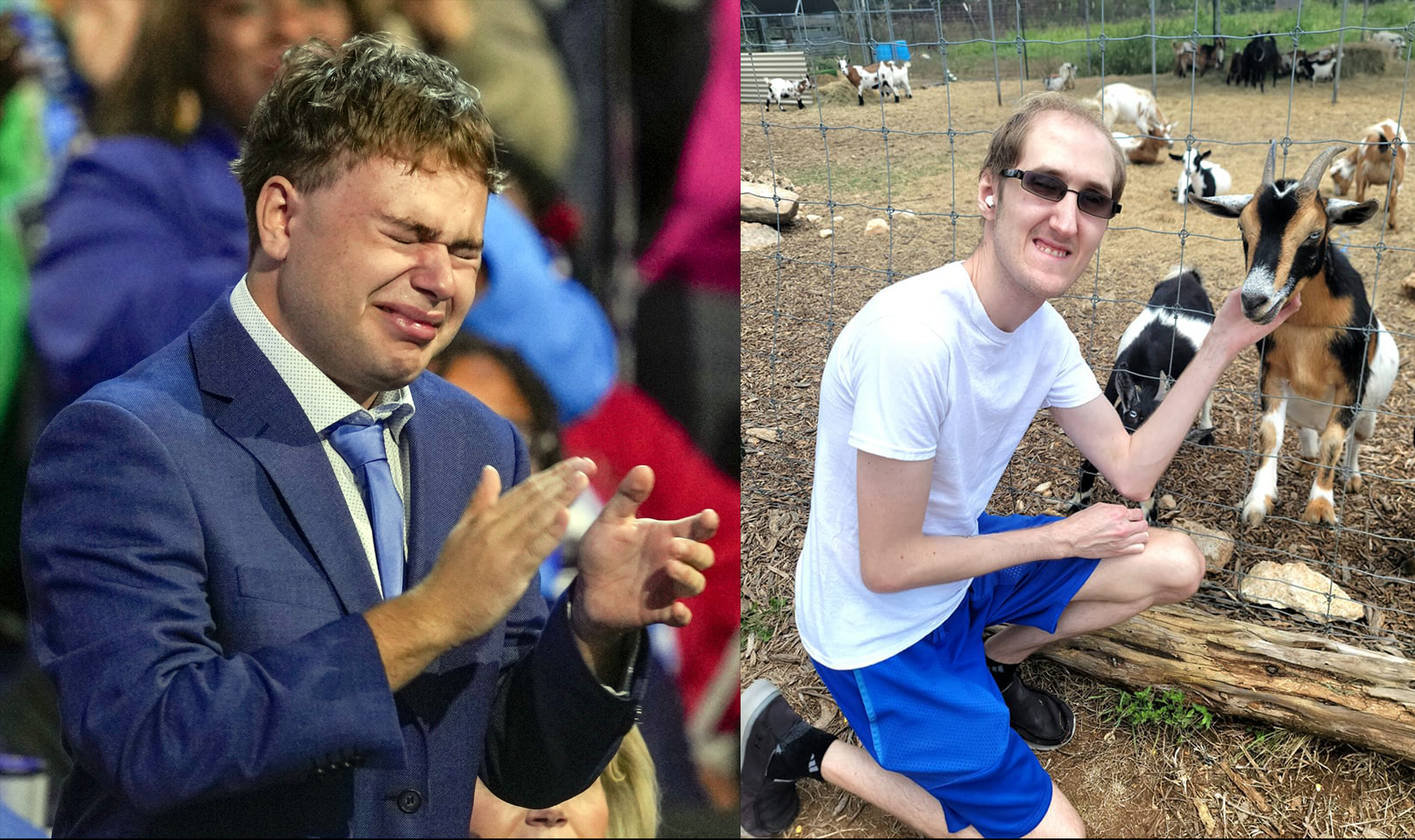
Which brings me to Gus Walz. When he cried at the Democratic National Convention, exclaiming “that’s my father!” with overflowing pride, I felt it. Later, when he smiled at the camera with the rest of his family, I saw it, as did millions of other people. We celebrated his humanity, our humanity, embracing him exactly as he is with his neurodivergent reality.
But in America, bullying has become an art form. Egged on by the former Bully-in-Chief, some of the cruelest practitioners are right-wing media darlings, and their reactions to Gus were lamentable. Here are some of the first comments posted through social media by these mean-spirited influencers.
Conservative columnist and right-wing provocateur Ann Coulter scorned Gus’s tears. “Talk about weird,” she wrote on X.
Mike Crispi, a Trump supporter and podcaster from New Jersey, mocked Walz’s “stupid crying son” on X and added, “You raised your kid to be a puffy beta male. Congrats.”
Alec Lace, a Trump fan who hosts a podcast about fatherhood, said, “Get that kid a tampon already,” an apparent reference to a Minnesota state law that Walz signed as governor that requires schools to provide free menstrual supplies to students.
The Milwaukee Journal Sentinel reported that Jay Weber, a conservative Milwaukee radio host, said, “If the Walzs (sic) represent today’s American man, this country is screwed: ‘Meet my son, Gus. He’s a blubbering baby boy. His mother and I are very proud’.”
Which brings me to my son, Kristoffer, now 27, an intellectually disabled young man whom I dearly love. Our journey in raising him has profoundly humanized my wife and me over the years. I wrote about this process in a feature article called A Medal for Two.
If you look into Kristoffer’s eyes, you will certainly notice his disability. But if you look with the heart and soul of a compassionate human being, you will also see the imago Dei.
During the furor about Gus Walz, there was a flurry of social media memes that divided our country into two camps—those who responded to this young man with love, and those who derided both him and his family.
Between these fractious poles, I believe there’s a more nuanced continuum of understanding. I see it in the reactions to Kristoffer when we’re out in public. Some are quizzical, his condition challenging their notions of normal. Some look with pity. Some react with what I call unctuous grace, a condescending smile and words for this “lesser creature.” (You know that reaction: “Let’s be nice to the poor, unfortunate young man.”)
But I’m pleased to say that there are many others who don’t flinch, who show no discomfort, who simply look steadily into Kristoffer’s eyes, encountering his life force with their own, a clear give and take of love, what Martin Buber called an I-Thou response. Bless them all!
I want to close with a troubling question. Can the imago Dei become so obscured in another person that we don’t recognize it in their eyes? Instead, do we see inwardly focused narcissism, smoldering contempt, even evil impulses that speak of a different reality?
You can wrestle with that question on your own, but my personal answer is two-fold. First, I believe that our eyes are indeed the windows to our soul, and that some souls become warped by the choices they make. Second, I will never stop trying to find some vestige of goodness beyond all that mutation.
Meanwhile, back to the overriding reason I am sharing these words. Let’s go full circle to the sanitation workers strike in Memphis, 1968. Martin Luther King, Jr. went to the city to join the protest, giving his famous I’ve Been to the Mountaintop speech a day before his assassination. That remarkable human being who called us to live in Beloved Community, once said, “Every human life is a reflection of divinity, and… every act of injustice mars and defaces the image of God in man.”
So, I say namaste to Gus Walz and my son, Kristoffer Van Tatenhove!
It was one of those conversations with a friend that I crave—wide-ranging, both intimate and global, drawing on our interests in literature, history, and current events. During the course of it, a philosophical question arose: “Should we take things personally?”
You may have an immediate answer but stay with the question for a moment.
In his popular book, The Four Agreements: A Practical Guide to Personal Freedom, Don Miguel Ruiz talks about the “domestication of humans.” From the moment we are born, he says, “outside” information is transferred to us internally, creating the “agreements” we make about ourselves and our place in the world. This transfusion comes through tribes, families, schools, and religions.
Given this maze of conflicting and often capricious viewpoints, Ruiz proposes the second of his four agreements. Don’t take anything personally. “Whatever you think,” he says, “and whatever you feel, I know is your problem and not my problem. It is the way you see the world. It is nothing personal, because you are dealing with yourself, not with me. Others are going to have their own opinion according to their belief system, so nothing they think about me is really about me, but it is about them.”
OK. There’s some truth here. How many of us have allowed our self-worth to be dragged through the muck of other people’s judgments? How many of us have allowed them to lease space in our heads, squandering our precious time and our unique destinies?
Wayne Dyer, a thinker I admired, steadfastly refused to take a side in conflicts, believing that the very act of aligning ourselves fuels the power of dualistic madness tearing our planet apart. He called us to stay centered in a place of unity and compassion for all of creation, including every single person who disagrees with us, even our enemies
Again, great value here. Many an enlightened spiritual teacher—among them the Buddha, Jesus, and Baháʼu’lláh—walked this higher plain in their teachings and actions.
But let’s go back to that conversation with my friend. Why? Because, to refute Ruiz, the decisions that people make, especially those in power, go far beyond just dealing with themselves. They affect all of us!
In our dialogue that morning, my friend and I turned to the current political scene, especially the rise of Christian Nationalism, that cult that misappropriates the teachings of Jesus and cloaks itself in American Exceptionalism. We lamented the erosion of a woman’s reproductive rights, the backlash against the LGBTQ population, the disregard for global warming, the demonization of immigrants and protestors, the undermining of public healthcare and education, and the threats leveled at social security.
Should we take this personally? Hell yes! Even if it causes some anger and angst? Hell yes! Read, really read, the background and content of Project 2025, a list of legislative and policy proposals that is ready to roll if Trump gets reelected.
Should we take the defeat of this agenda personally? Absolutely!
My friend is Jewish, and he recalled a famous poem by Martin Niemöller, a German theologian and Lutheran pastor during the rise of Nazism. It exists in many versions, but the one featured on the United States Holocaust Memorial reads: “First they came for the socialists, and I did not speak out – because I was not a socialist. Then they came for the trade unionists, and I did not speak out – because I was not a trade unionist. Then they came for the Jews, and I did not speak out – because I was not a Jew. Then they came for me – and there was no one left to speak for me.” For his opposition to the Nazis’ state control of churches, Niemöller was imprisoned in the Sachsenhausen and Dachau concentration camps from 1938 to 1945. He narrowly escaped execution.
It reminded me of words from Martin Luther King, Jr. that have informed my activism for decades. “In the end, we will remember not the words of our enemies, but the silence of our friends.”
Within the wider circle of my Christian friends, there’s a lot of talk about respecting the voices of those who disagree with us. Instead of red or blue, they champion the color purple. Listen; I agree that we need to reach across the boundaries of our differences. As Jesus so powerfully said, “If you love only those who love you, what good is that? Even scoundrels do that much. If you are friendly only to your friends, how are you different from anyone else?” (Matthew 5:46-17a, Living Bible Translation). Can we champion the causes of justice nonviolently, opposing those who would erode our freedoms without disrespecting them? Harder, much harder, but yes!
However, if our efforts to be conciliatory cause us to muzzle ourselves and cease speaking truth to power, I object! If they lead us to accommodate the principles outlined in White Nationalist movements like Project 2025, I object!
I wholeheartedly support Kamala Harris as our next President of the United States. When I scroll through the many memes circulating around her candidacy, I love the one that says, “Rosa sat, so Ruby could walk, so Kamala could run.”
Did Rosa Parks take it personally when she was ordered to sit in the back of Montgomery, Alabama buses? Certainly! Did those who fought for school desegregation take it personally? Of course!
Parks once commented, “People have said over the years that the reason I did not give up my seat was because I was tired. I did not think of being physically tired. My feet were not hurting. I was tired in a different way. I was tired of seeing so many men treated as boys and not called by their proper names or titles. I was tired of seeing children and women mistreated and disrespected because of the color of their skin. I was tired of Jim Crow laws, of legally enforced racial segregation.”
Today, I am personally saying that I am sick and tired of Christian Nationalism and its idolatry. It’s not only an aberration; it’s a dangerous mutation. I will do everything in my sphere of influence to defeat those forces that seek to form a theocratic government in America.
And if you have made it to the end of this piece, I hope that you, too, will take this election and its repercussions PERSONALLY!
Rosa sat, so Ruby could walk, so Kamala could run!








 Krin Van Tatenhove - Words & Images