I am fueled by wanderlust. It has carried me to foreign lands and across North America, but also throughout my home state of Texas: 268,500 square miles, a landmass larger than any nation in the European Union. With its ten distinct ecoregions and a culture shaped by immigrants from more than 100 countries, Texas continues to surprise me. I never tire of exploring its landscapes, its history, and its many secrets.
This is the sixth poem in an upcoming book, Visions of the Lone Star State. I hope you enjoy it!
The Painted Churches
29.6819° N, 96.9071° W
Driving country roads beyond Schulenburg,
I see their steeples rise above the fields.
In High Hill, I enter St. Mary’s,
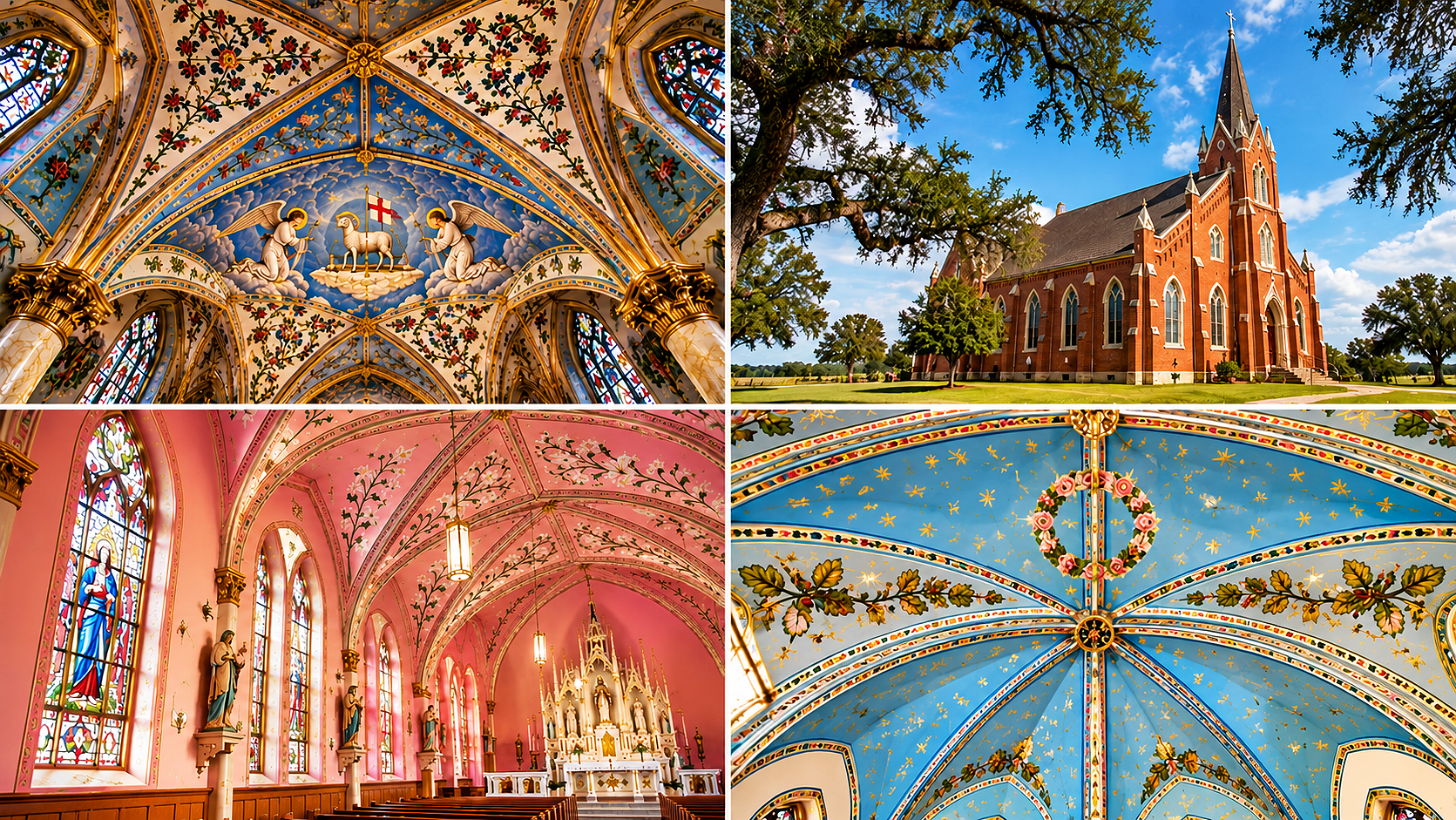
its gilded arches entwined with flowering vines,
the Lamb of God resting among painted clouds.
At Praha’s St. Mary of the Assumption,
the wooden ceiling resembles vaulted stone
where Texas flowers bloom against a blue sky.
Above the altar, three angels guard a jeweled cross,
and scenes of Prague recall the settlers’ homeland.
At Dubina, Tom Lee’s iron cross crowns the steeple,
the work of a man once enslaved, salvaged from hurricane ruins.
Golden stars and oak leaves brighten the blue ceiling.
In Ammannsville, St. John’s emerged from ashes,
its sanctuary glowing in shades of rose.
Inside Moravia’s Ascension of Our Lord,
Christ’s image rises above walls disguised as marble.
Nearby, the Pietà holds a mother’s grief in silence.
At St. John the Baptist, I lift my eyes
to the baptism of Jesus above the altar.
Six churches, and I cannot count what they hold:
the languages carried across oceans, the hands
that painted, repaired, cooked, sang, and welcomed.
I came to admire the beauty upon these walls,
but leave remembering the lives that preserved them.