It’s always this way. Call it the vagaries of chance or the randomness of an indifferent universe. Ten soldiers are in a convoy struck by mortar rounds; only two survive. A fire rips through a mountain village; dozens of homes burst into flame while others remain unscathed. A plane makes a crash landing in a cornfield, killing most passengers; a handful walk away from the wreckage. The Guadalupe River in Texas floods a girl’s summer camp, killing dozens; just a week earlier, similar campers had the time of their lives.
Please don’t say it was your god’s will that some lived while others perished. That’s a cruel heaping of insult on injury, and it paints a ghastly picture of your capricious deity.
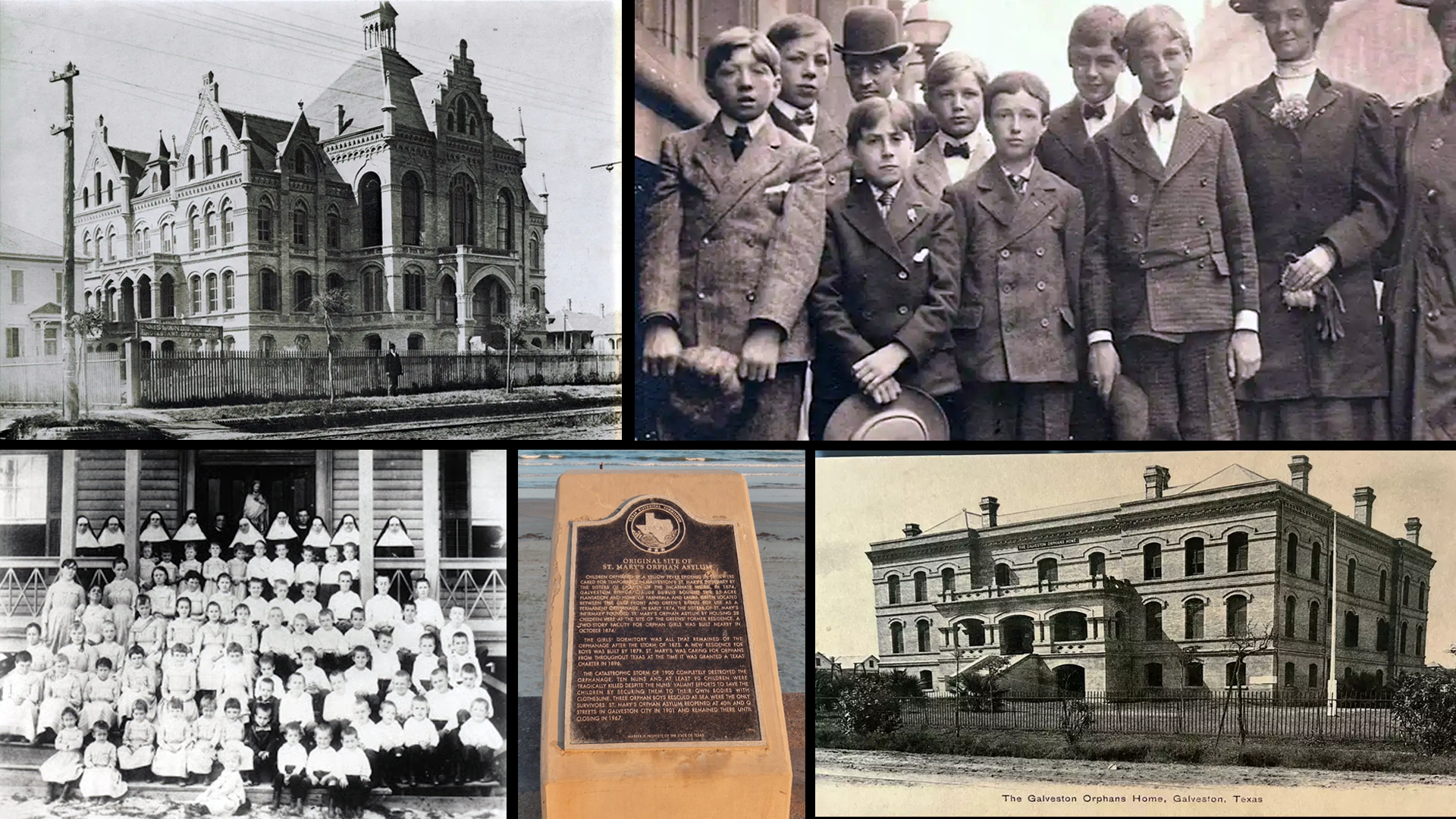
No. It’s always this way. And so it was with two orphanages in Galveston, Texas on September 8, 1900.
But first, some context.
In 1900, Galveston was at the zenith of its heyday, a bustling port with a population of 38,000, known as the “Wall Street of the Southwest” for its concentration of banks, businesses, and wealthy entrepreneurs. It boasted being the third richest city in the United States in proportion to population. All major railroads connected there, and it exported 60% of the state’s cotton crop, rivaling New Orleans. Its grand Victorian mansions and beachfront attractions earned it the nickname the “Queen City of the Gulf.”
Galveston also had more than its share of orphans, being the last stop for so-called “orphan trains.” Operating between 1854 and 1929, this social experiment transported 200,000 children from crowded Eastern cities to foster homes in the rural Midwest that were short on farming labor. The co-founders of the movement claimed the children were abandoned, abused, or homeless. They were mostly the offspring of immigrants living in urban slums. The movement garnered widespread criticism for its ineffective screening of caretakers and its insufficient follow-ups on placements. In some cases, the children were no better off than slaves after adoption.
By the time these trains rolled into Galveston, the children on board were those found less desirable. They ended up in one of two places: St. Mary’s Orphanage Asylum or the Galveston Orphan’s home. There they shared quarters with orphans whose parents had succumbed to a yellow fever epidemic.
Then came the fateful day of September 8, when a hurricane dubbed the Great Storm of 1900 made landfall on Galveston Island. With sustained winds up to 145 miles per hour and a storm surge reaching 12 feet, it decimated the city. Exact death tolls vary, but some estimates say up to 12,000 perished. Another 10,000 were homeless. The storm is still the greatest natural disaster in terms of its death toll to ever strike the United States. Massive funeral pyres burned everywhere in the aftermath, and barges carried stacks of the dead into the Gulf of Mexico for burial at sea.
St. Mary’s Orphan Asylum housed 93 children aged 2-23, cared for by 10 sisters of the Charity of the Incarnate Word. As the storm began to rage, the nuns, in a desperate attempt to save their young charges, relocated them from the boys’ dormitory to the newer girls’ dorm. From there, they watched the boys’ section collapse under the wind and tide. They offered prayers and sang hymns to comfort the terrified group, but by nightfall, the winds raged at 150 mph. The nuns tied a piece of clothesline around each of their waists and then around the wrists of some of the children, binding their fates together. The mighty storm finally lifted the girls’ dorm off its foundations. The bottom fell out and the roof crashed down. Only three boys survived by clinging to a nearby tree. They were later rescued at sea by some fisherman in a small boat.
Galveston Orphans’ Home had only been in its new structure for five years when the storm hit. Though the central part of the building collapsed, the rest remained stable. Staff and children, as well other residents, took refuge in the stronger sections and all of them survived the cataclysm.
On the anniversary of the storm in 1994, Galveston dedicated a marker at 69th Street and Seawall Boulevard, honoring the former site of St. Mary’s. The hymn Queen of the Waves, which had been sung by the sisters to calm the children, was part of the ceremony.
The Galveston Orphan’s Home was rebuilt with help from generous donors. Today it houses the Bryan Museum, which I recently visited. In its basement are artifacts found at the home after the storm. Among them is a small slipper once worn by a young child.
Two orphanages, two vastly different outcomes. When this happens in life, what can we do?
We can remember.
 Krin Van Tatenhove - Words & Images
Desperately sad 😢 Makes me humble and grateful. Thanks for sharing Krin 🙏🩷
Get Outlook for iOShttps://aka.ms/o0ukef