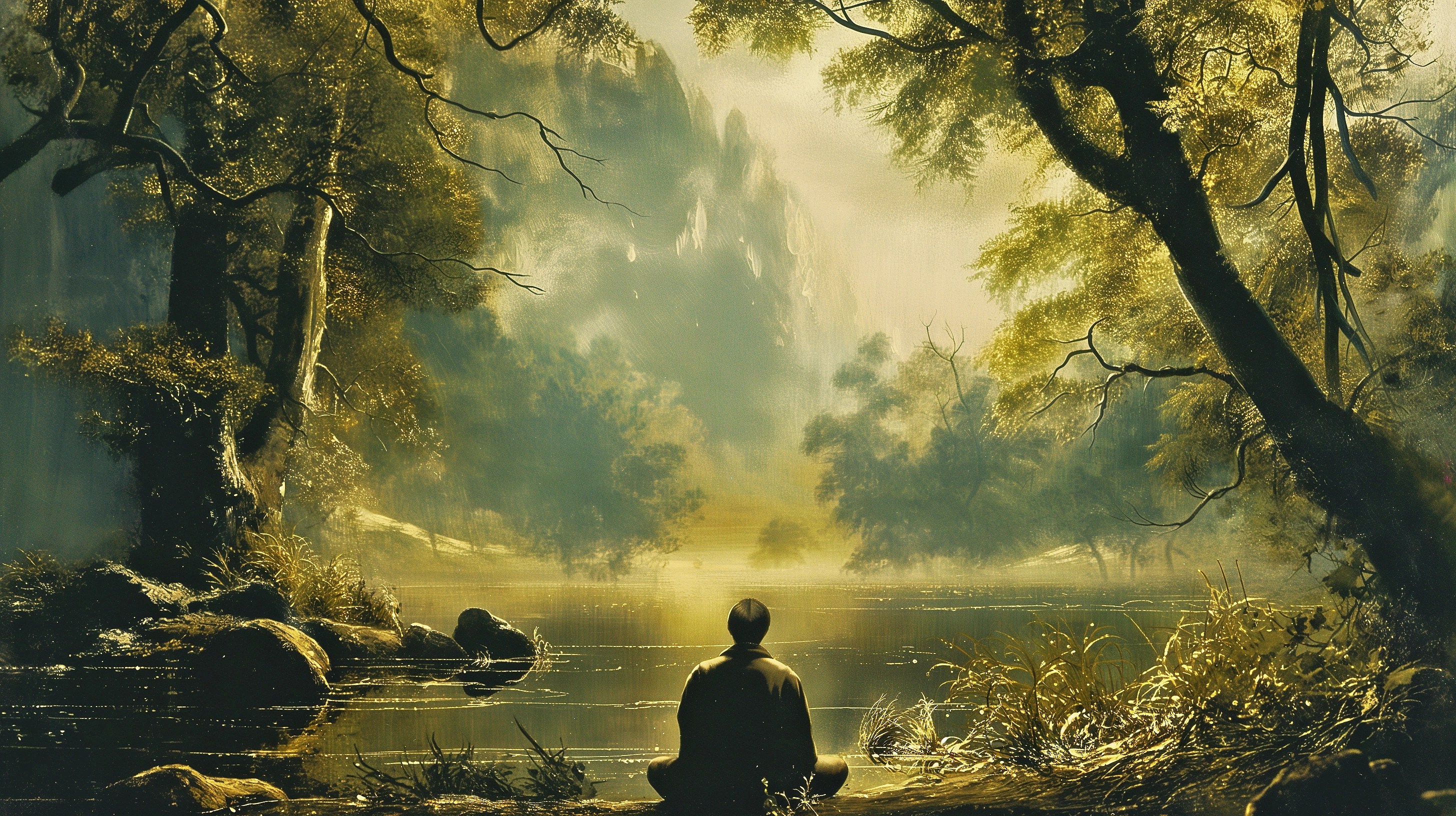
The Sacred Journey Beyond Religion

In 2024, the Pew Research Center found that 28% of Americans check “none” as their choice of religion.

So many of us have stepped away from organized faith, not out of rebellion, but from a courageous honesty with ourselves that we could no longer ignore. For some of us, the rituals had grown hollow, the dogmas too small for the vastness of our questions. Others of us saw how our institutions had become rigid or exclusionary.

Here’s a hard-won truth that many of us share. When we trade wonder for certainty, our souls begin to suffocate. As Jesus said in one of his most enduring metaphors, you can’t place new wine into old wineskins. It will only cause further rupture.

Have you ever walked out of a sanctuary you once felt was sacred, wondering if you were leaving behind not just your faith, but the language of your soul? If so, take heart. We are not losing our spirituality. We are rediscovering it in a deeper and freer form.

The Quiet Hunger Within

All of us carry a hunger for meaning that no amount of success, pleasure, or distraction can fill. We want to know that our lives matter, that we belong to something greater than ourselves. This longing stirs in the silence before dawn, in the tears we can’t explain, in the beauty that takes our breath away. It is not a problem to be solved. It is an invitation.

So where do we turn when we yearn for the sacred, but no longer fit inside the old containers?

The Open Path

First, we realize that spirituality was never confined to human temples, effigies, or sacred texts. It is written into the fabric of existence itself. The same Presence that inspired prophets and poets is alive in each of us, waiting for us to notice.

You might glimpse it in a forest trail glowing with morning light.
You might sense it in the deep stillness of meditation, or in the laughter of a friend who sees you fully.
You might feel it in moments of awe, when the boundaries between “you” and “everything else” dissolve.
You might see it looking back at you through the eyes of your child or grandchild.

Each of these is a doorway into the same mystery.

Spiritual satisfaction doesn’t come from subscribing to the right belief, but from cultivating awareness. And as our consciousness grows, so does our compassion, our sense of unity, and our capacity for joy. We begin to live not from fear, but from connection.

Companions on the Road

Our quest for meaning is not a solo expedition. We belong to a vast community of people asking similar questions, struggling with uncertainties, and finding revelations they never imagined. Each of our companions along the way carries a spark of the mystery we seek. When we share our stories, we participate in a sacred exchange. We remind each other that the search itself is holy.

Some of us find this connection through contemplative circles, mindfulness groups, or creative communities. Others of us find it through feeding the hungry, tending the earth, or comforting the lonely.

Wherever we practice love, spirit is present. As the timeless Persian poet, Rumi, once said, “In every religion there is love, yet love has no religion.”

Evolving Notions of the Divine

Words are simply pointers. This is a crucial realization. God, Tao, Source, Beloved, Mystery, Great Spirit are all terms intimating something we can never fully capture in language. The immensity of the cosmos and its origin are better experienced through awe. Over time, we find that the divine becomes less a being “out there” and more a living presence within and around everything. We come to see that spirituality is not about believing, but about being fully awake to the sacred dimension of everyday existence.

As our understanding expands, so does our compassion. We stop worrying about who’s right and who’s wrong in matters of faith. We start asking: What helps me love more deeply? What helps me live with gratitude? What helps me serve the wholeness of life?

The Great Thrills of the Journey

The spiritual journey beyond religion may begin with a sense of loss, but discoveries soon fill that void in myriad ways. Imagine:

  • The thrill of realizing that every sunrise, every act of kindness, every moment of awareness is a form of prayer.
  • The freedom of knowing that you no longer need to pretend certainty; that questions themselves are sacred.
  • The joy of feeling at home in the universe, even without a map.

Looking back, we see that we are not exiles. Instead, we have found a calling, an invitation to grow beyond the boundaries of old beliefs and into the spaciousness of wonder.

The Infinite Yes

If you find yourself wandering beyond the walls of religion, trust the journey. Follow the tug of your own curiosity. Keep your heart open to beauty, mystery, and love. The sacred has not abandoned you. It has simply changed its address, moving from the altar to the open sky, from the sermon to the beating of your own heart.

You are still on holy ground.
The Overview Effect

(Nationalism, religion, political ideologies, greed, and naked power grabs continue to fracture the human race, pitting us against each with tragic consequences. It leads me to share this chapter from my 2014 book entitled Invitation to The Overview, downloadable for free at this link.)

In my childhood family, what we called the “space race” was personal. I grew up in the 1960s in southern California, my father in charge of financial controls for the Apollo module. He consorted with famous astronauts and legends like Werner Von Braun. When it came time for “take your son to work day,” I got a chance to scramble through a mock-up of that small cone-shaped capsule designed to withstand both fiery reentries and violent splashdowns in the oceans of earth.

I remember the excitement in our home when a Saturn V was ready to launch a new mission from Cape Canaveral. Dad would rouse us from bed like we were about to embark on a dream vacation. He would lead us into the family living room where an early generation color TV sat on its throne. There we could see the rocket, aimed for the cosmos, steam billowing from beneath, its tip crowned with the Apollo. Dad would stalk around that screen with more intensity than a Brazilian soccer fan, the clock announcing T minus 4 hours, then 3, then 1, then the final dramatic countdown and that glorious, thunderous liftoff into the sky.

In retrospect, I know that our efforts to reach that lifeless chunk of rock were as motivated by competition as they were by scientific wonder. It was an expression of US pride, an extension of the longstanding Cold War. No Russian was going to conquer the moon before us! I’m also sadly aware of the military agendas that attended our forays into space, resulting in Strangelovian plans years later to deploy a “near space” defense system. Our land and sub-based nukes were apparently not enough, even though they represented enough doomsday power to demolish every major city on earth. We thought we needed missiles in orbit, polluting space with hardware and cancerous hatred. Thank God that plan never came to fruition.

Still, when Neil Armstrong took his immortal first step onto the lunar surface, it was a moment of wonder, a celebration of the imagination and possibilities of humankind. It taught us about our potential.

But there is an even more enduring lesson from our ventures into the beyond. It is called the The Overview Effect, a term first coined by Frank White, who explored them in his 1987 book, The Overview Effect — Space Exploration and Human Evolution in 1987. It is that moment when we turn and see our planet suspended in the vastness of space. For everyone who experiences it, this vantage point is life changing. It transforms their perspectives on Earth and humankind’s place upon it.

Here are some quotes from astronauts about their overview.

When we look down at the earth from space, we see this amazing, indescribably beautiful planet. It looks like a living, breathing organism. But it also, at the same time, looks extremely fragile. – Ron Garan, USA

Before I flew I was already aware of how small and vulnerable our planet is; but only when I saw it from space, in all its ineffable beauty and fragility, did I realize that humankind’s most urgent task is to cherish and preserve it for future generations. – Sigmund Jähn, German Democratic Republic

For those who have seen the Earth from space, and for the hundreds and perhaps thousands more who will, the experience most certainly changes your perspective. The things that we share in our world are far more valuable than those which divide us. – Donald Williams, USA

My first view – a panorama of brilliant deep blue ocean, shot with shades of green and gray and white – was of atolls and clouds. Close to the window I could see that this Pacific scene in motion was rimmed by the great curved limb of the Earth. It had a thin halo of blue held close, and beyond, black space. I held my breath, but something was missing – I felt strangely unfulfilled. Here was a tremendous visual spectacle, but viewed in silence. There was no grand musical accompaniment; no triumphant, inspired sonata or symphony. Each one of us must write the music of this sphere for ourselves. – Charles Walker, USA

Looking outward to the blackness of space, sprinkled with the glory of a universe of lights, I saw majesty – but no welcome. Below was a welcoming planet. There, contained in the thin, moving, incredibly fragile shell of the biosphere is everything that is dear to you, all the human drama and comedy. That’s where life is; that’s where all the good stuff is. – Loren Acton, USA

The Earth was small, light blue, and so touchingly alone, our home that must be defended like a holy relic. The Earth was absolutely round. I believe I never knew what the word round meant until I saw Earth from space. – Aleksei Leonov, USSR

The sun truly comes up like thunder and sets just as fast. Each sunrise and sunset lasts only a few seconds. But in that time you see at least eight different bands of color come and go, from a brilliant red to the brightest and deepest blue. And you see sixteen sunrises and sixteen sunsets every day you’re in space. No sunrise or sunset is ever the same. – Joseph Allen, USA

The Earth reminded us of a Christmas tree ornament hanging in the blackness of space. As we got farther and farther away it diminished in size. Finally it shrank to the size of a marble, the most beautiful marble you can imagine. That beautiful, warm, living object looked so fragile, so delicate, that if you touched it with a finger it would crumble and fall apart. Seeing this has to change a man, has to make a man appreciate the creation of God and the love of God. – James Irwin, USA

Suddenly, from behind the rim of the moon, in long, slow-motion moments of immense majesty, there emerges a sparkling blue and white jewel, a light, delicate sky-blue sphere laced with slowly swirling veils of white, rising gradually like a small pearl in a thick sea of black mystery. It takes more than a moment to fully realize this is Earth…home. My view of our planet was a glimpse of divinity. – Edgar Mitchell, USA

A Chinese tale tells of some men sent to harm a young girl who, upon seeing her beauty, become her protectors rather than her violators. That’s how I felt seeing the Earth for the first time. I could not help but love and cherish her. – Taylor Wang, China/USA

What if, like these astronauts, we internalized this overview, tucking it like a pearl of great price into our hearts and minds? What if it caused us to have a fundamental, life-changing paradigm shift? What if national boundaries remained for governmental purposes, but we saw them from the global vantage point of our human family? What if the current conflicts that divide us were eclipsed by our critical need to create planetary tolerance, to galvanize our collective will and protect this pale blue vessel sailing in space?

This leads me to the primary questions of this book. Is your religion, your faith tradition, or your life philosophy contributing to these universal causes? Is it compelling you to find unity, commonality, and peaceful dialogue with others, no matter how alien their faith or lifestyle seems to you? Or is it promoting exclusivity and privilege, erecting walls, fueling ancient hostilities? Is it setting you apart?

As you answer these questions for yourself, consider the glimpses of Universalism in section three—visions shared from the hearts, minds, and souls of human beings who looked beyond the veil of conventionality. The Overview was—and still is—central to their existence. We need more of their breed.

Test Every Truth!

(Heiwa No Bushi is a Buddhist-Christian monk. He has degrees in philosophy and theology and received classical training in both Mahayana and Zen Buddhism. He places his teachings under the moniker “BodhiChristo” which means “enlightened Christ,” an amalgam of the two rich streams of Buddhism and Christianity. Here he gives some reflections on this journey, an excerpt from my book The Smile on a Dog: Retrieving a Faith That Matters, remastered and downloadable for FREE here).

This is my story, but I believe it reflects all our stories.

I grew up in south Florida, essentially a preacher’s kid because my grandmother was heavily involved in both the southern and primitive Baptist movements. She was so devoted that when people within her circles wanted to erect a building, she loaned them the money.

By the time I was six years old, my grandmother had become a minister in that church, but she struggled constantly against patriarchy. The congregation was so misogynistic that they wouldn’t allow her to be a regular preacher. However, she was a very clever bird. She decided that every time they gave her an opportunity to fill the pulpit, she would use her grandson to introduce her. It was a way of deflecting all the attention from her, and the result was that I became a phenomenal, entertaining bit of Sunday mornings! People came to hear my grandmother because this young boy really knew how “to lay it out there.”

All that time I worked with my grandmother, I saw the inconsistency between her church life and her home life. At church she was outwardly “righteous,” but at home she would speak in ways normally prohibited. I thought it was hypocritical, but she quoted the Apostle Paul from I Corinthians: “I have become all things to all people so that by all possible means I might save some.”

As grandma’s ministry grew, I began to feel a calling to attend seminary. I received my training and then, in my early 20s, I traveled overseas with the military. It was a time of hands-on experience, what I call “tacit education.” It challenged me to look at the deeper and wider aspects of life on our planet. I encountered many other faiths, not only seeing their beautiful richness, but their many parallels, especially the “golden rule.”

In my experiences as a Christian, I had not encountered a real moral teaching about how to treat our planet, especially “lesser creatures.” As a lover of the earth, I found a much greater connection to creation through other religions, especially Buddhism and its tremendous emphasis on caring for all living things. Jainism also intrigued me. It insisted on not naming “God,” believing there is no particular god outside of ourselves.

These religions lifted up a type of humanity that many circles of Christianity seemed to usurp and ignore. They spoke volumes of higher learning to me, and it seemed to me that Christianity did not stand up in the court of reality. For instance, where in Christian scripture was the insistence on an intimate relationship with all living things that I found so beautiful in Buddhism?

Then I thought of the parable Jesus told of seeking out the one lost lamb. He was saying to the majority, “You hold on tight, I’m going to get the one that matters.” This began to bring out what I call the “more mature” interpretation of Christ that I am trying to live out today.

In my teachings, I emphasize that there are three types of knowledge.

  • Explicit knowledge that comes to us from textbooks, manuals, Sunday school lessons taught as literal. This is a form of cultural programming, even indoctrination.
  • Codified knowledge which is the design of the society around us—from traffic signs to laws to the licenses we need to practice our professions. All this is meant to make sure that we follow the rules and remain in compliance with the status quo.
  • Tacit knowledge which we gain firsthand in the laboratories of our own lives. It can’t just be told to us; we must experience it and adapt it to reality of our own understandings.

The bottom line is that we must test any truth for ourselves! Examine it in the light of our minds, hearts, consciences, and personal experience. I feel religious institutions, especially the Christian church, should be some of the most unregulated organizations in our society. They should always call us to the high adventure of exploring a fuller spiritual life.

On this adventure, I remain a lifelong learner, carrying on something my grandmother taught me long ago. “Go beyond what educational systems teach you,” she said.

Take on the world. Tacitly hold it, experience it, live it and understand it!