Will You Speak Their Names with Me?

After the words of committal. After the plaintive playing of taps or the drone of receding bagpipes. After the folding of flags and the scattering of petals. After the tears and sighs and final thup thup of loam on caskets. Even after everyone had gone, I – conductor of countless graveside services – would remain. And I would wander among the tombstones, the monuments, the shade trees and new mown grass, losing myself in the preternatural stillness.

Today, retired from my years as a cleric, I still frequent cemeteries on my travels. The historic presence of death is a tonic, a prophylactic against apathy, a memento mori in names and dates chiseled on stone. I always thought these reminders of mortality were the primary reason I felt drawn to these places. But recently, I realized there’s another motive that inspires me.

Quite simply, these moments deepen my compassion for humanity, lifting the veil of cynicism that can so easily shroud my feelings about our species. It reminds me that we all grieve, and that our grief could bind us if we let it. Because, in the end, despite our warring madness, our endless divisiveness, our greed, our envy, and our competition, we share the same destiny: the soil from which we arose. This is a common theme of poets, but do we really feel it in our bones on any given day?

As my eyes scan the dates and epitaphs of people who passed before us, I am especially moved by the markers commemorating children. So many of them! Their years cut short before they experienced the rites of passage common to human life. I imagine the visceral agony of their mothers and fathers. We have a word for children who have lost their parents. They are orphans. We have words for men and women who have lost their spouses. They are widows and widowers. Yet we have no moniker for parents who lose their children. It is too unnatural. Unspeakable.

And yet so many children are dying, even as you read these words! Lost in the murderous alleyways of Tegucigalpa, buried in the rubble of Gaza, or blown apart by shrapnel in Ukraine. Others, still alive, walking alongside their mothers in refugee caravans, or languishing in poorly monitored foster care, or living by their wits – with an estimated 100 million others – in ghettos around the world. Street urchins. Unseen, thrown away, forgotten.

So, where am I going with this post? Well, I want to ask you a favor. I fashioned this collage from grave makers I recently found in the Lockhart Cemetery of Cuero, Texas, and the Oak Hill Cemetery of Goliad, Texas. They represent only a portion of the young ones interred at these sites.
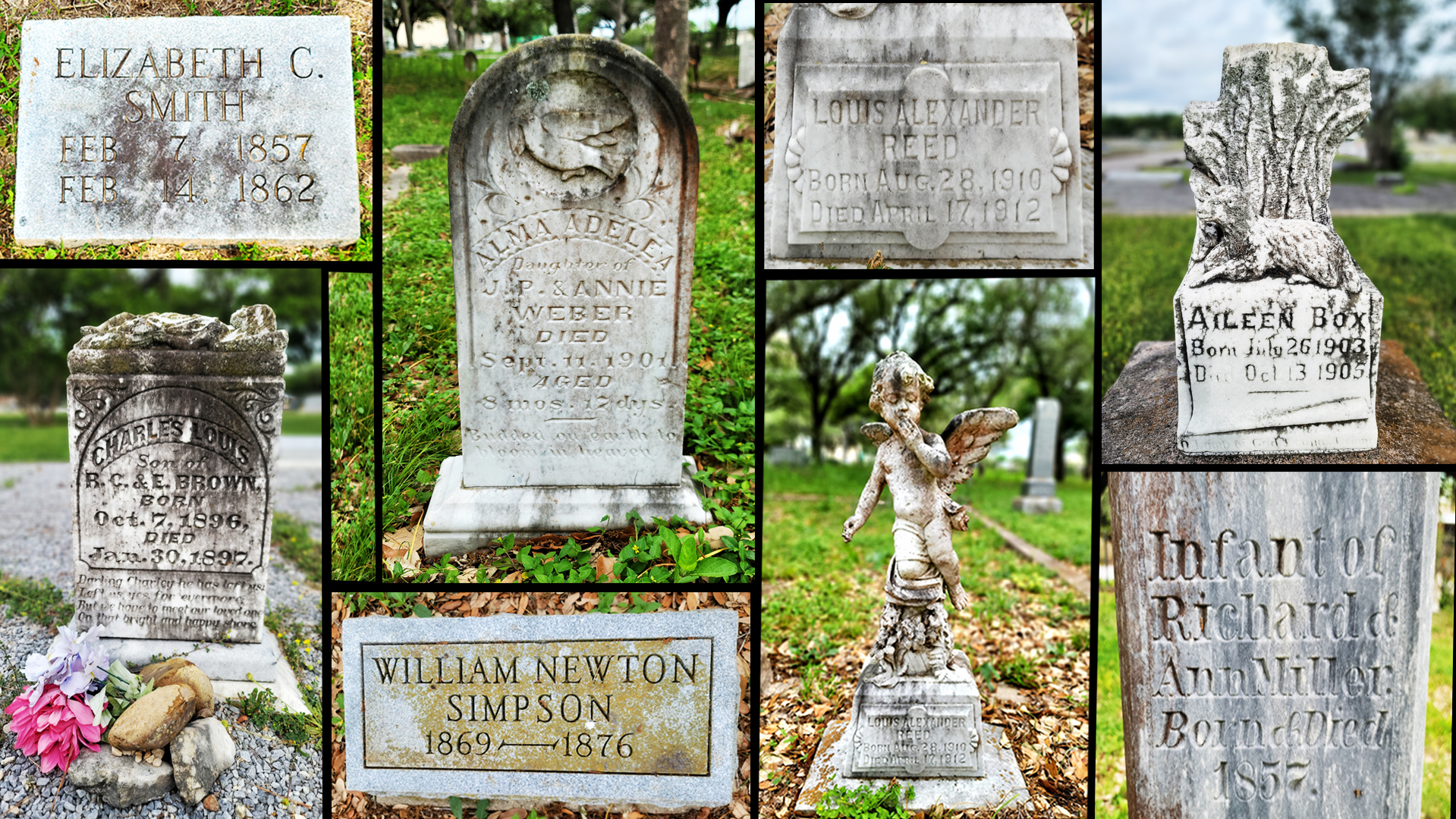
Will you speak, out loud, one of more of their names and the dates they lived? Here they are:

  • Elizabeth C. Smith, born February 7, 1857; died February 14, 1862.
  • Charles Louis Brown, born October 7, 1896; died January 30, 1897.
  • Alma Adelea Smith, died on September 11, 1901, age 8 months and 17 days.
  • William Newton Simpson, born 1869; died 1876.
  • Louis Alexander Reed, born August 28, 1910; died April 17, 1912.
  • Aileen Box, born July 26, 1903; died October 13, 1905.
  • Unnamed infant of Richard and Ann Miller, born and died in 1857.

Speaking the names of the dead (known as necronyms) is taboo in some cultures, shrouded in superstition about the afterlife. However, in my hometown of San Antonio, there is a different attitude, summed up in the yearly Dia de los Muertos celebrations. Families build altars to lost loved ones, then encourage us to not only speak their names, but to view objects and photos that elicit their presence. The celebration also binds us with the living, calling us to treasure whatever precious days we are given with them.

So, if you have conjured the presences of Elizabeth, Charles, Alma, William, Aileen, or the unnamed child of the Millers, my hope and prayer is twofold. May you commit yourself once again to the protection of children everywhere on this planet, no matter their nationality or race. And may you breathe the air of this day with an uncanny gratitude for every loved one that graces your life.

Namaste.

The Overview Effect

(Nationalism, religion, political ideologies, greed, and naked power grabs continue to fracture the human race, pitting us against each with tragic consequences. It leads me to share this chapter from my 2014 book entitled Invitation to The Overview, downloadable for free at this link.)

In my childhood family, what we called the “space race” was personal. I grew up in the 1960s in southern California, my father in charge of financial controls for the Apollo module. He consorted with famous astronauts and legends like Werner Von Braun. When it came time for “take your son to work day,” I got a chance to scramble through a mock-up of that small cone-shaped capsule designed to withstand both fiery reentries and violent splashdowns in the oceans of earth.

I remember the excitement in our home when a Saturn V was ready to launch a new mission from Cape Canaveral. Dad would rouse us from bed like we were about to embark on a dream vacation. He would lead us into the family living room where an early generation color TV sat on its throne. There we could see the rocket, aimed for the cosmos, steam billowing from beneath, its tip crowned with the Apollo. Dad would stalk around that screen with more intensity than a Brazilian soccer fan, the clock announcing T minus 4 hours, then 3, then 1, then the final dramatic countdown and that glorious, thunderous liftoff into the sky.

In retrospect, I know that our efforts to reach that lifeless chunk of rock were as motivated by competition as they were by scientific wonder. It was an expression of US pride, an extension of the longstanding Cold War. No Russian was going to conquer the moon before us! I’m also sadly aware of the military agendas that attended our forays into space, resulting in Strangelovian plans years later to deploy a “near space” defense system. Our land and sub-based nukes were apparently not enough, even though they represented enough doomsday power to demolish every major city on earth. We thought we needed missiles in orbit, polluting space with hardware and cancerous hatred. Thank God that plan never came to fruition.

Still, when Neil Armstrong took his immortal first step onto the lunar surface, it was a moment of wonder, a celebration of the imagination and possibilities of humankind. It taught us about our potential.

But there is an even more enduring lesson from our ventures into the beyond. It is called the The Overview Effect, a term first coined by Frank White, who explored them in his 1987 book, The Overview Effect — Space Exploration and Human Evolution in 1987. It is that moment when we turn and see our planet suspended in the vastness of space. For everyone who experiences it, this vantage point is life changing. It transforms their perspectives on Earth and humankind’s place upon it.

Here are some quotes from astronauts about their overview.

When we look down at the earth from space, we see this amazing, indescribably beautiful planet. It looks like a living, breathing organism. But it also, at the same time, looks extremely fragile. – Ron Garan, USA

Before I flew I was already aware of how small and vulnerable our planet is; but only when I saw it from space, in all its ineffable beauty and fragility, did I realize that humankind’s most urgent task is to cherish and preserve it for future generations. – Sigmund Jähn, German Democratic Republic

For those who have seen the Earth from space, and for the hundreds and perhaps thousands more who will, the experience most certainly changes your perspective. The things that we share in our world are far more valuable than those which divide us. – Donald Williams, USA

My first view – a panorama of brilliant deep blue ocean, shot with shades of green and gray and white – was of atolls and clouds. Close to the window I could see that this Pacific scene in motion was rimmed by the great curved limb of the Earth. It had a thin halo of blue held close, and beyond, black space. I held my breath, but something was missing – I felt strangely unfulfilled. Here was a tremendous visual spectacle, but viewed in silence. There was no grand musical accompaniment; no triumphant, inspired sonata or symphony. Each one of us must write the music of this sphere for ourselves. – Charles Walker, USA

Looking outward to the blackness of space, sprinkled with the glory of a universe of lights, I saw majesty – but no welcome. Below was a welcoming planet. There, contained in the thin, moving, incredibly fragile shell of the biosphere is everything that is dear to you, all the human drama and comedy. That’s where life is; that’s where all the good stuff is. – Loren Acton, USA

The Earth was small, light blue, and so touchingly alone, our home that must be defended like a holy relic. The Earth was absolutely round. I believe I never knew what the word round meant until I saw Earth from space. – Aleksei Leonov, USSR

The sun truly comes up like thunder and sets just as fast. Each sunrise and sunset lasts only a few seconds. But in that time you see at least eight different bands of color come and go, from a brilliant red to the brightest and deepest blue. And you see sixteen sunrises and sixteen sunsets every day you’re in space. No sunrise or sunset is ever the same. – Joseph Allen, USA

The Earth reminded us of a Christmas tree ornament hanging in the blackness of space. As we got farther and farther away it diminished in size. Finally it shrank to the size of a marble, the most beautiful marble you can imagine. That beautiful, warm, living object looked so fragile, so delicate, that if you touched it with a finger it would crumble and fall apart. Seeing this has to change a man, has to make a man appreciate the creation of God and the love of God. – James Irwin, USA

Suddenly, from behind the rim of the moon, in long, slow-motion moments of immense majesty, there emerges a sparkling blue and white jewel, a light, delicate sky-blue sphere laced with slowly swirling veils of white, rising gradually like a small pearl in a thick sea of black mystery. It takes more than a moment to fully realize this is Earth…home. My view of our planet was a glimpse of divinity. – Edgar Mitchell, USA

A Chinese tale tells of some men sent to harm a young girl who, upon seeing her beauty, become her protectors rather than her violators. That’s how I felt seeing the Earth for the first time. I could not help but love and cherish her. – Taylor Wang, China/USA

What if, like these astronauts, we internalized this overview, tucking it like a pearl of great price into our hearts and minds? What if it caused us to have a fundamental, life-changing paradigm shift? What if national boundaries remained for governmental purposes, but we saw them from the global vantage point of our human family? What if the current conflicts that divide us were eclipsed by our critical need to create planetary tolerance, to galvanize our collective will and protect this pale blue vessel sailing in space?

This leads me to the primary questions of this book. Is your religion, your faith tradition, or your life philosophy contributing to these universal causes? Is it compelling you to find unity, commonality, and peaceful dialogue with others, no matter how alien their faith or lifestyle seems to you? Or is it promoting exclusivity and privilege, erecting walls, fueling ancient hostilities? Is it setting you apart?

As you answer these questions for yourself, consider the glimpses of Universalism in section three—visions shared from the hearts, minds, and souls of human beings who looked beyond the veil of conventionality. The Overview was—and still is—central to their existence. We need more of their breed.