Dreams are the touchstones of our character. – Stephen LaBerge
The sign on my office door says John Longfellow, PsyD – Individual and Family Counseling. I’ve been a psychologist for 20 years, helping people unravel their burdens and find resolution.
About three years ago, my enthusiasm flagged. Call it a midlife crisis, but listening to others grew tedious, especially with clients who took little responsibility for their healing. I nodded my head and kept appropriate eye contact, but I felt like a bobble-head toy. My wife noticed that I’d lost my lost my passion.
“You’re just not yourself,” she said, kindly but with an edge of exasperation. “I don’t have a prescription, but you need to find a way to connect with your old zest. You still have a lot of years ahead of you. We still have a lot of years ahead of us.”
She was right. I needed a new spark, a fresh avenue of exploration.
That direction came unexpectedly. I was listening to a podcast on my way to work called Wake Up Inside Your Dreams, a fascinating overview of lucid dreaming. The podcaster said, “It’s possible to step into our minds with our eyes open. We begin to see the architecture of our fears and our longings. We realize that we’ve built every wall and horizon ourselves.”
I’ve always had vivid dreams, but their meanings evaporate as I awaken. I knew a little about lucid dream theory, but the podcast spurred me to sharpen my research. I devoured everything I could find, from Jung’s Red Book to LaBerge, Bogzaran, Holziner, Aspy, and every article archived by The Lucidity Institute.
I began to experiment in my own life, keeping detailed dream journals and using practices like reality testing and mnemonic induction. It paid off. I could stay longer in my visions, understand more symbols, and even translate a few simple lessons into my waking world.
But still, something eluded me, something deeply connected to that sense of joy I’d been lacking for so long.
Gradually, I integrated this new focus into my practice, becoming a guide for others in their nightly walkabouts. Word got out through the therapeutic community. New referrals sought me out for release from night terrors, recurring guilt dreams, or lost loves who visited frequently like ghosts. I taught them to stay calm, to recognize the subtle distortions of the dream world: a light switch that doesn’t work, a clock whose hands refuse to move, words that rearrange themselves when you blink. These are the cues, I told them. The seams of the dream world. Pull at them, and you can wake up inside your own story.
I never imagined the fullness of what my own subconscious was preparing for me.
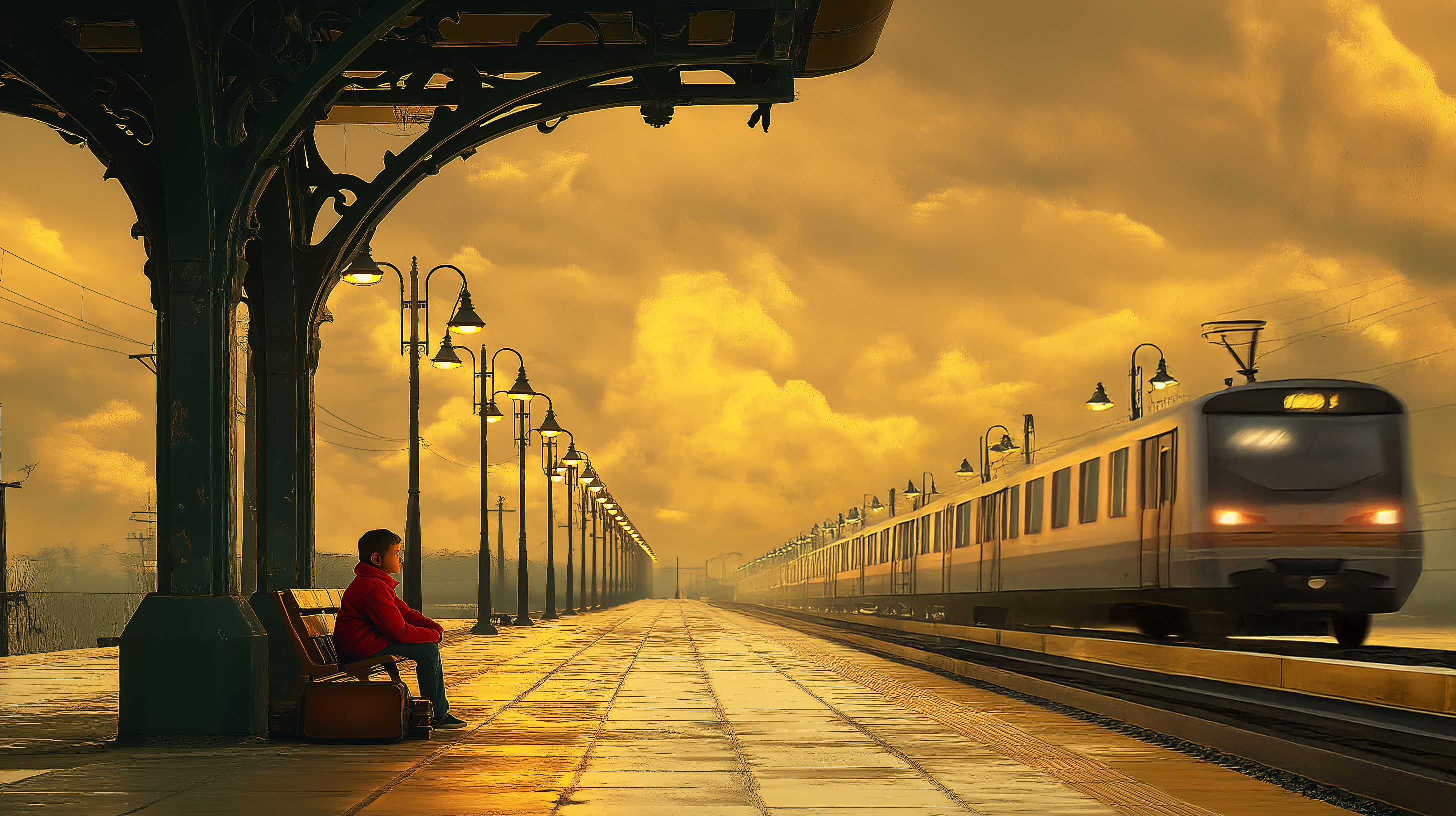
It began one winter night after an exhausting day of sessions. I’d just finished with Claire, a woman haunted by a recurring nightmare of drowning in a river that looked suspiciously like the one outside her childhood home. That night, perhaps still affected by her angst, I dreamed of a place I’d never been, an old train platform under a sky the color of brass.
It was still at first. No wind, no movement, just a suspended hush. The platform stretched endlessly in both directions, lined with benches and antique lamps that cast faint halos of light. A few people milled about, blurred, like they were painted in watercolor.
And then I saw him in sharp focus.
Across the tracks, on a bench opposite mine, sat a boy. He was swinging his legs and rolling a toy car from the palm of one hand to the other. I didn’t need to guess who he was. I knew instantly that I was looking at myself at eight years old.
The shock of recognition was almost physical. Inside the dream, I felt my chest tighten and my breath quicken. He looked exactly as I remembered myself. Thin, serious, with that same stubborn cowlick that refused to lie flat no matter how much my mother spat on her palm. He was wearing a red windbreaker I hadn’t thought about in decades.
I called out his name—my name—but even as the sound left my mouth, a train thundered between us, all smoke and screeching metal. When it passed, the bench was empty.
I woke up with my heart hammering. The clock read 3:14 a.m. My sheets were twisted around me, damp with sweat. I sat up, rubbed my eyes, and tried to tell myself what I’d tell a patient: it’s just an image, a projection of memory, nothing more. But I couldn’t shake the feeling that something in me had been waiting for this encounter.
The dream came again the next night.
This time the station looked older, like a faded photograph. The air shimmered with sunset light. The boy was there again, farther away, walking along the opposite platform. I shouted, but my voice came out thick, like a sound underwater. He turned his head slightly, enough for me to see his eyes. There was no surprise in them, only recognition and something else I couldn’t name.
Then the scene shifted, as dreams often do. The tracks vanished. I was standing in a field outside my grandparents’ farm, the one I hadn’t visited since childhood. The boy was near the tree line, still holding that toy car. I started toward him, but the ground turned to mud. I slogged forward, desperate to reach him, until the earth pulled at my ankles like quicksand. Just before I sank, I woke up gasping.
By the end of that week, the dreams were nightly appointments. Sometimes I’d find the boy in places I hadn’t thought about in years. The hallway of my elementary school, the corner of our old backyard where I set up battlefields for my toy soldiers, my childhood bedroom as sunlight streamed through the window. Each time, I was a step closer to him, but each time, something intervened.
The researcher in me cataloged every detail in a notebook: dates, colors, emotional tones. The therapist in me found it thrilling to be recording pure, personal data. But the man in me felt a form of grief. There was something I’d lost in the past, and it was still slipping through my fingers.
I began to see small echoes of those dreams in my waking life. A boy on the bus holding a toy car. A poster in a coffee shop showing a train steaming into the horizon. It was eerie enough that I called a colleague I trusted and explained what was happening.
“I hear you, John,” he said. “Do you know Jung’s theory of synchronicity?”
“A bit. Describe it to me.”
“He said that sometimes events coincide in time and appear meaningfully related, but they lack any real causal connection. That sounds like what’s happening to you.”
I muttered an agreement as we hung up, but I knew better. I knew that my subconscious was breaching the border between worlds. And I began to understand the exasperation of my patients. As one of them had said about his recurring nightmares, “If there’s a lesson here, just fucking teach it to me and get out of my mind! You’re driving me crazy!”
I tried all the techniques I taught others, but none of them stopped the dreams. If anything, the lucidity deepened. I could feel the texture of the air. I could smell dust and rain. I could hear my own heartbeat, quick and young, as if borrowed from the boy I pursued.
Three weeks in, the dream took a new turn.
I found myself in a park I knew intimately. It was where my father taught me to ride a bike. The grass was impossibly green, the air full of the smell of lilacs. My father wasn’t there, but the boy was sitting beneath a tree, his knees drawn up, that toy car in his hands.
For a moment I couldn’t move. After all my pursuing, it now felt wrong to approach him, like I was intruding on sacred ground. But the boy looked up, and I saw no confusion or fear in his face, just patience.
“You took long enough,” he said. His voice was clear and even, nothing ghostly about it.
“I’ve been trying to reach you,” I said.
He smiled, my own smile softened by time. “No. You’ve been trying not to.”
Those words cut through me. I wanted to ask what he meant, but he stood and started walking toward the swings, motioning for me to follow. The scene wavered, colors bleeding at the edges. I fought to stay asleep, to hold the moment.
“Why are you here?” I asked.
He stopped and looked back over his shoulder. “Because you finally are.” And then he walked right up to me and handed me the toy car. I looked down and recognized it instantly, a Matchbox green Camaro that had been one of my favorites. Our eyes locked and he smiled in a way that filled my body with light and warmth.
“I lost this years ago,” I said.
He shrugged and sighed. “You stopped looking.”
When I woke, my hand was open, my palm warm, as if I’d been holding something small and solid. There were tears on my cheeks. For the first time in years, I didn’t feel tired. I felt lighter, as though some long-frozen part of me had started to thaw.
Still, I’m a scientist at heart. I spent the morning journaling and cross-referencing symbols. The park. The train. The toy car. All anchors of memory, all pointing toward one obvious conclusion: the boy represented my unintegrated childhood self, the part I’d buried under professionalism and adult control. I regained my usual clinical detachment.
That afternoon, during a session, one of my patients—a middle-aged woman suffering grief after the loss of her mother—told me she’d dreamed of chasing her mom through endless corridors, never quite reaching her. Normally, I would have guided her toward strategies for confronting the dream figure. Instead, I said, “Maybe she’s not running from you. Maybe she’s leading you somewhere.”
She stared at me, wide-eyed, and nodded slowly, as if I’d just offered her a map.
In truth, I was offering one to myself.
The dreams didn’t stop after that, but they softened. The boy would appear beside me now instead of across some impassable barrier. Sometimes we’d sit quietly together on a curb, a hill, or the roof of a house. He never said much. It was like communion, and it lasted longer than any other dream experience I’d had, time rolling out ahead of us.
Changes seeped into my waking life. I started taking walks with my wife after dinner instead of falling asleep at my desk. One night she held my hand and said, “I like this new spring in your step.” I called my sister, whom I hadn’t spoken to in months. I even dug through an old storage box in the attic and found a Polaroid of myself at eight, sitting under that same tree in the park. My father had written on the back: To my brave boy. Keep going.
That night, the dream came again, but this time there was no boy. I was standing alone in the park, dusk settling around me, the air thick with that lilac scent. The toy car lay in the grass at my feet. I picked it up, turned it over, felt its weight. From somewhere distant, I heard laughter—mine, but younger. Then everything faded into light.
I woke before dawn, not startled this time, just awake. Truly awake.
Since then, my dreams have changed in tone. Sometimes the boy appears, older now, walking beside me through unfamiliar cities. On other nights, he’s absent entirely, but I feel his presence like a hand at my back. I no longer chase him. We’re walking in the same direction, a deep, lucid reunion between who I was and who I’ve become.
A few weeks ago, a patient asked me, “Dr. Longfellow, what happens when we master lucid dreaming and can control everything?”
I smiled. “I’ve learned in my own dreams that control isn’t the point. It’s more important to listen and let the dream speak its own strange language.”
She nodded and looked down with tears on her cheeks.
These nights, when I drift toward sleep, I feel an exciting flicker of anticipation. I know that somewhere in that vast theater of my mind, a child version of me might still be sitting beneath a tree, turning a toy car in his hands.
And he’s not waiting anymore.
 Krin Van Tatenhove - Words & Images