Lalla the Chick Magnet

Megan Green was content with her looks. She left the mirror every morning with her hair pulled back, wearing jeans and a soft flannel shirt that smelled of her favorite detergent. People sometimes told her she was attractive in a way that snuck up on you: the quiet steadiness of her hazel eyes, the curve of her smile. But at thirty-five, she had no need to turn heads when she entered a room.

She had animals, and that was enough.

The Humane Society shelter where she worked felt more like home than her apartment. Cages lined the walls, filled with eager whines and hopeful eyes. The air smelled of disinfectant and the musky undertone of fur, but Megan breathed it like perfume. Every dog, every cat, every rabbit or ferret that came through the doors received her loving attention. She knew them all by name, as well as the quirks of their personalities. The way Frankie, the one-eyed tabby, insisted on pawing his water bowl before drinking. Or how Milo, a shepherd mix, tried to herd the volunteers when they walked down the hall.

Her heart was once wed to a dog of her own: Brie, a Jack Russell terrier with more personality than weight. For thirteen years, Brie was Megan’s second shadow, demanding fetch games in the hallway of her apartment, curling against her ribs at night. When Brie had been too sick from cancer to even raise her head, Megan held her paw as the shelter’s vet mercifully euthanized her. Megan had cried almost as much as when she lost her mother, and the grief over Brie’s absence still felt raw.

She hadn’t considered getting another dog yet. Instead, she poured herself into her work, her social life slowly shrinking until some well-meaning coworkers finally convinced her to try dating again. Get out of your shell, they insisted. Reluctantly, Megan filled out a profile for an online app that promised compatible matches. She went on a couple dates with women, but each meeting was so awkward that she resigned herself to the thought that she might always be single.

Then, one morning at the shelter, she looked up from her computer and saw a woman walk through the front door. The stranger carried herself in a way that Megan associated with privilege: tailored linen pants, silk blouse, a scarf knotted loosely around her neck, a diamond pendant flashing over her breasts. On a leash beside her walked a dog unlike any Megan had ever seen. Tall and elegant, the animal moved as if carved from sunlight, its tan fur shimmering against taut muscles. Megan prided herself on her encyclopedic knowledge of breeds, but this time she faltered. Greyhound, she thought at first, but taller, leaner.

The woman approached the counter. “This is Lalla,” she explained in a smooth voice. “We’re moving abroad and we can’t bring her. But I must warn you. She’s pretty picky when it comes to people, so we hope you can find her a home.”

Megan crouched, extending her hand. Lalla was aloof and regal, sweeping her gaze over the room with indifferent eyes until they found Megan. Without hesitation, Lalla stepped forward, pressing her long muzzle against Megan’s palm. Then she went even further and nuzzled Megan’s shoulder.

“Now that doesn’t happen very often,” said the woman. “Lalla has discriminating taste in character.”

As Lalla continued to nuzzle Megan, something opened inside her, like a door pushed ajar by a warm wind.

“What breed is she?”

“Sloughi,” the woman replied. “Arabian greyhound. Not to be confused with a Saluki.”

Sloughi. The word felt strange but beautiful on Megan’s tongue. She couldn’t look away from the dog now leaning into her, as if they’d always belonged to each other.

Megan stood decisively. “I’ll take her,” she said, before her director even appeared from the office. “I want to adopt her.”

__

Lalla filled the space that Brie had left, not by replacing her, but by initiating something new. She was no lapdog. She wanted the outdoors where she could speed, and because Megan didn’t want her to get lost, that meant the large, fenced dog park near her apartment. Megan found herself lacing up sneakers every morning, then walking to the park where Lalla could sprint like a ribbon unspooling across the grass.

At home, Lalla draped herself across the couch with regal elegance, but her eyes followed Megan everywhere. For all of her aloofness with others, she was tender with Megan, pressing her narrow head into Megan’s chest during late-night reading, curling up on the floor like a sentinel beside Megan’s bed.

Megan had done research on Sloughis. They were an ancient North African breed, prized by Amazigh ethnic groups for hunting gazelle. She even found images of cave drawings that depicted dogs uncannily like Lalla, their lithe figures running beside men with spears. Megan traced those lines with her finger on the computer screen, astonished that her companion carried such history in her bones.

The park became their ritual. Lalla rarely played with other dogs, content to race around the perimeter. When strangers approached, she usually ignored them, except on a couple occasions. Once with a young woman tossing a Frisbee, and once with an older man reading on a bench. Lalla went to each of them, tail flicking, and nuzzled their hands. Both times, Megan had talked with those people, and she found herself charmed by them as well.

Megan knew the popular notion that dogs could help you attract the opposite sex. One of her coworkers even bragged that his golden retriever was a chick magnet. She began to joke in her head: maybe Lalla would be her own personal chick magnet, a four-legged matchmaker that could find someone for her.

She laughed at herself, but part of her was cautiously optimistic.

__

The afternoon that changed everything was bright. Late September sunlight illuminated the edges of tree leaves that were just beginning to turn autumn gold. Lalla loped around the dog park in her usual solitary arcs. Megan leaned against the fence, sipping from a water bottle, when another woman approached, pulled by a stocky mutt with mismatched ears.

 “Mind if we join you?” the stranger asked, her voice low and friendly.

Megan opened her mouth to reply, but Lalla answered first. She stopped running and trotted straight to the woman, nudging her hand. Even more astonishing, she bent down to sniff the other dog with a wag of her tail.

Megan blinked.

“Well,” the stranger said with a laugh, “I think we’ve been approved.”

Her name was Dana. She was a slender brunette with delicate features, sporting a tattoo of a flower on one of her forearms. She worked as a graphic designer and lived only a few blocks away. Her dog, Moose, was a rescue mutt with soulful eyes and the energy of a toddler. Conversation with Dana was easy in a way Megan hadn’t felt in years, like slipping into water at the perfect temperature. They compared notes on their dog adoptions, swapped stories about their work, and compared their tastes in music and local coffee shops.

When Dana laughed, her whole body seemed to join in, and Megan felt herself leaning closer, caught in her orbit.

Lalla stayed near, content, as if to confirm Megan’s growing suspicion: this was someone worth knowing.

__

They began to meet at the park once, twice, then three times a week. Their dogs chased each other along the fence line—Lalla swift and elegant, Moose clumsy but determined. Dana always brought a thermos of coffee to share.

Megan looked forward to those hours with a longing she had long suppressed. Dana’s stories brightened her days: a client who wanted a logo shaped like a mango, and the time Moose escaped into a laundromat. Megan responded with tales from the shelter, where puppies chewed through leashes and volunteers fell hopelessly in love with more animals than they could ever adopt.

Gradually, their conversations grew more intimate and vulnerable. Megan shared about her life growing up with a single mom who died too young of breast cancer, the story bringing tears to her eyes. Dana listened attentively and shared her own background. She’d been raised in a military family stationed in so many different places that she never felt like she had roots. Her parents were loving, but their political and religious conservatism was tested when Dana came out as gay. They tried, but there was always a slight distance. Dana was at peace with it; she expected nothing more from them.

Sometimes, while they shared, Dana studied Megan with eyes that had a quiet and inquisitive warmth. Each time, Megan was the first to look away, afraid to trust what was happening.

One evening, as the sun dipped and shadows stretched long across the dog park grass, Dana reached over and brushed a strand of hair from Megan’s face, her fingers lingering on Megan’s cheek. The touch was fleeting, but it lit Megan like fire.

“Sorry,” Dana whispered.

 “No,” Megan said. “Don’t be.”

__

Their first real date wasn’t called a date. Dana invited Megan for dinner. “Nothing fancy, just pasta,” she had said.  Megan arrived with a bottle of wine she’d agonized over choosing, feeling a bit nervous. Moose bounded at the door, and Lalla—usually wary in strange houses—walked in as if she’d always belonged.

The evening passed with laughter and a wonderful ease. By dessert, Megan realized she hadn’t thought of Brie’s absence once. For the first time in a long while, she felt unburdened and full of possibility.

Later, as she stood in the doorway ready to leave, Dana leaned close. Their kiss was gentle and exploratory. Lalla pressed against Megan’s leg, Moose barked, and both women broke into laughter.

__

Weeks blurred into months. Megan still poured herself into her work at the shelter. She still memorized the names of every new arrival. But now her life was fuller and brighter. She looked forward to walks with Dana and the dogs, movies sprawled on the couch, nights full of tender lovemaking, quiet mornings drinking coffee side by side. They hadn’t moved in with each other yet, alternating between apartments, but their relationship grew stronger by the day.

There were moments of hesitation. Megan sometimes pulled back, fear whispering that somehow her happiness could vanish. But Dana was steady and patient. And Lalla, her unlikely matchmaker, always seemed to approve, nudging Megan toward a newfound trust.

Sometimes, late at night with Dana asleep by her side, Megan would reach to the floor and rest her hand on Lalla’s sleek fur. “Thank you,” she would whisper. “Not just for your companionship, but for opening a door that I was afraid would always be locked.”

Lalla’s tail would thump gently against the floor.

__

Spring arrived with green bursting from the trees. Megan and Dana sat on a park bench one afternoon, the dogs tangled in joyful play nearby. The air smelled of damp earth and possibility.

“You know,” Dana said, breaking a comfortable silence, “I think Lalla deserves partial credit for this.”

At the sound of her name, Lalla trotted over to be near them. Megan laughed, sliding one hand into Dana’s and resting the other on Lalla’s head. “More than partial. Without her approval, none of this would have happened.”

“I’m so glad I passed the test,” Dana said with a chuckle.

The two of them looked at each other, and Megan felt the final ache of her loneliness slip away. Love hadn’t arrived with fireworks, but in a quiet and steady way, ushered in by a dog who seemed to know the future before either of them.

Megan leaned over and kissed Dana softly while Lalla’s head pressed warmly against her knee.

Heaven is Now: Adjust Your Vision, Find Balance – Part Two

If you missed Part One of this series, here is the link.

The Harmony of Appreciation and Anticipation

This early part of the 21st century, like most junctures in human history, showcases the worst of our failures. Nations reverting to xenophobia, scapegoating immigrants. Chasms widening between classes. Wars continuing to rage. Ecosystems groaning under the weight of unsustainable consumption. Despite its tiny duration, the Anthropocene era is exceedingly destructive.

I cannot live without hope. It’s like oxygen for my soul. I maintain that there’s another trend, another golden strand of our evolution, an awareness dawning across our globe. I see people awakening. People recognizing our crucial need to embody love and tolerance. People realizing that our driven consumerism, stoked by discontent and covetousness, is ultimately hollow, even poisonous. May all of us emerge from our societal illusions as soon as possible!

Part of this trend is the popularity of what we call mindfulness, championed by talk show hosts, celebrities, and scores of books. There are even phone apps like Calm that help us reside more fully here and now. It conjures hope that the liberation of our minds will lead to the freedom of our hearts and spirits.

As I’ve stated, I propose some additions to our mindfulness—a fusion of differing realities that impinge on our consciousness daily. Let’s do this first with appreciation (no regrets) and joyful anticipation (no fears).

Appreciation

Of Our Genetic Makeup: An entire industry now exists for the analysis of our DNA. We pay a sum, send in an organic sample, then learn the root percentages of our ancestry. On TV, we hear people sharing the surprises that awaited them: unique forebears, some of them famous; awareness of ethnic mixtures; ties to new tribes and traditions.

Hopefully, this celebration of our roots leads to another gift: accepting and loving the literal shape of who we are.

There’s a tragic truth that permeates human history. We have discriminated against each other based on skin color, height, weight, facial features, and body shapes that pass as beautiful. In some cultures, these notions of physical appearance have taken a bizarre turn.

While on a trip to Belize, I learned of a cruel way that the Mayans shaped the looks of male children destined to be leaders. They placed an apparatus between their eyes to induce them to become crossed, and then affixed slats of wood against their foreheads, gradually tightening the fasteners so that their craniums slanted upward. Why would they cause such pain to an innocent child? Because a slightly cross-eyed man with a sloped skull was their depiction of god-like physical attributes.

The Padaung people of southeast Asia consider long necks among women an attractive trait. Girls as young as age two are fitted with neck rings that artificially stretch the length between the clavicle and the chin. The rings increase with age until a grown woman may have as many as 20 or more. They endure painful chafing their entire lives and cannot remove these coils without the risk of neck collapse. All in the name of beauty!

A more familiar example was foot binding in China, the brutal practice of breaking and tightly binding the feet of young girls to change their shape and size. Feet conformed in this way became “lotus feet,” touted as a mark of feminine beauty, but in reality, a relegation to servitude. It led to great pain, limited motion, and lifelong disabilities. It wasn’t until 1949 that China officially outlawed this savage, sexist practice.

These examples seem extreme, but Western culture promotes its own brand of desirable traits. Publishers plaster their magazines with images of those considered beautiful and desirable, often “photoshopped” to mask any blemishes. Traditionally, these were skinny, almost waif-like icons of femininity. I celebrate that recently we are seeing more “full-bodied” appearances, but the underlying message is often the same. Our culture objectifies others and us, a lack of appreciation and acceptance of our natural physicality.

Beneath this harmful veneer are countless individuals who internalize these notions of beauty. They weigh themselves on this scale and decide they are lacking, leading to self-doubt, even depression.  You can see this clearly in recent statistics. Demand for cosmetic surgery continues to grow in America, with the industry expected to gross 254 billion by 2033.1 Another study shows that between 2000 and 2018, eating disorders doubled worldwide.2 And the lunacy continues. In my hometown of San Antonio, there are billboards along the freeway that promise fuller lips, shapely buttocks, and larger breasts. One of these cosmetic surgeons is known as El Frutero, the Fruit Seller, implying that he can turn women into luscious edibles.

 I’m the father of a disabled adult son. Over the years, his peers have included those with Down Syndrome and other genetic markers giving them physical characteristics far outside our cultural notions of beauty. I’ve had the glorious privilege of involvement with Special Olympics, a celebration of accepting ourselves for who we are. There’s a powerful moment seared in my memory. A young man with cerebral palsy was participating in the 100-meter dash at the state finals in Texas. I was in the stands with hundreds of spectators. The palsied competitor couldn’t actually run, just walk in a jerky manner. He soon fell to last place, moving at one fourth the speed of other competitors. Those of us in the bleachers rose to our feet, cheering him on. You would have thought we were applauding Usain Bolt, and the crescendo of our support as he crossed the finish line is something I will always cherish.

In one of my speaking engagements, I pointed to a large easel draped in white cloth. “In a moment,” I said, “I will unveil the face of the most beautiful woman in the world.” I paused, letting those words sink in. “I mean it. This is not just my opinion, but the result of numerous international polls. So, are you ready? Do you want to see her?” Hundreds of heads nodded in unison, men showing the most eagerness. I walked to the easel and pulled away the cloth with a flourish, revealing the craggy face of Anjezë Gonxhe Bojaxhiu, known to the world as Saint Teresa of Calcutta. A woman who, by any world standard of physical beauty, was not even in the ballpark, but whose inner beauty of spirit shone through her eyes to everyone who knew her.

Imagine if we learned to see others in way that is untainted by the judgements society injects into us. In one of my short stories, The Sanctuary, two of the characters are chatting at a farmer’s market. They discover a common interest in people watching. Let’s eavesdrop on their conversation.

“This may sound strange,” said Dona, “but I’ve been experimenting with my perspective, especially in public places. When I watch, I try to observe how my mind responds. Am I reacting to people as types? You know, cataloguing skin colors, body shapes, clothing choices, tones of voice. Or can I just see each person, really see them? Does that make sense?”
John smiled. “It does. It’s hard, isn’t it, to just be in the moment and let go of the constant chatter and judgements? I remember reading a powerful piece by Krishnamurti to that effect. The line I recall is this, ‘The ability to observe without evaluating is the highest form of intelligence.’”

Try applying this higher intelligence more regularly to others. When you see them, think “What a beautiful human being!” Then practice the same acceptance with yourself if you ever look in the mirror. Appreciate your genetic characteristics! This is your only physical form for this life’s journey. As we learn to love others and ourselves with all of our attributes, especially those the world considers imperfect, we discover a more radiant love!

Appreciation of Our Family Influence. There is nature (our genes) and there is nurture, the influence of family, teachers, and other key people who raise us. Learning to appreciate their effects on us—both positive and negative—is key to developing this third eye that sees a harmonious balance of life’s realities.

If you come from a family that consistently affirmed you, helping you accept your uniqueness and make the most of it, I hope you feel blessed. If, instead, you come from a dysfunctional home, a nuclear system that left you with scars of heart and mind, I understand. Believe me! I know this firsthand, and sometimes it seems near impossible to release our grievances about the past.

Here is where I’m hopeful once again. I sincerely believe that each of us can arrive at inner serenity if we put in the spiritual work. This requires deep forgiveness and acceptance, a state of mind in which we no longer need affirmation from those who should have freely given it to us. It’s the liberation found in the well-known prayer attributed to St. Francis, “O Divine Master, grant that I may not so much seek to be consoled as to console; to be understood as to understand; to be loved as to love.”

Consider the concept of filial piety taught by Confucius in the 5th century B.C. It calls for respecting our ancestors and current family members, beginning with our parents. According to Confucius, this is the mortar that holds societies together. To use another image, it’s the sinews that connect the body of humanity. Without it, there is chaos.

I’m not saying we should submit to unjust authority. There are times when we need to raise our fists in protest. There are times when we need to withdraw from the reach of those who would continue to hurt us, even our family members.

Yet there is still great wisdom in what Confucius taught, echoed in the Jewish commandment, “Love your father and mother, so that it may be well with you, and you may live long on the earth.” When we learn to love our elders, breaking loose of resentments into the pure air of forgiveness and acceptance, our world becomes steadier on its axis. We are then freer to exercise our own uniqueness.

How will we know when we have reached this level of maturity? When our memories of toxic events become healed, no longer releasing radioactivity into our lives. I’ve always loved these words from Lewis B. Smedes, one of the most profound writers on forgiveness.

“Forgiving does not erase the bitter past. A healed memory is not a deleted memory. Instead, forgiving what we cannot forget creates a new way to remember. We change the memory of our past into a hope for our future.”

I once counseled a man who demonstrated this healing principle in action.

He had every legitimate reason to hate his upbringing. His whole family system was addicted—his father to work, his mother to alcohol, a brother to drugs. With an absent male figure and a female influence that was domineering and unpredictable, he had no port in a storm. He drifted into addiction himself, making one misguided decision after another.

In recovery, his mind began to clear. He learned the concepts of surrender, transparency, forgiveness, and serving others. He began to practice what Twelve Steppers call a “daily inventory,” a growing awareness of the thought patterns that still held him in bondage.

What cropped up repeatedly was the residual pain and anger attached to his family. He knew that without letting go of this turmoil, he couldn’t experience true sobriety. But how was he to do that? People gave him loads of advice and most of it sounded like trite slogans that never penetrated his spirit.

Then he internalized another essential part of appreciation…

Appreciation of Our Suffering and Struggle: Participants in Twelve Step fellowships often hear startling words. Someone says, “My name is ‘so and so’ and I’m a grateful addict/alcoholic.” Then they often share their painful history: blackouts, health problems, jail time, repeated stints in rehab, or the overwhelming despair that led to thoughts of suicide. If they have plumbed the depths of recovery, they also see the suffering they caused for everyone around them—relatives, neighbors, coworkers, even innocent bystanders in the community.

Who would be grateful for a disease that led to these consequences? Answer: someone who realizes a profound and liberating truth: every experience in our lives, no matter how painful, can promote spiritual maturity, even joy, if we learn the lessons offered.

Despite what you may think, this isn’t a rare occurrence. You will find it among people of all races, ages, occupations, and educational levels who have done the work to liberate themselves. Let them bring you hope!

Every one of us can look back and dwell on mistakes we’ve made, loves we’ve lost, or chances we missed. Regret can become a self-defeating trance that traps us in the hamster-wheel repetitions of our minds. Or, we can cling to our blame of family members, friends, or associates who carelessly or intentionally wounded us. We nurse those grudges as if we are watering one of the plants in Little Shop of Horrors.

Instead, if we calmly affirm the lessons we have learned from each and every one of these struggles, our third eye begins to open and gives us clarity.

Thankfully, the man I mentioned broke through to the liberating insights he needed. As he prepared to make amends to those he had harmed through his addiction, he realized that he also needed to forgive himself for the pain he had caused. He connected with the saving power of grace, and he knew that he needed to extend this quality to others who had harmed him. It was far from easy, but over time, he transformed his memories into serenity for the present and hope for the future. He recently said this to me: “It’s amazing. It never thought I would reach this point in my life. I am completely in my own skin. I wouldn’t want to have any other history. I wouldn’t want to be any other place. I wouldn’t want to be any other person.”

Think again of the Tao symbol in which the dark portion contains a point of light, and the light portion contains a point of darkness. This is a perfect depiction of living in a middle path when it comes to our suffering and struggle. In the dark we can discover points of illumination. In the light, we are aware of our own flaws so that we never succumb to arrogance. It’s a beautiful way of being!

Now let’s turn from appreciation to anticipation.

Joyful Anticipation

In a previous book of mine—Consider the Lilies: Five Ways to Stop Worrying and Enjoy the Kingdom of God—I wrote the following.

Our English word “worry” comes from the Old English wyrgan, meaning “to strangle.” How fitting, for this is exactly what worry does to us! It grabs us by the neck and chokes away the vitality from our lives. Worry steals our peace, weakens our potential, and sours our closest relationships. Just when it seems we have pried away its strangling tentacles, it throws out others we never knew were there.

Worry is fear rooted in negative anticipation. Fueled by unhealed moments from our past or the constant barrage of negativity that flows from the world around us, we anticipate, even imagine, the worst. But despite our fight or flight genetics, there’s a more peaceful reality, a pearl of great price imbedded in our innermost nature. It’s the knowledge that we are immersed in a benign Presence that we alternately call God, Higher Power, Spirit, or Tao. Surrendering to this Mystery can fill us with a sense of wellbeing that erases our expectation of calamity.

Unlike the past and its concrete images stored in our memory, the future is yet unexplored. This is why I use the words joyful anticipation.

At this point, some of you may strongly object. Based on your assessment of your past and all the dark cards you think you’ve been dealt, you’re cynical about what lies ahead. Fatalism clouds your vision. There’s no harmony in your perspective, only dread.

I invite you to think in another way. No matter how difficult your past has been, you survived. You grew stronger and hopefully a bit wiser from your experience. Let that realization help you believe that your future, no matter what happens, will work to enrich your life.

Recently, in one of my Twelve Step meetings, I heard a poignant story. A woman chronicled her descent into addiction and alcoholism, her version of a downward spiral that, in one form or another, was common to all of us. When she had lost everything—her children, her job, and most of her health—her family had her committed to a psychiatric institution. She remembered sitting in the back seat of her brother’s car, looking out at the foreboding building through her window, overcome by despair.

Fast forward ten years. The woman embraced the treatment offered to her like a floating mast after a shipwreck. She began to trust others. She began to treat herself with love and grace. She resurrected her lifelong dream of returning to school and pursuing a career in nursing. On a proud day, she received her diploma. Then, after graduation, she worked for a temp company that provided skilled care to a number of hospitals in her hometown.

This brought her, once again, to the parking lot of the very place she had received treatment. She looked out at the buildings that had inspired such dread, now seeing them from a vastly different perspective. She tried to describe something she said was indescribable—the feeling of her new life, a person with purpose, remembering the shell of herself that had been on death’s doorstep that day her brother delivered her. She began to cry, struggling for words, but to each of us who were listening, she couldn’t have been more eloquent. Our tears flowed with hers. Her story was a living parable, a shining example of one of the promises in the Big Book of Alcoholics Anonymous: We will suddenly realize that God is doing for us what we could not do for ourselves.

If you wince at the word God, think of it another way. The Universe has your back. You are not destined for disaster. There is love, grace, and fulfillment in your future, so joyfully anticipate it.

Inspirational writer, Alan Cohen, sums up some of the thoughts in this chapter in his book A Course in Miracles Made Easy: Mastering the Journey from Fear to Love.

The future you expect is a projection of your beliefs about the past…When you change your thoughts about the past, you change your thoughts about the future, and thus you create a better future…If you regard yourself and life through the lens of fear, guilt, and mistrust, you will expect a morbid future. If you regard yourself and life through the lens of love, innocence, and faith, you will expect a bright future.

Practice

Take time today to practice the suggestions in this chapter. Sit for some moments and be grateful for the physical form you’ve been given, the family that birthed you into this world, and every single struggle that has taught you lessons of strength and maturity. Bring this appreciation into the present. Then anticipate that every day from here on forward—no matter what you may face—the Presence upholding you will ultimately guide you, teach you, and bring you peace.

Here are some affirmations you can speak out loud.

  1. I celebrate my physical body exactly as it is, knowing I am created as a one-of-a-kind miracle.
  2. Despite any pain from my past, I choose to affirm the family and ancestral roots that gave birth to my unique existence. I seek to forgive any ills done to me, no matter how difficult they may be.
  3. I affirm that every trial I survived has imparted knowledge and power that I can use to live more fully.
  4. I anticipate the future with joy, knowing that I can never be separated from the loving Presence that surrounds me and upholds me.

            As you fuse these aspects of appreciation and joyful anticipation into this present moment, remember this:

Heaven is here. There is nowhere else.
Heaven is now. There is no other time.

Part Three will post on June 11
Are You Choosing Fear?

Every day the headlines scream. Tariffs, deportations, inflation, layoffs, violence in Europe and the Middle East, political infighting! It’s a litany of doom and conflict, and it’s no wonder that for many people, these are fearful times.

Or maybe your unease is closer to home. A pending medical test. A legal entanglement. A relationship falling apart. Insecurity over your employment and financial status.

Here’s a question that should be central to each of our lives. As challenges arise, both near and far, how do we stay sane?

There’s a profound truth grasped by people from many walks of life, forged in their own crucibles. If their words seem repetitious, let them offset the repeated negativity that barrages us daily.

You hold the key to love and fear
All in your trembling hand
Just one key unlocks them both
It’s there at your command

 – Chester Powers (from lyrics of the Youngbloods song, Get Together

May your choices reflect your hopes, not your fears. — Nelson Mandela

If you want to tap into what life has to offer, let love be your primary mode of being, not fear. Fear closes us down and makes us retreat. It locks doors and limits opportunities. Love is about opening to possibilities. Seeing the world with new eyes. It widens our heart and mind. Fear incarcerates, but love liberates. — John Mark Green

There are two basic motivating forces: fear and love. When we are afraid, we pull back from life. When we are in love, we open to all that life has to offer with passion, excitement, and acceptance. – John Lennon

Fear is the darkroom where negatives are developed. – Zig Ziglar

There is no fear in love; but perfect love casts out fear, because fear involves torment. – I John 4:18b

I’m sure you’ll agree. Fear is toxic to our souls, an acid wash on our brains, a slayer of peace and relationships. So how do we learn to gradually banish it from our lives?

Start like this. Look back over the past century and see how many times we have faced uncertainty as a nation. Similarly, in the arc of your personal life, think of the trials you’ve survived, all the turbulent rivers you crossed to stand where you are today.

Does the universe have your back? Is there a force looking out for you? Is there a higher power, a god that is protecting you in ways you can only imagine? You will answer these questions for yourself, but for what it’s worth, let me share a glimpse into my recent struggles.

In the past year, our family has weathered three deaths, two cancer diagnoses, the failing mental capacity of parents, and legal challenges that are still pending. It’s hard for me. I’ve always found it difficult to let go. I’m energetic and I can efficiently tackle any problem, so when events are out of my control, I too often let stress—then fear—invade my spirit.

When this happens, there’s a coping mechanism I use. I recall the darkest hours of my life, those times when my alcoholism led me to contemplate suicide. I think of the path my wife and I have trodden with our intellectually disabled son—the grief at his original diagnosis, then all the effort to secure the services he needs. I remember all the financial rollercoasters we’ve survived.

Yet here I am at this moment. Alive. Housed, fed, supported by the love of my family and friends. Able to pursue my advocations of writing and visual art. In touch with that Force that lives and breathes through all of us—call it what you will—and recognizing that it wants only my wholeness and freedom. Thank you, Spirit, God, Higher Power, Tao. Thank you, Mystery!

As this gratitude infuses my life, I’m determined to decrease the lag time. I don’t want to look back weeks, months, or years from now and realize that I came through this season as a more mature human being. I want to claim RIGHT NOW the truth that this too shall pass. That I am OK and will be OK. That I will evolve and grasp more of the meaning for which I was created.

Whatever you’re going through, my friends, I truly empathize. My prayer is that you won’t deepen your malaise by choosing fear rather than love. So, I close with these words from Lisa Nichols.

“When you can’t control what’s happening, challenge yourself to control the way you respond to what’s happening. That’s where your power lies.”

An Experience That Shaped His Entire Life

Every family has stories told so often that they’re part of our collective legacy. When older relatives do the retelling, we might roll our eyes. Not this one again…

In my family, there are many. The time my mother caught a 95-pound Nile perch at Lake Victoria. My father setting a senior track record for the mile in his early 40s. My brother catching trout in the Sierra Nevada on a scouting trip, using only a stick, some line, and a bare hook. The time I defied my parents’ warnings and snuck into a screening of Kubrick’s A Clockwork Orange while it still had an X rating.

But there’s no tale as powerful and poignant as the one told by my father about an incident in his childhood. Even now—at age 95—that moment can emerge from his dementia and stir the waters of his memory. In 2019, he preserved the episode as a letter to my brothers and me, claiming he recalled it on a daily basis throughout his life.

Here’s the outline.

It was the summer of 1935, midway through the Great Depression, and Dad was five years old. On a bucolic day in the countryside, he was with his mother at the Wisconsin farm of some relatives. While she attended a quilting party, Dad went to a swimming hole with his cousin, Sally. Not unlike Dad, he boasted to her that he had just learned to swim. To prove it, he would take a raft to the middle of the pond, which was about 11 feet deep. Then he would let go and paddle back to her, putting his cockiness to the test. I’ll let him tell you what happened next.

“When I reached a spot close to the bank, I gave the raft a shove. However, I was so tired getting it to this spot, and the raft was now moving away from me so that I could not swim to it. As I began to sink underwater, I said a prayer to God: ‘Please do not let my parents blame themselves for my drowning. It was all my fault!’ As I sank, I made one last attempt to breath, but all I got was a mouthful of water. As I passed out, I was floating with white light all around me. This went on for quite some time until I sensed that someone was placing their hands on my hips and lifting me up, setting me in shallower water. When I opened my mouth, water flowed out. I began to breathe but I was blind. Then I heard Sally shouting at me, ‘Why were you down so long? What happened?’”

I won’t idealize my father. Like all of us, he had his faults, especially his workaholism that kept him from spending more quality time with us. That addiction left a vortex at the center of our family.

But in this story—what Dad always called a miracle—I see some of the core beliefs that informed the arc of his life, truly a Horatio Alger story, rising from poverty to the upper echelons of corporate America. If you are agnostic or atheistic like some of my friends, suspend your judgment for a moment and just encounter this human being I call my father.

  • Notice that he didn’t ask God to save him for his own benefit. His petition was to spare his parents from blaming themselves that he had drowned. This sense of other-centeredness and duty was a hallmark of his character. One of six boys, he was the only one that cared for his parents in their final years, providing for them physically and financially. He showed that same kind of devotion to our nuclear family.
  • He saw his near-drowning as the proverbial second chance in life. God had rescued him for a purpose, and he wanted to honor God for that reprieve.
  • After that day, he says he sought God’s guidance at key junctures in life, especially before critical decisions. Though he and I have faith perspectives that are widely divergent, I resonate with the need to find direction from a power greater than myself.

Do you have a childhood memory that lays hold to your mind and heart? Does it still act as a lodestar for your life’s journey? If so, have you shared it with others?

Here are the final words of Dad’s recollection as he transcribed it in 2019.

“When my sight came back, I walked up to the house where mother was attending the quilting party. As she saw me coming in the door, she came to me and said, ‘What has happened to you?’ (There must have been something about my face that she would ask that question). I said, ‘Mom, I just want to take a nap.’

“I kept this miracle to myself for many decades because I didn’t want my parents to worry about me. I told my mother only after she was older.

“Love and prayers to all three of you, Dad.”

Three Verses, Eternal Light

Whether it’s verses from your religious tradition, or memes from public figures, proof texting is precarious. We all see it: social media flooded with words out of context, warped by prejudice and politics.

Still, there are times when ancient wisdom jibes EXACTLY with both its origin and the present moment, shedding eternal light. Here’s a case in point, but first some background.

My parents grew up during the Great Depression with clear scripts for their futures. Get married, settle down, work hard, have kids. They labored tirelessly, my father as a financial wizard, my mother as a capable homemaker. Eventually, Dad became CFO of a large, publicly traded company, quite a feat for a boy raised on a Wisconsin farm.

In their later years, my parents built two trophy homes, filling them with expensive decorations. My mother had become a part-time antique dealer, purchasing items she claimed she would resell. Instead, she hoarded them. They seemed to multiply like ferrets on fertility drugs. The garages, closets, and drawers were jammed with acquisitions, and every room was decorated to the point of clutter. Mom was no fan of feng shui.

When they finally sold one of those homes, I helped clear a two story “carriage house,” watching as local nonprofits carted away truckloads of items for two days.

Fast forward to now. Mom and Dad currently live together in a group home for the elderly in Las Vegas, Nevada. It was a tough transition, but they seem content to be with each other as they approach their 74th anniversary. That’s right, 74 years!

I’ve taken many trips to visit them, handle their affairs, and monitor their care. This included the task of tending to their empty home, something that became so impractical that my brother and I convinced them to put the house on the market.

Which brings me to those promised verses.

One afternoon, I took our 33-year-old realtor to visit my parents and get the papers signed. He’s a Filipino guy with amazing energy, a great knowledge of the market, and a flair with technology. He also dresses like a fashion plate, drives an expensive car, and participates in the World Series of Poker. He embodies much of the glitz of Vegas culture. All that said, he’s very personable, and I like him immensely.

As we sat around a small table, the finality of the decision weighed on Mom’s countenance. Dad was also nodding, but with more resignation

“It’s the end of an era,” Mom said with a sigh. “Tell me again what you plan to do with all my collections.”

We’d gone over this numerous times, a sign of her failing memory.

“We will disperse the items you earmarked for family members,” I said gently and patiently. “Then we’ll have an estate sale when the home goes into escrow. The items that remain will be moved to a consignment store.”

She nodded and sighed again. “So many things, so many memories…”

At the center of the table was a Bible my parents use for their morning devotions. I opened it and turned to Matthew 5:19-21 – words of Jesus collected in what we call the Sermon on the Mount. I noticed the realtor listening intently.

“I know it’s hard,” I said, “but you and Dad have had more years to enjoy your accomplishments than the average person. And because your faith is so important to you, listen to these words.”

Do not store up for yourselves treasures on earth, where moth and rust consume and where thieves break in and steal; but store up for yourselves treasures in heaven, where neither moth nor rust consumes and where thieves do not break in and steal. For where your treasure is, there your heart will be also.

I put down the Bible and looked at all three of them.

“When he said heaven, Jesus didn’t just mean some reality after death. He meant our quality of life on earth. Part of this is to treasure the love we have for each other. Think of what a blessing you both have, Mom and Dad. You’re still together after 74 years! You can still treasure each other in whatever time you have left.”

They were both nodding. Then they took each other’s hands and leaned in for a long kiss. In my mind’s eye, I saw their wedding picture, their young faces beaming with hope for their future.

Listen. I don’t care if you’ve never darkened the door of a church or read a single word of scripture from any religious source. Surely you see the wisdom of what Jesus said 2,000 years ago. Surely you know that material possessions and the weight of caring for them can warp our values and waste our precious time. All our stuff will end up in the landfill of time. Guaranteed.

Instead, we can revel in the unencumbered joy of the present moment. We can relish the give and take of affection with our loved ones. We can stand in awe under the Milky Way, or breathe the freshness of an ocean breeze, soaking in the free of gift of nature’s beauty. We can enjoy this Presence we often call God as it uplifts and energizes us.

When we left the house that day, the realtor turned to me.

“Watching your parents and hearing those words made it so clear,” he said. “I only have my mother and grandmother nearby, but I’m going to go visit both of them this afternoon. Thank you!”

He spontaneously reached over and gave me a hug.

Then he walked away in his expensive suit, got into his pricey Tesla, and drove off. I could see the opulent skyline of Las Vegas casinos in the distance, those kitschy monuments to over-consumption.

I smiled and nodded. We’ll see, I thought. We’ll see

Will You Speak Their Names with Me?

After the words of committal. After the plaintive playing of taps or the drone of receding bagpipes. After the folding of flags and the scattering of petals. After the tears and sighs and final thup thup of loam on caskets. Even after everyone had gone, I – conductor of countless graveside services – would remain. And I would wander among the tombstones, the monuments, the shade trees and new mown grass, losing myself in the preternatural stillness.

Today, retired from my years as a cleric, I still frequent cemeteries on my travels. The historic presence of death is a tonic, a prophylactic against apathy, a memento mori in names and dates chiseled on stone. I always thought these reminders of mortality were the primary reason I felt drawn to these places. But recently, I realized there’s another motive that inspires me.

Quite simply, these moments deepen my compassion for humanity, lifting the veil of cynicism that can so easily shroud my feelings about our species. It reminds me that we all grieve, and that our grief could bind us if we let it. Because, in the end, despite our warring madness, our endless divisiveness, our greed, our envy, and our competition, we share the same destiny: the soil from which we arose. This is a common theme of poets, but do we really feel it in our bones on any given day?

As my eyes scan the dates and epitaphs of people who passed before us, I am especially moved by the markers commemorating children. So many of them! Their years cut short before they experienced the rites of passage common to human life. I imagine the visceral agony of their mothers and fathers. We have a word for children who have lost their parents. They are orphans. We have words for men and women who have lost their spouses. They are widows and widowers. Yet we have no moniker for parents who lose their children. It is too unnatural. Unspeakable.

And yet so many children are dying, even as you read these words! Lost in the murderous alleyways of Tegucigalpa, buried in the rubble of Gaza, or blown apart by shrapnel in Ukraine. Others, still alive, walking alongside their mothers in refugee caravans, or languishing in poorly monitored foster care, or living by their wits – with an estimated 100 million others – in ghettos around the world. Street urchins. Unseen, thrown away, forgotten.

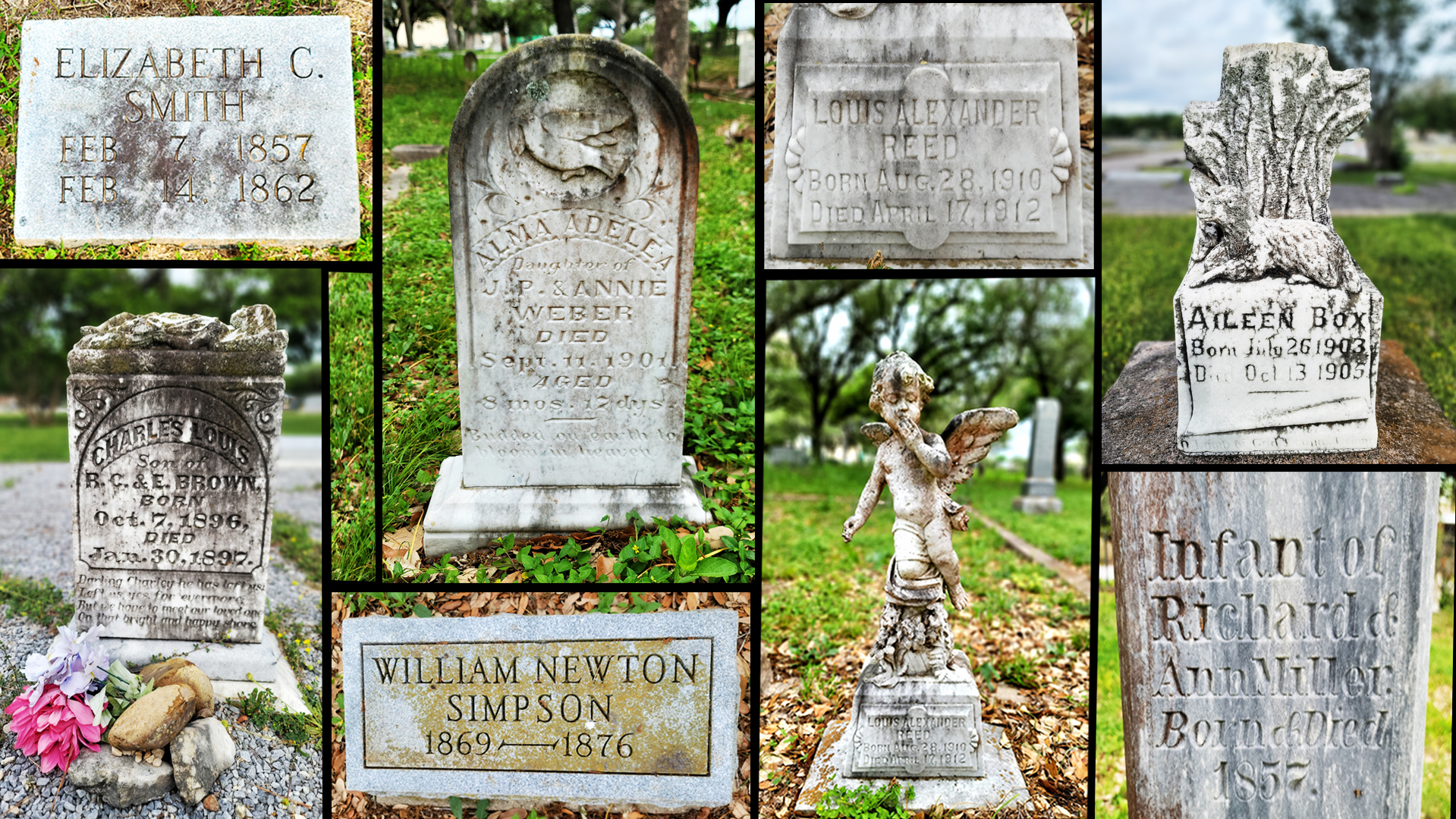
So, where am I going with this post? Well, I want to ask you a favor. I fashioned this collage from grave makers I recently found in the Lockhart Cemetery of Cuero, Texas, and the Oak Hill Cemetery of Goliad, Texas. They represent only a portion of the young ones interred at these sites.

Will you speak, out loud, one of more of their names and the dates they lived? Here they are:

  • Elizabeth C. Smith, born February 7, 1857; died February 14, 1862.
  • Charles Louis Brown, born October 7, 1896; died January 30, 1897.
  • Alma Adelea Smith, died on September 11, 1901, age 8 months and 17 days.
  • William Newton Simpson, born 1869; died 1876.
  • Louis Alexander Reed, born August 28, 1910; died April 17, 1912.
  • Aileen Box, born July 26, 1903; died October 13, 1905.
  • Unnamed infant of Richard and Ann Miller, born and died in 1857.

Speaking the names of the dead (known as necronyms) is taboo in some cultures, shrouded in superstition about the afterlife. However, in my hometown of San Antonio, there is a different attitude, summed up in the yearly Dia de los Muertos celebrations. Families build altars to lost loved ones, then encourage us to not only speak their names, but to view objects and photos that elicit their presence. The celebration also binds us with the living, calling us to treasure whatever precious days we are given with them.

So, if you have conjured the presences of Elizabeth, Charles, Alma, William, Aileen, or the unnamed child of the Millers, my hope and prayer is twofold. May you commit yourself once again to the protection of children everywhere on this planet, no matter their nationality or race. And may you breathe the air of this day with an uncanny gratitude for every loved one that graces your life.

Namaste.

The Overview Effect

(Nationalism, religion, political ideologies, greed, and naked power grabs continue to fracture the human race, pitting us against each with tragic consequences. It leads me to share this chapter from my 2014 book entitled Invitation to The Overview, downloadable for free at this link.)

In my childhood family, what we called the “space race” was personal. I grew up in the 1960s in southern California, my father in charge of financial controls for the Apollo module. He consorted with famous astronauts and legends like Werner Von Braun. When it came time for “take your son to work day,” I got a chance to scramble through a mock-up of that small cone-shaped capsule designed to withstand both fiery reentries and violent splashdowns in the oceans of earth.

I remember the excitement in our home when a Saturn V was ready to launch a new mission from Cape Canaveral. Dad would rouse us from bed like we were about to embark on a dream vacation. He would lead us into the family living room where an early generation color TV sat on its throne. There we could see the rocket, aimed for the cosmos, steam billowing from beneath, its tip crowned with the Apollo. Dad would stalk around that screen with more intensity than a Brazilian soccer fan, the clock announcing T minus 4 hours, then 3, then 1, then the final dramatic countdown and that glorious, thunderous liftoff into the sky.

In retrospect, I know that our efforts to reach that lifeless chunk of rock were as motivated by competition as they were by scientific wonder. It was an expression of US pride, an extension of the longstanding Cold War. No Russian was going to conquer the moon before us! I’m also sadly aware of the military agendas that attended our forays into space, resulting in Strangelovian plans years later to deploy a “near space” defense system. Our land and sub-based nukes were apparently not enough, even though they represented enough doomsday power to demolish every major city on earth. We thought we needed missiles in orbit, polluting space with hardware and cancerous hatred. Thank God that plan never came to fruition.

Still, when Neil Armstrong took his immortal first step onto the lunar surface, it was a moment of wonder, a celebration of the imagination and possibilities of humankind. It taught us about our potential.

But there is an even more enduring lesson from our ventures into the beyond. It is called the The Overview Effect, a term first coined by Frank White, who explored them in his 1987 book, The Overview Effect — Space Exploration and Human Evolution in 1987. It is that moment when we turn and see our planet suspended in the vastness of space. For everyone who experiences it, this vantage point is life changing. It transforms their perspectives on Earth and humankind’s place upon it.

Here are some quotes from astronauts about their overview.

When we look down at the earth from space, we see this amazing, indescribably beautiful planet. It looks like a living, breathing organism. But it also, at the same time, looks extremely fragile. – Ron Garan, USA

Before I flew I was already aware of how small and vulnerable our planet is; but only when I saw it from space, in all its ineffable beauty and fragility, did I realize that humankind’s most urgent task is to cherish and preserve it for future generations. – Sigmund Jähn, German Democratic Republic

For those who have seen the Earth from space, and for the hundreds and perhaps thousands more who will, the experience most certainly changes your perspective. The things that we share in our world are far more valuable than those which divide us. – Donald Williams, USA

My first view – a panorama of brilliant deep blue ocean, shot with shades of green and gray and white – was of atolls and clouds. Close to the window I could see that this Pacific scene in motion was rimmed by the great curved limb of the Earth. It had a thin halo of blue held close, and beyond, black space. I held my breath, but something was missing – I felt strangely unfulfilled. Here was a tremendous visual spectacle, but viewed in silence. There was no grand musical accompaniment; no triumphant, inspired sonata or symphony. Each one of us must write the music of this sphere for ourselves. – Charles Walker, USA

Looking outward to the blackness of space, sprinkled with the glory of a universe of lights, I saw majesty – but no welcome. Below was a welcoming planet. There, contained in the thin, moving, incredibly fragile shell of the biosphere is everything that is dear to you, all the human drama and comedy. That’s where life is; that’s where all the good stuff is. – Loren Acton, USA

The Earth was small, light blue, and so touchingly alone, our home that must be defended like a holy relic. The Earth was absolutely round. I believe I never knew what the word round meant until I saw Earth from space. – Aleksei Leonov, USSR

The sun truly comes up like thunder and sets just as fast. Each sunrise and sunset lasts only a few seconds. But in that time you see at least eight different bands of color come and go, from a brilliant red to the brightest and deepest blue. And you see sixteen sunrises and sixteen sunsets every day you’re in space. No sunrise or sunset is ever the same. – Joseph Allen, USA

The Earth reminded us of a Christmas tree ornament hanging in the blackness of space. As we got farther and farther away it diminished in size. Finally it shrank to the size of a marble, the most beautiful marble you can imagine. That beautiful, warm, living object looked so fragile, so delicate, that if you touched it with a finger it would crumble and fall apart. Seeing this has to change a man, has to make a man appreciate the creation of God and the love of God. – James Irwin, USA

Suddenly, from behind the rim of the moon, in long, slow-motion moments of immense majesty, there emerges a sparkling blue and white jewel, a light, delicate sky-blue sphere laced with slowly swirling veils of white, rising gradually like a small pearl in a thick sea of black mystery. It takes more than a moment to fully realize this is Earth…home. My view of our planet was a glimpse of divinity. – Edgar Mitchell, USA

A Chinese tale tells of some men sent to harm a young girl who, upon seeing her beauty, become her protectors rather than her violators. That’s how I felt seeing the Earth for the first time. I could not help but love and cherish her. – Taylor Wang, China/USA

What if, like these astronauts, we internalized this overview, tucking it like a pearl of great price into our hearts and minds? What if it caused us to have a fundamental, life-changing paradigm shift? What if national boundaries remained for governmental purposes, but we saw them from the global vantage point of our human family? What if the current conflicts that divide us were eclipsed by our critical need to create planetary tolerance, to galvanize our collective will and protect this pale blue vessel sailing in space?

This leads me to the primary questions of this book. Is your religion, your faith tradition, or your life philosophy contributing to these universal causes? Is it compelling you to find unity, commonality, and peaceful dialogue with others, no matter how alien their faith or lifestyle seems to you? Or is it promoting exclusivity and privilege, erecting walls, fueling ancient hostilities? Is it setting you apart?

As you answer these questions for yourself, consider the glimpses of Universalism in section three—visions shared from the hearts, minds, and souls of human beings who looked beyond the veil of conventionality. The Overview was—and still is—central to their existence. We need more of their breed.

Chase Your Dreams!

(I met Darci Tretter and her sister, Emily, at Lokahi, the communal living compound on the island of Maui. Both of them grew up in a loving family that taught traditional Christian values and practices. When those values no longer spoke personal truth to them, they had the courage to follow their own stars. In many ways, the following words from Darci encapsulate the call to freedom at the heart of my book, The Smile on a Dog: Retrieving a Faith That Matters, remastered and downloadable here for FREE).

My life today is a unique fairy tale, quite different than I imagined when I was a child. Sitting here on my back deck overlooking the Pacific Ocean at sunset, coconut trees waving in the breeze and the sound of children giggling and playing, is a dream come true. A dream I didn’t even know I had.

I grew up with loving parents in a wonderful home, but I felt a lot of anxiety as a kid. Anxiety about school, church, and the soccer games in which I competed. We lived in a sweet little neighborhood, and I spent a lot of time outdoors. I felt a strong connection with the wooded area behind our house, so I spent hours by a babbling brook that had a mysterious, magical appeal. It sparkled with a sense of freedom that matched the freedom within me. A sense of freedom that over time grew dull and dim, eventually stuffed so far away that I had forgotten it existed.

So, at 25 years old, I walked away from my life as I knew it. I left my job as a social worker living in the city. I sold most of my belongings and drove out West. Something was calling me, something I could no longer ignore. It was the call of freedom.

From where I sit now, decades away from that enchanted little girl in the woods, I believe our society has evolved (or devolved) to diminish freedom. Imagine if we all followed the deepest calling of our souls. Would we allow ourselves to be cooped up in an office all day? Or sit in rush hour traffic? Or spend only two days a week with our families and the rest working? I have come to realize that the conventional trajectory of so many folks might have an allure of freedom, but in reality, it’s a life chained to materialism and starved for fulfillment. Fancy cars, designer clothes, and that condo on the beach sparkle with illusory joy, but do they bring us any closer to love, truth, or our deepest selves?

Finding the courage to step outside of the norm was the biggest obstacle between me and my dreams. This was something I had never done before. Even though I always wanted to shine my true colors, I was afraid of what others might think. I played it small and quiet to avoid judgment, but I had a mediocre life, feeling safe but empty. I believe the first breakthrough happened for me when I ended an uneventful relationship. This was something I held on to for so long, thinking it would change, but it finally fell loose, leaving me light and free.

This had a domino effect; I suddenly had ample time to focus on myself. I dove heart first into books, practices, and events that fed my soul. Then, when I moved to the West Coast, I began to find my soul family. I traveled around to music festivals and gatherings that had a common theme of spiritual growth and self-development. Eventually, I made an impromptu trip to Maui, where I landed in a small, intentional community focused on spiritual development using sacred plant medicines.

During the five years I lived there, I went deep into physical cleansing and emotional healing. I woke before the sun to practice kundalini yoga. I fasted on coconuts and cleansed my liver. I sat in ceremonies with ancient-plant teachers to illuminate the truth within my soul and clear my spiritual lens. Something inside me merged with the natural elements around me. I became highly sensitive and intuitive. Perhaps I had always carried these gifts, but they had gone undeveloped. I was able to manifest anything I desired into my reality: financial wealth, a beautiful home by the sea, vibrant health, and eventually my partner with whom I now have three beautiful children.

I believe we all have the capacity to make our wildest dreams come true. It takes courage to step beyond our edges and trust that life will meet us there. It requires shucking off the baggage we carry and freeing ourselves from inhibition.

The freedom we chased as children is our birthright. We simply need to claim it!