After the words of committal. After the plaintive playing of taps or the drone of receding bagpipes. After the folding of flags and the scattering of petals. After the tears and sighs and final thup thup of loam on caskets. Even after everyone had gone, I – conductor of countless graveside services – would remain. And I would wander among the tombstones, the monuments, the shade trees and new mown grass, losing myself in the preternatural stillness.
Today, retired from my years as a cleric, I still frequent cemeteries on my travels. The historic presence of death is a tonic, a prophylactic against apathy, a memento mori in names and dates chiseled on stone. I always thought these reminders of mortality were the primary reason I felt drawn to these places. But recently, I realized there’s another motive that inspires me.
Quite simply, these moments deepen my compassion for humanity, lifting the veil of cynicism that can so easily shroud my feelings about our species. It reminds me that we all grieve, and that our grief could bind us if we let it. Because, in the end, despite our warring madness, our endless divisiveness, our greed, our envy, and our competition, we share the same destiny: the soil from which we arose. This is a common theme of poets, but do we really feel it in our bones on any given day?
As my eyes scan the dates and epitaphs of people who passed before us, I am especially moved by the markers commemorating children. So many of them! Their years cut short before they experienced the rites of passage common to human life. I imagine the visceral agony of their mothers and fathers. We have a word for children who have lost their parents. They are orphans. We have words for men and women who have lost their spouses. They are widows and widowers. Yet we have no moniker for parents who lose their children. It is too unnatural. Unspeakable.
And yet so many children are dying, even as you read these words! Lost in the murderous alleyways of Tegucigalpa, buried in the rubble of Gaza, or blown apart by shrapnel in Ukraine. Others, still alive, walking alongside their mothers in refugee caravans, or languishing in poorly monitored foster care, or living by their wits – with an estimated 100 million others – in ghettos around the world. Street urchins. Unseen, thrown away, forgotten.
So, where am I going with this post? Well, I want to ask you a favor. I fashioned this collage from grave makers I recently found in the Lockhart Cemetery of Cuero, Texas, and the Oak Hill Cemetery of Goliad, Texas. They represent only a portion of the young ones interred at these sites.
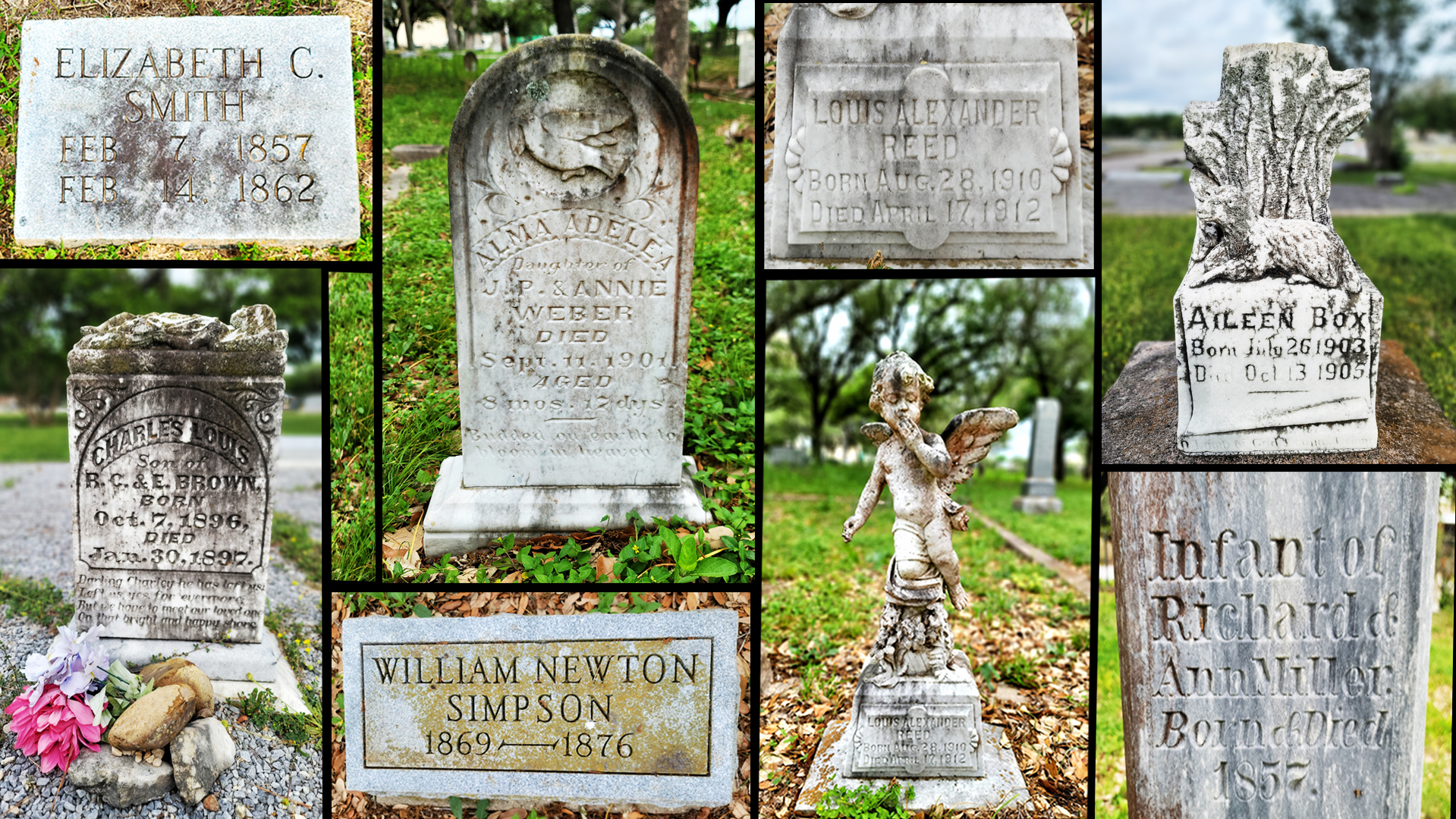
Will you speak, out loud, one of more of their names and the dates they lived? Here they are:
- Elizabeth C. Smith, born February 7, 1857; died February 14, 1862.
- Charles Louis Brown, born October 7, 1896; died January 30, 1897.
- Alma Adelea Smith, died on September 11, 1901, age 8 months and 17 days.
- William Newton Simpson, born 1869; died 1876.
- Louis Alexander Reed, born August 28, 1910; died April 17, 1912.
- Aileen Box, born July 26, 1903; died October 13, 1905.
- Unnamed infant of Richard and Ann Miller, born and died in 1857.
Speaking the names of the dead (known as necronyms) is taboo in some cultures, shrouded in superstition about the afterlife. However, in my hometown of San Antonio, there is a different attitude, summed up in the yearly Dia de los Muertos celebrations. Families build altars to lost loved ones, then encourage us to not only speak their names, but to view objects and photos that elicit their presence. The celebration also binds us with the living, calling us to treasure whatever precious days we are given with them.
So, if you have conjured the presences of Elizabeth, Charles, Alma, William, Aileen, or the unnamed child of the Millers, my hope and prayer is twofold. May you commit yourself once again to the protection of children everywhere on this planet, no matter their nationality or race. And may you breathe the air of this day with an uncanny gratitude for every loved one that graces your life.
Namaste.
 Krin Van Tatenhove - Words & Images