Every family has stories told so often that they’re part of our collective legacy. When older relatives do the retelling, we might roll our eyes. Not this one again…
In my family, there are many. The time my mother caught a 95-pound Nile perch at Lake Victoria. My father setting a senior track record for the mile in his early 40s. My brother catching trout in the Sierra Nevada on a scouting trip, using only a stick, some line, and a bare hook. The time I defied my parents’ warnings and snuck into a screening of Kubrick’s A Clockwork Orange while it still had an X rating.
But there’s no tale as powerful and poignant as the one told by my father about an incident in his childhood. Even now—at age 95—that moment can emerge from his dementia and stir the waters of his memory. In 2019, he preserved the episode as a letter to my brothers and me, claiming he recalled it on a daily basis throughout his life.
Here’s the outline.
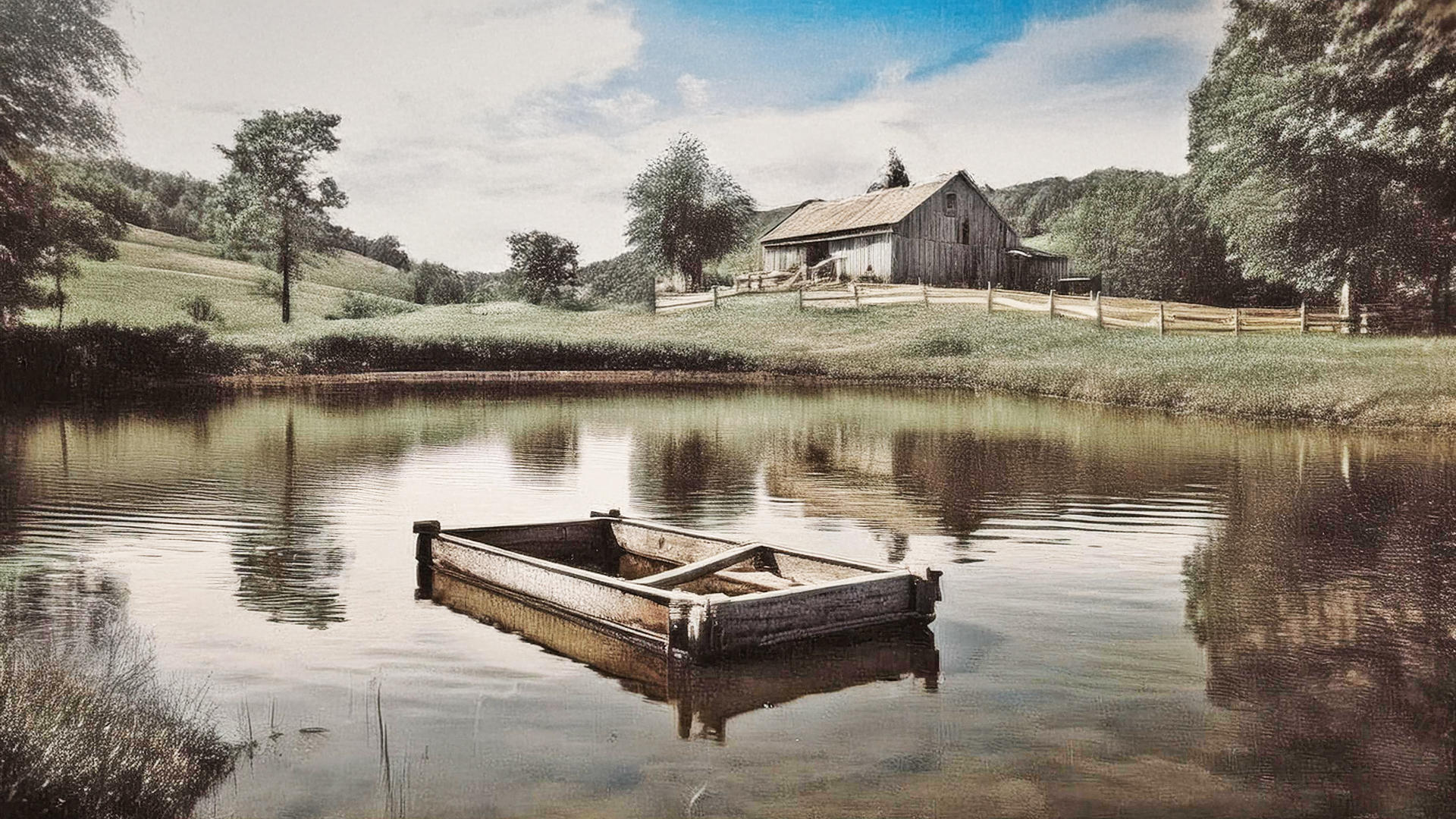
It was the summer of 1935, midway through the Great Depression, and Dad was five years old. On a bucolic day in the countryside, he was with his mother at the Wisconsin farm of some relatives. While she attended a quilting party, Dad went to a swimming hole with his cousin, Sally. Not unlike Dad, he boasted to her that he had just learned to swim. To prove it, he would take a raft to the middle of the pond, which was about 11 feet deep. Then he would let go and paddle back to her, putting his cockiness to the test. I’ll let him tell you what happened next.
“When I reached a spot close to the bank, I gave the raft a shove. However, I was so tired getting it to this spot, and the raft was now moving away from me so that I could not swim to it. As I began to sink underwater, I said a prayer to God: ‘Please do not let my parents blame themselves for my drowning. It was all my fault!’ As I sank, I made one last attempt to breath, but all I got was a mouthful of water. As I passed out, I was floating with white light all around me. This went on for quite some time until I sensed that someone was placing their hands on my hips and lifting me up, setting me in shallower water. When I opened my mouth, water flowed out. I began to breathe but I was blind. Then I heard Sally shouting at me, ‘Why were you down so long? What happened?’”
I won’t idealize my father. Like all of us, he had his faults, especially his workaholism that kept him from spending more quality time with us. That addiction left a vortex at the center of our family.
But in this story—what Dad always called a miracle—I see some of the core beliefs that informed the arc of his life, truly a Horatio Alger story, rising from poverty to the upper echelons of corporate America. If you are agnostic or atheistic like some of my friends, suspend your judgment for a moment and just encounter this human being I call my father.
- Notice that he didn’t ask God to save him for his own benefit. His petition was to spare his parents from blaming themselves that he had drowned. This sense of other-centeredness and duty was a hallmark of his character. One of six boys, he was the only one that cared for his parents in their final years, providing for them physically and financially. He showed that same kind of devotion to our nuclear family.
- He saw his near-drowning as the proverbial second chance in life. God had rescued him for a purpose, and he wanted to honor God for that reprieve.
- After that day, he says he sought God’s guidance at key junctures in life, especially before critical decisions. Though he and I have faith perspectives that are widely divergent, I resonate with the need to find direction from a power greater than myself.
Do you have a childhood memory that lays hold to your mind and heart? Does it still act as a lodestar for your life’s journey? If so, have you shared it with others?
Here are the final words of Dad’s recollection as he transcribed it in 2019.
“When my sight came back, I walked up to the house where mother was attending the quilting party. As she saw me coming in the door, she came to me and said, ‘What has happened to you?’ (There must have been something about my face that she would ask that question). I said, ‘Mom, I just want to take a nap.’
“I kept this miracle to myself for many decades because I didn’t want my parents to worry about me. I told my mother only after she was older.
“Love and prayers to all three of you, Dad.”

 Krin Van Tatenhove - Words & Images