Pole to Pole with an Age Old, Liberating Truth

I’ve been watching Pole to Pole, a National Geographic series hosted by Will Smith. His objective intrigued me: “to travel across all seven continents, to explore the world’s most extreme environments, seeking answers to life’s important questions by stepping into the unknown.”

Episode Four finds him trekking to the Himalayan nation of Bhutan. He was there to explore the secret of happiness, famously enshrined by the Bhutanese in their concept of Gross National Happiness. You got that right. GNH, not GNP.

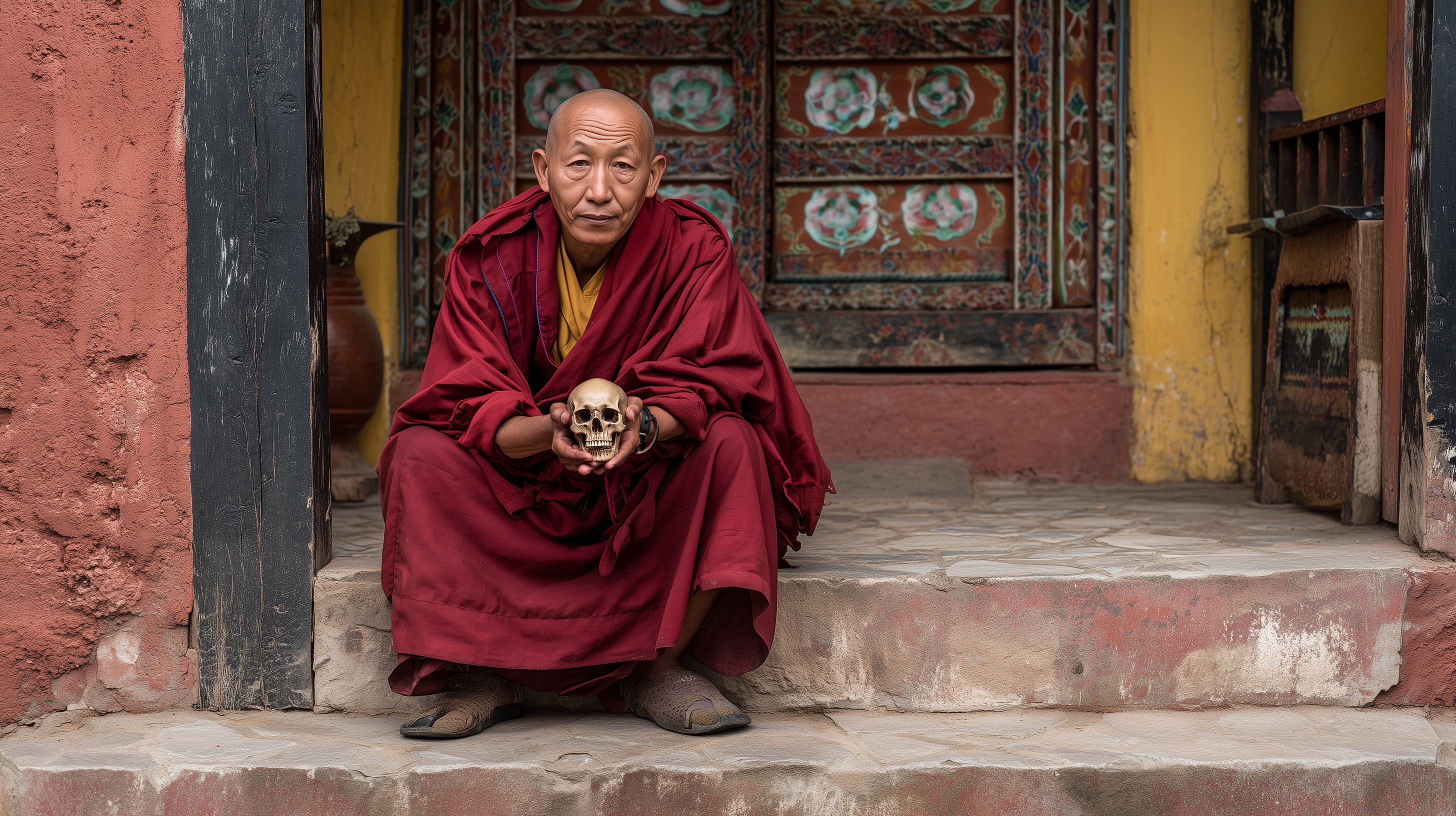
In one scene, Smith sits with a Buddhist monk who offers a disarmingly direct message. If we contemplate death regularly, not as a morbid obsession but as a truth we refuse to look away from, it sharpens our awareness of being alive. It makes the ordinary radiant. It turns the fleeting resource of time into something sacred.

We’ve always known this, haven’t we? It’s one of humanity’s oldest lessons, hiding in plain sight. The fact that we will die is not a curse. It is the condition that gives life its urgency and texture.

And yet, think of how much effort we’ve poured into pretending otherwise.

The pharaohs of ancient Egypt didn’t just accept mortality; they aimed to defeat it. They constructed pyramids, had their bodies mummified, and buried themselves with treasures, all to ensure that their power continued in the afterlife.

Chinese Emperor Qin’s Terracotta Army has stood for two millennia in silent formation beneath the earth. Thousands of life-sized soldiers created to guard him in the next world. Imagine the slave labor, the resources, and the sheer will it took to bring that vision into being. All of it to satisfy an “afterlife ego.”

History is rife with other examples. Roman Emperors deified themselves, casting their likenesses in marble and bronze as a desperate attempt at permanence. Medieval alchemists searched for the elixir of life, convinced that somewhere in the crucible of chemistry lay a secret that could outwit time. Ponce de Leon searched unsuccessfully for the Fountain of Youth.

Fast forward to our modern world. The demand for cosmetic surgery continues to rise, promising a veneer that masks the inevitable. Companies offer cryogenic freezing, allowing us to gamble on a future where science might reverse the irreversible. Even our language reflects our resistance to embrace death’s reality. We “pass away.” We are “no longer with us.” “Grandma is in heaven with Jesus.”

I get it. It’s profoundly unsettling to think that everything we are—our memories, our relationships, our inner worlds—will simply stop. It’s not just our fear of pain or the unknown. It’s the erasure that unnerves us.

As I watched Smith speak to that Bhutanese monk, it was clear to me. The problem isn’t death itself. It’s the energy we spend trying to outrun it.

So, even though it’s obvious, let’s say it again. Each of us will die.  Not someday in the abstract, but actually. No exception. No workaround.

The art is to make this a portal to liberation. Once we stop buffering ourselves from death, it clears the clutter and exposes what matters. Petty grievances lose their grip. Delayed dreams start to feel urgent. The people we love become more vivid, more necessary, and more present in our lives.

Contemplating death doesn’t shrink life. It enlarges it. It makes our morning coffee taste a little better. It makes the sunlight on a wall feel like a small miracle. It reminds us that the conversation we’ve been putting off might be worth having today. It prompts us to feel grateful, knowing how quickly everything can disappear.

Let the thought of your own finitude sit beside you today. Not as a threat, but as a companion. Let it moisten your appetite for the ordinary yet EXTRAORDINARY fact that you are alive RIGHT NOW.

This is not a morbid discipline. It’s a beginning.
Will You Speak Their Names with Me?

After the words of committal. After the plaintive playing of taps or the drone of receding bagpipes. After the folding of flags and the scattering of petals. After the tears and sighs and final thup thup of loam on caskets. Even after everyone had gone, I – conductor of countless graveside services – would remain. And I would wander among the tombstones, the monuments, the shade trees and new mown grass, losing myself in the preternatural stillness.

Today, retired from my years as a cleric, I still frequent cemeteries on my travels. The historic presence of death is a tonic, a prophylactic against apathy, a memento mori in names and dates chiseled on stone. I always thought these reminders of mortality were the primary reason I felt drawn to these places. But recently, I realized there’s another motive that inspires me.

Quite simply, these moments deepen my compassion for humanity, lifting the veil of cynicism that can so easily shroud my feelings about our species. It reminds me that we all grieve, and that our grief could bind us if we let it. Because, in the end, despite our warring madness, our endless divisiveness, our greed, our envy, and our competition, we share the same destiny: the soil from which we arose. This is a common theme of poets, but do we really feel it in our bones on any given day?

As my eyes scan the dates and epitaphs of people who passed before us, I am especially moved by the markers commemorating children. So many of them! Their years cut short before they experienced the rites of passage common to human life. I imagine the visceral agony of their mothers and fathers. We have a word for children who have lost their parents. They are orphans. We have words for men and women who have lost their spouses. They are widows and widowers. Yet we have no moniker for parents who lose their children. It is too unnatural. Unspeakable.

And yet so many children are dying, even as you read these words! Lost in the murderous alleyways of Tegucigalpa, buried in the rubble of Gaza, or blown apart by shrapnel in Ukraine. Others, still alive, walking alongside their mothers in refugee caravans, or languishing in poorly monitored foster care, or living by their wits – with an estimated 100 million others – in ghettos around the world. Street urchins. Unseen, thrown away, forgotten.

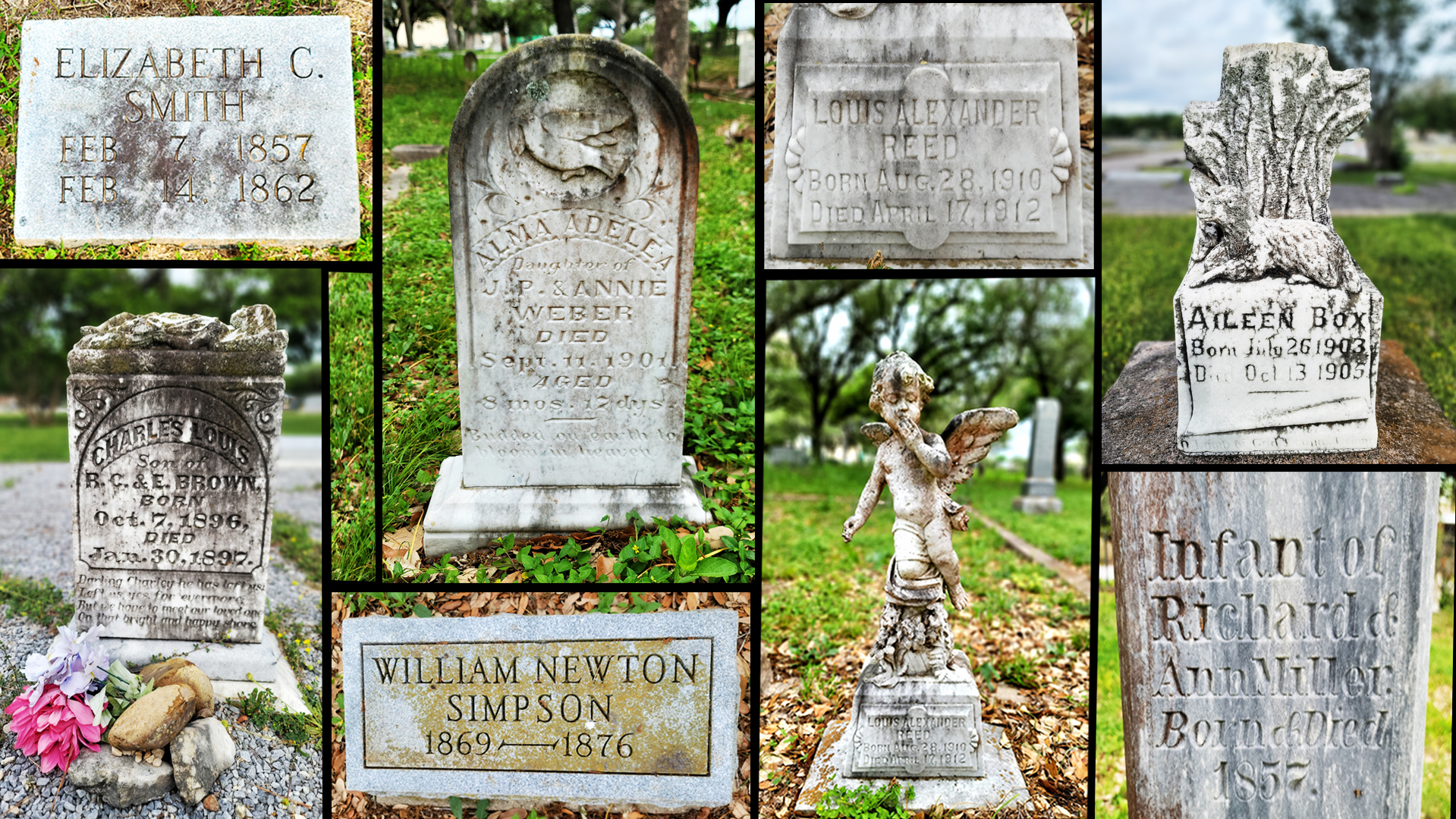
So, where am I going with this post? Well, I want to ask you a favor. I fashioned this collage from grave makers I recently found in the Lockhart Cemetery of Cuero, Texas, and the Oak Hill Cemetery of Goliad, Texas. They represent only a portion of the young ones interred at these sites.

Will you speak, out loud, one of more of their names and the dates they lived? Here they are:

  • Elizabeth C. Smith, born February 7, 1857; died February 14, 1862.
  • Charles Louis Brown, born October 7, 1896; died January 30, 1897.
  • Alma Adelea Smith, died on September 11, 1901, age 8 months and 17 days.
  • William Newton Simpson, born 1869; died 1876.
  • Louis Alexander Reed, born August 28, 1910; died April 17, 1912.
  • Aileen Box, born July 26, 1903; died October 13, 1905.
  • Unnamed infant of Richard and Ann Miller, born and died in 1857.

Speaking the names of the dead (known as necronyms) is taboo in some cultures, shrouded in superstition about the afterlife. However, in my hometown of San Antonio, there is a different attitude, summed up in the yearly Dia de los Muertos celebrations. Families build altars to lost loved ones, then encourage us to not only speak their names, but to view objects and photos that elicit their presence. The celebration also binds us with the living, calling us to treasure whatever precious days we are given with them.

So, if you have conjured the presences of Elizabeth, Charles, Alma, William, Aileen, or the unnamed child of the Millers, my hope and prayer is twofold. May you commit yourself once again to the protection of children everywhere on this planet, no matter their nationality or race. And may you breathe the air of this day with an uncanny gratitude for every loved one that graces your life.

Namaste.