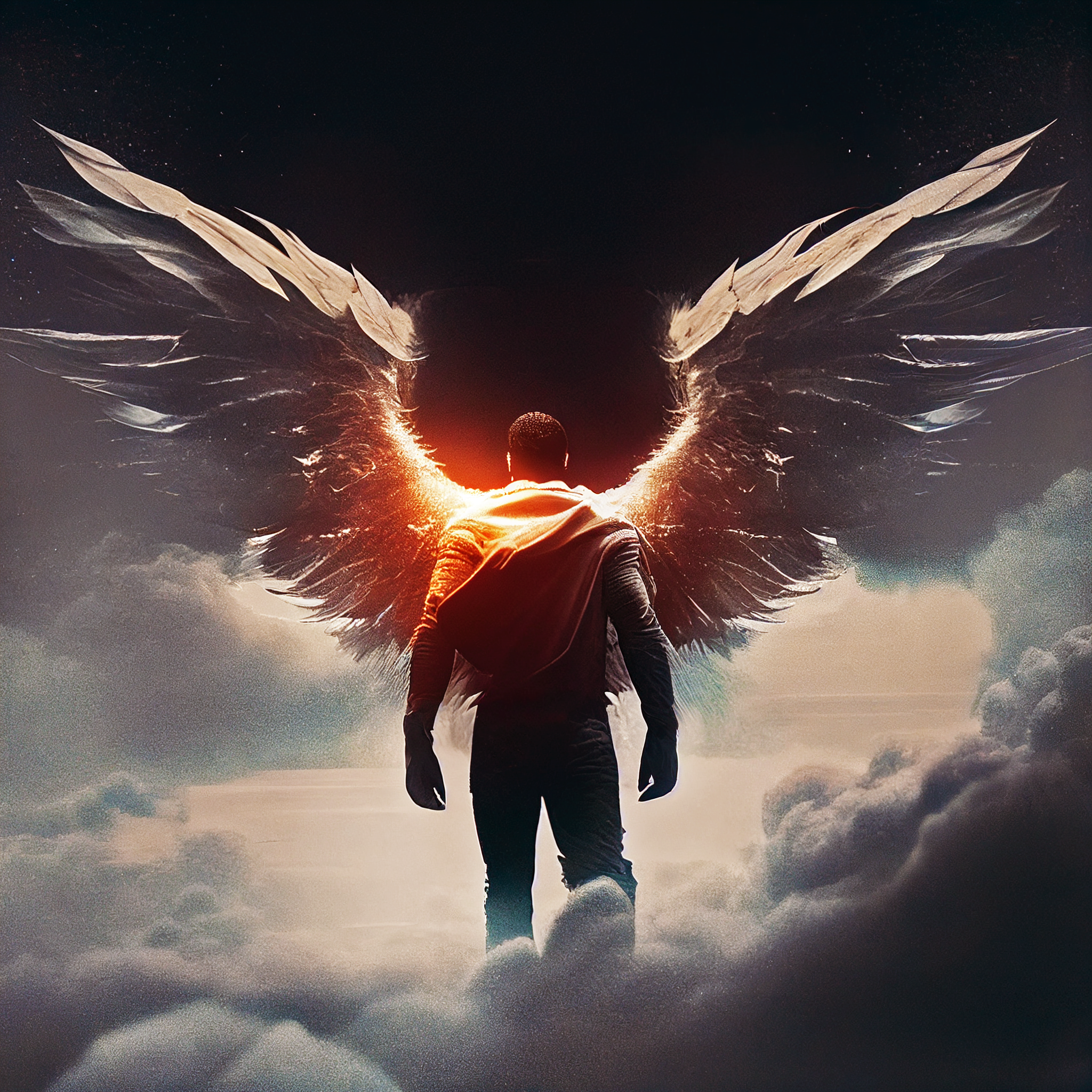
Unsung? Not Today!

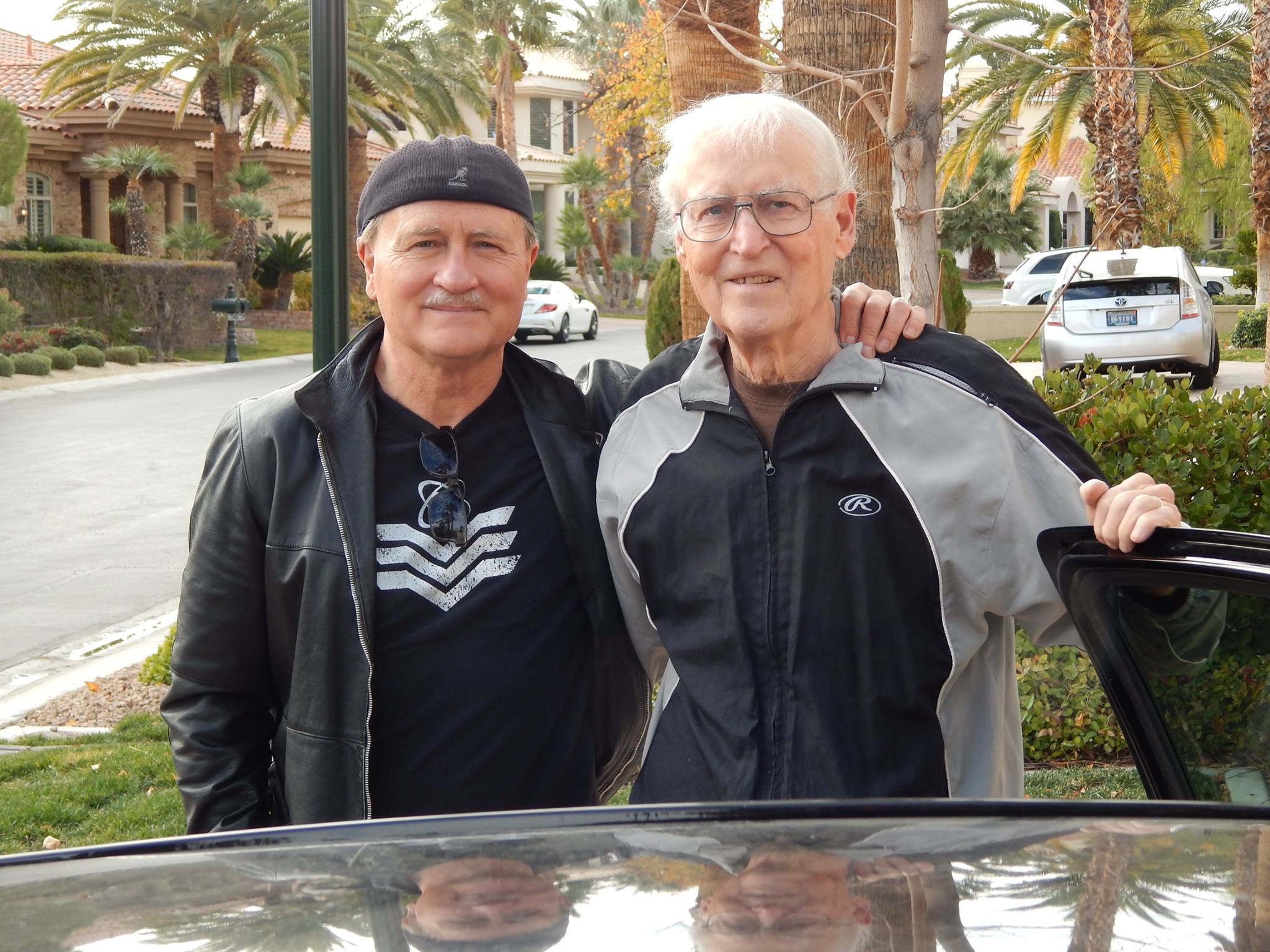
26240433_10211465630985460_9215734007543031285_o
I first heard the word “elegy” in a high school class called Great Books. Our teacher, Bill Cole, introduced us to Thomas Gray’s beloved poem from 1750: Elegy Written in a Country Churchyard. The poet wanders among gravestones, pondering the unsung virtues of people who lived and died in obscurity, summed up in these beautiful verses.

Full many a gem of purest ray serene
The dark unfathomed caves of ocean bear:
Full many a flower is born to blush unseen,
And waste its sweetness on the desert air
.

I have a deep affinity with those outside the limelight, people faithful to the values they cherish, fighting their version of the good fight, running their courses with courage and fidelity. During my three decades as a pastor, I gained privileged admittance to their inner circles.

An elegy is too somber on this Father’s Day, 2021. Instead, I offer this tribute to unsung fathers everywhere. Your love and labor may go unnoticed, but your character matters in the lives of your loved ones!

I had a powerful experience this week. I sat and read the entirety of my father’s memoirs, notes begun in 1950. It’s a remarkable odyssey. He grew up on a Wisconsin farm during the Depression with no running water or electricity. Decades later, he would rise to be a key player in America’s Apollo Program, then serve as the CFO of a multinational corporation.

It’s not his stellar career feats that I celebrate this morning. It’s a moment captured in these words from 1957. I was 16 months old.

I’m writing this about 9:30 p.m. after watching a program on our 21-inch TV. Marilyn has gone to a church meeting and Krin is sleeping. I can hear the hum of the refrigerator in the background and smell the blossoms of the orange trees from the grove just in back of our house.

Why did this memory move me so deeply? Because it captures a father at home with his sleeping child—ME! —keeping vigil. In the ensuing years, my Dad would sacrifice family time for work, an issue we resolved long ago in our loving relationship. But this moment in 1957 reminds me of his steadfast presence in my life.

All you fathers know what I mean. Changing diapers, braiding hair, helping with homework, reading books, cooking, paying bills, chauffeuring, listening, doctoring scrapes and bruises—all the small things that sum up faithfulness on a daily basis. You’re the best!

I also give a shout out to my ex father-in law, Don Oseid, who died many years ago. He consistently nurtured my interest in writing, acting as a mentor and second father. I remember one evening when he came to me holding an anthology open to a particular poem. It was Those Winter Sundays, by Robert Hayden, the first black American to serve as Consultant in Poetry to the Library of Congress, a title now changed to Poet Laureate.

You can read the entire poem here, a son remembering how his father, after a week’s hard labor, got the fires blazing on Sunday mornings, even polishing his son’s shoes. The final words speak volumes.

What did I know, what did I know
of love’s austere and lonely offices?

To all you fathers who inhabit these offices, remaining faithful to the daily tasks of loving your children, I say…

Thank you and happy Father’s Day!


The Middle of Nowhere

Rowena collage

On a lonely stretch of highway north of San Angelo, Texas, my wife Donna pointed into the distance.

“Look at that steeple,” she said.

It rose above a smattering of low-slung buildings, its elegance out of touch with its nondescript surroundings. We love impromptu detours in our travels, so I said, “Let’s check it out!”

As I turned, a faded marker welcomed us to Rowena, Texas, clearly a place long past its prime. Shuttered businesses lined the main street, signs faded with age and neglect. No tourist attractions here—just a dusty, forgotten pitstop.

Then we came to the sharp contrast of St. Joseph Catholic Church. It was immaculate, every brick and painted surface reflecting a pride of ownership. Catholic parishes, unlike their Protestant counterparts, often leave their doors open during the day, so we parked and walked inside.

The interior gleamed, stained-glass reflections slanting across the floor and pews. In the center aisle, an elderly white man, his head bowed, was conversing with a younger man who looked Filipino, dressed in shorts and sandals. I doffed my cap in respect and detoured around them towards the altar.

I tried not to eavesdrop, but the gentlemen’s voices carried in the acoustically sensitive space. I couldn’t make out the older man’s words, but the younger man’s voice was unmistakable. As he listened to his elderly companion, he replied with gentle phrases. I understand…It’s going to be OK…I’ll help you take care of everything.

I noticed Donna edging closer to the men, which made me a bit uncomfortable. I exited out the back, sat in our truck, and while I awaited her return, I googled Rowena.

Texas land developer, Paul J. Baron, platted the township in 1888, naming it Baronsville. German and Czech settlers convinced the Post Office to rename it Rowena in 1904 after the wife of a local businessman. Rowena reached its population zenith of 800 in 1930. Today it has less than 500 residents.

I also discovered that Rowena was the birthplace of Bonnie Parker, born in 1910, living there until her father died and her mother moved her to an industrial suburb of Dallas.

With both windows open, noisy grackles in the trees, I glanced right and left along nearby streets: abandoned buildings, rusty cars, old farm equipment, pavement ending quickly as if dissolving into the earth. I thought of how historical figures often rise up from the middle of nowhere. This time, a woman whose crime spree of 100 felonies with Clyde Barrow became legendary, and whose death at age 24 in a fusillade of bullets is seared into our national psyche.

Donna snapped me back from my daydreaming as she opened the passenger door.

“That was so touching,” she said.

“What?” I asked.

“Those two men,” she said. “It was the priest talking to one of his members. That old man lost his wife of 69 years just a couple days ago. Due to COVID-19, he had not been able to see her at her convalescent home for a couple months. But they finally let him back in and he was with her when she died. He and his wife lived here in Rowena their entire marriage. I just wanted to hug him!”

69 years of dreams, joys and sorrows, a wealth of memories lived out in a place that, to me, seems so remote. A loving, sensitive priest, giving honor to his post in obscurity.

“I told the priest how beautiful the church building is,” said Donna. “He pointed east and said there’s another one about 10 miles down the road.

“In the middle of nowhere,” he said.

What Do You Expect?

Too many of us traffic in half-truths to our own detriment. We find a sensationalized headline or social media misquote, then use it to wield our worldview. We cling to worn out creeds without challenging their relevance on a regular basis.

Half-truths stymie our maturation. Kudos to those who are willing to dig deeper and find the truest version of the truth?”

Consider this motto that is central to the recovery movement: Let go of expectations, because today’s expectations are tomorrow’s resentments.

In many ways, this is only half true. We all have legitimate expectations. In my life:

  • I expect justice, and when I see racist brutality in our country, I will vehemently protest and work for change. The death of my expectation for justice would equal the death of hope.
  • I expect my wife to meet me halfway in the partnership of managing our home and raising our specials needs son. This is our contract of love.
  • I expect my closest friends to be interested in my life, just as I am in theirs. If they remain self-centered, I will choose to spend less time with them.
  • I expect performance from collaborators on a project. If they slack off, I will likely not work with them again.

Having said all this, I know that expectations can also become attachments leading to grief, anger, and resentment. It happens in my life when:

  • I expect certain behaviors from others even though history teaches me otherwise. This is especially hard when I long for understanding or acceptance from certain members of my extended family.
  • I expect an external factor—some accomplishment or acquisition—to give me lasting happiness, leaving me ripe for disappointment.
  • I expect a response from my Higher Power (God, Spirit, Tao) on my timetable, ignoring that waiting is a potent part of spiritual growth.

Ultimately, learning what to expect and what to relinquish is an art, summed up perfectly in the Serenity Prayer. God, grant me the serenity to accept the things I cannot change, the courage to change the things I can, and the wisdom to know the difference.

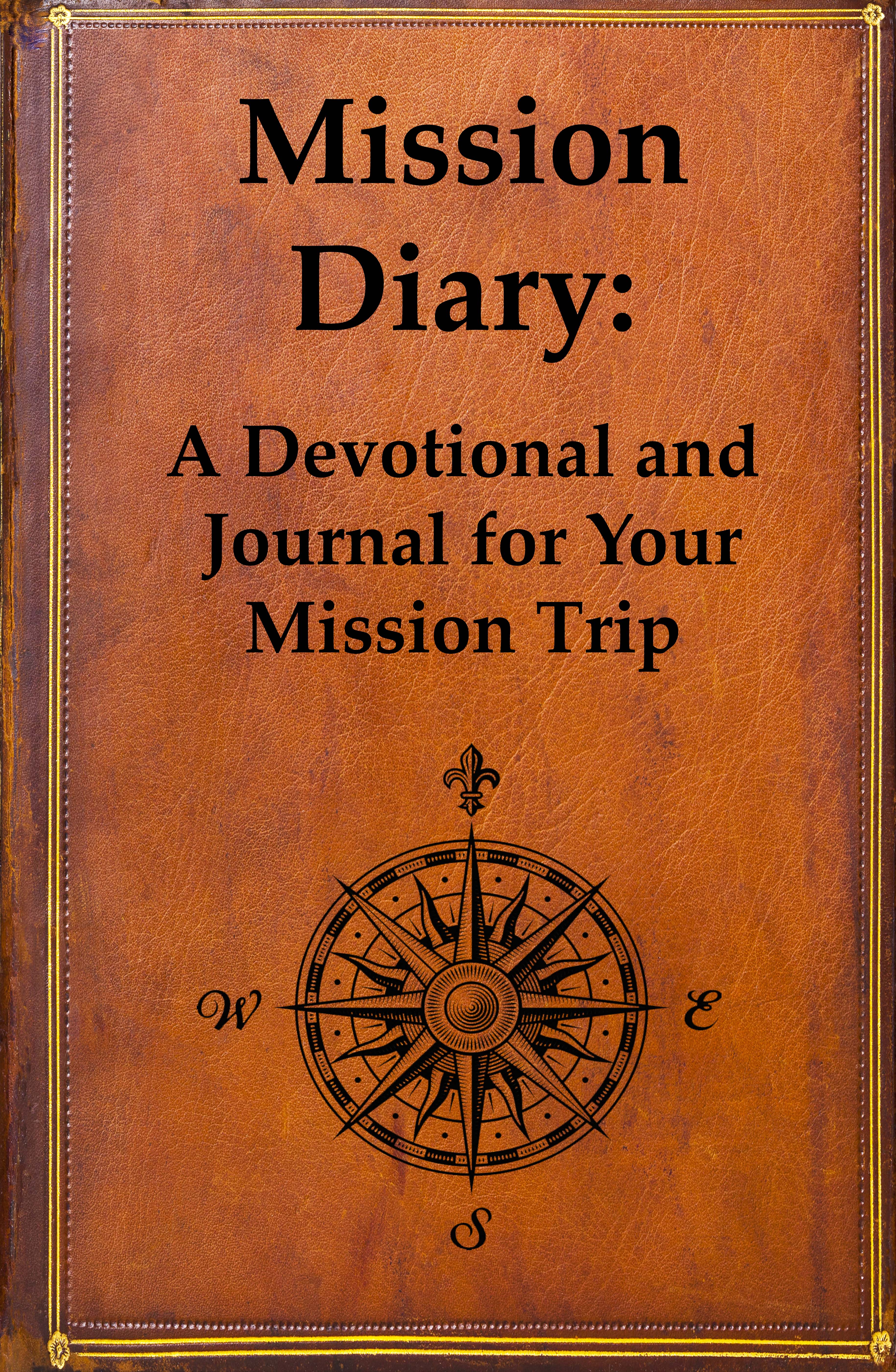
Letting go; this is key! In my collaboration with Heiwa no Bushi called The Six Medicines of BodhiChristo (downloadable here) I share the following.

Siddhartha (the first Buddha) didn’t believe in a personal soul or deity. He held to a pattern of thinking and behavior now called The Middle Way. It strikes a balance in eight different areas: our viewpoints, intentions, speech, action, livelihood, effort, mindfulness, and concentration. The Buddha offered these teachings and disciplines to help others avoid the extremes of thought or behavior that cause us to suffer. This path helped his followers let go of habits that kept them shrouded in darkness.

Here is a description of The Middle Way from Ajahn Chah, a revered Thai Buddhist who died in 1992. It may seem odd to Western minds, but let the analogy unfold.

If we cut a log of wood, throw it into the river, and it doesn’t sink, rot, or run aground on either bank, it will definitely reach the sea. (The Middle Way) is comparable to this. If you practice according to the path laid down by the Buddha, following it straightly, you will transcend two things. What two things? Indulgence in pleasure and indulgence in pain. These are the two banks of the river. One of the banks of that river is hate, the other is love. Or you can say that one bank is happiness, the other unhappiness. The log is our mind. As it flows down the river it will experience both happiness and unhappiness. If the mind doesn’t cling to either, it will reach the ocean. You should see that all emotions and thoughts arise then disappear. If you don’t run aground on these things, then you are on the path.

Because we have not learned to let go of extreme thinking and behavior, our minds are often unsteady. We carom from one fear or preoccupation to another, crashing into the banks of our old, seemingly deterministic modes of living. Every collision is detrimental to our well-being.

Letting go starts as a simple process in our daily lives, but it progresses to ever-deepening levels. Eventually, we encounter deeply rooted resistance that, nonetheless, still invites us to let go. Here are a few examples.

  • Fear: For some of us, the “devil we know is better than the devil we don’t know.” Even if we see the allure of a new life—an azure lake on the horizon of our desert—we have become accustomed to our unhealthy habits. In a sick way, they provide a level of comfort, even if this comfort means sacrificing our freedom.
  • Trust: If we have been hurt in life, or raised in families that were chaotic or dysfunctional, truly trusting anyone or anything is hard. If we let go into a new lifestyle, will the arms of safety be there to catch us? Is our chosen pathway trustworthy? One woman remarked that in her estimate, “God” had never been there for her during difficult times in her life. Why would “God” suddenly show up now?
  • Laziness: Yes, laziness. We realize that applying this medicine will take effort and vigilance. Though others have told us it will get easier over time, we wonder how long it will take. If we submit, what are we getting ourselves into? It takes less energy (lie!) to remain stuck.
  • Deep woundedness: Some of us have experienced trauma that is hard to overcome. We need more thorough counseling from an expert to help us extricate ourselves. This can be especially true for those of us who grew up in families that shamed us. Shame is a deep and toxic response. Like any other conditioning, it can be released, but it helps to seek the guidance of a counselor, mentor, or spiritual guide. Learning the origin of our shame helps us transition to a life of trust and affirmation.

As we release our worries on a daily basis, consider this quote by Richard Rohr from his book The Art of Letting Go: Living the Wisdom of Saint Francis.

Authentic spirituality is always on some level or in some way about letting go…letting go of our false self, letting go of our cultural biases, and letting go of our fear of loss and death. Freedom is letting go of wanting more and better things, and it is letting go of our need to control and manipulate God and others. It is even letting go of our need to know and our need to be right–which we only discover with maturity. We become free as we let go of our three primary energy centers: our need for power and control, our need for safety and security, and our need for affection and esteem.

How about you? What are your expectations? Are they legitimate expressions of your hopes, dreams, and personal dignity? Or, are they attachments causing you to suffer?

Namaste!

Slow Dissolve

It happened on a trail at Big Bend National Park.

I sat down to drink some water and soak in the panoramic view of rock spires reaching to the clouds. As my breathing slowed and my heart settled in my chest, a great stillness and serenity descended over me. Just a whisper of wind in the junipers punctuated by the distant shriek of a hawk.

There are those moments, far too infrequent, when we pass fully through the veil of the present and let it teach us its mysteries. As I sat there absorbing a landscape carved over billions of years, the mental and spiritual pollution of human society began to fade away.

Slowly dissolving…

The trappings of modernity. Plastic bags, plastic smiles, laugh tracks on sitcoms, tickers of every world stock exchange. Social and unsocial media. TV ads, phone apps, Wi-Fi signals. Parasitic technology that consumes our time and spirit.

Slowly dissolving…

Our human divisions of race, religion, class and gender. Creeds and doctrine that separate us. Crosses, grenades, and crusades. Barbed wire, border walls, and the barriers within our hearts. The dueling dualities of partisan politics and their currencies of greed and corruption.

Slowly dissolving…

The most stubborn vestige, my emphasis on Self, the definitions and attachments of identity. Hamster wheel worries and obsessions. My trafficking in words. The Ego gasping for air as it sank away.

Slowly dissolving…

An even deeper stillness enveloped me, a primordial wellspring of time and place, until I felt merged in kinship to our ancient ancestors. Those who raised their faces to the heavens from Olduvai Gorge, or the original people of Big Bend, hunter-gatherers of the Folsom culture.

For a few moments they were gazing with me into the mysteries of eons.

Silence…

Stillness…

Wonder…

A form of communion so rare in daily life…

Sharp peals of laughter from the trail below snapped me from my reverie.

The Unspiritual Spirit

A Buddhist gardener risks his life to remove creeping foliage from the pinnacles of Angkor Wat. He believes he is protecting spirits that live within the temple.

A Catholic man, one of 242, lifts the 11,000-pound throne of Virgen de la Esperanza, parading it through the streets of Malaga, Spain on Holy Thursday. He endures the pain because, “Life has no meaning without going out under the Virgen.”

An initiate at China’s Shaolin Temple practices Monkey Stick routines and memorizes scripture, hoping to be ordained as a Kung Fu warrior monk. His goal is to reach enlightenment.

A young Palestinian man volunteers as a paramedic at Al-Aqsa—the Dome of the Rock—during The Night of Power, Ramadan’s crescendo. By caring for those who have collapsed in the crushing crowds, he seeks to prove himself to Allah.

These religious practices come alive in the PBS documentary series, Earth’s Sacred Wonders: Closer to the Divine. As my wife and I watched the episodes, we marveled at the color and passion of our human family. We have so many rituals, prayers, and disciplines born of our desire to understand the mystery surrounding us. The forms are as diverse as the plumage on our planet’s species of birds!

I try to respect faith expressions no matter how foreign they seem to me. This has become increasingly difficult in America, where a brand of Evangelical Christianity undermines women’s reproductive rights, contributes to prejudice against the LGBTQ+ community, clings tenaciously to the National Rifle Association, and promotes a dangerous brand of nationalism. All in the supposed name of Jesus, the Prince of Peace. Que lastima!

All that aside, there are still many beautiful expressions of what we call spirituality in our world. I continue to try and cultivate my own awareness. And in this journey, I often think of these words by T.S. Eliot from Little Gidding, the final of his Four Quartets.

We shall not cease from exploration
And the end of all our exploring
Will be to arrive where we started
And know the place for the first time.

For me, this knowing, this waking up, is more than just living in the moment. It is an awareness that Presence, Tao, Spirit, God—whatever term you use—surrounds us with love, encouragement, and serenity. It is like inhaling sustenance and light, letting our Source heal us in the deepest recesses of our spirit.

As soon as we start dissecting this experience, giving it names and developing disciplines to grasp it more fully, it can easily slip away. Seeking the “spiritual” often buffers us from Spirit. In the Tao Te Ching, we find these words:

The Tao that can be told is not the eternal Tao;
The name that can be named is not the eternal name.

The nameless is the beginning of heaven and earth.
Ever desireless, one can see the mystery.

How hard this is for human brains that want to categorize and control!

Could the end of our explorations really be here, right now? Is it ultimately so simple, so obvious? I believe it is. And this awareness can infuse every task with new meaning. The late Thich Nhat Hanh said this about his fellow community members at Plum Village, the monastic community he founded in southwest France.

“When we wash dishes…it is to live every minute of the washing. Wash each bowl…in such a way that joy, peace, and happiness are possible. Imagine you are giving a bath to the baby Buddha. It is a sacred act. I have arrived. I am home. Through these two phrases, you can experience a lot of joy and happiness.”

Eliot’s words are probably true. We will not cease from exploration. We will continue to invent elaborate rituals designed to find the One. We will grind out volumes of theology, debating the nuances of our beliefs, while the present moment slips past us.

But what if, sooner than later, we discovered we are already home?

Where is the Habitat of Your Heart?

Studies show that our favorite music—the tunes that stir us the most—come from the soundtracks of our younger years. Musicologist Nolan Gasser, architect of The Music Genome Project, says that even though our tastes evolve, “The music people listened to at an early age becomes their native home comfort music. It will always be a part of who they are, tied in with deeper memories. It becomes a stake in the ground that says ‘this is who I am.’”

This rings true for me. My playlists are eclectic—new age, ambient, 70s/80/90s, jazz, metal, reggae, flamenco, bluegrass, folk—but there are certain classic rock tunes that transport me to another time and place. As Boston said, “It’s more than feeling.” I see this in my parents. On a recent visit, they asked me to sit with them and watch a rerun of an old Lawrence Welk episode. I squirmed in my chair, but they were enraptured.

This kind of organic resonance also applies to our favorite places. In a book I recently co-authored, one of the chapters begins like this:

“Think of a place that has a powerful hold on you. It may be a family homestead, a setting in nature, or a venue in your city where you spend quality time. These locations evoke more than memories; they stir our spirits and connect us with memories of times past.”

Where is this habitat of your heart, past or present? Specifically, where is that place in the woods, the fields, the mountains, or along the seashore that stakes your heart powerfully in time? Tell me its sights, smells, sounds and textures.

For me, the chaparral hills of Southern California, mingled with orange and avocado orchards, will always lay claim to my spirit. This was the playground of my childhood. It’s Mediterranean climate, Santa Ana winds, sage, manzanita, scrub oak, and “warm smell of colitas rising up through air.” Its kingsnakes, alligator lizards, roadrunners. The intoxicating aroma of orange blossoms on a summer evening.

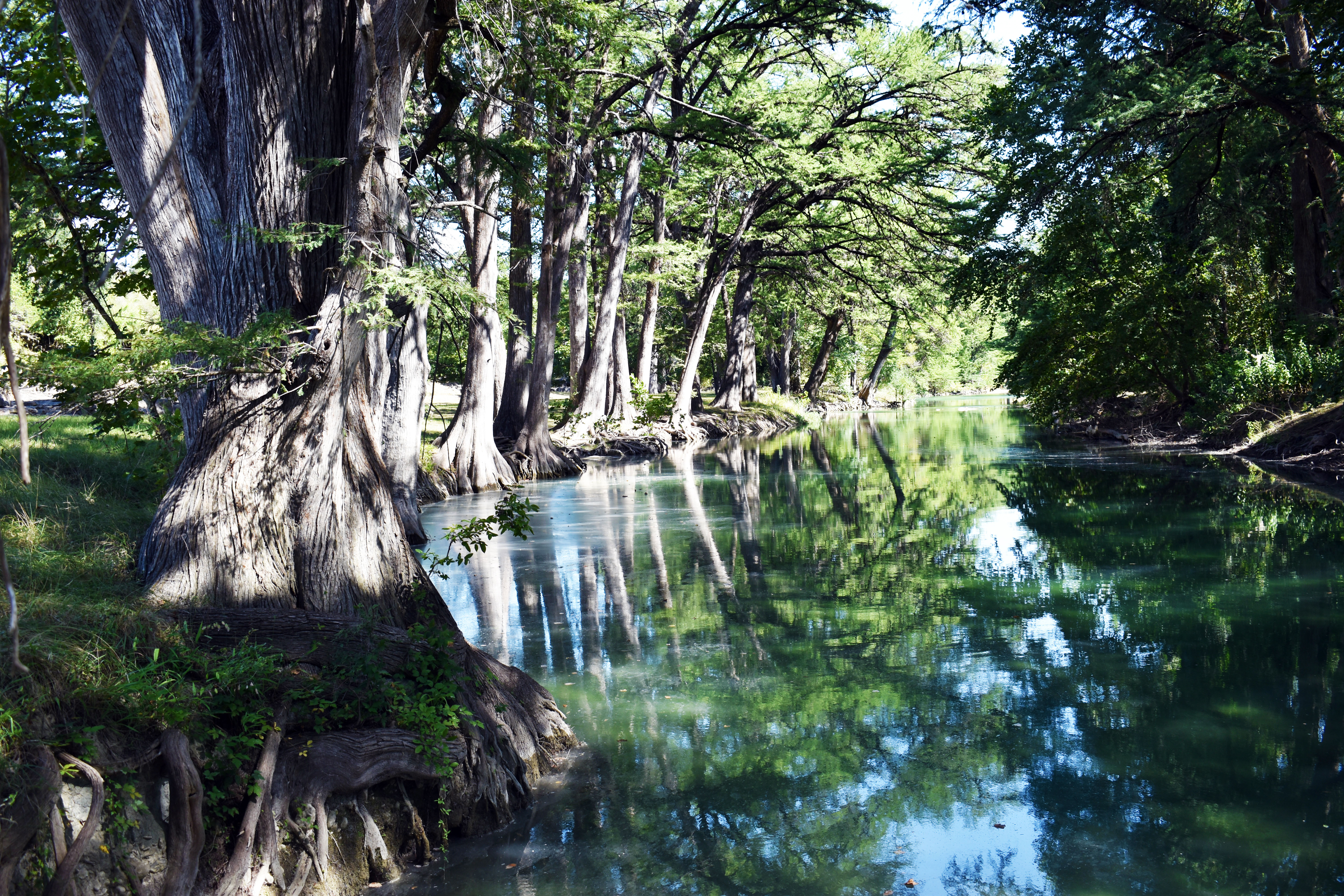
As a geographical transplant, I now have a new heart habitat. 15 years in Texas has led me to a lasting kinship with its Hill Country, especially its cypress-lined rivers. When I feel restless, experiencing what Richard Louv calls “nature deficit,” I drive a half hour north to Bandera. I park at a secluded place on the northern edge of town, then walk to the banks of the Medina River and wander slowly along its course. I am learning the names of trees, shrubs, flowers and grasses in this biome. Its birds, butterflies, reptiles and mammals are becoming family members.

I have taken this walk countless times, savoring every season, but it is always fresh. Here is an image from a recent trips.

Medina River banksI ask again: where is the habitat of your heart? If it’s a childhood place and you still live there, immerse yourself! If you live in a new locale but have not discovered a habitat to cherish, get out there!

As Stephen Stills sang, “If you can’t be with the one you love, love the one you’re with.”


In Defense of Perla

Early morning, a colonia on the outskirts of Reynosa, Mexico. Chilly winter air tinged with smoke from trash fires. The neighborhood is mostly shacks cobbled from old wood, tin, and cardboard. There is no running water; the city has promised electricity, but so far those pledges are hollow.

Most of the residents are migrants from Chiapas, lured to jobs in maquiladoras along la frontera. These are not squatters. They have purchased their tiny lots with a mortgage through Habitat para la Humanidad, and now they hope to build their dream homes: 500 square foot, cement block structures with 2 bedrooms, a living space, a kitchen, often housing large families. Latrines remain outside.

884274_avs-front-pic

Our crew of volunteers is inspecting construction sites. We will work alongside members of the community, a day of labor and fellowship, but first I have other tasks. Word has rippled through the dirt streets that a pastor is present, and I have received invitations to bless homes recently completed. One family asks me to pray for their newborn child.

I am glad to oblige, even though my bendiciones are clumsy mixtures of English and broken Spanish. It doesn’t matter. I have friends who translate, and my smile and eyes communicate more love than my words could ever convey.

One house after another, joining hands, lifting our hearts to God with petitions for abundance and safety. I receive many more blessings than I give, especially when I arrive to pray for the infant. Her home is a one-room shack where she lives with her parents and two siblings, walls of scrap plywood, a roof of rusted tin. Outside is a cooking fire, and they share a pit latrine with an adjacent family.

An old bench seat from a bus is near the front door, listing slightly, its surface torn to reveal the springs beneath. The parents ask me to sit as they bring their tiny daughter to me, only two weeks old.

Que preciosa,” I say. “Come se llama ella?”

Perla,” is the answer.

I cradle the girl in my arms, bundled in blankets. She is quiet, her dark eyes staring up at me, and though she will never remember this moment, it is sacramental for me.

I make the sign of the cross on her forehead. I pray for God’s guiding hand to be upon her and her family all their days, giving them strength, safety, and abundance for this new life they seek to establish.

Then I hold her against my chest for a moment, encircled by her family and smiling neighbors.

Our work that week was a triumph for all of us. Yes, we helped two structures rise from that neighborhood, but more importantly we joined our hearts across cultures, time, and space.

Months later, through my Habitat connections, I received a photograph and a brief note. Perla’s family was standing proudly in front of their new home, and the words said: “To Perla’s padrino. Muchas bendiciones.” To Perla’s godfather. Many blessings!

In over three decades of ministry, I have occasionally been asked what drives my passionate efforts for justice and peace. I could give answers complicated by theological jargon, socio-economic statistics, or political convictions, but my reasons are far simpler.

I act in defense of Perla and countless others I have met. I stand in unity with those struggling on the edge, joining hands in our one human family.

You see, Perla is also my daughter. She is your daughter as well.

 Selah!

Born Again?

There are people with stellar IQs who are short on common sense. People who exhibit genius within the narrow bandwidth of their expertise but lack any breadth of cultural literacy.

Conversely, there are human beings who will never be labeled brilliant by societal standards but who startle us with insights about life. I know this firsthand as father to a special-needs son. Kristoffer often voices simple nuggets of wisdom that awaken me to what is truly important.

I believe there is one definition of intelligence that is sorely needed in all of us. It is the ability to get outside ourselves and our given culture. The ability to see our reality in time and place, then respond (not react) to it with a fresh, objective perspective.

Sociologists say that when it comes to our cultures, we are like fish in water. We swim in the conditioning of our upbringing, our genetic makeup, our juncture in history. Often, we never rise above these determining factors. We never decide what to claim and what to reject, what to shed and what to make part of our flesh. Examples are rife in our world.

  • People who adopt the spoon-fed religion of their tribe or nation, then wield it as an exclusive truth that trumps the faith and beliefs of others. James Fowler, in his Stages of Faith, called this Stage Three—Synthetic-Conventional Faith—a closed mindset that prevents us from celebrating the mystery of spirituality in all its diversity.
  • People reared with a righteous sense of patriotism, an idolatry of their country’s identity and flag. American Exceptionalism is a tragic example, but history is replete with similar examples of dangerous nationalism.
  • People indoctrinated with racism, sexism, or homophobia who never rise about the fear that promotes their exclusion and hatred.
  • People whose skin color or class has afforded them a privilege that traffics, consciously or not, in systemic injustice.
  • People raised to put their trust and security in material things.
  • People trained to gauge their worth by the hollow standards of power and prestige.

In the Christian Gospel of John, Jesus has a clandestine meeting with the Jewish leader Nicodemus. He says to him, “Very truly, I tell you, no one can see the kingdom of God without being born from above.” (John 3:7) It’s a pity that these words have been coopted by Christian fundamentalists as being “born again,” a pat phrase that means conversion to their brand of Stage Three Christianity.

I see them as a deeper call to wake up, to be born outside the determinates of our lives, to recognize the timeless existence of Source’s liberating presence that permeates everything around us.

When this happens, the scales fall off our eyes in a kind of conversion experience. I believe we ALL need this transformation. It helps us evolve into citizens of the world, not just the territories of our genetic and cultural conditioning.

This is hard work. It begins with a sobering analysis of our own habitual thinking, our prejudices and privilege. It often requires repentance, amends, even restitution. But the resulting freedom is well worth the effort!

How did Jesus describe this freedom in that conversation with Nicodemus? “The wind blows where it chooses, and you hear the sound of it, but you do not know where it comes from or where it goes. So it is with everyone who is born of the Spirit.” In a mysterious and beautiful way, this is a powerful image of liberation.

Kristoffer recently said, “Dad, there will never be peace unless people change.”

Amen! I could phrase it another way. There will never be peace until more people are born again into the ENTIRE human family, not just their tribe or nation.

Are you next?

Box of Darkness

From the introduction to Box of Darkness. Here is a link to the entire book.

The title of this book comes from The Uses of Sorrow by Mary Oliver, beloved American poet who died on January 17, 2019. She wrote it following the death of Molly Malone Cook, her partner for 40 years. With her usual straightforward imagery, Oliver reminds us that the darker aspects of life can offer surprising inspiration.

We invited the following artists to share some of their work, prompted by simple questions: ‘How do you receive inspiration from the darker fringes? How are you drawn artistically to the shadows?’

The result? A box of darkness, presented through paintings. photographs, collages, and poems. Our images and words are eclectic—a multiplicity of perspectives—but together we invite you to become more familiar with your shadow side, finetuning your eyes to its presence.

Krin Van Tatenhove and Angelica Gudino, Editors/Curators

Photo for Crowdfunding campaign