Of Sonograms, Ahab, and the Right to Choose

The young woman, daughter of a struggling single mother in our church, came to my office with a cloud of confusion surrounding her. She had just discovered she was pregnant, and her young lover—backed by his family and their money—was demanding that she have an abortion.

“I don’t know what to do, Pastor,” she said. “I feel like I’m too young to care for a baby, and I know I won’t get any help from his family if I decide to give birth. I’ve got so many feelings. Mostly I’m angry…pissed off at him and myself for not being more careful. But I’m also afraid and sad…”

Her voice trailed off as she hung her head and quietly cried. After a few moments, she looked up at me.

“What do you think I should do, Pastor?” she asked.

“First of all,” I said, “please know that whatever you decide, I will always support you.”

“I appreciate that,” she said, “but still, what do YOU think I should do?”

“I am deeply opposed to abortion,” I said. “My personal belief is that life begins at conception, and that the genetic material setting the stage for your child’s life is already present. I feel it is wrong to violently end what has begun in the womb. But I also believe that as a man I can’t make decisions about what women decide to do with their bodies and their futures. That is why I am pro-choice, even though abortion seems tragic to me. If you can’t care for this baby, you might consider adoption as an alternative. But I truly mean this…whatever you decide is between you and God. I will always support you.

I paused for a second, then added, “What does your mother think?”

“She kind of surprised me. I expected her to freak out and lecture me, but she said that even though she would help with a baby, the decision was ultimately up to me.”

She sat up straighter in her chair, and it struck me how the magnitude of this choice was weighing on the shoulders of a 16-year-old teenager. She would never be the same.

“Thank you for sharing with me,” she said. “I still don’t know what I am going to do, but I do appreciate everyone’s concern.”

“Of course,” I said. “You can talk to me any time you wish.”

I listened some more as she spoke about her relationship with her boyfriend. Then we had a prayer together and she left.

That memory returned to me a few years ago when I saw a sonogram of the twins inside my daughter-in-law’s womb. My grandchildren were taking shape quickly – small human beings, their features already emerging. I’ve heard the arguments regarding unwanted infants born into poverty. I fully realize that the world is plagued by overpopulation, and that millions of children go hungry or suffer from violence. Still, a child in the womb is one-of-a-kind, an emerging creation like no other. What a miracle!

The battle over a woman’s right to choose will continue in America. The recent Supreme Court decision to strike down Roe v. Wade has been met by opposition in states that are securing legislation to protect reproductive rights. One thing is obvious. For many conservatives in this country, outlawing abortion has become like Captain Ahab’s legendary obsession with Moby Dick. They will pursue it at all costs, supporting politicians whose morals are contrary to everything else they believe. They will even risk the unravelling of democracy. In this one area—limiting a woman’s choice—they have the narrow-minded zeal of jihadists.

For myself, I hold fast to a key component of my faith—that our Creator has given each of us the sanctity of our own conscience, free from the dictates of other human beings.

That young woman made her decision, then returned to church two weeks later. I welcomed her with a hug.

That Damn List on the Altar

She calls it her altar—a small, squat table at one end of her bedroom. Every morning she sits on a pillow in front of it, lights a candle or two, then practices mindfulness by bringing herself into the present. The altar is lovingly decorated with icons from her spiritual adventures around the globe: a spray of white sage gifted by a member of the Taos Pueblo, a Mayan-style amulet from a shaman in Cusco, a Celtic cross from the Iona Community in Scotland, a picture of her and her “sisters” dancing under a full moon near the ruins of Templo Mayor in Mexico City.

And then there’s the list. “That damn list,” she says with a self-deprecating laugh. It was sent to her by close members of her extended family, a step-by-step outline of how to find the salvation that comes only through Jesus Christ.

When she received it in the mail, it stabbed her heart with multiple levels of grief. She knew once again that her path and the path of her loved ones were continuing to diverge. She knew that despite her efforts to foster mutual acceptance, there was no room for her brand of spirituality in their eyes. She grieved because love in all its fullness would not be mutually experienced in their relationship.

But she also felt the bile of anger, an acid taste that surprised her. It told her that she had not fully healed from her time among conservative Christians. She felt twinges of animosity towards their “our way is the only way” theology. She resented their efforts to reduce her rich complexity to either/or categories, a sickness she sees in our world at large, especially America. She even felt some recrimination towards herself for all the energy she expended over the years seeking the approval of others.

So, what did she do? She placed the list in a prominent place on her altar, unavoidable whenever she sits down to meditate.

“Why did you do that?” I asked.

“Because that list represents an area in my life that still needs healing, a buried resentment that is keeping me from freedom. My goal is that someday very soon, I will look at that list with only unconditional love, forgiveness, and compassion towards my family, praying that God will surround them with the grace that leads to acceptance.”

Then she chuckled. “Meanwhile, I call it that damn list.”

After our conversation, I sat in my study and mulled her words. I recalled the countless times I counseled people about the need for forgiveness during my decades of ministry. I thought of the metaphors I used, including my favorite from Lewis Smedes, the “forgiveness guru.”

To forgive is to set a prisoner free and discover that the prisoner was you.

I ask you, dear reader: do you have a “list” in your life? A memory of a person or incident that stakes a dark claim to territory in your mind and spirit? If so, I ask you to seize the truth so clearly demonstrated in my friend’s life. Growing spiritually requires discipline and focus. We can heal, but it takes mindfulness. Moreover, the tools we need can be found in many world traditions and faiths.

Though my friend will not be called Christian according to any orthodox definition, her reason for pondering that damn list is one of the most Christ-like behaviors I have encountered in years.

As Jesus reportedly said, “Whoever has ears, let them hear.”

The Angel Who Climbed into My Truck

Still sweaty from my workout, I pulled out of the gym’s parking lot, and there she was on the opposite sidewalk: a thin woman in her seventies, wraith-like, wearing a loose house dress and simple white sandals. She clutched a spray of pink flowers and a large purple wallet against her chest. Her hair—dirty blonde and streaked with gray—fell in wet strands to her shoulders.

I had no air-conditioning in my old truck, so the windows were wide open for every breath of air. As I came to the stop sign, she looked across the street at me with imploring eyes.

“Do you know where 909 Cloverdale is?” she called out.

“No, I’m sorry,” I said.

“Oh dear,” she exclaimed, “I seem to be lost.”

I checked my rearview mirror. No cars.

“Tell you what,” I said, “Let me turn back around through the parking lot, check the address on my phone, then give you a ride.”

Her eyes brightened.

“If you don’t mind. That would be wonderful!”

I googled the coordinates and made a U-turn. She walked—no, glided—across the pavement to my passenger side door. She struggled to get into my truck’s high seat, so I reached across and firmly gave her a hand. A smell like lavender and vanilla filled my musty cab.

As I began the drive, she made some whispery comments.

“This looks a bit familiar…wait, no…was that where we were supposed to turn…no, here…maybe…I just don’t know…Lord…”

“Don’t worry,” I said. “I’ve got the address. When we get there, you can tell me if it’s the right home. If not, we will find it. I promise.”

The house was a couple twisting miles away, and as we got closer, questions came to mind. Had she wandered away from a care home? Should I call someone? 

“What’s your name?” I asked.

“Evelyn,” she said. “And what’s yours?

“Krin.”

“That’s unusual. I’ve never heard that one before.”

“Neither have I,” I said with a grin. “It’s taken awhile to grow into that uniqueness.”

She laughed, and her wrinkles seemed to dissolve, the face of a younger woman peering out as if from underwater.

“Where did you get the flowers?” I asked.

As if she’d forgotten them, she stared down, lifting them to her nose.

“I don’t know,” she said, “but aren’t they beautiful?”

“They sure are. You have excellent taste.”

She tilted her head like a small curtsy, and then we reached the address.

“Yes!” she exclaimed. “That’s it!”

Immediately, she was all business, straightening her dress over her knees, clutching her bouquet and pocketbook to her chest, sliding to the sidewalk. Was this really the house?

“Do you want me to walk to the door with you?” I asked.

“No,” she said, “that’s not necessary.”

“Well, goodbye Evelyn. It was a pleasure to meet you.”

“Thank you for your kindness, sir,” she said, her eyes going inward for a moment as if probing. “Krin, right?”

“Yes.”

She smiled, walked to the door, fumbled in her purse, extracted a key, then opened it with ease. I idled at the curb, waiting. She turned, smiled, waved the bouquet like a bridesmaid at a wedding, then was gone.

As I drove away, I recalled a verse from the Christian book of Hebrews. “Do not forget to show hospitality to strangers, for by so doing some people have shown hospitality to angels without knowing it.”

It was such a simple favor to offer, yet all the way home I felt wings on my shoulders.

Building, Not Burning

Is this penchant born of my former profession, or a natural part of my personality? I suspect the latter, but here it is: I constantly see metaphors in the world around us.

per-5

My wife and I have been watching a documentary called Kingdoms of the Sky. It overviews landscapes, animals, and people that inhabit the Andes, Rocky Mountains, and Himalaya.

The Andes episode startled us with facts and images: birds that nest in glaciers; Salar de Uyuni, the world’s largest salt flat that becomes an immense natural mirror when glazed with rain, reflecting clouds by day and the Milky Way by night.

Then came the portion that screamed METAPHOR! It chronicles four family groups (tribes) that trace their lineage to the Incas. Separated by peaks and chasms, they come together annually to build Q’eswachaka, the last surviving example of a woven Inca suspension bridge. Recognized by UNESCO for its “intangible cultural heritage,” Q’eswachaka spans a section of Collasuyo, an ancient Inca road that connects Cusco to Titicaca.

Building the bridge is a three-day, communal project, performed annually because harsh seasons erode last year’s work. Villagers of all ages harvest grass that forms the rope’s fiber, then weave it into strong cords using pre-Columbian techniques. Priests bless the process with offerings and prayers in Quechua, dedicating the effort to Pachamama (Mother Earth).

The metaphor is that the bridge leads to community, and it raises a vexing question. In our culture separated by peaks and chasms of race, class, and ideology, will we ever find ways to build new connections?

This insidious division affects all of us. Like many Americans, I am tempted to “write off” whole groups of people. Be honest. How about you?

Mitt Romney did it when he said, “There are 47 percent of the people who…are dependent upon government, who believe that they are victims.…These are people who pay no income tax. …and so my job is not to worry about those people.”

Hillary Clinton did it when she said, “You know, to just be grossly generalistic, you could put half of Trump’s supporters into what I call the basket of deplorables…some of those folks, they are irredeemable, but thankfully, they are not America.”

I’m not immune to these broadsides. I feel like saying, “If you shrug at the separation of women from their children on the border, or want to strip reproductive rights from women, or support the proliferation of AR-15 blueprints for 3-D printers, then ‘unfriend me’ now. We don’t live in the same universe!”

At those exact moments, I succumb to the cancer; I have become part of the problem, not the solution.

Let’s not burn be bridge burners. Let’s challenge ourselves (once again) to build new ones, no matter how difficult. Let’s establish space, both literally and in our souls, where we can listen to others no matter how disparate their views. For me, this means returning to the core of my beliefs: Ahimsa, Matthew 5:43-38, and M.L.K., Jr., saying “The chain reaction of hate begetting hate, wars producing more wars, must be broken, or we shall be plunged into the dark abyss of annihilation.”

Back to the Andes. For the tribes building Q’eswachaka, it is a sacred expression of their bond with nature, tradition, and history. Their shared work reestablishes communication and strengthens bonds that are centuries old.

The final image in the Inca segment shows an aged woman carefully making her way across the bridge, the abyss below her, secure in her knowledge that she is supported by the communion of four different communities.

 Now THAT’s a metaphor!

Authority with a small a

We’ve all seen big A authority in action. Physicians who treat their staff and patients like authorityplebeians. Clergy who wear their robes as emblems of power. Politicians who operate like they’re above the people who elected them. Professors who respond to classroom questions with smugness. Supervisors who pull rank to mask their insecurities.  Those who insist on reminding us of the letters before or after their names (Rev., Dr., Honorable, Ph.D.)

Big A authority shouts EGO (edging God out). It is the province of small minds, small hearts, small spirits. Ultimately, in the grand scheme of things, it is a delusion from which its practitioners have not yet awakened. Many of them never do.

When I encounter big A authority, I flee in the opposite direction. If I see it in a physician, I find a new clinic. If I hear it from a pulpit, I find a new church. If I sense it in a professor, I drop the class.

Thankfully, there is also authority with a small a. It is a quality we willingly bestow on others, not a surrender to forcible demands. You can see it many ways.

  • Physicians whose bedside manner is like a warm hearth, their genuine compassion working in tandem with staff and patients.
  • Clergy who, like Jesus, metaphorically take off their robes and lift up the basin and towel to wash the feet of others.
  • Politicians who regularly spend time with the neediest of their constituents, not just for photo ops at campaign time.
  • Professors who believe there are no dumb questions, and that learning of any type is an advancement in life’s miracles.
  • Supervisors whose doors are always open and who make it their mission to see others succeed.
  • Anyone who shows us—without pretension—that what they have to share with us was learned in the school of life, sometimes painfully, and not just in the ivory towers of academia.

Obviously, I’m talking about humility, a quality we obtain when we are least aware of it. As Martin Luther once said, “True humility does not know that it is humble. If it did, it would be proud from the contemplation of so fine a virtue.” It happens when we lose ourselves in Spirit and service rather than self-promotion. Call it self-forgetting, self-denial, or even bliss and joy. By any name, it is the hallmark of a highly developed character.

I adhere to many faiths; no “religion” has a corner on truth. That said, I have always loved the closing verses of what Christians call The Sermon on the Mount, a collection of Jesus’s teachings in the Gospel of Matthew. It crystallizes the core principles of the Nazarene’s life and ministry, including his call to love our enemies.

At the end of those verses, we hear, “The crowds were amazed at his teaching, because he taught as one who had authority, and not as their teachers of the law.”

I get that. I really get that. The challenge will always be to live it.

Not THAT Great Commission: This One

People seem to need mandates, marching orders, clear commands that fuel theirUntitled-1 missions. No shades of gray; just tell me what I’m supposed to do!
Many Christians, both historically and today, point to the Great Commission as their decree for evangelizing others into their faith. The verses are found in Matthew, chapter 28:18-20, Jesus’s final post-resurrection words to his disciples in that Gospel.

“All authority in heaven and on earth has been given to me. Go therefore and make disciples of all nations, baptizing them in the name of the Father and of the Son and of the Holy Spirit, and teaching them to obey everything that I have commanded you. And remember, I am with you always, to the end of the age.” (NRSV)

It’s the ultimate manifest destiny, given by a God/Man who claims all authority, emphasizing baptism and obedience to commands.

There’s just one problem. I, along with many scholars, don’t believe Jesus ever said these words. Do the research yourself, but even if you don’t go down that rabbit hole, consider this. Why would a first-century carpenter who taught in simple parables suddenly lapse into the exact Trinitarian formula used by the Roman Church as it co-opted the People of the Way?

In the name of the Father and of the Son and of the Holy Spirit? In nomine Patris et Filii et Spiritus Sancti?

Really? I don’t think so. This is a scribal interpolation, an addition to early manuscripts that justified the expansion of Christendom. And where did that lead? Surely to much beauty and goodness, but also to untold misery. Ask those who suffered the Inquisitor’s tortures. Ask indigenous peoples stripped of their dignity and lives. Witness the wholesale plunder of riches and land under the banner of a cross. Witness the unholy alliances between kings and pontiffs. Look at the flag-waving aberration called American Evangelicalism. I know…it’s a litany we’ve all heard. It is nonetheless true.

Clearly, this regrettable legacy lives on today. I recently took a trip to meet church leaders in two African countries, and I heard it repeatedly. Their reason for expanding their mission, their evangelical touchstone, is the Great Commission. I cringed, because I also heard its corollary: “WE have the truth, not other faiths, and WE have an eternal obligation to share the ONLY way.”

God in a box. Anthropomorphism running rampant. Religion trumping unity.

Personally, I adhere to a different commission. Not a mind-calcifying mandate, but a lodestar for living. It stems not only from the world-overturning teachings of Jesus, but other enlightened human beings. It includes these qualities but is always evolving.

  • A desire to love what we call God/Presence/Creator, and to love others as I love myself.
  • A striving for life in the Spirit rather than a grasping of material things.
  • A compassion that empties itself in service.
  • A forgiveness that defies logic.
  • A heart that longs to hear—and eyes that long to see—the often forgotten, silenced peoples of this world.
  • A vision of unity that transcends religion, race, and national identity.

Though I often stumble, I’m trying to live from this vision more fully every day. I believe it opens the portal to a place Jesus called the Kingdom of God, a new way of being human.

Grace and peace to you on your journeys, my friends!

A Memorial Day Tale to Remember

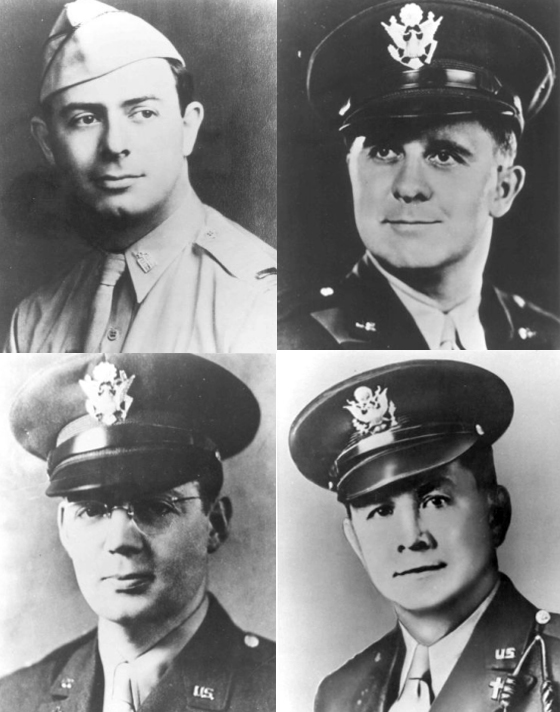
In a former life that seems light years away, I served as an Army Chaplain at Fort 4 chapsJackson, South Carolina. My duties included weekly preaching to recruits in a World War Two chapel that housed the beginnings of the U.S. Army Chaplain Corps Museum.

That’s where I first heard of George Fox, Alexander Goode, John Washington, and Clark Poling. Theirs are not household names, but on this Memorial Day 2018, let’s recall them with gratitude.

Even if you know the story, it’s worth remembering.

On the evening of February 2, 1943, the U.S.A.T Dorchester—a cruise liner converted to an Army transport ship—was carrying 902 service men, merchant seamen, and civilian workers across icy waters from Newfoundland to a base in Greenland. Shortly after midnight, the German submarine U-223 spotted the Dorchester through its periscope and fired three torpedoes. One strike was deadly: mid-ship, starboard side, far below the water line. The Dorchester’s fate was sealed.

Scores of men died instantly or were seriously wounded. For those that remained, chaos reigned. As they staggered to the deck, bracing themselves in an arctic wind, many panicked, throwing themselves into the frigid water rather than lifeboats.

That’s when four chaplains began ministering in the midst of tragedy: George Fox (Methodist), Alexander Goode (Jewish), John Washington (Roman Catholic), and Clark Poling (Dutch Reformed). They calmed the frightened, tended to the wounded, and guided the disoriented to safety. As they distributed life jackets from a locker on deck, the supply ran out. Calmly, each of them took off their own preservers and gave them to others.

Survivors recalled their last image of the four men. They were standing at the railing on the slanting deck, arms locked together, still offering prayers and words of courage as the ship sank to an icy grave.

One survivor, John Ladd, said, “It was the finest thing I have seen or hope to see this side of heaven.”

Ultimately, the deaths of these chaplains are no more meaningful than the legions of unknown soldiers who lost their lives in conflict. Their heroism, remembered in chilling detail, has no more eternal value than anonymous acts of bravery lost in the sweep of death, never to be told.

Still, there is so much here that brings hope to our souls: love, self-sacrifice, and a vision of humanity than transcends divisions of religion, class, or race.

Memorial Day should never be a glorying in the death of our troops. It is meant as a deep and sober reminder of the higher values for which they died. It calls us to embody in our own lives these words from Abraham Lincoln in his second inaugural address: “With malice toward none; with charity for all; with firmness in the right, as God gives us to see the right, let us strive…to achieve and cherish a just, and a lasting peace, among ourselves, and with all nations.”

The sinking of the Dorchester cost the lives of 672 men. On January 18, 1961, President Eisenhower awarded the posthumous Special Medal for Heroism to each of the chaplains. Stringent guidelines for the Medal of Honor, requiring “heroism under fire,” prohibited that award, but the medals these families received were meant to have the same weight.

Today, as we remember men and women who died in the tragedy of human warfare, let us include George Fox, Alexander Goode, John Washington, and Clark Poling.

Semper fidelis


A Rose for Baby Haab

Call me morbid, but I find it enlivening to stroll through graveyards. I remember a day when my wife and I drove down a remote road in Hardin County, Texas, to the Holland Cemetery, a lovingly preserved sanctuary. Surrounded by lush grass and a canopy of live oaks—cardinals singing in their branches—I came upon a rain-stained headstone.

But first…

I know I’m not the only one afflicted by a certain dis-ease. I have been blessed with abundance on so many levels: a loving family; more than adequate food and shelter; decent health; creative outlets that engage my mind, heart, and soul. 

Yet I still find myself ungrateful at times, restless in spirit. Succumbing to a culture where enough is never enough, I allow myself to become a spiritual casualty.

The simplest life-changing truths will lie inert in our lives unless we live into their power. I fully know that ingratitude—like fear, worry, and resentment—is a slayer of inner peace, a murderer of time. From a Buddhist perspective, these states of mind are the epitome of suffering, and they are self-induced. We can immaturely point to external factors as the source of our complaints, but we are the ones who choose our responses. There’s no passing the buck.

To rouse myself from this stupor, I have adopted a discipline that spans history. In medieval Christianity, it was called memento mori; in Buddhism, maranasati or lojong; in Islam, Tadhkirat al-Mawt. It is the core of every Dia de los Muertos celebration.

Remember death. Internalize life’s brevity and you can awaken to its present magnificence. Your hands, clenched so tightly around illusory problems, will begin to relax and let go.

A while back, I visited the San Antonio Art Museum to see an exhibit called San Antonio 1718, Art from Viceregal Mexico. It was a collection from that period of Spanish colonialism and included many oil paintings of idealized clergy and noble people. Clutched in many of their hands are memento moris, small replicas of skulls to remind them of death.

I have objects like these in my office, gathered during my service as a pastor, three decades when I was the one people turned to for comfort during times of loss.

  • There’s the box given to me by a heroin addict. She found it while dumpster diving and could not, in good conscience, throw it back into the refuse. Its label reads: Cremated remains of Baby Bridget Spell, age 0, Date of Death, 9-20-88.
  • There’s a rubber wristband that says, “Help me help the next Hugo Tale-Yax,” a tribute to a 31-year-old homeless Guatemalan immigrant, a Good Samaritan stabbed while helping a woman avoid a mugging. He bled out on a street in Queens, New York, while dozens of pedestrians passed by.
  • There’s the small picture of 13-year-old Tony Matrulo, who died in a freak go-cart accident just months after I baptized him.

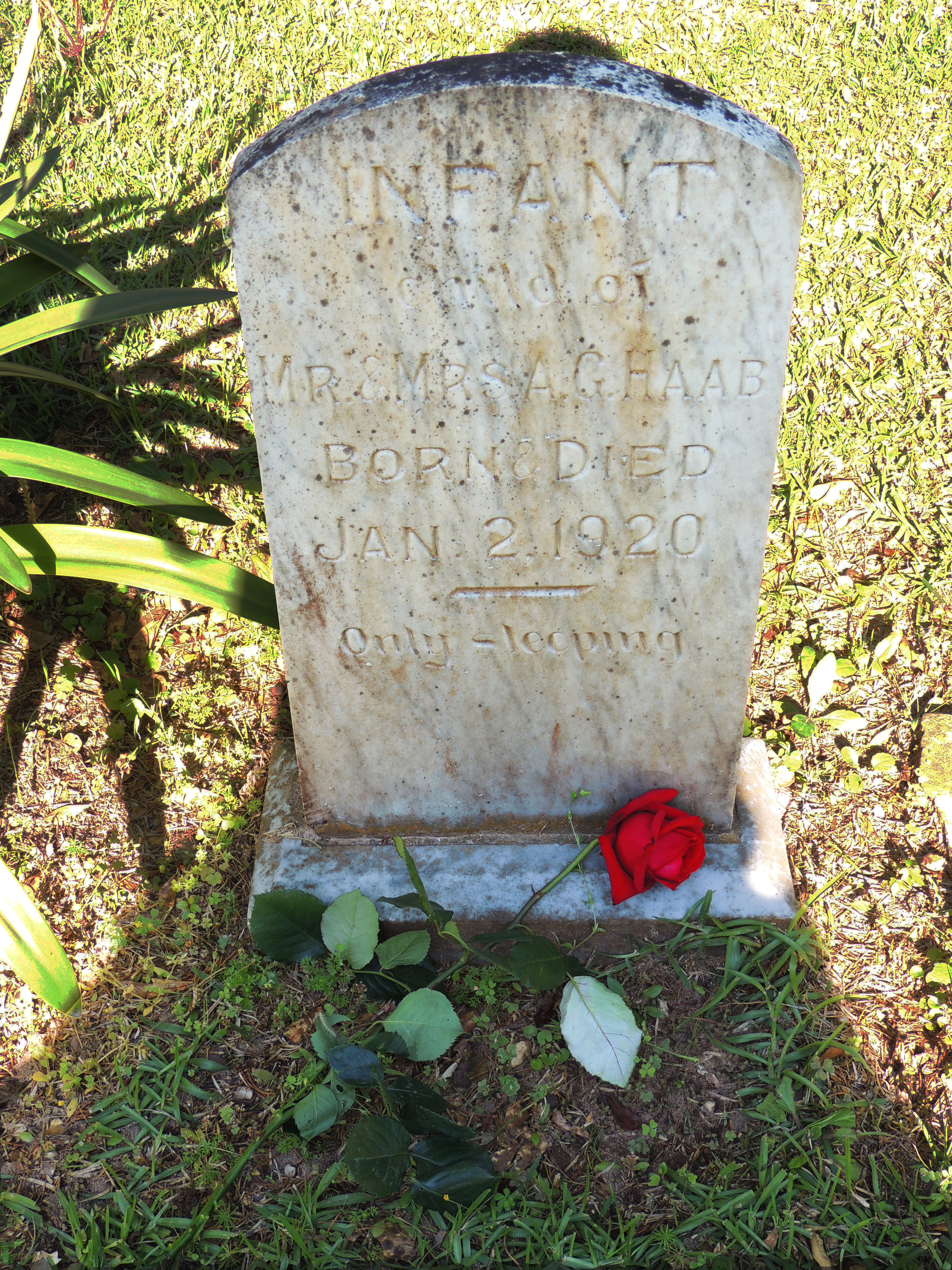
Back to that day in the Holland Cemetery, which has given a new memento mori. It’s a photo of a headstone that says: Infant Child of Mr. & Mrs. A. G. Haab, Born and Died, January 2, 1920, Only sleeping…

Unnamed child of God, knitted together in your mother’s womb, you never knew the seasons of this life. You never loved, laughed or grieved. You never smelled a flower or lifted your face to the sunlight. You never wrestled with the questions of existence. Your epitaph cries out to each of us: Remember death, and through its portal savor each moment!

I laid a rose at the headstone of baby Haab, then walked from the Holland Cemetery.

A cloud raced across the sun…

The Gunshots that Changed a Church (and Its Pastor!)

September, 2017. A typically busy morning on the campus of Divine Redeemer

Una Mesa Para La Gente, a mural of inclusive community partially painted by youth from Divine Redeemer

Presbyterian Church, San Antonio (DR), a congregation that has ministered to one of the poorest neighborhoods of its city for 100 years.

Pastor Rob Mueller and a church elder were clearing a stump to make way for a donated trailer. On the sidewalk, scores of people stood in line to receive a weekly donation of food.

Suddenly, kitty corner to all of them, shots rang out in the front yard of a home notorious for drug dealing. A gang leader from a nearby housing project fell dead with 15 bullet wounds. His assailant fled. All of it in broad daylight at 11 a.m.

“I had listened to neighbors’ descriptions of other shooting incidents,” says Mueller. “I had talked with youth about the pressure to join gangs. But when I became a witness to murder, something flipped in me.  I could no longer stay on the sidelines.  I had to figure out how to stop this.”

Mueller began to converse more intentionally with the church’s neighbors about drug trafficking in their midst. These residents knew the players—what they sold, when they sold it, and who was buying. But they hadn’t spoken up for fear of reprisal.

Experience is the greatest teacher. As Mueller thought about the statement he had given the police, fearful questions crept into his own mind and heart. What if the gang members returned to ambush him late at night as he left the church? What if they targeted the congregation in a coordinated attack?

Listening to their community has been a mainstay of DR’s ministry, but this was a new and gut-wrenching level of awareness. “I empathized with the fear that my neighbors feel all the time!” says Mueller.And yet we knew we had to find a solution together.”

The church and its neighbors agreed on a goal of shutting down a handful of known drug-dealing homes nearby. They began a process of engagement with local authorities. What they discovered was an array of resources they didn’t know existed. This was especially true with the city police department, which provided support through its San Antonio Fear Free Environment program, as well as two experts whose community organizing influence has helped other neighborhoods plagued by similar violence.

Together, DR and its neighbors have learned what it takes to build a case for change, not only marshaling available resources, but truly coming together as a community of witness. They are now in the process of vigilance, watching and cataloging the evidence they need to move forward. Their strategy is to collect information via neighbors, channel it through the church to protect them, and then slowly and deliberately, one by one, remove drug dealers from their area.

As for the murder? The victim, a young African-American man, becomes a grim statistic. According to detectives, the perpetrator fled to Mexico and may never be apprehended.

Yet the legacy of their violent altercation will live on in a positive, unexpected way. A sense of hope is rising in the neighborhood around DR. They are feeling their united strength, dreaming of a future when community children will not have to resist appeals to buy or sell drugs. A future when they will be free from bullying.

“We have finally begun to feel the power we actually have to transform what we previously considered an impenetrable force of evil,” says Mueller. “We now believe that together we can turn the tide from death to life.”

Slaying the Two Goliaths

Did he write the words himself? Or did he borrow them from another source?

Some are still concerned with these questions, but this much is true. In 1943, during some of the darkest days of WWII, Reinhold Niebuhr – pastor, theologian, seminary professor – concluded his sermon at a church in Heath, Massachusetts with these words. “God give us grace to accept with serenity the things that cannot be changed, courage to change the things that should be changed, and the wisdom to distinguish the one from the other.”

Slightly altered…forever immortalized…this became The Serenity Prayer, one of the most recognized petitions on our planet. Some have called it the perfect prayer. 

Learning to live by the truths of Niebuhr’s prayer requires daily mindfulness. We especially need courage to change our thinking about the two greatest killers of our serenity: fear and resentment.

Meet the two Goliaths that threaten to undo us.

FEAR. Call it by any name – including worry or anxiety – it is still a form of insanity so many of us indulge. It can be anxieties about our health, families, finances, or any other phantom from the future. These fears range from irritants nibbling at the fringe of our consciousness to full-blown obsessions. If we are the ones who shoulder responsibility in any arena – family, home, work – we often justify our stress with the adage that “it’s a dirty job, but somebody has to do it!”

“Worry” comes from the Old English wyrgan, meaning “to strangle.” Could it be any clearer? The abundant flow of life, fully streaming in this moment, choked and syphoned to a miserable dribble.

There’s a simple but eternal sentence spoken by Jesus in what we call his Sermon on the Mount. “Which one of you by worrying can add a single hour to your life?” The genius is in that word “hour.” Not years, months, even days. Our futile anxiety cannot add a single hour! As Jesus said, “Let those who have ears really hear!”

RESENTMENT. Call it by any name – anger or unforgiveness – it infuses our world with poison. “Resentment” comes from the Latin sentire, meaning “to feel.” So, at its root, resentment means to re-feel or re-experience negative emotions from a prior wound. That injury may have come from a very real transgression against us. It may simply be self-scarring from our prideful egos. It may be self-incrimination for chances we have missed and mistakes we have made. Whatever the content of our re-feeling, the result is cancerous.

HERE’S THE REASON FOR THIS POST. We must find ways to slay these two Goliaths on a daily basis. If you think of life (I hope you do!) as learning to treasure every day, our fullness of existence depends on this.

The recovery community that meets around our globe has some pithy words for all of us as we seek to free ourselves. One phrase from AA is particularly powerful. “What we have is a daily reprieve based on the maintenance of our spiritual condition.” How do we claim this liberty? DISCIPLINE! Mental, physical, and spiritual practices that help us banish fear and resentment. There are so many! Find one that works for you, like:

  • Meditation that allows this blessed moment to cleanse us.
  • Daily gratitude, both for past evidence of our Creator’s faithfulness, as well as for the abundance of good things this new day has to offer.
  • A crisp walk surrounded by the beauty of nature, glimpsing eternity and our humble place within it.
  • An act of love that transforms our self-indulgence into a blessing for others.
  • Forgiving and asking for forgiveness.

Do you have a discipline? If not, please find one. I am a man who squandered far too many years on fear and resentment. Let’s whisper this prayer together on our daily journeys…

“God grant me the serenity to accept the things I cannot change, the courage to change the things I can, and the wisdom to know the difference.”